
 100% FREE ACCESS
12th Standard CBSE Syllabus & Materials
12th Standard CBSE
CBSE 12th Economics Government Budget and the Economy Previous year Question Papers Study Material - QB365 Set A
NEW12th Standard CBSE
CBSE 12th Computer Science Interface Python with MySQL - New Previous year Question Papers Study Material - QB365 Set A
NEW12th Standard CBSE
CBSE 12th Computer Science Database Concept - New Previous year Question Papers Study Material - QB365 Set A
NEW12th Standard CBSE
CBSE 12th Computer Science Data Communication - New Previous year Question Papers Study Material - QB365 Set A
NEW12th Standard CBSE
CBSE 12th Computer Science Data Structures - New Previous year Question Papers Study Material - QB365 Set A
NEW12th Standard CBSE
CBSE 12th Computer Science Functions - New Previous year Question Papers Study Material - QB365 Set A

Published on: 20/09/2019
Relations and Functions
Download CBSE Class 12th Standard CBSE Maths question papers, sample papers, important questions, and previous year solved papers in PDF format. Get free study materials, NCERT solutions, and exam preparation resources for Class 12th Standard CBSE Maths
Questions + Answers key
Take MCQ Maths Test
1.
Let \(A=R\times R\) and '*' be a binary operation on A defined by:\((a,b)*(c,d)=(a+c,b+d).\)
Show that '*' is commutative and associative Find the identity element for '*' on A. Also find the inverse of every element \((a,b)\in R\) .
2.
Let f: \(N\rightarrow N\) be a function defined as:\(f(x)=9x^{ 2 }+6x-5\).
Show that \(f:N\rightarrow S\) , where S is the range of f, is invertible. Find the inverse of \(f\) and hence find \(f^{ -1 }\) (43) and \(f^{ -1 }\) (163).
3.
Let N denote the set of all natural numbers and R be the relation on \(N\times N\) defined by:
(a, b)R(c, d) if ad(b+c)(a+d) = bc(a + d)
Show that R is an equivalence relation.
4.
(Allocation Problem) A cooperative society of farmers has 50 hectares of land to grow two crops X and Y. The profits from crops X and Y per hectare are estimated as Rs. 10,500 and Rs. 9,000 respectively. To control weeds, a liquid herbicide has to be used for crops X and Y at rates of 20 litres and 10 litres per hectare. Further, no more than 800 litres of herbicide should be used in order to protect fish and wild life using a pond which collects drainage from this land. How much land should be allocated to each crop so as to maximise the total profit of the society?
5.
(Diet Problem) A dietician wishes to mix two types of food in such a way that the vitamin contents of the mixture contain at least 8 units of vitamin A and 10 units of vitamin C. Food I contains 2 unit/ kg of vitamin A and 1 unit/kg of vitamin C while food II contains 1 unit/kg of vitamin A and 2 units/kg of vitamin C. It costs Rs.50 per kg to purchase Food I and Rs.70 per kg to purchase food II.
Formulate the problem as a linear programming problem to minimise the cost of such a mixture.
6.
Let ' * ' be the binary operation on the set {1,2,3,4,5} defined by: a*b = H.C.F. of a and b.
Is the operation ' * ' same as the operation ' * ' defined in above? Justify your answer.
7.
Show that addition and multiplication are associative binary operations on R. But subtraction is not associative on R. Division is not associative on R.
8.
Show that \(*:R\times R\rightarrow R\) defined by \(a*b=a+2ab\) is not communicative.
9.
Show that \(+:R\times R\rightarrow R\) and \(\times :R\times R\rightarrow R\) are commutative binary operations but \(-:R\times R\rightarrow R\) and \(\div :R\times R\rightarrow R\) are not commutative.
10.
Show that \(\vee :R\times R\rightarrow R\) given by \((a,b)\rightarrow \) max. {a,b} and \(\wedge :R\times R\rightarrow R\) given by \((a,b)\rightarrow \) min. (a, b} are binary operations.
11.
Show that if \(f\) :\(A\rightarrow B\) and \(B\rightarrow C\) are one-one, then \(gof:A\rightarrow C\) is also one-one.
12.
Show that the function \(f:N\rightarrow N\) given by \(f(2)=1\) and \(f(x)=x-1\) , for every \(x>2\) is onto but not one-one.
1.
(i) Commutativity. for \(a,b\in R,\quad (a,b)*(c,d)\)
\(=(a+c,b+d)\)
\(=(c+a,d+b)=(c,d)*(a,b)\)
\(\left[ \because \ a+c=c+a\quad in\ R;etc. \right] \)
Thus '*' is commutative.
Associativity. For \(a,b,c\in R,\)
\(\left[ (a,b)*(c,d) \right] *(e,f)=(a+c,b+d*(e,f)\)
\(=(a+c+e,b+d+f)\)
\((a*b)*\left[ (c,d)*(e,f) \right] =(a*b)*(c+e,(d+f)\)
\(=(a+c+e,b+d+f)\)
\(\therefore \quad [(a*b)*(c,d)*(e,f)=(a*b)*[(c,d)*(e,f)]\)
Thus '*' is associative.
(II) (I) Let (x,y) be the identity element.
Then \(a,b)*(x,y)=(a,b)=(x,y)*(a,b)\)
\(\Rightarrow \) \((a+x,b+y)=(a,b)=(x+a,y+b)\)
\(\Rightarrow \) \(x=0,y=0\)
Hence, (0,0) is the identity element.
(II) Let (x, y) be the inverse of \((a,b)\in A\)
Then (a,b)*(x, y) = (0, 0) = (x, y)*(a,b)
\(\Rightarrow \) (a+x, b+y) = (0, 0) = (x+a, y+b)
\(\Rightarrow \) a+x = x+a =0 and b+y = y+b = 0
\(\Rightarrow \) x = -a,y = -b
Hence, (-a, -b) is the inverse of (a, b)\(\in A\).
2.
We have: \(f:N\rightarrow S\) , \(f(x)=9x^{ 2 }+6x-5\).
Now \(f(x_{ 1 })=f(x_{ 2 })\Rightarrow 9x_{ 1 }^{ 2 }+6x_{ 1 }-5=9x_{ 2 }^{ 2 }+6x_{ 2 }-5\)
\(\Rightarrow 9(x_{ 1 }-x_{ 2 })+6(x_{ 1 }-x_{ 2 })=0\)
\(\Rightarrow (x_{ 1 }-x_{ 2 })\left[ 9x_{ 1 }+9x_{ 2 }+6 \right] \)
\(\Rightarrow x_{ 1 }=x_{ 2 }\quad \left[ \because x_{ 1 },x_{ 2 }\in N \right] \)
\(\Rightarrow f\ \ is\quad one-one.\)
Let \(y\ \in \ S\) be an arbitrary number.
Now \(y=f(x)\Rightarrow y=9x^{ 2 }+6x-5\Rightarrow y=(3x+1)^{ 2 }-6\)
\(\Rightarrow \sqrt { y+6 } =3x+1\Rightarrow x=\sqrt { \frac { y+6-1 }{ 3 } } \in N\)
\(\Rightarrow \ x=f^{ -1 }(y)\)
Since f is one-one and onto \(\Rightarrow \) f is invertible.
Also \(f^{ -1 }(y)=\sqrt { \frac { y+6-1 }{ 3 } } \)
\(\Rightarrow \) \(f^{ -1 }(x)=\sqrt { \frac { x+6-1 }{ 3 } } \)
\(\therefore \) \(f^{ -1 }(43)=\frac { \sqrt { 49 } -1 }{ 3 } =\frac { 7-1 }{ 3 } =2\)
and \(f^{ -1 }=\frac { \sqrt { 169 } -1 }{ 3 } =\frac { 13-1 }{ 3 } =4\).
3.
We have: (a, b)R(c, d) if ad(b+c)(a+d).
(I) \((a,b)R(a,b)\Rightarrow ab(b+a)=ba(a+b)\)
\(\Rightarrow ab(a+b)=ab(a+b)\), which is true.
Thus R is reflexive.
(II) \((a,b)R(c,d)\Rightarrow ad(b+c)=bc(a+d)\)
\(\Rightarrow bc(a+d)=ad(b+c)\)
\(\Rightarrow cb(d+a)=da(c+b)\)
\(\left[ \because \quad bc=cb\quad and\quad a+d=d+a;\quad etc.\quad \forall \quad a,b,c,d\in N \right] \)
\(\Rightarrow \) (c,d) R (a,b).
Thus R is symmetric.
(III) Let (a,b) R (c,d) and (c,d) R (e,f).
\(\therefore \) ad(b+c) = bc(a+d) and cf(d+e) = de(c+f)
\(\Rightarrow \) \(\frac { b+c }{ bc } =\frac { a+d }{ ad } \) and \(\frac { d+e }{ de } =\frac { c+f }{ cf } \)
\(\Rightarrow \) \(\frac { 1 }{ c } +\frac { 1 }{ b } =\frac { 1 }{ d } +\frac { 1 }{ a } \) and \(\frac { 1 }{ e } +\frac { 1 }{ d } =\frac { 1 }{ f } +\frac { 1 }{ c } \)
\(\Rightarrow \) \(\frac { 1 }{ c } -\frac { 1 }{ d } =\frac { 1 }{ a } -\frac { 1 }{ b } \) and \(\frac { 1 }{ c } +\frac { 1 }{ d } =\frac { 1 }{ e } +\frac { 1 }{ f } \)
\(\Rightarrow \) \(\frac { 1 }{ a } -\frac { 1 }{ b } =\frac { 1 }{ e } -\frac { 1 }{ f } \) \(\Rightarrow \) \(\frac { 1 }{ a } +\frac { 1 }{ f } =\frac { 1 }{ b } +\frac { 1 }{ e } \)
\(\Rightarrow \) be (a+f) = af(b+e) \(\Rightarrow \)af(b+e)=be(a+f)
\(\Rightarrow \) (a,b) R (e,f).
Thus R is transitive.
Hence, R is an equivalence relation.
4.
Let 'x' hectares land be allocated to crop X and 'y' hectares to crop Y.
We have: \(x\ge 0\) .....(1)
\(y\ge 0\) .....(2)
\(x+y\le 50\) .....(3)
\(20x+10y\le 800\)
\(\therefore \) i.e. \(2x+y\le 80\)....(4)
The mathematical formulation of the problem is as be low:
Maximize Z = 10500x + 9000y subject to the constraints (1)-(4).
For solution set, we draw the lines:
x = 0, y = 0, x + y = 50 and 2x + y = 80.
The lines x + y = 50 and 2x + y = 80 meet at E (30, 20).
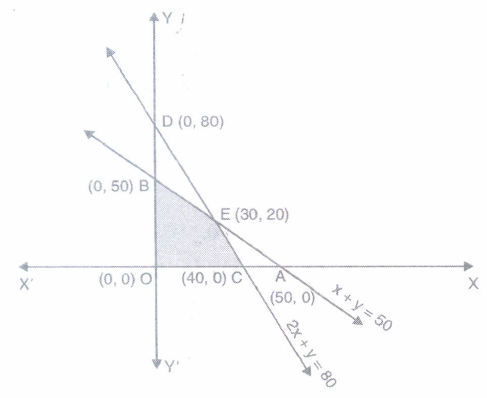
The shaded portion represents the feasible region, which is bounded.
Applying Corner Point Method, we have:
| Corner Point | Z = 10500x + 9000y |
| O : (0,0) | 0 |
| C : (40,0) | 420000 |
| E : (30,20) | 495000 (Maximum) |
| B : (0,50) | 450000 |
Hence, the maximum profits is Rs. 4,95,000 by allocating 30 hectares for crop X and 20 hectares for crop Y.
5.
Let 'x' kg of food I and 'y' kg of food II be mixed. We have the table:
| Food | Amount | Unit of Vitamin A | Unit of Vitamin C | Cost (in Rs) |
| I | x kg | 2x | x | 50x |
| II | y kg | y | 2y | 70y |
| Total | 2x+y | x+2y | 50x + 70y |
Thus LLP problem is as below:
Minimize: Z=50x+70y ....(1)
Subject to:\(2x+y\ge 8\) ...(2)
\(x+2y\ge 10\) ...(3)
and \(x,y\ge 0\) ....(4)
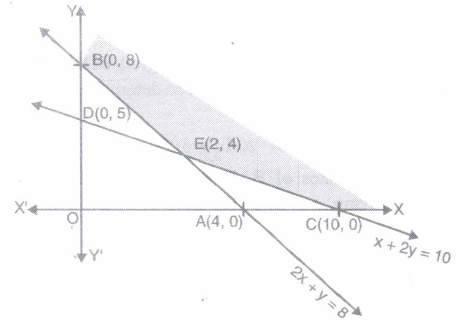
First of all, we locate the region represented by (2)-(4).
The shaded region, as shown above, is feasible region.
Applying Corner Point Method, we have:
| Corner Point | Z = 50x + 70y |
| C : (10,0) | 500 |
| E : (2,4) | 380 (Minimum) |
| B : (0,8) | 560 |
Hence, the minimum cost = Rs. 380 when 2 kg of food I and 4kg of food II are mixed.
6.
We have a*b = H.C.F. of a and b.
The composition table is as below:
| * | 1 | 2 | 3 | 4 | 5 |
| 1 | 1 | 1 | 1 | 1 | 1 |
| 2 | 1 | 2 | 1 | 2 | 1 |
| 3 | 1 | 1 | 3 | 1 | 1 |
| 4 | 1 | 2 | 1 | 4 | 1 |
| 5 | 1 | 1 | 1 | 1 | 5 |
7.
(i) For all a, b, c \(\in \) R
(a + b) + c = a + (b + c)
and (a x b) x c = a x (b x c)
Hence, '+' and 'x' are associative binary operations on R
(ii) For a, b, c \(\in \) R
(a - b) - c \(\neq \)a - (b - c)
and (a/b) / c \(\neq \)a/(b/c)
Hence, '-' and '/' are not binary operations on R
8.
\(a*b=a+2ab\) and \(b*a=a+2a\)
\(\therefore a*b\neq b*a\) \(\left[ \because a+2b\neq b+2d \right] \)
Hence, '*' is not communicative
9.
(i) For all \(a,b\in R\),
a + b = b + a and \(a\times b=b\times a\).
Hence, '+' and '\(\times \)' are commutative binary operations.
(i) For all \(a,b\in R\),
\(a-b\neq b-a\) \(\left[ For\quad ex.4-5\neq 5-4 \right] \)
and \(a\div b\neq b\div a\) \(\left[ For\quad ex.\frac { 4 }{ 5 } \neq \frac { 5 }{ 4 } \right] \)
Hence, ' - ' and ' \(\div \)' are not commutative binary operations.
10.
\(\vee :R\times R\rightarrow R\) given by \((a,b)\rightarrow \)min. {a,b},
which is a unique element \(viz\). max. of \((a,b)\rightarrow \).
Hence, \(\vee \) is a binary operation.
(ii) \(\wedge :R\times R\rightarrow R\) given by \((a,b)\rightarrow \)min. {a,b},
which is a unique element \(viz\).max. of \(a,b\rightarrow R\).
Hence, \(\wedge \) is a binary operation.
11.
suppose \((gof)(x_{ 1 })=(gof)(x_{ 2 })\)
\(\Rightarrow \) \(g(f(x_{ 1 }))=g(f(x_{ 2 }))\)
\(\Rightarrow \) \(f(x_{ 1 })=f(x_{ 2 })\) [\(\because \) g is one-one]
\(\Rightarrow \) \(x_{ 1 }=x_{ 2 }\) [\(\because \)f is one-one]
Hence, gof is one-one.
12.
f is not one-one, as f(1) = f(2) = 1. But f is onto, as given any y \(\in \) N, y \(\ne\) 1, we can choose x as y + 1 such that f (y + 1) = y + 1 – 1 = y. Also for 1 \(\in \) N, we have f(1) = 1.

12th Standard CBSE Syllabus & Materials
12th Standard CBSE
CBSE 12th Computer Science Python Revision Tour I - New Previous year Question Papers Study Material - QB365 Set A
NEW12th Standard CBSE
CBSE 12th Business Studies Planning Important Questions And Answers Study Material - QB365 Set A
NEW12th Standard CBSE
CBSE 12th Business Studies Business Environment Important Questions And Answers Study Material - QB365 Set A
NEW12th Standard CBSE
CBSE 12th Business Studies Principles of Management Important Questions And Answers Study Material - QB365 Set A



CBSE 12th Standard CBSE Subjects
CBSE Standards










