
 100% FREE ACCESS
12th Standard CBSE Syllabus & Materials
12th Standard CBSE
CBSE 12th Economics Government Budget and the Economy Previous year Question Papers Study Material - QB365 Set A
NEW12th Standard CBSE
CBSE 12th Computer Science Interface Python with MySQL - New Previous year Question Papers Study Material - QB365 Set A
NEW12th Standard CBSE
CBSE 12th Computer Science Database Concept - New Previous year Question Papers Study Material - QB365 Set A
NEW12th Standard CBSE
CBSE 12th Computer Science Data Communication - New Previous year Question Papers Study Material - QB365 Set A
NEW12th Standard CBSE
CBSE 12th Computer Science Data Structures - New Previous year Question Papers Study Material - QB365 Set A
NEW12th Standard CBSE
CBSE 12th Computer Science Functions - New Previous year Question Papers Study Material - QB365 Set A

Published on: 24/04/2021
12th Standard CBSE Maths Application Of Derivatives Important Quetions
Download CBSE Class 12th Standard CBSE Maths question papers, sample papers, important questions, and previous year solved papers in PDF format. Get free study materials, NCERT solutions, and exam preparation resources for Class 12th Standard CBSE Maths
Questions + Answers key
Take MCQ Maths Test
1.
If the following matrix is skew symmetric, find the values of a, b, c
\(A=\left[ \begin{matrix} 0 & a & 3 \\ 2 & b & -1 \\ c & 1 & 0 \end{matrix} \right] \)
2.
Find \(\lambda\) and \(\mu\) if \((\overset\wedge i+3\overset\wedge j+9\overset\wedge k)\times(3\overset\wedge i-\lambda \overset\wedge j+\mu \overset\wedge k)=0\)
3.
If x = \(\frac { at }{ 1+{ t }^{ 2 } } ,y=\frac { a{ t }^{ 2 } }{ 1+{ t }^{ 2 } } ,find\frac { dy }{ dx } at\) t = 2
4.
If y = tan-1\(\sqrt { \frac { 1-x }{ 1+x } } find\frac { dy }{ dx } \)
5.
If P(E) = \(\frac { 7 }{ 13 } \) , P(F) = \(\frac { 9 }{ 13 } \) and P(E\(\cap\)F) = \(\frac { 4 }{ 13 } \),then evaluate :
(a) \(P(\overline { E } /F)\)
(b) \(P(\overline { E } /F)\)
6.
Find the unit vector in the direction of \(\overset\rightarrow a+\overset\rightarrow b\)if \(\overset\rightarrow a= 2\overset\wedge i+\overset\wedge j+3\overset\wedge k\), and \(\overset\rightarrow b= \overset\wedge i+2\overset\wedge j-\overset\wedge k\)
7.
Find the scalar components of the vector \(\overset\rightarrow {AB} \) with initial point A(2, 1) and terminal point B(-5, 7).
8.
Let f and g be real function be \(f(x)=\sqrt { x+4 } ,x\ge 4\) find the function fg, \(\frac { f }{ g } \)
9.
\(\int { { sin }^{ 2 }x{ \ cos }^{ 2 }x } dx\)
10.
Find the point on the curve \(y^2 =8x + 3\) for which the y-coordinate changes 4 times more than coordinate of x.
11.
Find the value of x and y in each if AB exist
(i) \({ A }_{ 3\times x },{ B }_{ 4\times y }\) and \({ AB }_{ 3\times 3 }\)
(ii) \({ A }_{ x\times 2 },{ B }_{ y\times 4 }\) and \({ AB }_{ 3\times 4 }\)
12.
Find the value of X and Y if
\(X+Y=\left[ \begin{matrix} 2 & 3 \\ 5 & 1 \end{matrix} \right] ,X-Y=\left[ \begin{matrix} 6 & 5 \\ 7 & 3 \end{matrix} \right] \)
13.
Given P(A) = 0.4, P(B) = 0.7 and P(B/A) = 0.6, Find \(P(A\cup B)\)
14.
What is the cosine of the angle which the vector \(\sqrt { 2 } \hat { i } +\hat { j } +\hat { k } \) makes with y-axis?
15.
\(\int tan^{-1}(cot\ x)dx.\)
16.
\(\int {1+tan\ x\over 1-tan\ x}dx\).
17.
Evaluate the integral: \(({\int{\sqrt x+{1\over\sqrt x}}})^2dx.\)
18.
If \(2\begin{bmatrix} 1 & 3 \\ 0 & x \end{bmatrix}+\begin{bmatrix} y & 0 \\ 1 & 2 \end{bmatrix}=\begin{bmatrix} 5 & 6 \\ 1 & 8 \end{bmatrix}\), then write the value of (x+y).
19.
If f(x) = 27x3 and g(x) = x1/3 find gof(x).
20.
Evaluate: \(\int _{ 0 }^{ \pi /2 }{ \frac { x\sin { x\cos { x } } }{ \sin ^{ 4 }{ x } +\cos ^{ 4 }{ x } } } dx.\)
21.
Check whether the function:
\(f(x)=x^{ 100 }+sinx-1\)
is strictly increasing or strictly decreasing or none of both on(-1,1). Should the nature of a man be like this function? Justify your answer.
22.
Find the absolute maximum and absolute value of the function given by:
\(f(x)sin^{ 2 }x-cosx,x\in [0,\pi ]\)
23.
Two numbers are selected at random (without replacement)from first six positive integers 2, 3, 4, 5, 6 and 7. Let X denote the larger of the two numbers obtained. Find the probability distribution of X. Find the mean and variance of this distribution
24.
Differentiate \({ tan }^{ -1 }\left( \frac { \sqrt { 1+{ x }^{ 2 } } -1 }{ x } \right) \) w.r.t.x.
25.
Let \(\vec{a}=\hat{i}+2 \hat{j} \text { and } \vec{b}=2 \hat{i}+\hat{j} . \text { Is }|\vec{a}|=|\vec{b}| ?\) Are the vector \(\overset { \rightarrow }{ a } \) is \(\overset { \rightarrow }{ b } \) equal?
26.
In each of the following cases, state whether the function is one-one, onto or bijective. Justify your answer.
(i) \(f:R\rightarrow R\) defined by f(x) = 3 - 4x
(ii) \(f:R\rightarrow R\) defined by \(f(x)=1+x^{ 2 }\) .
27.
(Diet Problem) A dietician has to develop a special diet using two foods P and Q. Each packet (containing 50g) of food P contains 12 units of calcium, 4 units of iron, 6 units of cholesterol and 6 units of vitamin A. Each packet of the same quantity of food q contains 3 units of calcium, 20 units of iron, 4 units of cholesterol and 3 units of vitamin A. The diet requires at least 240 units of calcium, at least 460 units of iron and at most 300 units of cholesterol. How many packets of each food should be used to minimise the amount of vitamin A in the diet. What is the minimum amount of vitamin A?
28.
Six balls are drawn successively from an urn containing 7 red and 9 black balls.Tell whether or not the trials of drawing black balls are Bernoulli trials when after each draws the ball drawn is:
(i) replaced
(ii) not replaced in the urn.
29.
Prove that the function given by by f (x) = cos x is
(a) strictly decreasing in \((0,\pi )\)
(b) strictly increasing in \((\pi ,2\pi )\)
(c) neither increasing nor decreasing in \((0,2\pi )\)
30.
Discuss the continuity of the function f defined by:
\(f(x)={ x }^{ 3 }+{ x }^{ 2 }-1\)
31.
Discuss the continuity of the function f given by f(x) = | x | at x = 0.
32.
In a factory which manufactures bolts, machines A, B and C manufacture respectively 25%, 35% and 40% of the bolts. Of their outputs, 5, 4 and 2 percent are respectively defective bolts. A bolt is drawn at random from the product and is found to be defective. What is the probability that it is manufactured by the machine B?
33.
Points L,M,N divide the sides BC,CA and AB of a triangle ABC in the ratio 1:4,3:2 and 3:7 respectively. Prove that \(\overrightarrow { AL } +\overrightarrow { BM } +\overrightarrow { CN } \) is a vector parallel to \(\overrightarrow { CK } \) where k divides AB in the ratio 1:3
34.
The total cost C(x) in Rupees, associated with the production of x units of an item is given by
C(x) = 0.005 x3 – 0.02 x2 + 30x + 5000
Find the marginal cost when 3 units are produced, where by marginal cost we mean the instantaneous rate of change of total cost at any level of output.
35.
Evaluate the integral: \(\int sin\ x.\ sin2x.\ sin3x\ dx\)
36.
Let f be a function defined on an open interval I.(First Derivative Test)
37.
The sum of three numbers is -1. If we multiply the second number by 2 , third number by 3 and add them we get 5. If we subtract the third number from the sum of first and second numbers we get -1. Represent it by a system of equations . Find the three numbers using inverse of a matrix
38.
Find : \(\int { \frac { \sqrt { x^{ 2 }+1 } \left\{ log({ x }^{ 2 }+1)-2logx \right\} }{ x^{ 4 } } } dx\)
39.
A man is known to speak the truth 3 out of 5 times. He throws a die and reports that it is 1. Find the probability that it is actually 1.
40.
Find the point P on the curve \(y^2= 4ax\) which is nearest to the point (11a, 0).
41.
Using elementary transformation, find the inverse of the matrix \(A=\left[ \begin{matrix} 8 & 4 & 3 \\ 2 & 1 & 1 \\ 1 & 2 & 2 \end{matrix} \right] \) and use it to solve the following system of lines equations :
8x + 4y + 3z = 19
2x + y + z = 5
x + 2y + 2z = 7
42.
Using elementary transformations, find the inverse of the matrix
\(\left[ \begin{matrix} 1 & 3 & -2 \\ -3 & 0 & -1 \\ 2 & 1 & 0 \end{matrix} \right] \).
43.
If a, b, c and d are the position vectors of the points A, B, C and D such that a + c = b + d, then ABCD is a
Trapezium
Rectangle
Square
Parallelogram
44.
For what real value of y will matrix A be equal to matrix B, where
\(A=\begin{bmatrix} 3x-4 & 5y \\ 8 & { y }^{ 2 }-4y \end{bmatrix};B=\begin{bmatrix} x+1 & 6{ y }^{ 2 }+1 \\ 8 & -3 \end{bmatrix}\)
1, 3
No real value
1/3, 1/2
2 and 3
45.
If A = {1,3,5,7} and define a relation, such that R = { (a,b) a,b ∈ A : |a+b| = 8}. Then how many elements are there in the relation R
8
16
1
4
46.
Suppose that two cards are drawn at random from a deck of cards. Let X be the number of aces obtained. Then the value of E(X) is
\(\frac{37}{221}\)
\(\frac{5}{13}\)
\(\frac{1}{13}\)
\(\frac{2}{13}\)
47.
The probability of obtaining an even prime number on each die, when a pair of dice is rolled is _____.
0
\(\frac13\)
\(\frac{1}{12}\)
\(\frac{1}{36}\)
48.
If P(A) = \(\frac12\), P(B) = 0, then P(A|B) is ______.
0
\(\frac12\)
not defined
1
49.
Area of a rectangle having vertices A, B, C and D with position vectors \(-\widehat { i } +\frac { 1 }{ 2 } \widehat { j } +4\widehat { k } \), \(\widehat { i } +\frac { 1 }{ 2 } \widehat { j } +4\widehat { k } \), \(\widehat { i } -\frac { 1 }{ 2 } \widehat { j } +4\widehat { k } \) and \(-\widehat { i } -\frac { 1 }{ 2 } \widehat { j } +4\widehat { k } \), respectively is
\(\frac12\)
1
2
4
50.
\(\int { \sqrt { { x }^{ 2 }-8x+7 } } dx\) is equal to
\(\frac { 1 }{ 2 } (x-4)\sqrt { { x }^{ 2 }-8x+7 } + 9log|x-4+\sqrt { { x }^{ 2 }-8x+7 } |+\)C
\(\frac { 1 }{ 2 } (x+4)\sqrt { { x }^{ 2 }-8x+7 } + 9log|x+4+\sqrt { { x }^{ 2 }-8x+7 } |+\)C
\(\frac { 1 }{ 2 } (x-4)\sqrt { { x }^{ 2 }-8x+7 } - 3\sqrt2log|x-4+\sqrt { { x }^{ 2 }-8x+7 } |+\)C
\(\frac { 1 }{ 2 } (x-4)\sqrt { { x }^{ 2 }-8x+7 } - \frac92log|x-4+\sqrt { { x }^{ 2 }-8x+7 } |+\)C
51.
For all real values of x, the minimum value of \(\frac { 1-x+{ x }^{ 2 } }{ 1+x+{ x }^{ 2 } } \) is
0
1
3
\(\frac { 1 }{ 3 } \)
52.
The interval in which y = x2 e–x is increasing is
(– ∞, ∞)
(– 2, 0)
(2, ∞)
(0, 2)
53.
The number of all possible matrices of order 3 × 3 with each entry
27
18
81
512
54.
Consider a binary operation * on N defined as a * b = a3 + b3. Choose the correct answer
Is * both associative and commutative?
Is * commutative but not associative?
Is * associative but not commutative?
Is * neither commutative nor associative?
55.
Let f : R ➝ R be defined as f (x) = 3x. Choose the correct answer
f is one-one onto
f is many-one onto
f is one-one but not onto
f is neither one-one nor onto
56.
Let \({ I }_{ 1 }=\int _{ 1 }^{ 2 }{ \frac { dx }{ \sqrt { 1+{ x }^{ 2 } } } } \) and \({ I }_{ 2 }=\int _{ 1 }^{ 2 }{ \frac { dx }{ x } } \), then
I1 > I2
I2 > I1
I1 = I2
I1 > 2I2
57.
The absolute maximum value of y = x3 – 3x + 2 in 0 ≤ x ≤ 2 is
4
6
2
0
58.
The equation of the normal to the curve y = sin x at (0, 0) is
x = 0
y = 0
x + y = 0
x – y = 0
59.
If y = tan-1 \(\left( \frac { 1-{ x }^{ 2 } }{ 1+{ x }^{ 2 } } \right) \), then \(\frac { dy }{ dx } \) is equal to
\(\frac { 1 }{ 1+{ x }^{ 4 } } \)
\(\frac { -2x }{ 1+{ x }^{ 4 } } \)
\(\frac { -1 }{ 1+{ x }^{ 4 } } \)
\(\frac { { x }^{ 2 } }{ 1+{ x }^{ 4 } } \)
60.
A function \(f(x)=\begin{cases} \frac { sinx }{ x } +cosx,x\neq 0 \\ 2k\quad \quad \quad \quad ,x=0 \end{cases}\) is continuous at x = 0 for
k = 1
k = 2
K = \(\frac12\)
k = \(\frac32\)
61.
If A = diag(3, -1), then matrix A is
\(\begin{bmatrix} 0 & 3 \\ 0 & -1 \end{bmatrix}\)
\(\begin{bmatrix} -1 & 0 \\ 3 & 0 \end{bmatrix}\)
\(\begin{bmatrix} 3 & 0 \\ 0 & -1 \end{bmatrix}\)
\(\begin{bmatrix} 3 & -1 \\ 0 & 0 \end{bmatrix}\)
1.
a = -2, b = 0, c = -3
2.
Getting \(\lambda =-9\)
and \(\mu=27\)
Alternative Method :
\((\overset\wedge i+3\overset\wedge j+9\overset\wedge k)\times(3\overset\wedge i-\lambda \overset\wedge j+\mu\overset\wedge k)=0\)
\(\Rightarrow \left| \begin{matrix} \overset { \wedge }{ i } & \overset { \wedge }{ j } & \overset { \wedge }{ k } \\ 1 & 3 & 9 \\ 3 & -\lambda & \mu \end{matrix} \right| \)
\(\Rightarrow \overset\wedge i(3\mu+9\lambda)-\overset\wedge j(\mu-27)+\overset\wedge k(-\lambda-9)=0\)
\(\Rightarrow 3\mu+9\lambda=0 ....(i)\)
\(\Rightarrow \mu-27=0 ...(ii)\)
\(\Rightarrow -\lambda-9=0...(iii)\)
from eqn.(ii) and (iii),
\(\mu=27\)
and \(\lambda=-9\)
3.
We have, x = \(\frac { at }{ 1+{ t }^{ 2 } } ,y=\frac { { at }^{ 2 } }{ 1+{ t }^{ 2 } } \)
\(\frac { dx }{ dt } =\frac { { (1+t) }^{ 2 }a-at(2t) }{ { (1+{ t }^{ 2 }) }^{ 2 } } \)
\(\Rightarrow\) \(\frac { dx }{ dt } =\)\(\frac { a+a{ t }^{ 2 }-2a{ t }^{ 2 } }{ { (1+{ t }^{ 2 }) }^{ 2 } } \)
=\(\frac { a-a{ t }^{ 2 } }{ { (1+{ t }^{ 2 }) }^{ 2 } } \)
and \(\frac { dy }{ dt } =\frac { { (1+{ t }^{ 2 } })^{ 2 }2at-a{ t }^{ 2 }(2t) }{ { (1+{ t }^{ 2 } })^{ 2 } } \)
\(\Rightarrow\)\(\frac { dy }{ dt } =\frac { 2at+2a{ t }^{ 3 }-2a{ t }^{ 3 } }{ { (1+{ t }^{ 2 }) }^{ 2 } } =\frac { 2at }{ { (1+{ t }^{ 2 }) }^{ 2 } } \)
\(\therefore\) \(\frac { dy }{ dx } =\frac { 2at }{ { (1+{ t }^{ 2 } })^{ 2 } } \times \frac { { (1+{ t }^{ 2 } })^{ 2 } }{ a-a{ t }^{ 2 } } \)
\(=\frac { 2at }{ a-a{ t }^{ 2 } } =\frac { 2t }{ 1-{ t }^{ 2 } } \)
\({ (\frac { dy }{ dx } ) }_{ att=2 }\) = \(\frac { 2(2) }{ 1-4 } \)
= -4/3
4.
We have, y = tan-1\(\sqrt { \frac { 1-x }{ 1+x } } \)
Put x = cos2\(\theta\)
\(\Rightarrow\)2\(\theta\) = cos-1x
\(\Rightarrow\)\(\theta\) = 1/2cos-1x
y = tan-1\(\sqrt { \frac { 1-cos2\theta }{ 1+cos2\theta } } \)
y = \({ tan }^{ -1 }\sqrt { \frac { 2{ sin }^{ 2 }\theta }{ 2{ cos }^{ 2 }\theta } } \)
(\(\because\)cos2\(\theta\) = 2cos2\(\theta\)-1 = 1-2sin2\(\theta\)
y = tan-1(tan \(\theta\))
y = \(\theta\) = 1/2cos-1x
\(\frac { dy }{ dx } =\frac { 1 }{ 2 } \left( \frac { -1 }{ \sqrt { 1-{ x }^{ 2 } } } \right) =\frac { -1 }{ 2\sqrt { 1-{ x }^{ 2 } } } \)
5.
P(E) = \(\frac { 7 }{ 13 } \)
P(F) = \(\frac { 9 }{ 13 } \)
and P(E\(\cap\)F) = \(\frac { 4 }{ 13 } \)
(a) \(P(\bar { E } /F)=\frac { P(\bar { E } \cap F) }{ P(F) } \)
\(=\frac { P(F)-P(E\cap F)) }{ P(F) } \)
\(=1-\frac { P(E\cap F) }{ P(F) } =1-\frac { \frac { 4 }{ 13 } }{ \frac { 9 }{ 13 } } \)
\(\Rightarrow P(\bar { E } /F)=1-\frac { 4 }{ 9 } =\frac { 5 }{ 9 } \)
(b) \(P(\bar { E } /\bar { F } )=\frac { P(\bar { E } \cap \bar { F } ) }{ P(\bar { F } ) } \)
\(=\frac { P\overline { (E\cup F) } }{ P(\bar { F } ) } \)
\(=\frac { 1-P(E\cup F) }{ 1-P(F) } \)
\(P(E\cup F)=P(E)+P(F)-P(E\cap F)\)
\(=\frac { 7 }{ 13 } +\frac { 9 }{ 13 } -\frac { 4 }{ 13 } \)
\(=\frac { 12 }{ 13 } \)
\(P(E/F)=\frac { 1-\frac { 12 }{ 13 } }{ 1-\frac { 9 }{ 13 } } \)
\(=\frac { \frac { 1 }{ 13 } }{ \frac { 4 }{ 13 } } \)
\(=\frac { 1 }{ 4 } \)
6.
\(\overset\rightarrow c=\overset\rightarrow a+\overset\rightarrow b\)
\(=(2\overset\wedge i+\overset\wedge j+3\overset\wedge k)+(\overset\wedge i+2\overset\wedge j-\overset\wedge k)\)
\(=3\overset\wedge i+3\overset\wedge j+2\overset\wedge k\)
\(\overset\wedge c=\frac{\overset\rightarrow c}{\left|c \right| }\)
\(=\frac{2i+3j+2k}{\sqrt{9+9+4}}\)
\(=\frac{3}{\sqrt{22}}\overset\wedge i+\frac{3}{\sqrt{22}}\overset\wedge j+\frac{2}{\sqrt{22}}\overset\wedge k\)
7.
\(\overset\rightarrow {AB} \) = Position vector of B-Position vector of A
= (−5\(\hat{i}\) +7\(\hat{j}\)) − (2\(\hat{i}\)+1\(\hat{j}\))
= (−5−2)\(\hat{i}\)+ (7−1)\(\hat{j}\)
= −7\(\hat{i}\)+ 6\(\hat{j}\)
∴ The scalar components are (-7,6,0).
8.
(i) f(g) = f(x)g(x)
\(fg=(\sqrt { x+4 } )(\sqrt { x-4 } )=\sqrt { x^{ 2 }-4 } \)
(ii) \(\frac { f }{ g } =\frac { f(x) }{ g(x) } =\frac { \sqrt { x+4 } }{ \sqrt { x-4 } } \)
\(=\frac { \sqrt { x+4 } }{ \sqrt { x-4 } } \times \frac { \sqrt { x-4 } }{ \sqrt { x-4 } } \)
\(=\frac { \sqrt { x^{ 2 }-16 } }{ x-4 } \)
9.
\(\int { \left[ \frac { 2sinxcosx }{ 2 } \right] ^{ 2 } } dx\)
\(=\frac { 1 }{ 4 } \int { (sin2x)^{ 2 } } dx\)
\(=\frac { 1 }{ 4 } \int { { sin }^{ 2 }2x } dx\)
\(\frac { 1 }{ 4 } \int { \frac { 1-cos4x }{ 2 } } dx=\frac { 1 }{ 8 } \int { 1dx } -\frac { 1 }{ 8 } \int { cos4xdx } \)
\(=\frac { x }{ 8 } -\frac { 1 }{ 8 } \frac { sin4x }{ 4 } \)
\(=\frac { 1 }{ 8 } \left( x-\frac { 1 }{ 4 } sin4x \right) +c\)
10.
\(y^2 =8x + 3\)
\(2y\frac{dy}{dt}=8\frac{dx}{dt}\)
\(\frac{dy}{dt}=8\frac{dx}{dt}\)
\(2y\cdot8\frac{dx}{dt}=8\frac{dx}{dt}\)
\(\Rightarrow y=\frac{8}{16}=\frac{1}{2}\)
\(y=\frac{1}{2},y^2=8x+3\)
\((\frac{1}{2})^2=8x+3\)
\(\frac{1}{4}-3=8x\)
\(\Rightarrow x=\frac{1-12}{4}\times \frac{1}{8}=-\frac{11}{32}\)
Points \((-\frac{11}{32},\frac{1}{2})\)
11.
We have, \({ A }_{ 3\times x }\) and \({ B }_{ 4\times y }\) = \({ AB }_{ 3\times 3 }\)
(i) \(\left( { A }_{ 3\times x }, \right) \left( { B }_{ 4\times y } \right) =\left( { AB }_{ 3\times 3 } \right) \)
\(\therefore\) x = 4 and y = 3
(ii) \(\left( { A }_{ x\times 2 } \right) \left( { B }_{ y\times 4 } \right) =\left( { AB }_{ 3\times 4 } \right) \)
\(\therefore\) y = 2, x = 3
12.
We have, \(X+Y=\left[ \begin{matrix} 2 & 3 \\ 5 & 1 \end{matrix} \right] ,X-Y=\left[ \begin{matrix} 6 & 5 \\ 7 & 3 \end{matrix} \right] \)
\(\left( X+Y \right) +\left( X-Y \right) =\left[ \begin{matrix} 2 & 3 \\ 5 & 1 \end{matrix} \right] +\left[ \begin{matrix} 6 & 5 \\ 7 & 3 \end{matrix} \right] \)
\(2X=\left[ \begin{matrix} 8 & 8 \\ 12 & 4 \end{matrix} \right] \)
\(\Rightarrow X=\left[ \begin{matrix} 4 & 4 \\ 6 & 2 \end{matrix} \right] \)
\(\therefore \ X=\left[ \begin{matrix} 4 & 4 \\ 6 & 2 \end{matrix} \right] \)
and \(Y=\left[ \begin{matrix} 2 & 3 \\ 5 & 1 \end{matrix} \right] -\left[ \begin{matrix} 4 & 4 \\ 6 & 2 \end{matrix} \right] \)
\(=\left[ \begin{matrix} -2 & -1 \\ -1 & -1 \end{matrix} \right] \)
13.
\(
P(B / A)=\frac{P(A \cap B)}{P(A)}
\)
\(\Rightarrow 0.6 \times 0.4=P(A \cap B)
\)
\(\Rightarrow P(A \cap B)=0.24
\)
\( P(A \cup B)=P(A)+P(B)-P(A \cap B)
\)
\(=0.4+0.7-0.24=0.86
\)
14.
\(\text { Let } \vec{a}=\sqrt{2} \hat{i}+\hat{j}+\hat{k} \)
\(\text { then } \hat{a}=\frac{1}{\sqrt{2}} \hat{i}+\frac{1}{2} \hat{j}+\frac{1}{2} \hat{k} \)
\(\text { Cosine of an angle with } y \text { -axis is coefficient of } \hat{j} \text { , }\)
\(cos\beta =\frac { 1 }{ 2 } \)
15.
\(\text { We have }\int \tan ^{-1}(\cot x) d x=\int \tan ^{-1}\left\{\tan \left(\frac{\pi}{2}-x\right)\right\} d x=\int\left(\frac{\pi}{2}-x\right) d x=\frac{\pi}{2} x-\frac{x^{2}}{2}+C \)
16.
\(\int \frac{1+\tan x}{1-\tan x} d x =\int \frac{\cos x+\sin x}{\cos x-\sin x} d x
\)
\(=-\int \frac{1}{t} d t
\)
\(=-\log |t|+C
\)
\(=-\log |\cos x-\sin x|+C\)
17.
Consider : \(\int({\sqrt x+{1\over \sqrt x}})^2dx=\int({x+{1\over x+2}+2})dx={x^2\over2}+log |x| + 2x + c\)
18.
\(\begin{bmatrix} 2 & 6 \\ 0 & 2x \end{bmatrix}+\begin{bmatrix} y & 0 \\ 1 & 2 \end{bmatrix}=\begin{bmatrix} 5 & 6 \\ 1 & 8 \end{bmatrix} \)
\(\Rightarrow \begin{bmatrix} 2+y & 6 \\ 1 & 2x+2 \end{bmatrix}=\begin{bmatrix} 5 & 6 \\ 1 & 8 \end{bmatrix} \)
\(\Rightarrow 2+y=5,2x+2=8\Rightarrow x=3,y=3 \)
\(\therefore \ x+y=3+3=6\)
19.
\( f(x)=27 x^3 and g(x)=x^{1 / 3}\\ \operatorname{gof}(x)=g[f(x)]=g\left[27 x^3\right]=\left[27 x^3\right]^{1 / 3} \\ =\left[(3 x)^3\right]^{1 / 3}=3 x \therefore \operatorname{gof}(x)=3 x \)
20.
Let \(I= \int _{ 0 }^{ \pi /2 }{ \frac { x\sin { x\cos { x } } }{ \sin ^{ 4 }{ x } +\cos ^{ 4 }{ x } } } dx\)
\(\therefore I= \int _{ 0 }^{ \pi /2 }{ \frac { \left( \frac { \pi }{ 2 } -x \right) \sin { \left( \frac { \pi }{ 2 } -x \right) \cos { \left( \frac { \pi }{ 2 } -x \right) } } }{ \sin ^{ 4 }{ \left( \frac { \pi }{ 2 } -x \right) } +\cos ^{ 4 }{ \left( \frac { \pi }{ 2 } -x \right) } } } dx\)
\(\Rightarrow I= \int _{ 0 }^{ \pi /2 }{ \frac { \left( \frac { \pi }{ 2 } -x \right) \cos { x } \sin { x } }{ \cos ^{ 4 }{ x } +\sin ^{ 4 }{ x } } } dx\)
\(=\frac { \pi }{ 2 } \int _{ 0 }^{ \pi /2 }{ \frac { \sin { x } \cos { x } }{ \cos ^{ 4 }{ x } +\sin ^{ 4 }{ x } } } dx-1\)
\(\Rightarrow 2I=\frac { \pi }{ 2 } \int _{ 0 }^{ \pi /2 }{ \frac { \sin { x } \cos { x } }{ \cos ^{ 4 }{ x } +\sin ^{ 4 }{ x } } } dx\)
\(\Rightarrow I= \frac { \pi }{ 4 } \int _{ 0 }^{ \pi /2 }{ \frac { \sin { x } \cos { x } }{ \cos ^{ 4 }{ x } +\sin ^{ 4 }{ x } } } dx.\)
\(Put\sin ^{ 2 }{ x } =t\) so that \(2\sin { x } \cos { x } dx=dt\)
\(i.e.\sin { x\cos { x } } dx=\frac { 1 }{ 2 } dt.\)
When \(x=0,t=0.\) when
\(\therefore I= \frac { \pi }{ 4 } \int _{ 0 }^{ 1 }{ \frac { \frac { 1 }{ 2 } dt }{ (1{ -t) }^{ 2 }+{ t }^{ 2 } } } =\frac { \pi }{ 8 } \int _{ 0 }^{ 1 }{ \frac { dt }{ 2{ t }^{ 2 }-2t+1 } }\)
\(=\frac { \pi }{ 16 } \int _{ 0 }^{ 1 }{ \frac { dt }{ { t }^{ 2 }-t+\frac { 1 }{ 2 } } } =\frac { \pi }{ 16 } \int _{ 0 }^{ 1 }{ \frac { dt }{ \left( t-\frac { 1 }{ 2 } \right) ^{ 2 }+\left( \frac { 1 }{ 2 } \right) ^{ 2 } } } \)
\(=\frac { \pi }{ 16 } \frac { 1 }{ 1/2 } { \left[ \tan ^{ -1 }{ \left( \frac { 1-1/2 }{ 1/2 } \right) } \right] }_{ 0 }^{ 1 }\)
\(=\frac { \pi }{ 8 } { \left[ \tan ^{ -1 }{ \left( 2t-1 \right) } \right] }_{ 0 }^{ 1 }\)
\(=\frac { \pi }{ 8 } { \left[ \tan ^{ -1 }{ \left( 1 \right) - } \tan ^{ -1 }{ \left( -1 \right) } \right] }_{ 0 }^{ 1 }\)
\(=\frac { \pi }{ 8 } \left[ \frac { \pi }{ 4 } +\frac { \pi }{ 4 } \right] =\frac { { \pi }^{ 2 } }{ 16 } .\)
21.
We have: \(f(x)=x^{ 100 }+sinx-1\)
\(f'(x)=100x^{ 99 }+cosx.\)
At(-1, 1) \(f'(-1)=100(-1)^{ 99 }+cos(-1)\)
=-100 + cos1 < 0
Hence 'f' is strictly decreasing on (-1, 14)
Yes, strictness is not always good in life.
22.
We have :\(f(x)=sin^{ 2 }x-cosx\)
\(f'(x)=2sinxcosx+sinx\)
\(=sinx(2cosx+1)\)
Now \(f'(x)=0\Rightarrow sinx(2cosx+1)=0\)
\(\Rightarrow sinx=0orcosx=\frac { -1 }{ 2 } \)
\(\Rightarrow x=0,\pi orx=\frac { 2\pi }{ 3 } \)
Now \(f(0)=0-1=-1.f\left( \frac { 2\pi }{ 3 } \right) =sin^{ 2 }\frac { 2\pi }{ 3 } -cos\frac { 2\pi }{ 3 } \)
23.
We have : {1, 2, 3, 4, 5, 6}
Here 'X' is the larger of the two numbers obtained>
Now X = 2, 3, 4, 5, 6
\(P(X=2)=\frac { 1 }{ ^{ 6 }{ C }_{ 2 } } =\frac { 1 }{ 15 } \)
\(P(X=3)=\frac { 2 }{ ^{ 6 }{ C }_{ 2 } } =\frac { 2 }{ 15 } \)
\(P(X=4)=\frac { 3 }{ ^{ 6 }{ C }_{ 2 } } =\frac { 3 }{ 15 } \)
\(P(X=5)=\frac { 4 }{ ^{ 6 }{ C }_{ 2 } } =\frac { 4 }{ 15 } \)
\(P(X=6)=\frac { 5 }{ ^{ 6 }{ C }_{ 2 } } =\frac { 5 }{ 15 } \)
Hence, probability distribution is :
| X: | 2 | 3 | 4 | 5 | 6 |
| P(X): | \(\frac { 1 }{ 15 } \) | \(\frac { 2 }{ 15 } \) | \(\frac { 3 }{ 15 } \) | \(\frac { 4 }{ 15 } \) | \(\frac { 5 }{ 15 } \) |
(ii) we have
| xi | pi | pixi | xi2 | pixi2 |
| 2 | \(\frac { 1 }{ 15 } \) | \(\frac { 2 }{ 15 } \) | 4 | \(\frac { 4 }{ 15 } \) |
| 3 | \(\frac { 2 }{ 15 } \) | \(\frac { 6 }{ 15 } \) | 9 | \(\frac { 18 }{ 15 } \) |
| 4 | \(\frac { 3 }{ 15 } \) | \(\frac { 12 }{ 15 } \) | 16 | \(\frac { 48 }{ 15 } \) |
| 5 | \(\frac { 4 }{ 15 } \) | \(\frac { 20 }{ 15 } \) | 25 | \(\frac { 100 }{ 15 } \) |
| 6 | \(\frac { 5 }{ 15 } \) | \(\frac { 30 }{ 15 } \) | 36 | \(\frac { 180 }{ 15 } \) |
| Total |
(I) Mean \(\mu =\sum { { p }_{ i }-{ x }_{ i }=\frac { 70 }{ 15 } =\frac { 14 }{ 3 } } \)
(II) Variance \({ \sigma }^{ 2 }=\sum { { p }_{ i } } { x }_{ i }^{ 2 }-{ \mu }^{ 2 }\)
\(=\frac { 350 }{ 15 } -{ \left( \frac { 14 }{ 3 } \right) }^{ 2 }=\frac { 350 }{ 15 } -\frac { 196 }{ 9 } =\frac { 1050-980 }{ 45 } =\frac { 70 }{ 45 } =\frac { 14 }{ 9 } \)
24.
Let y = \({ tan }^{ -1 }\left( \frac { \sqrt { 1+{ x }^{ 2 } } -1 }{ x } \right) \)
Put \(x=tan\theta \)
\(y={ tan }^{ -1 }\frac { \sqrt { 1+{ tan }^{ 2 }\theta } -1 }{ tan\theta } \)
\(={ tan }^{ -1 }\left( \frac { sec\theta -1 }{ tan\theta } \right) \)
\(={ tan }^{ -1 }\left( \frac { 1-cos\theta }{ sin\theta } \right) \)
\(={ tan }^{ -1 }\left( \frac { 2{ sin }^{ 2 }\frac { \theta }{ 2 } }{ 2{ sin }\frac { \theta }{ 2 } cos\frac { \theta }{ 2 } } \right) \)
\(={ tan }^{ -1 }\left( \frac { { sin }\frac { \theta }{ 2 } }{ cos\frac { \theta }{ 2 } } \right) ={ tan }^{ -1 }\left( { tan }\frac { \theta }{ 2 } \right) \)
\(=\frac { \theta }{ 2 } =\frac { 1 }{ 2 } { tan }^{ -1 }x\)
Hence \(\frac { dy }{ dx } =\frac { 1 }{ 2 } \frac { 1 }{ 1+{ x }^{ 2 } } =\frac { 1 }{ 2(1+{ x }^{ 2 }) } \)
25.
\(\text { We have }|\vec{a}|=\sqrt{1^{2}+2^{2}}=\sqrt{5} \text { and }|\vec{b}|=\sqrt{2^{2}+1^{2}}=\sqrt{5}\)
So, | \(\overset { \rightarrow }{ a } \) | =| \(\overset { \rightarrow }{ b } \) |. But, the two vectors are not equal since their corresponding components are distinct
26.
(i) Let \(x_{ 1 },x_{ 2 }y\in R\).
Now \(f(x_{ 1 })=f(x_{ 2 })\)
\(\Rightarrow \) \(3-4_{ x1 }=3-4_{ x2 }\)
\(\Rightarrow \) \(x_{ 1 }=x_{ 2 }\Rightarrow f\) is one-one.
Let \(y\in R\). Let \(y=f(x_{ 0 })\).
Then \(3-4x_{ 0 }=y\Rightarrow x_{ 0 }=\frac { 3-y }{ 4 } \).
Now \(y\in R\Rightarrow \frac { 3-y }{ 4 } \in R\Rightarrow x_{ 0 }\in R\)
\(f(x_{ 0 })=3-4x_{ 0 }=3-4\frac { 3-y }{ 4 } =3-3+y=y\).
\(\because \) For each \(y\in R\) , there exists \(x_{ 0 }\in R\) such that
\(f(x_{ 0 })=y\)
\(\because \) \(f\) is onto
Hence, 'f' is ne-one and onto or bijective.
(ii) Here f(1) = 1 + 1 = 2,
f(-1) = 1 + 1 = 2.
Now \(1\neq -1\) but f(1) = f(-1)
\(\because \) \(f\) is onto
Also range of \(f\) is \([1,\infty )\neq R\)
\(\because \) \(f\) is onto.
Hence, 'f' os not bijective
27.
Let 'x' and 'y' the number of packets of food P and Q respectively.
We have: \(x\ge 0\) ...(1)
\(y\ge 0\) ....(2)
\(12x+3y\ge 240\quad i.e.4x+y\ge 80\) .....(3)
\(4x+20y\ge 460\quad i.e.x+5y\ge 115\) .....(4)
\(6x+4y\le 300\quad i.e.3x+2y\le 150\) .....(5)
The mathematical problem is as below:
Minimize Z=6x+3y subject to (1)-(5)
Draw the lines
x = 0, 4x + y = 80, x + 5y = 80, x + 5y = 115 and 3x + 2y = 150.
The lines 3x + 2y = 150 and 4x + y = 80 meet at L (2, 72)
The lines 4x + y = 80 and x + 3y = 115 meet at M (15, 20)
The lines 3x + 2y = 150 and x + 5y = 115 meet at N(40,15).
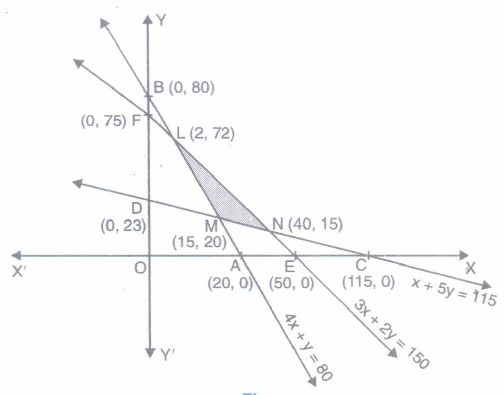
The shaded portion represents the feasible region, which is bounded.
Apply Corner Point Method, we have:
| Corner Point | Z = 6x + 3y |
| L : (2,72) | 228 |
| M : (15,20) | 150 (Maximum) |
| N : (40,15) | 285 |
Hence, minimum amount of vitamin A = 150 units.
28.
(i) The number of trials is finite. When the drawing is done with replacement, the probability of success (say, red ball) is p = \(\frac{7}{16}\)which is same for all six trials (draws). Hence, the drawing of balls with replacements are Bernoulli trials.
(ii) When the drawing is done without replacement, the probability of success (i.e., red ball) in first trial is \(\frac{7}{16}\)in 2nd trial is \(\frac{6}{15}\) if the first ball drawn is red or \(\frac{7}{15}\) if the first ball drawn is black and so on. Clearly, the probability of success is not same for all trials, hence the trials are not Bernoulli trials
29.
Note that f '(x) = – sin x
(a) Since for each x \(\in\) (0, \(\pi\)), sin x > 0, we have f '(x) < 0 and so f is decreasing in (0, \(\pi\)).
(b) Since for each x \(\in\) (\(\pi\), 2\(\pi\)), sin x < 0, we have f '(x) > 0 and so f is increasing in (\(\pi\), 2\(\pi\)).
(c) Clearly by (a) and (b) above, f is neither increasing nor decreasing in (0, 2\(\pi\)).
30.
\(We\quad have:f(x)={ x }^{ 3 }+{ x }^{ 2 }-1\)
Which is polynomial function
\(and\ { D }_{ f }=R\)
\(Let\quad c\in { D }_{ f }\)
\(Then\ \lim _{ x\rightarrow c }{ f(x) } =\lim _{ x\rightarrow c }{ ({ x }^{ 3 }+{ x }^{ 2 }-1) } \)
\(={ c }^{ 3 }+{ c }^{ 2 }-1=f(c)\)
\(\Rightarrow \) f is continuous at x = c.
But c is arbitrary.
Hence, f is continuous at each of its domains.
31.
\( f(x)=\begin{cases} -x,if\quad x<0 \\ x,\quad if\quad x\ge 0. \end{cases}\)
Clearly the function is defined at 0 and f(0) = 0. Left hand limit of f at 0 is
\(\lim _{ x\rightarrow { 0 }^{ - } }{ f(x) } =\lim _{ x\rightarrow { 0 }^{ - } }{ (-x) } =0\)
Similarly, the right hand limit of f at 0 is
\(\lim _{ x\rightarrow { 0 }^{ + } }{ f(x) } =\lim _{ x\rightarrow { 0 }^{ - } }{ (x) } =0\)
Thus, the left hand limit, right hand limit and the value of the function coincide at x = 0.
Hence, f is continuous at x = 0.
32.
Let events B1, B2, B3 be the following :
B1 : the bolt is manufactured by machine A
B2 : the bolt is manufactured by machine B
B3 : the bolt is manufactured by machine C
Clearly, B1, B2, B3 are mutually exclusive and exhaustive events and hence, they represent a partition of the sample space.
Let the event E be ‘the bolt is defective’.
The event E occurs with B1 or with B2 or with B3. Given that,
P(B1) = 25% = 0.25, P (B2) = 0.35 and P(B3) = 0.40
Again P(E|B1) = Probability that the bolt drawn is defective given that it is manufactured by machine A = 5% = 0.05
Similarly, P(E|B2) = 0.04, P(E|B3) = 0.02.
Hence, by Bayes' Theorem, we have
\(\mathrm{P}\left(\mathrm{B}_{2} \mid \mathrm{E}\right) =\frac{\mathrm{P}\left(\mathrm{B}_{2}\right) \mathrm{P}\left(\mathrm{E} \mid \mathrm{B}_{2}\right)}{\mathrm{P}\left(\mathrm{B}_{1}\right) \mathrm{P}\left(\mathrm{E} \mid \mathrm{B}_{1}\right)+\mathrm{P}\left(\mathrm{B}_{2}\right) \mathrm{P}\left(\mathrm{E} \mid \mathrm{B}_{2}\right)+\mathrm{P}\left(\mathrm{B}_{3}\right) \mathrm{P}\left(\mathrm{E} \mid \mathrm{B}_{3}\right)} \)
\(=\frac{0.35 \times 0.04}{0.25 \times 0.05+0.35 \times 0.04+0.40 \times 0.02} \)
\(=\frac{0.0140}{0.0345}=\frac{28}{69} \)
33.
\(\overrightarrow { AL } +\overrightarrow { BM } +\overrightarrow { CN } \)=\(\lambda \)\(\overrightarrow { CK } \)
34.
Since marginal cost is the rate of change of total cost with respect to the output, we have
Marginal \(\operatorname{cost}(\mathrm{MC})=\frac{d C}{d x}=0.005\left(3 x^{2}\right)-0.02(2 x)+30\)
When x = 3, MC = 0.015(32 ) − 0.04(3) + 30
= 0.135 – 0.12 + 30 = 30.015
Hence, the required marginal cost is Rs. 30.02 (nearly).
35.
\(\text { Consider } \frac{1}{2} \sin x(2 \sin 3 x \sin 2 x) =\frac{1}{2} \sin x(\cos x-\cos 5 x) \)
\(=\frac{1}{4}(2 \sin x \cos x-2 \cos 5 x \sin x)=\frac{1}{4}(\sin 2 x-\sin 6 x+\sin 4 x) \)
\(\therefore \int \sin x \sin 2 x \sin 3 x d x =\frac{1}{4} \int(\sin 2 x-\sin 6 x+\sin 4 x) d x \)
\(=\frac{1}{4}\left[\frac{-\cos 2 x}{2}+\frac{\cos 6 x}{6}-\frac{\cos 4 x}{4}\right]+C\)
36.
Let f be continuous at a critical point c in I. Then
(i) If f ′(x) changes sign from positive to negative as x increases through c, i.e., if f ′(x) > 0 at every point sufficiently close to and to the left of c, and f ′(x) < 0 at every point sufficiently close to and to the right of c, then c is a point of local maxima.
(ii) If f ′(x) changes sign from negative to positive as x increases through c, i.e., if f ′(x) < 0 at every point sufficiently close to and to the left of c, and f ′(x) > 0 at every point sufficiently close to and to the right of c, then c is a point of local minima.
(iii) If f ′(x) does not change sign as x increases through c, then c is neither a point of local maxima nor a point of local minima. Infact, such a point is called point of inflection
37.
Let numbers be x, y, z then
x + y + z = -1
2y + 3z = 5
x + y – z = -1
\(x=-\frac { 7 }{ 2 } \), y = \(\frac { 5 }{ 2 } \), z = 0
38.
\(\int { \frac { \sqrt { x^{ 2 }+1 } \left\{ log({ x }^{ 2 }+1)-2logx \right\} }{ x^{ 4 } } } dx\)
\(=\sqrt { 1+\frac { 1 }{ { x }^{ 2 } } } \left( log\left( 1+\frac { 1 }{ x^{ 2 } } \right) \right) \frac { 1 }{ x^{ 3 } } dx\)
Let, \(1+\frac { 1 }{ { x }^{ 2 } } ={ t }^{ 2 }\)
\(\Rightarrow \frac { -2 }{ { x }^{ 3 } } dx=2tdt\)
\(\Rightarrow \frac { 1 }{ { x }^{ 3 } } dx=-tdt\)
\(=-\int { t(2logt)t\quad dt+ } -2\int { logt.{ t }^{ 2 }dt } \)
\(=-2logt.\frac { { t }^{ 3 } }{ 3 } +\int { 2\frac { 1 }{ t } .\frac { t^{ 3 } }{ 3 } dt } \)
\(=-\frac { 2 }{ 3 } logt.{ t }^{ 3 }+\frac { 2 }{ 9 } { t }^{ 3 }+C\)
\(=\frac { 2 }{ 3 } \left( 1+\frac { 1 }{ { x }^{ 2 } } \right) ^{ 3 }\left( -log\left( 1+\frac { 1 }{ { x }^{ 2 } } \right) +\frac { 1 }{ 3 } \right) +C\)
39.
E1 = Event that 1 occur;
E2 = Event that 1 does not occur;
A = Event that the man reports that 1 occur.
\(P({ E }_{ 1 })=\frac { 1 }{ 6 } ;P({ E }_{ 2 })=\frac { 5 }{ 6 } ;\)
\(P(A/{ E }_{ 1 })=\frac { 3 }{ 5 } ;P(A/{ E }_{ 2 })=\frac { 2 }{ 5 } ;\)
\(P({ E }_{ 1 }/A)=\frac { \frac { 1 }{ 6 } .\frac { 3 }{ 5 } }{ \frac { 1 }{ 6 } .\frac { 3 }{ 5 } +\frac { 5 }{ 6 } .\frac { 2 }{ 5 } } =\frac { 3 }{ 13 } \)
40.
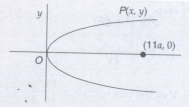
Let P(x, y) be the nearest point
\(\therefore \ D=\sqrt{(x-11a)^2+y^2}\)
\(S=(x-11a)^2+y^2=(x-11a)^2+4ax\)
\(\frac{dS}{dx}=2(x-11a)+4a\)
\(\frac{dS}{dx}=0\Rightarrow x=9a\)
\(\therefore\ y=pm6a\)
\(\Rightarrow\ \frac{d^2S}{dx^2}=2>0\)
For minimum distance, coordinates are \(p(9a,\pm6a)\)
41.
We know that A = I3A
\(\left[ \begin{matrix} 8 & 4 & 3 \\ 2 & 1 & 1 \\ 1 & 2 & 2 \end{matrix} \right] =\left[ \begin{matrix} 1 & 0 & 0 \\ 0 & 1 & 0 \\ 0 & 0 & 1 \end{matrix} \right] A\)
Applying \({ R }_{ 3 }\rightarrow 2{ R }_{ 3 }\)
\(\left[ \begin{matrix} 8 & 4 & 3 \\ 2 & 1 & 1 \\ 2 & 4 & 4 \end{matrix} \right] =\left[ \begin{matrix} 1 & 0 & 0 \\ 0 & 1 & 0 \\ 0 & 0 & 2 \end{matrix} \right] A\)
Applying \({ R }_{ 3 }\rightarrow { R }_{ 3 }-{ R }_{ 2 }\)
\(\left[ \begin{matrix} 8 & 4 & 3 \\ 2 & 1 & 1 \\ 0 & 3 & 3 \end{matrix} \right] =\left[ \begin{matrix} 1 & 0 & 0 \\ 0 & 1 & 0 \\ 0 & -1 & 2 \end{matrix} \right] A\)
Applying \({ R }_{ 2 }\rightarrow 4{ R }_{ 2 }\)
\(\left[ \begin{matrix} 8 & 4 & 3 \\ 8 & 4 & 4 \\ 0 & 3 & 3 \end{matrix} \right] =\left[ \begin{matrix} 1 & 0 & 0 \\ 0 & 4 & 0 \\ 0 & -1 & 2 \end{matrix} \right] A\)
Applying \({ R }_{ 2 }\rightarrow { R }_{ 2 }-{ R }_{ 1 }\)
\(\left[ \begin{matrix} 8 & 4 & 3 \\ 0 & 0 & 1 \\ 0 & 3 & 3 \end{matrix} \right] =\left[ \begin{matrix} 1 & 0 & 0 \\ -1 & 4 & 0 \\ 0 & -1 & 2 \end{matrix} \right] A\)
Applying \({ R }_{ 2 }\rightarrow { R }_{ 2 }+{ R }_{ 3 }\)
\(\left[ \begin{matrix} 8 & 4 & 3 \\ 0 & 3 & 4 \\ 0 & 3 & 3 \end{matrix} \right] =\left[ \begin{matrix} 1 & 0 & 0 \\ -1 & 3 & 2 \\ 0 & -1 & 2 \end{matrix} \right] A\)
Applying \({ R }_{ 3 }\rightarrow { R }_{ 3 }-{ R }_{ 2}\)
\(\left[ \begin{matrix} 8 & 4 & 3 \\ 0 & 3 & 4 \\ 0 & 0 & -1 \end{matrix} \right] =\left[ \begin{matrix} 1 & 0 & 0 \\ -1 & 3 & 2 \\ 1 & -4 & 0 \end{matrix} \right] A\)
Applying \({ R }_{ 1 }\rightarrow { R }_{ 1 }+{ 3R }_{ 3 }\)
\(\left[ \begin{matrix} 8 & 4 & 0 \\ 0 & 3 & 4 \\ 0 & 0 & -1 \end{matrix} \right] =\left[ \begin{matrix} 4 & -12 & 0 \\ -1 & 3 & 2 \\ 1 & -4 & 0 \end{matrix} \right] A\)
Applying \({ R }_{ 2 }\rightarrow { R }_{ 2 }+{ 4R }_{ 3 }\)
\(\left[ \begin{matrix} 8 & 4 & 0 \\ 0 & 3 & 0 \\ 0 & 0 & -1 \end{matrix} \right] =\left[ \begin{matrix} 4 & -12 & 0 \\ 3 & -13 & 2 \\ 1 & -4 & 0 \end{matrix} \right] A\)
Applying \({ R }_{ 1 }\rightarrow { R }_{ 1 }-\frac { 4 }{ 3 } { R }_{ 2 }\)
\(\left[ \begin{matrix} 8 & 0 & 0 \\ 0 & 3 & 0 \\ 0 & 0 & -1 \end{matrix} \right] =\left[ \begin{matrix} 0 & \frac { 16 }{ 3 } & -\frac { 8 }{ 3 } \\ 3 & -13 & 2 \\ 1 & -4 & 0 \end{matrix} \right] \)
Applying \({ R }_{ 1 }\rightarrow \frac { 1 }{ 8 } { R }_{ 1 },{ R }_{ 2 }\rightarrow \frac { 1 }{ 3 } { R }_{ 2 }\) and R3 = - R3
\(\left[ \begin{matrix} 1 & 0 & 0 \\ 0 & 1 & 0 \\ 0 & 0 & 1 \end{matrix} \right] =\left[ \begin{matrix} 0 & \frac { 2 }{ 3 } & -\frac { 1 }{ 3 } \\ 3 & -\frac { 13 }{ 3 } & \frac { 2 }{ 3 } \\ -1 & 4 & 0 \end{matrix} \right] A\)
\({ A }^{ -1 }=\left[ \begin{matrix} 0 & \frac { 2 }{ 3 } & -\frac { 1 }{ 3 } \\ 3 & -\frac { 13 }{ 3 } & \frac { 2 }{ 3 } \\ -1 & 4 & 0 \end{matrix} \right] \)
Matrix representation of given linear equation is
\(\left[ \begin{matrix} 8 & 4 & 3 \\ 2 & 1 & 1 \\ 1 & 2 & 2 \end{matrix} \right] \left[ \begin{matrix} x \\ y \\ z \end{matrix} \right] =\left[ \begin{matrix} 19 \\ 5 \\ 7 \end{matrix} \right] \)
\(\Rightarrow \) AX = B
\(\Rightarrow \) X = A-1B
\(\left[ \begin{matrix} x \\ y \\ z \end{matrix} \right] =\left[ \begin{matrix} 0 & \frac { 2 }{ 3 } & -\frac { 1 }{ 3 } \\ 1 & -\frac { 13 }{ 3 } & \frac { 2 }{ 3 } \\ -1 & 4 & 0 \end{matrix} \right] \left[ \begin{matrix} 19 \\ 5 \\ 7 \end{matrix} \right] \)
\(\Rightarrow \left[ \begin{matrix} x \\ y \\ z \end{matrix} \right] =\left[ \begin{matrix} 0+\frac { 10 }{ 3 } -\frac { 7 }{ 3 } \\ 19-\frac { 65 }{ 3 } +\frac { 14 }{ 3 } \\ -19+20+0 \end{matrix} \right] \)
\(\therefore \left[ \begin{matrix} x \\ y \\ z \end{matrix} \right] =\left[ \begin{matrix} 1 \\ 2 \\ 1 \end{matrix} \right] \)
\(\therefore \) x = 1, y = 2, z = 1
42.
Use A=lA. Proceed. [Refer 2]
\(\left[ \begin{matrix} 1 & -2 & -3 \\ -2 & 4 & 7 \\ -3 & 5 & 9 \end{matrix} \right] \)
43.
(d)
Parallelogram
44.
(b)
No real value
45.
(d)
4
46.
(d)
\(\frac{2}{13}\)
47.
(d)
\(\frac{1}{36}\)
48.
(c)
not defined
49.
(c)
2
50.
(d)
\(\frac { 1 }{ 2 } (x-4)\sqrt { { x }^{ 2 }-8x+7 } - \frac92log|x-4+\sqrt { { x }^{ 2 }-8x+7 } |+\)C
51.
(d)
\(\frac { 1 }{ 3 } \)
52.
(d)
(0, 2)
53.
(d)
512
54.
(b)
Is * commutative but not associative?
55.
(a)
f is one-one onto
56.
We have 1 + x2 > x2
\(\Rightarrow \sqrt { 1+{ x }^{ 2 } } >x\) for x ∈ [1, 2]
\(\Rightarrow \frac { 1 }{ \sqrt { 1+{ x }^{ 2 } } } <\frac { 1 }{ x } \)
\(\Rightarrow \int _{ 1 }^{ 2 }{ \frac { 1 }{ \sqrt { 1+{ x }^{ 2 } } } dx } <\int _{ 1 }^{ 2 }{ \frac { dx }{ x } } \Rightarrow { I }_{ 1 }<{ I }_{ 2 }\)
57.
As y’ = 3x² – 3, for a point of absolute maximum or minimum y’=0 ⇒ x = ± 1.
y]x=0 = 2,
y]x=1 = 1 – 3 + 2 = 0,
y]x=-1 = -1 +3+ 2 = 4,
y]x=2 = 8 – 6 + 2 = 4
58.
(c)
x + y = 0
59.
y = tan-1 \(\left( \frac { 1-{ x }^{ 2 } }{ 1+{ x }^{ 2 } } \right) \)
= tan-1 \(\left( \frac { \pi }{ 4 } \right) -{ tan }^{ -1 }{ x }^{ 2 }\)
\({ y }^{ ' }=0-\frac { -1 }{ 1+{ x }^{ 4 } } 2x=\frac { -2x }{ 1+{ x }^{ 4 } } \)
60.
As \(\lim _{ x\rightarrow 0 }{ \left( \frac { sinx }{ x } +cosx \right) } \)
= 1 + 1 = 2 2k
⇒ k = 1
61.
As diag (3, -1) is a diagonal matrix. Its order is 2 × 2 with diagonal elements 3 and (-1).

12th Standard CBSE Syllabus & Materials
12th Standard CBSE
CBSE 12th Computer Science Python Revision Tour I - New Previous year Question Papers Study Material - QB365 Set A
NEW12th Standard CBSE
CBSE 12th Business Studies Planning Important Questions And Answers Study Material - QB365 Set A
NEW12th Standard CBSE
CBSE 12th Business Studies Business Environment Important Questions And Answers Study Material - QB365 Set A
NEW12th Standard CBSE
CBSE 12th Business Studies Principles of Management Important Questions And Answers Study Material - QB365 Set A



NCERT Books

Syllabus

Exam Pattern

Sample Question Papers

Previous year Question Papers

Important Notes

MCQ Practice test

NCERT Exemplers

Case study Questions

Image Based Questions

Passage based Questions

HOT Questions

Value Based Questions

Model Questions Papers
NCERT ( Book Back ) Questions

Assertion and Reason
Important Questions And Answers

CBSE 12th Standard CBSE Subjects
CBSE Standards








