
 100% FREE ACCESS
12th Standard CBSE Syllabus & Materials
12th Standard CBSE
CBSE 12th Economics Government Budget and the Economy Previous year Question Papers Study Material - QB365 Set A
NEW12th Standard CBSE
CBSE 12th Computer Science Interface Python with MySQL - New Previous year Question Papers Study Material - QB365 Set A
NEW12th Standard CBSE
CBSE 12th Computer Science Database Concept - New Previous year Question Papers Study Material - QB365 Set A
NEW12th Standard CBSE
CBSE 12th Computer Science Data Communication - New Previous year Question Papers Study Material - QB365 Set A
NEW12th Standard CBSE
CBSE 12th Computer Science Data Structures - New Previous year Question Papers Study Material - QB365 Set A
NEW12th Standard CBSE
CBSE 12th Computer Science Functions - New Previous year Question Papers Study Material - QB365 Set A

Published on: 18/07/2019
Introductory Microeconomics
Download CBSE Class 12th Standard CBSE undefined question papers, sample papers, important questions, and previous year solved papers in PDF format. Get free study materials, NCERT solutions, and exam preparation resources for Class 12th Standard CBSE undefined
Questions + Answers key
Take MCQ Biology Test
1.
Distinguish between microeconomics and macroeconomics.
2.
Distinguish between a centrally planned economy and a market economy.
3.
What is a Production Possibility Frontier?
4.
Demand for electricity has 'increased'. however, supply cannot be increased due to lack of resources. Explain how, in any two ways demand for electricity can be decreased
5.
In the union budget for year 2012-2013, the excise duty on tea was reduced from rs 2 per kg to rs 1 per kg. All other things remaining unchanged, how will it affect the market price of tea?
6.
In what respect do the supply nd demand curves in the labour market differ from those in the goods market?
7.
How is the equilibrium number of firms determined in a market where entry and exit is permitted?
8.
What do you understand by normative economic analysis?
9.
What do you understand by positive economic analysis?
10.
Discuss the subject matter of economics.
11.
List the events of macroeconomics study.
12.
What is positive economics?
13.
Define market.
14.
What are the main tools of economic analysis?
15.
Define an economy.
16.
Why is economic problem regarded as a problem of choices?
17.
What is optimisation?
18.
What is rationality?
19.
Give two reasons for the problems of choice.
20.
What is meant by scarcity of resources?
21.
is a state in which market demand and supply of a commodity match each other
22.
is a state in which market demand equals market supply
23.
Excess supply occurs when corresponding to the existing price, supply of a commodity is than its demand
24.
Excess demand occurs when corresponding to the existing price, supply of a commodity is than its supply
25.
Price under perfect competition is always equal to the __________
26.
Which of the following is an economic activity?
Production
Consumption
Exchange
All of these
27.
When does the normal price determine?
Very short run
Short run
Long run
All of these
28.
What is the relationship between demand and supply in the controlled prices?
Demand
Demand>supply
Demand=supply
All of these
29.
Among whom does the competition arise due to excess demand?
Buyer
seller
Entrepreneurs
Firms
30.
What is the effect of excess demand on market price?
It will decrease
It will increase
It will be constant
it will zero
1.
Following are the points of distinction between microeconomics and macroeconomics:
| Basis | Microeconomics | Macroeconomics |
| Scope of the Study | Microeconomics is the study of a particular household, firm, industry, good, individual pnce, wage, income, etc. | Macroeconomics "is the study of economy as a whole or its aggregates such as national Income, level of employment, general pnce level, aggregate demand, aggregatedemand, Ietc. |
| Subject Matter | Microeconomics deals with the price of Individual goods and individual factors of production |
Macroeconomics deals with the general price level. |
| Central Problem | Microeconomics emphasises on the price determination and allocation of resources. | Macroeconomics emphasises on the determination of national income and em 10 ment. |
2.
Following are the points of distinction between centrally planned economy and market economy:
| S.No. | Centrally Planned Economy | Market Economy |
|---|---|---|
| 1. | Economic activities are planned by the government or the central authority in the economy. | The economic activities are managed through the market. |
| 2. | The central authority is the only owner of the resources and is soley engaged in the production and distribution of goods and services. | Prices of goods and services are determined by market forces of demand and supply with minimum intervention by the government. |
| 3. | Primary motive of a centrally planned economy is social welfare. | Profit is the primary motive of the market economy. |
| 4. | Economic planning solves the central problems of the centrally planned economy. | Price signals solve central problems of the market economy. |
3.
Production Possibility Frontier (PPF) is the graph depicting all the possible combinations of two goods (services) that can be produced in an economy by making an efficient and full utilisation of all the resources and given state of technology. It is also known as the Production Possibility Curve (PPC). PPF can be shown with the help of the given figure.
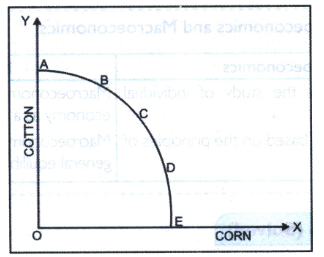
The figure illustrates the production possibilities of the economy. Any point on the curve represents a combination of corn and cotton that can be produced with full utilisation of the economy's resources. The curve represents the maximum amount of corn that can be produced in the economy for any given amount of cotton and vice-versa.
4.
(i) consumers may be motivated to use energy saving electrical appliances. nowadays, electrical appliances with one to five stars available These electrical appliances with maximum use, consume least electricity.
(ii) consumers may be encouraged to use alternate source of energy such as solar energy, wind energy etc.
5.
It will reduce the market price of tea because lesser excise duty will shift the supply curve to the right
6.
In the goods market, the supply of goods is by the firm because they produce the goods and the demand for goods is from the household because they purchase the goods
In the labour market, the supply of labour is by the household nd the demand for labour is from the firms because they need labour for producing goods
7.
In a market where entry and exit is permitted, each firm supplies the same amount of output. Therefore the equilibrium number of firms in the market is equal to the number of firms required to supply the equilibrium quantity at the prevailing price, \({ P }_{ 0 }\) thus,
\({ n }_{ 0 }=\frac { { Q }_{ 0 } }{ { q }_{ 0f } \ } \\ where; { n }_{ 0 }=Equilibrium \ number \ of \ firms \ in \ the \ market\\ { Q }_{ 0 }=Equilibrium \ quantity\\ { q }_{ 0f }=Quantity \ supplied \ by \ each \ firm\)
8.
Normative economic analysis discusses the economics of 'what ought to be'. In normative economic analysis, the desirability of different mechanisms is checked and recommendations are prescribed for making corrections, if necessary.
9.
Positive economic analysis discusses the economics of 'what is'. In positive economic analysis, the functioning of different mechanisms is analysed and their respective outcomes are figured out for refernce in future.
10.
The subject matter of economics has been studied under two broad branches:
(i) Microeconomics
(ii) Macroeconomics
In microeconomics we study the behaviour of individual decision-making units, such as households and firms. Equilibrium prices and quantities of goods and services are determined through the interaction of individuals in the markets.
In macroeconomics, we study the behaviour of factors affecting the economy as a whole. It focuses on the behaviour of national level aggregates such as national income, total output, employment level, price level, etc. Here, we are interested in finding out how thelevels of these aggregate measures are determined and how these measures change over time.
11.
()
The events of macroeconomic study include:
(i) Rate of inflation
(ii) Level of unemployment
(iii) Decline in agricultural and industrial output
(iv) Fluctuations in business activities
(v) Accumulation of foreign exchange reserves
(vi) Capital market changes.
12.
()
Positive economics is an economic approach that studies the behaviour and functioning of different market systems without making judgments.
13.
()
A market is an arrangement through which buyers and sellers can freely interact with one another for exchange of factors of production, and final goods and services.
14.
()
The main tools of economic analysis are logic reasoning, graphs, diagrams and functional.
15.
()
Economy refers to the system of production, distribution and consumption of economic goods and services by different agents in a country or region.
16.
()
Human wants are unlimited and it is impossible to satisfy all the wants. The individual, therefore, is required to make a choice between his or her wants. Economic problem arises the moment the problem of choice arises.
17.
()
Maximisation o output per unit of input is known as optimisation.
18.
()
Rationality refers to the quality of making reasonable comparison of all possible combinations of goods and prices by an individual while making purchase decisions.
19.
()
Following are the two reasons for the problems of choice:
(i) Unlimited wants
(ii) Limited means
20.
()
Scarcity of resources means limited availability of resources in relation to their demand.
21.
()
Equilibrium price
22.
()
Market equilibrium
23.
()
greater
24.
()
greater
25.
()
min AC
26.
(d)
All of these
27.
(c)
Long run
28.
(b)
Demand>supply
29.
(a)
Buyer
30.
(b)
It will increase

12th Standard CBSE Syllabus & Materials
12th Standard CBSE
CBSE 12th Computer Science Python Revision Tour I - New Previous year Question Papers Study Material - QB365 Set A
NEW12th Standard CBSE
CBSE 12th Business Studies Planning Important Questions And Answers Study Material - QB365 Set A
NEW12th Standard CBSE
CBSE 12th Business Studies Business Environment Important Questions And Answers Study Material - QB365 Set A
NEW12th Standard CBSE
CBSE 12th Business Studies Principles of Management Important Questions And Answers Study Material - QB365 Set A



CBSE 12th Standard CBSE Subjects
CBSE Standards











