
 100% FREE ACCESS
12th Standard CBSE Syllabus & Materials
12th Standard CBSE
CBSE 12th Economics Government Budget and the Economy Previous year Question Papers Study Material - QB365 Set A
NEW12th Standard CBSE
CBSE 12th Computer Science Interface Python with MySQL - New Previous year Question Papers Study Material - QB365 Set A
NEW12th Standard CBSE
CBSE 12th Computer Science Database Concept - New Previous year Question Papers Study Material - QB365 Set A
NEW12th Standard CBSE
CBSE 12th Computer Science Data Communication - New Previous year Question Papers Study Material - QB365 Set A
NEW12th Standard CBSE
CBSE 12th Computer Science Data Structures - New Previous year Question Papers Study Material - QB365 Set A
NEW12th Standard CBSE
CBSE 12th Computer Science Functions - New Previous year Question Papers Study Material - QB365 Set A

Published on: 26/07/2019
Production and Cost
Download CBSE Class 12th Standard CBSE undefined question papers, sample papers, important questions, and previous year solved papers in PDF format. Get free study materials, NCERT solutions, and exam preparation resources for Class 12th Standard CBSE undefined
Questions + Answers key
Take MCQ Biology Test
1.
What is meant by returns to a factor ? What leads to increasing returns to factor? Explain
2.
Explain the likely behaviour of Total Product and Marginal Product When only one input is increased while all other inputs are kept unchanged.
3.
What is the average product of an input?
4.
What is the total product of an input?
5.
Explain the concept of a production function.
6.
What is meant by decreasing returns to factor? Give causes of its application.
7.
Explain Law of Variable Proportions.
8.
Explain the relationship between the marginal products and the total product of an input.
9.
What is marginal product of an input?
10.
Give meaning of 'opportunity cost'
11.
What does cost mean in economics
12.
Define marginal Cost.
13.
Define Variable Costs.
14.
What is fixed Costs?
15.
What will you say about the Marginal Product of a factor when Total Product is falling?
16.
How is total product derived from the Marginal Product schedule?
17.
What is meant by Average Physical Product?
18.
What is meant by Total Physical Product?
19.
Define Marginal Physical Product.
20.
What do you understand by increasing returns to scale? How do they arise?
21.
Giving reason, state whether the following statements are true or false:
(i)Increase in Total Product always indicates that there are increase returns to a factor.
(ii) Marginal Revenue is always the price at which the last unit of commodity is sold.
(iii)When these are diminishing returns to a factor Marginal and Total Product both always fall.
22.
The 2nd stage of output is also known as stage of diminishing returns.
23.
When MP is negative,then TP starts increasing
24.
The formula of MP is,\(MP=\frac { TP }{ L } \)
25.
In short run,all the factors of production are variable.
26.
Production function studies the functional relationship between physical input and physical output.
27.
Returns to a factor operates in------------
Short Run
Long Run
Very Long Run
None of these
28.
Returns to scale operates in the --------------- run.
Short
Long
Very short
None of these
29.
Marginal product (MP) =
\(\frac { \Delta TP }{ \Delta L } \)
\(AP*L\)
\(\frac { TP }{ L } \quad \)
\(TP*L\)
30.
Total Product (TP)=
\(\frac { AP }{ L } \)
\(\frac { AP }{ MP } \)
\(MP*L\)
\(AP*L\)
31.
Which among the following is the factor of production?
Land
Capital
Human capital
All of the these
1.
Returns to a factor means the increase in the Total Product (TP) per unit increase in the employment l of a variable factor, when the employment of other factors is kept constant.
Increasing Marginal Product leads to increasing returns to factor. In other words, when Total Product increases at an increasing rate, increasing returns to factor takes place. This can be explained with the help of following table.
| Units of Variable Factor | Total Product | Marginal Product |
| 0 | 0 | 0 |
| 1 | 10 | 10 |
| 2 | 22 | 12 |
| 3 | 36 | 14 |
| 4 | 52 | 16 |
| 5 | 70 | 18 |
In the table, MarginalProduct increases by employing an additional unit of variable factor. That is,Total Product is increasing at an increasing rate.Thus increasing MP leads to increasing returns of factor
2.
The Law of variable Proportions explains the behaviour of Total Product ~nd Marginal Product. It states that when more and more units of a variable factor are employed, keeping the other factors fixed, the Total Product (TP) first increases at an increasing rate, then increases at a diminishing rate and finally starts falling.The different phases in the behaviour of TP and MP can be explained as below.
| Phase | Total Product (TP) | Marginal Product(MP) |
| I | TP raises at increasing rate | MP raises |
| II | TP raises at decreasing rate | MP falls but remains positive |
| III | TP falls | MP falls and becomes negative |
3.
Average product is defined as the output produced by per unit of variable factor (labour) employed. Algebraically, it is defined as the ratio of the total product by units of labour employed to produce the output, i.e.
\(\mathrm{AP}=\frac{\mathrm{TP}}{L}\)
Where,
TP = Total product
L = units of labour employed
4.
Total product is defined as the sum total of output produced by a firm by employing a particular input. It is also known as the Total Physical Product and is represented as
\(\mathrm{TP}=\sum Q_{x}\)
Where, ∑ represents summation of all outputs and Qx represents units of output x produced by an input.
5.
The production function of a firm is a relationship between inputs used and output produced by the firm. For various quantities of inputs used, it gives the maximum quantity of output that can be produced. Ir other words, the production function shows the technical relation between factor input and output.
The inputs that a firm uses in the production process are called factors of production. Suppose a firm produces output using only two factors of production, factor I and factor 2. The production function, hence, shows the maximum quantity of output that can be produced by using different combinations of these two factors. Thus, a production function can be expressed as:
\(q=F(x_{ 1 },x_{ 2 })\)
According to the above equation, the firm can produce at most q units of output by using \(x_{ 1 }\) amount of factor I and \(x_{ 2 }\) amount of factor 2.
6.
Decreasing returns to factor implies that keeping other inputs constant, an increase in the variable input will cause the Marginal Product to decrease after a certain level of output. It is also known as the Law of Diminishing Marginal Returns.
Following are the causes of Diminishing Marginal Returns to Factor:
(i) Fixity of Factors: When more and more units of variablefactor are combined with the fixed factor, the latter gets over-utilised. As a result, the Marginal Product from each additional unit of variable factor declines.
(ii) Imperfect Substitution: Factors of production are imperfect substitutes of each other. It is possible to use one factor as a substitute for another factor of production only till a limit. However, production beyond that limit causes diminishing marginal returns.
(iii) Scarcity of Factors of Production: Every factor of production is available in limited quantity. Availability of limited factor decreases asthe level of output is increases. Consequently, the cost increases and marginal product starts to decline.
7.
The factors of production can be classified as fixed and variable factors. The fixed factors cannot be changed over a short period. The Law of Variable Proportions (or the Law of Returns to a Factor) states that when more and more units of a variable factor are employed, keeping the other factors fixed, the Total Product (TP) first increases at an increasing rate, then increases at a diminishing rate and finalIy starts falling.The law explains the change in output due to the change in the proportions between the fixed and variable factors. The law of returns to a factor can be explained with the help of following diagram:
 Stage I: Increasing Returns to Variable Factor
The Total Product (TP) increases at an increasing rate from 0 to L, units of labour. That is, Marginal Product (MP) is increasing.
Stage 2: Diminishing Returns to Variable Factor
The Total Product (TP) increases at a diminishing rate from L, to L, units of labour. That is, Marginal Product (MP) is decreasing. MP is 0 at ~ units of labour. •
Stage 3: Negative Returns to Variable Factor
The Total Product (TP) is decreasing beyond ~ units of labour. The output decreases as an additional unit of labour is employed. That is, Marginal Product (MP) is negative.
8.
Relationship between marginal products (MP) and the total product (TP) can be represented graphically as
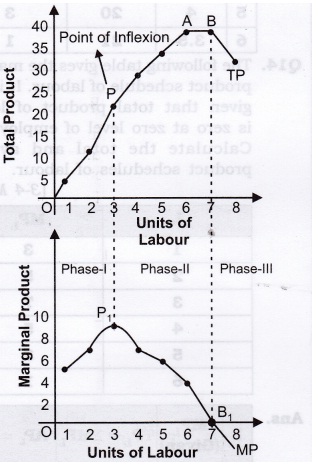
1) TP increases at an increasing rate till point K, when more and more units of labour are employed. The point K is known as the point of inflexion. At this point MP (second part of the figure) attains its maximum value at point U.
2) After point K, TP increases but at a decreasing rate. Simultaneously, MP starts falling after reaching its maximum level at point U.
3) When TP curve reaches its maximum and becomes constant at point B, MP becomes zero.
4) When TP starts falling after B, MP becomes negative.
5) MP is derived from TP by
\(\mathrm{MP}=\frac{\Delta \mathrm{TP}}{\Delta L}\)
Or, MP = TPn - TPn-1
9.
Marginal Product is defined as the additional output produced because of the employment of an additional unit of labour. In other words, it is the change in the total output brought by employing one additional unit of labour. Algebraically, it is expressed as the ratio of the change in the total product to the change in the units of labour employed, i.e.
\(MP=\frac { \Delta TP }{ \Delta { X }_{ 1 } } \)
or, MPL = TPn - TPn-1
Where,
TPn = Total product produced by employing n units of labour
TPn−1 = Total product produced by employing (n − 1) units of labour.
10.
()
Opportunity cost refers to the cost of next best alternative foregone while making a choice or decision
11.
()
Costs refer to the total expenditure incurred by a firm on the production of a good ,it is the sum of actual and imputed expenditure on the inputs by the owner
12.
()
Marginal Cost (MC) is the extra cost of producing an additional unit of output.
13.
()
Variables Costs (VC) are incurred on the employment of variable factors of production.These costs which vary with the level of output.
14.
()
Fixed Costs(FC) are the costs incurred on the employment of fixed factors of production.These costs remain fixed at all the levels of output.
15.
()
When Total Product is falling the Marginal Product will be negative.
16.
()
Total product is derived by summing the Marginal Product of each unit of variable input.
17.
()
Average Physical Product (APP) or Average Product (AP) is the total product per unit variable factor.It can be calculated by dividing the Total Product with the units of variable input employed.
\(AP=\frac { TP }{ { X }_{ 1 } } \)
Where \({ x }_{ 1 }\) is a variable factor.
18.
()
Total Physical Product (TPP) or Total Product(TP) is the total output produced by a firm using its variable inputs during a period of time.
19.
()
Marginal Physical Product (MPP) or Marginal Product (MP) is the change in the Total Physical Product due to a unit increase in the employment of a variable input.
20.
Increasing returns to scale implies that a proportionate change in the output is greater than the proportionate change in input. For example, the output increases by 20 percent due to 15 percent increase in all the inputs. Increasing returns to scale are due to economies of scale. Economies of scale indica e that long run Average Cost decreases, which corresponds to increasing returns to scale in terms 0 output. Economies of scale can be classified as::
1. Internal Economies of Scale: These include
(i) Technical Economies
(ii) Financial Economies
(iii) Marketing Economies
(iv) Managerial Economies
(v) Labour Economies
(vi) Risk-bearing Economies
(vii) Economies due to Indivisibilities
2. External Economies of Scale:These include
(i) Economies of Concentration
(ii) Economies of Information
(iii) Economies of Disintegration
21.
(i) False. Increasing in Total Product indicates increasing returns to a factor as well as decreasing returns to a factor. When Marginal Product increases, Total Product increases at increasing rate causing increasing returns to a factor. When Marginal Product decreases, Total Product increases at decreasing rate causing decreasing returns to a factor.
(ii) False. Marginal Revenue is not always the price at which the last unit of commodity is sold. It is rue only under perfectly competitive market structure. Marginal Revenue can be zero or even negative under other forms of market, but-price cannot be zero or negative
(iii) False. When there are diminishing returns to a factor, only Marginal Product falls. However, Total Product increases but at a diminishing rate. Total Product tends to increase as long as Marginal Product is positive. When there are diminishing returns to a factor marginal and total products both always fall is a false statement. We can understand this situation with the help of schedule.
22.
(a)
23.
(b)
24.
(b)
25.
(b)
26.
(a)
27.
(a)
Short Run
28.
(b)
Long
29.
(a)
\(\frac { \Delta TP }{ \Delta L } \)
30.
(d)
\(AP*L\)
31.
(d)
All of the these

12th Standard CBSE Syllabus & Materials
12th Standard CBSE
CBSE 12th Computer Science Python Revision Tour I - New Previous year Question Papers Study Material - QB365 Set A
NEW12th Standard CBSE
CBSE 12th Business Studies Planning Important Questions And Answers Study Material - QB365 Set A
NEW12th Standard CBSE
CBSE 12th Business Studies Business Environment Important Questions And Answers Study Material - QB365 Set A
NEW12th Standard CBSE
CBSE 12th Business Studies Principles of Management Important Questions And Answers Study Material - QB365 Set A



CBSE 12th Standard CBSE Subjects
CBSE Standards











