
 100% FREE ACCESS
12th Standard CBSE Syllabus & Materials
12th Standard CBSE
CBSE 12th Economics Government Budget and the Economy Previous year Question Papers Study Material - QB365 Set A
NEW12th Standard CBSE
CBSE 12th Computer Science Interface Python with MySQL - New Previous year Question Papers Study Material - QB365 Set A
NEW12th Standard CBSE
CBSE 12th Computer Science Database Concept - New Previous year Question Papers Study Material - QB365 Set A
NEW12th Standard CBSE
CBSE 12th Computer Science Data Communication - New Previous year Question Papers Study Material - QB365 Set A
NEW12th Standard CBSE
CBSE 12th Computer Science Data Structures - New Previous year Question Papers Study Material - QB365 Set A
NEW12th Standard CBSE
CBSE 12th Computer Science Functions - New Previous year Question Papers Study Material - QB365 Set A

Published on: 03/10/2019
Atoms and Nuclei
Download CBSE Class 12th Standard CBSE Physics question papers, sample papers, important questions, and previous year solved papers in PDF format. Get free study materials, NCERT solutions, and exam preparation resources for Class 12th Standard CBSE Physics
Questions + Answers key
Take MCQ Physics Test
1.
One day Shyam noticed that his younger brother was engaged in solving a question related to light emission from vapour lamp. Shyams brother was anxious to know about different colours being emitted by different light with mercury and also keep to have idea about what is inside the sodium vapour lamps kept in physics lab. With this, Shyam explained to his brother about absorption of energy and re-emission of photons in visible region. While explaining to his brother, Shyam advised his brother not to touch or break any items in physics lab for the thirst of knowledge.
(i) What is the moral you derive from Shyam?
(ii) Which series in the hydrogen spectrum is in the visible region?
2.
(i) Draw a schematic arrangement of Geiger-Marsden experiment showing the scattering of a-particles by a thin foil of gold. Why is it that most of the a-particles go right through the foil and only a small fraction gets scattered at large angles?
Draw the trajectory of the a-particle in the coulomb field of a nucleus. What is the Significance of impact parameter and what information can be obtained regarding the size of the nucleus?
(ii) Estimate the distance of closest approach to the nucleus (Z = 80) if a 7.7 MeV a-particle before it comes momentarily to rest and reverses its direction.
3.
Asha's mother read an article in the newspaper about a disaster that took place at Chernobyl. She could not understand much from the article and asked a few questions from Asha regarding the article.
Asha tried to answer her mother's questions based on what she learnt in Class XII Physics?
4.
On the basis of Bohr's theory of H-atom, total energy of electron in a stationary orbit is given by the relation
Where, n is the number of orbits. It is clear that total energy of electron in a stationary orbit is negative which implies that electron is bound to the nucleus and is not free to leave it. The value of negative energy decreases as n increases.
Read the above p[assagr and answer the following questions:
(i) What is the total energy of electron in ground state of hydrogen atom? What does it indicate?
(ii) Why does energy required to remove an electron is smaller when atom is in any one excited state?
5.
According to Bohr's theory of hydrogen atom, total energy of electron in a stationary orbit is \(E=-\frac { 13.6 }{ { n }^{ 2 } } eV,\) where n is the number of orbit. Clearly, total energy of electron in a stationary orbit is negative, which means the electron is bound to the nucleus and is not free to leave it. An n increases, value of negative energy decreases, i.e., energy is progressively larger in the outer orbits.
Read the above passage and answer the following questions :
(i) What is total energy of electron in ground state of hydrogen atom? What does it imply?
(ii) Energy required to remove an electron is smaller when atoms is in any one excited state. Comment.
(iii) How is this concept translated in day to day life?
6.
A nuclear reactor is a powerful device, wherein nuclear energy is utilised for peaceful purposes. It is based upon controlled nuclear chain reaction. The nuclear chain reaction is controlled by the use of control rods (of boron or cadmium) and moderators like heavy water, graphite, etc. The whole reactor is protected with concrete walls 2 to 2.5 metre thick, so that radiations emitted during nuclear reactions may not produce harmful effects.
Read the above passage and answer the following questions:
(i) Give any two merits of nuclear reactors.
(ii) What is radiactive waste?
(iii) Why do people often oppose the location site of a nuclear reactor? What do you suggest?
7.
The energy of an electron in a hydrogen atom is \({ E }_{ n }=\frac { -13.6 }{ { n }^{ 2 } } eV\), where n = 1, 2, 3,... Show that
(i) the electron in a hydrogen atom cannot have an energy of -6.8eV.
(ii) spacing between the lines within the given set of observed hydrogen spectrum decreases as n increases.
1.
(i) Concern for his brother/care about the school property.
(ii) Balmer Series.
2.
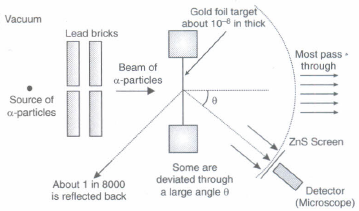
It gives an estimate of the size of nucleus.
(ii) K.E of the ∝-particle = potential energy Possessed by beam at distance of closest approach.
\(\frac { 1 }{ 2 } { mv }^{ 2 }=\frac { 1 }{ 4\pi { \varepsilon }_{ 0 } } .\frac { (2e)(Ze) }{ { r }_{ 0 } } \)
7.7 x 1.6 x 10-3 = \(\frac { 9\times { 10 }^{ 9 }\times 2\times 2.56\times { 10 }^{ -38 } }{ { r }_{ 0 } } \)
r0 = \(\frac { 9\times { 10 }^{ 9 }\times 2\times 2.56\times { 10 }^{ -38 } }{ 7.7\times 1.6\times { 10 }^{ -13 } } m\)
= 299 x 10-16 m
3.
Installation at chernobyl is a pressurised fusion reactor. Possible cause of disaster is melt down of core due to excessive heat development, which occurs when k (multiplication factor) become more than 1.
In a fusion reaction, energy released = (mass defect) x c2.
According to Asha-subject knowledge and knowledge sharing.
4.
(i) The total energy of electron in ground state (n = 1) is
\({ E }_{ 1 }=-\cfrac { 13.6 }{ { 1 }^{ 2 } } eV=-13.6eV\)
It indicates that 13.6eV energy is needed to remove an electron from hydrogen atom in its ground state.
(ii) Energy in first excited state(n = 2) is
\({ E }_{ 2 }=-\cfrac { 13.6 }{ { 2 }^{ 2 } } eV=-3.4eV\)
It implies that energy needed to remove an electron from hydrogen atom in first excited state is 3.4eV, which is less than 13.6eV.
5.
(i) For ground state, n = 1
\(\therefore E=\frac { -13.6 }{ { n }^{ 2 } } eV= \ \frac { -13.6 }{ { I }^{ 2 } } eV= \ -13.6 \ eV\)
It implies that 13.6 eV energy is required to remove an electron from hydrogen atom in its ground state.
(ii) In first excited state, n = 2,
\(\therefore \ E=-\frac { 13.6 }{ { 2 }^{ 2 } } eV \ = \ -3.4eV\)
It means that energy required to remove an electron from hydrogen atom in first excited state is 3.4 eV, which is less than 13.6 eV. Therefore, the statement is true.
(iii) Negative energy of electron indicates that it is bound to the nucleus and cannot leave it until energy equal to its negative energy is supplied from outside. The same is true in day to day life. A person intending to leave the country has to show that nothing is pending against him in a court of law, and he has cleared income tax/sales tax payments due from him. A person from whom any type of payment is due, is not free to leave the country. He is bound till he clears all his dues.
6.
(i) Nuclear reactors are used in electric power generation. They are also used to produce radioactive isotopes which have applications in medicine, industry and agriculture.
(ii) Radioactive waste consists of fission products and transuranic elements such as plutonium and americium. This waste is extremely hazardous to all forms of life on earth.
(iii) People often oppose the location site of a nuclear reactor because any leakage of nuclear radiations can affect adversely miles of area surrounding it. Elaborate safety measures are needed not only for reactor operations, but also for handling and disposal of radioactive waste.
I would suggest that Government must take stringent safety measures and assure people of safeguards in the event of nuclear accidents. At the same time, people must also be educated accordingly.
7.
\(Here,\ { E }_{ n }=\frac { -13.6 }{ { n }^{ 2 } } eV\)
\( Putting\ n=1,2,3,......,\ we\ get\)
\( { E }_{ 1 }=\frac { -13.6 }{ { 1 }^{ 2 } } eV=-13.6eV\)
\({ E }_{ 2 }=\frac { -13.6 }{ { 2 }^{ 2 } } eV=-3.4eV\)
\( { E }_{ 3 }=\frac { -13.6 }{ { 3 }^{ 2 } } eV=-1.51eV\)
\( { E }_{ 4 }=\frac { -13.6 }{ { 4 }^{ 2 } } eV=-0.85eV;{ E }_{ \infty }=0\)
Clearly, an electron in a hydrogen atom cannot have the energy of -6.8 eV.
(ii) As the value of n increases, energy diff. between two consecutive energy levels decreases.

12th Standard CBSE Syllabus & Materials
12th Standard CBSE
CBSE 12th Computer Science Python Revision Tour I - New Previous year Question Papers Study Material - QB365 Set A
NEW12th Standard CBSE
CBSE 12th Business Studies Planning Important Questions And Answers Study Material - QB365 Set A
NEW12th Standard CBSE
CBSE 12th Business Studies Business Environment Important Questions And Answers Study Material - QB365 Set A
NEW12th Standard CBSE
CBSE 12th Business Studies Principles of Management Important Questions And Answers Study Material - QB365 Set A



CBSE 12th Standard CBSE Subjects
CBSE Standards










