
 100% FREE ACCESS
12th Standard CBSE Syllabus & Materials
12th Standard CBSE
CBSE 12th Economics Government Budget and the Economy Previous year Question Papers Study Material - QB365 Set A
NEW12th Standard CBSE
CBSE 12th Computer Science Interface Python with MySQL - New Previous year Question Papers Study Material - QB365 Set A
NEW12th Standard CBSE
CBSE 12th Computer Science Database Concept - New Previous year Question Papers Study Material - QB365 Set A
NEW12th Standard CBSE
CBSE 12th Computer Science Data Communication - New Previous year Question Papers Study Material - QB365 Set A
NEW12th Standard CBSE
CBSE 12th Computer Science Data Structures - New Previous year Question Papers Study Material - QB365 Set A
NEW12th Standard CBSE
CBSE 12th Computer Science Functions - New Previous year Question Papers Study Material - QB365 Set A

Published on: 15/02/2020
12th Standard CBSE Physics board Exam Model Question Paper I 2019 - 2020
Download CBSE Class 12th Standard CBSE Physics question papers, sample papers, important questions, and previous year solved papers in PDF format. Get free study materials, NCERT solutions, and exam preparation resources for Class 12th Standard CBSE Physics
Questions + Answers key
Take MCQ Physics Test
1.
Two Capacitors of capacitace 6\(\mu \)F and 12\(\mu \)F ae connnected in series with tha battery the volatage across the 6\(\mu \)F capacitor is 2 volt, Compute the total battery voltage.
2.
Two closely spaced equipotential surfaces A and B with potentials V and V + 8 Y, (where 8 V is the change in V), are kept 81 distance apart as shown in the figure. Deduce the relation between the electric field and the potential gradient between them. Write the two important conclusions concerning the relation between the electric field and electric potentials.
.png)
3.
A d.c. motor acts as generator too. Is it true?
4.
There is an impression among many people that a person touching a high power line gets stuck with the line. Is that true? Explain.
5.
Write the relation for the magnetic field induction at a point due to a linear conductor carrying current and hence deduce the relation for the magnetic field induction at a point due to a very long linear conductor carrying current.
6.
Define the term 'drift velocity' of charge carriers in a conductor and write its relationship with the current flowing through it.
7.
Two point charge of \(+3\times {{10}^{-8}}C\) and \(-2\times {{10}^{-8}}C\) are located 15cm apart in air. Find at what point on the joining these charge the electric potential is zero. Take potential at infinity to be zero.
8.
In a permanent magnet at room temperature
the magnetic moment of each molecule is zero
the individual molecules have a non-zero magnetic moment which is all perfectly aligned
domains are partially aligned
domains are all perfectly aligned.
9.
A circular coil expands radially in a region of magnetic field and no electromotive force is produced in the coil. This can be because
the magentic field is constant
the magnetic field is in the same plane as the circular coil and it may or may not vary
the magnetic field has a perpendicular componet whose magnitude is decreasing suitably
there is a constant magnetic field in the perpendicular direction.
10.
The value of absolute electrical permittivity of free space is
\(9\times 10^9Nm^2C^{-2}\)
\(9\times 10^{-9}Nm^2C^{-2}\)
\(8.85\times 10^{-12}C^2N^{-1}m^{-2}\)
\(8.85\times 10^{-12}C^2Nm^{-2}\)
11.
A linearly polarized electromagnetic wave given as \(E={ E }_{ 0 }\overset { \wedge }{ i } cos \ (kz-wt)\) incident wall at \(z=a\) . Assuming that the material of the wall os optically inactive, the reflected wave will be given as
\(\overset { \rightarrow }{ { E }_{ r } } ={ E }_{ 0 }\overset { \wedge }{ i } cos(kz-wt)\quad \)
\(\overset { \rightarrow }{ { E }_{ r } } ={ E }_{ 0 }\overset { \wedge }{ i } cos(kz+wt)\quad \)
\(\overset { \rightarrow }{ { E }_{ r } } ={ -E }_{ 0 }\overset { \wedge }{ i } cos(kz+wt)\quad \)
\(\overset { \rightarrow }{ { E }_{ r } } ={ -E }_{ 0 }\overset { \wedge }{ i } sin(kz+wt)\quad \)
12.
In a playground, Akhil with his friends were playing cricket. A ball during the play, hit on left leg of Bharat and soon he screamed with pain. At that time, Akhil rushed towards Bharat for giving help and told him not to move his left leg. Akhil quickly took his mobile phone and informed Bharat's parents about the incident. Quickly within 10 minutes, they took Bharat to nearby hospital where doctor on examining advised X-rays test for his left leg. The doctor after seeing Bharat Xray test report,
confirm an hairline fracture in his leg.
(i) How are X-rays produced?
(ii) Mention one another application of X-rays.
(iii) Mention two qualities of Akhil which are reflected from the above situation.
13.
A solenoid coil of 300 turns/m is carrying a current of 5 A. The length of the solenoid is 0.5 m and has a radius of 1 cm. Find the magnitude of the magnetic field well inside the solenoid.
14.
A sinusoidal voltage of peak value 283 V and frequency 50 Hz is applied to a series LCR circuit in which R = 3 Ω, L = 25.48 mH, and C = 796 μF. Find (a) the impedance of the circuit; (b) the phase difference between the voltage across the source and the current; (c) the power dissipated in the circuit; and (d) the power factor.
15.
A parallel plate capacitor made of circular plates each of radius 10 cm has a capacity 200 pF. The capacitor is connected to a 230 V a.c. supply with an angular frequency of 400 rad s-1.
(i) What is the rms value of the conduction current?
(ii) Find the amplitude of \(\overrightarrow { B } \) at a point 2.0 cm from the axis of the plates.
16.
A laser beam has intensity 3.0 x 10¹⁴ M m-2. Find the amplitudes of electric and magnetic fields in the beam.
17.
Explain how does the resistivity of a conductor depend upon
(i) number density 'n' of free electrons, and
(ii) relaxation time \(\rho \) ?
18.
1MW power is to be delivered from a power station to a town 10 km away. One uses a pair of Cu wires of radius 0.5 cm for this purpose. Calculate the fraction of ohmic losses to power transmitted if
(i) power is transmitted at 220 V.Comment on the feasibility of doing this.
(ii) a step-up transformer is used to boost the voltage to 11000 V, power transmitted, then a step-down transformer is used to bring voltage to 220 V.
\(({ \rho }_{ Cu }=1.7\times { 10 }^{ -8 }\ SI\ unit)\)
19.
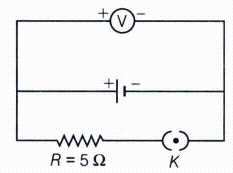
The reading on a high resistance voltmeter, when a cell is connected across it, is 2.2 v. When the terminals of the cell are connected to a resistance of 5 Ω as shown in figure given alongside, the voltmeter reading drops to 1.8 V. Find the internal resistance of the cell.
20.
If \({ \theta }_{ 1 } \ and \ { \theta }_{ 2 }\) be the apparent angles of dip observed in two vertical planes at right angles to each other, then show that the true angle of dip, \({ \theta }\) is given by \({ cot }^{ 2 }\theta ={ cot }^{ 2 }{ \theta }_{ 1 }+{ cot }^{ 2 }{ \theta }_{ 2 }.\)
21.
The amplitude of the magnetic field part of a harmonic electromagnetic wave in vacuum is B0 = 510 nT. What is the amplitude of the electric field part of the wave?
1.
V = V1 + V2
Q = C1V = 6 x 10-6 x 2 = 12\(\mu \)C
As C2 is in series same amount of charge will also flow through it now V2 = Q/C2 = (12 x 10-6) /(12 x 10-6) = 1 volt
Total Battery voltage, V = 2 + 1 = 3 Volt
2.
Work done in moving a unit positive charge along distance \(\delta l\)
\(\left| { E }_{ l } \right| \delta ={ V }_{ A }-{ V }_{ B\\ }\)
\(=V-(V+\delta V)\)
\(=-\delta V\)
\(\left| { E }_{ l } \right| =-\frac { \delta V }{ \delta l } \)
Electric field is in the direction in which the potential decreases the steepest.
(ii) The magnitude of electric field is given by the change in the magnitude of potential per unit displacement, normal to the equipotential surface at the point.
3.
Yes. A d.c. motor generates induced e.m.f. which opposes the supplied e.m.f. It is called back e.m.f.
4.
This impression is misleading. In fact, there is no special attractive force that keeps a person stuck with a high power line while touching that wire, whereas a current of few milliampere is enough to disorganise our nervous system. As a result of it, the affected person loses temporarily his ability to exercise his nervous control to get himself free from the high power line.
5.
Magnetic field induction at a point P in space at a perpendicular distance a from a linear conductor carrying current i is
\(B=\frac { { \mu }_{ o } }{ 4\pi a } \left( sin{ \phi }_{ 1 }+sin{ \phi }_{ 2 } \right) \)
Where \({ \phi }_{ 1 }\) and \({ \phi }_{ 2 }\) are the angles subtended by the lines joining the ends of linear conductor with point P and perpendicular drawn on the conductor from point P.
In case of infinitely long conductor,
\( { \phi }_{ 1 }=\frac { \pi }{ 2 } ={ \phi }_{ 2 }\)
\(\\ \therefore \quad \quad B=\frac { { \mu }_{ o } }{ 4\pi } \frac { i }{ a } \left( sin\frac { \pi }{ 2 } +sin\frac { \pi }{ 2 } \right) =\frac { { \mu }_{ o } }{ 4\pi } \frac { 2i }{ a } \)
6.
Drift velocity is the average velocity with which the free electrons get drifted towards the positive end of the conductor under the influence of an external electric field applied.
The relation between current I and drift velocity vd is I = nAevd
Where n is the number density of electrons in a conductor of area of cross-section A and e is the charge on an electron.
7.
\(x=0.09\)m from \(q=3\times {{10}^{-8}}C\)
8.
(c)
domains are partially aligned
9.
(b)
the magnetic field is in the same plane as the circular coil and it may or may not vary
10.
(c)
\(8.85\times 10^{-12}C^2N^{-1}m^{-2}\)
11.
(b)
\(\overset { \rightarrow }{ { E }_{ r } } ={ E }_{ 0 }\overset { \wedge }{ i } cos(kz+wt)\quad \)
12.
(i) X-rays are produced by bombarding a metal target by high energy electrons.
(ii) To study the atomic structures, treatment for certain forms of cancer.
(iii) Presence of mind, alertness, taking initiative, helpful and caring.
13.
n = 300 turns/m ;
I = 5 A ; l = 0.5 m, r = 10-2 m.
\({ B }={ \mu }_{ o }nI=\left( 4\pi \times { 10 }^{ -7 } \right) \times 300\times 5\)
= 1.9 x 10⁻³ T.
14.
(a) To find the impedance of the circuit, we first calculate \(X_{\mathrm{L}}\) and \(X_{\mathrm{C}}\).
\( X_L=2 \pi v L \)
\(=2 \times 3.14 \times 50 \times 25.48 \times 10^{-3} \Omega=8 \Omega \)
\(X_c=\frac{1}{2 \pi v C} =\frac{1}{2 \times 3.14 \times 50 \times 796 \times 10^{-6}}=4 \Omega\)
Therefore.
\(Z =\sqrt{R^2+\left(X_L-X_C\right)^2}=\sqrt{3^2+(8-4)^2} =5 \Omega\)
\(Z =\sqrt{R^2+\left(X_L-X_C\right)^2}=\sqrt{3^2+(8-4)^2} =5 \Omega\)
(b) Phase difference, \(\phi=\tan ^{-1} \frac{X_C-X_L}{R}\)
\(=\tan ^{-1}\left(\frac{4-8}{3}\right)=-53.1^{\circ}\)
Since \(\phi\) is negative, the current in the circuit lags the voltage across the source.
(c) The power dissipated in the circuit is
\(P=I^2 R\)
Now, \(I=\frac{i_m}{\sqrt{2}}=\frac{1}{\sqrt{2}}\left(\frac{283}{5}\right)=40 \mathrm{~A}\)
Therefore, \(P=(40 \mathrm{~A})^2 \times 3 \Omega=4800 \mathrm{~W}\)
(d) Power factor \(=\cos \phi=\cos \left(-53.1^{\circ}\right)=0.6\)
15.
Here, R = 10 cm = 0.10 cm;
C = 200 pF = 200 x 10-12 F,
\(\omega\)=400 rad s-1 , Vrms = 230 V.
(i) \({ I }_{ rms }=\frac { { V }_{ rms } }{ { X }_{ C } } =\frac { { V }_{ rms } }{ 1/\omega C } ={ V }_{ rms }\times \omega C\)
= 230 x 400 x (200 x 10-12)
= 18.4 x 10⁻⁶ A = 18.4 \(\mu A\)
(ii) Magnetic field at a distance r from the axis of plates is
\(B=\frac { { \mu }_{ 0 } }{ 2\pi } \frac { r }{ { R }^{ 2 } } I\) [See Solved Example 5]
Amplitude of \(\overrightarrow { B } \) is given by
\({ B }_{ 0 }=\frac { { \mu }_{ 0 } }{ 2\pi } \frac { r }{ { R }^{ 2 } } { I }_{ 0 }=\frac { { \mu }_{ 0 } }{ 2\pi } \frac { r }{ { R }^{ 2 } } { I }_{ rms }\sqrt { 2 } \)
\(\left[ \because { I }_{ rms }={ I }_{ 0 }/\sqrt { 2 } \right] \)
Here, r = 2.0 cm = 2.0 x 10⁻² m ; R = 0.10 m.
\(\therefore { B }_{ 0 }=\frac { \left( 4\pi \times { 10 }^{ -7 } \right) }{ 2\pi } \times \frac { 2.0\times { 10 }^{ -2 } }{ { \left( 0.10 \right) }^{ 2 } } \times \left( 18.4\times { 10 }^{ -6 } \right) \)
= 1.04 x 10⁻¹¹
16.
Here, I = 3.0 x 10¹⁴ M m-2 , E0 = ?, B0 = ?
Intensity of the plane electromagnetic wave is
\(I={ u }_{ av }c=\frac { 1 }{ 2 } { \epsilon }_{ 0 }{ E }_{ 0 }^{ 2 }c\)
\(\therefore { E }_{ 0 }=\sqrt { \frac { 2I }{ { \epsilon }_{ 0 }c } = } \sqrt { \frac { 2\times 3\times { 10 }^{ 14 } }{ \left( 8.85\times { 10 }^{ -12 } \right) \times \left( 3\times { 10 }^{ 8 } \right) } } \)
= 4.75 x 10⁸ V m-1
\({ B }_{ 0 }=\frac { { E }_{ 0 } }{ c } =\frac { 4.75\times { 10 }^{ 8 } }{ 3\times { 10 }^{ 8 } } =1.58T\)
17.
Since drift velocity \({ v }_{ d }\) and current, I flowing in a conductor are related by the relation:
\({ v }_{ d }=\frac { I }{ neA } ......(1)\)
Also drift velocity in terms of average relaxation time T is given by
\({ v }_{ d }=\frac { eE\tau }{ m } .......(2)\)
From (1) and (2), we have
\(\frac { eE\tau }{ m } =\frac { I }{ neA } \)
\(or\quad \frac { E }{ I } =\frac { m }{ n{ e }^{ 2 }A\tau }\)
\(or\quad \frac { V }{ lI } =\frac { m }{ n{ e }^{ 2 }A\tau }\)
\(or\quad \frac { V }{ I } =\frac { ml }{ n{ e }^{ 2 }A\tau } ........(3)\)
The R.H.S. of Eq(3) is constant
\( \frac { V }{ I } = \ Constant\)
This is Ohm′s law
\((But \ \frac { V }{ I } =R,\)the resistance of the conductor)
So Equation (3) becomes
\(R=\frac { ml }{ n{ e }^{ 2 }A\tau } \)
\(But\quad R=\rho \frac { l }{ A }\)
\(\therefore \quad \rho \frac { l }{ A } =\frac { ml }{ n{ e }^{ 2 }A\tau }\)
\(\rho =\frac { m }{ n{ e }^{ 2 }A\tau } )\)
18.
\(P= \ 1MW={ 10 }^{ 6 }W, \ distance \ of \ town=10km,\)
\(so \ length \ of \ wires \ l=2\times 10=20km=20,000 \ m.\)
(i) Resistance of Cu wire
\(R=\rho \frac { l }{ A } =\frac { 1.7\times { 10 }^{ -8 }\times 2000 }{ \pi \times { \left( \frac { 1 }{ 2 } \right) }^{ 2 }\times { 10 }^{ -4 } } =4\Omega \)
Current drawn
\(I=\frac { P }{ V } =\frac { { 10 }^{ 6 } }{ 220 } =0.45\times { 10 }^{ 4 }A\)
\(Power \ loss={ I }^{ 2 }R={ \left( 0.45 \right) }^{ 2 }\times { 10 }^{ 8 }\times 4=0.81\times { 10 }^{ 8 }W\)
This loss is very large as compared to the power to be transmitted \(\left( { 10 }^{ 6 }W \right) \), hence this method cannot be used for transmission.
\((ii) \ Current \ drawn{ \ I }^{ \prime }=\frac { { 10 }^{ 6 } }{ 11000 } =\frac { { 10 }^{ 3 } }{ 11 } A\)
\(So \ power \ loss={ I }^{ \prime 2 }R=\frac { { 10 }^{ 6 } }{ 121 } \times 4=3.3\times { 10 }^{ 4 }W\)
\(Fraction \ of \ power \ loss=\frac { 3.3\times { 10 }^{ 4 } }{ { 10 }^{ 6 } } =3.3 \ p \ %\)%
19.
Given, emf, E = 2.2 V
Terminal potential difference, V = 1.8 V
External resistance, R = 5Ω
∴ Internal resistance,
\(r=\left(\frac{E-V}{V}\right) R=\left(\frac{2.2-1.8}{1.8}\right) \times 5\)
\(=\frac{10}{9} \Omega\)
20.
\({ tan\theta }_{ 1 }=\frac { V }{ { H }_{ 1 } } ,{ tan\theta }_{ 2 }=\frac { V }{ { H }_{ 2 } } ,{ tan\theta }=\frac { V }{ { H } } \)
As H1 & H2 are horizontal components in two planes at 90o to each other,
H2 = H12 + H22
\({ \left( Vcot\theta \right) }^{ 2 } \ ={ \left( Vcot{ \theta }_{ 1 } \right) }^{ 2 }+{ \left( Vcot{ \theta }_{ 2 } \right) }^{ 2 }\)
\(or \ { cot }^{ 2 }\theta ={ cot }^{ 2 }{ \theta }_{ 1 }+{ cot }^{ 2 }{ \theta }_{ 2 }.\)
21.
Given, amplitude of the magnetic field part of harmonic electromagnetic wave,
B0 = 510 nT = 510 \(\times\)10-9 T
Speed of light in a vacuum, c = 3 × 10⁸ m/s
Amplitude of electric field of the electromagnetic wave is given by the relation,
E = cB0
= 3 × 108 × 510 × 10−9 = 153 N/C
Therefore, the electric field part of the wave is 153 N/C.

12th Standard CBSE Syllabus & Materials
12th Standard CBSE
CBSE 12th Computer Science Python Revision Tour I - New Previous year Question Papers Study Material - QB365 Set A
NEW12th Standard CBSE
CBSE 12th Business Studies Planning Important Questions And Answers Study Material - QB365 Set A
NEW12th Standard CBSE
CBSE 12th Business Studies Business Environment Important Questions And Answers Study Material - QB365 Set A
NEW12th Standard CBSE
CBSE 12th Business Studies Principles of Management Important Questions And Answers Study Material - QB365 Set A



CBSE 12th Standard CBSE Subjects
CBSE Standards










