
 100% FREE ACCESS
12th Standard CBSE Syllabus & Materials
12th Standard CBSE
CBSE 12th Economics Government Budget and the Economy Previous year Question Papers Study Material - QB365 Set A
NEW12th Standard CBSE
CBSE 12th Computer Science Interface Python with MySQL - New Previous year Question Papers Study Material - QB365 Set A
NEW12th Standard CBSE
CBSE 12th Computer Science Database Concept - New Previous year Question Papers Study Material - QB365 Set A
NEW12th Standard CBSE
CBSE 12th Computer Science Data Communication - New Previous year Question Papers Study Material - QB365 Set A
NEW12th Standard CBSE
CBSE 12th Computer Science Data Structures - New Previous year Question Papers Study Material - QB365 Set A
NEW12th Standard CBSE
CBSE 12th Computer Science Functions - New Previous year Question Papers Study Material - QB365 Set A

Published on: 23/09/2019
Current Electricity
Download CBSE Class 12th Standard CBSE Physics question papers, sample papers, important questions, and previous year solved papers in PDF format. Get free study materials, NCERT solutions, and exam preparation resources for Class 12th Standard CBSE Physics
Questions + Answers key
Take MCQ Physics Test
1.
Kirchhoff's junction rule is a reflection of
(a) conservation of current density vector.
(b) conservation of charge
(c) the fact that the momentum with which a charged particle approaches a junction is unchanged as the charged particle leaves the junction.
(d) the fact that there is no accumulation of charges at a junction.
2.
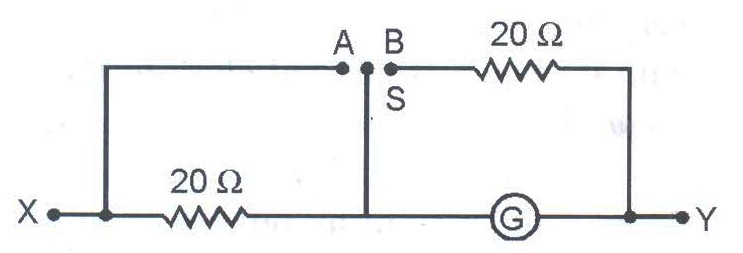
The galvanometer in the circuit shown here has a resistance of 20\(\Omega\)The terminals X and Y are connected to a cell of e.m.f. 1.5V and internal resistance 10\(\Omega\) Calculate the current flowing in the galvanometer:
(i) When the switch S is in position.
(ii) When the switch S is in position B.
3.
(i) State the principle of working of a potentiometer.
(ii) In the following potentiometer circuit AB is a uniform wire of length 1 m and resistance 10 \(\Omega \) .Calculate the potential gradient along the wire and balance length AO (= l).
4.
Raghav lives in an area where birds in large groups play around producing pleasing humming sounds. One day he notices that the high power lines soon after a strong wind have come too close which may prove fatal for the birds that would sit on them and flutter their wings for some reason or other. He complained to the authorities and the lines were set at the proper distance once again.
(1) What are the values possessed by Raghav and the authorities?
(2) What is the danger that could happen to the innocent birds in Raghav's view?
5.
The unknown resistance of a conductor can be determined by Wheatstone bridge. The standard form of Wheatstone bridge is shown in the figure. It can be shown when the bridge is balanced.
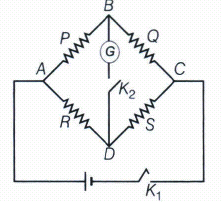
\(\frac { P }{ Q } =\frac { R }{ S } \quad or\quad S=\frac { Q }{ P } R\)
Knowing P,Q and R, unknown resistance S can be calculated.
Read the above passage and answer the following questions.
(i) Name any two applications of Wheatstone bridge.
(ii) What is the practical utility of the post office box in day to day life?
6.
Establish the relation between current and drift velocity.
7.
(a) State Ohm's law.
(b) Define resistance. Give its SI unit.
8.
(a) Define electric current. What is its S.I. unit? Is it a scalar or a vector quantity? What is the direction of electric current?
(b) How many electrons flowing per second should flow to produce a current of 1A?
9.
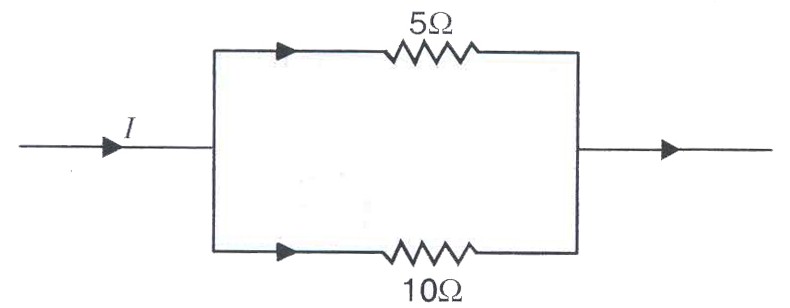
In the arrangement of resistors shown here, what fraction of I will pass through 5\(\Omega\) resistor?
1.
Kirchhoff's law is based on conservation of charge and the fact that there is no accumulation of charges at a junction.
2.
(i) If S is in position A, the resistance 20 Ω short-circuited.
\(\therefore I_{g}=\frac{1.5}{20+10}=0.05 \mathrm{~A}\)
(ii) If S is in position B, circuit will be as shown in the
Now, \(
I=\frac{1.5}{20+10+20 \| 20}
\)
\(I=\frac{1.5}{20+10+10}=\frac{1.5}{40} \mathrm{~A}
\)
∴ Reading of galvanometer \(=\frac{I}{2}=0.01875 \mathrm{~A}\)
3.
(i) When constant current flows through a conductor of uniform area of cross-section ,the potential difference, across a length l of the wire, is directly proportional to that length of the wire.[\(V\propto l\)] (provided current and area are constant]
(ii) Current flowing in the potentiometer wire
\(i=\frac { E }{ { R }_{ total } } =\frac { 2.0 }{ 15+10 } =\frac { 2 }{ 25 } A\)
∴Potential difference across the two ends of the wire
\({ V }_{ AB }=\frac { 2 }{ 25 } \times 10V=\frac { 20 }{ 25 } =0.8volt\)
Hence potential gradient K = \(\frac { { V }_{ AB } }{ { l }_{ AB } } =\frac { 0.8 }{ 1.0 } =0.8\frac { V }{ m } \)
Current flowing in the circuit containing experimental cell, = \(\frac { 1.5 }{ 1.2+0.3 } =1A\)
Hence, potential difference across length AO of the wire \(=0.3\times 1V=0.3V\)
\(\Rightarrow \) \(0.3=K\times { l }_{ AO }\)
\(=0.8\times { l }_{ AO }\)
\(\Rightarrow \)\({ l }_{ AO }=\frac { 0.3 }{ 0.8 } m=0.375m\)
\(=\) 37.5cm
4.
(1) Raghav: affection towards birds, taking appropriate action. Authorities: duty conscious.
(2) The bird may get electrocuted; avoid sparking as shown in the diagrams below:
5.
(i) Post office box and meter bridge are two electrical appliances based on the principal of Wheatstone bridge.
(ii) The post office box is used practically in post and telegraph department to locate the snapping of telephone line.
The broken telephone line will touch the ground. Using post office box, resistance S of broken line is determined.
As resistance per unit length of line is known, the length of broken line can be calculated. Therefore, snapping of line is located.
6.
Consider that a wire of length l and area of cross-section A be subjected to an electric field of strength E.
If V = Potential difference applied across the end of the wire,
\(E=\frac { V }{ l } or \ V=El\)
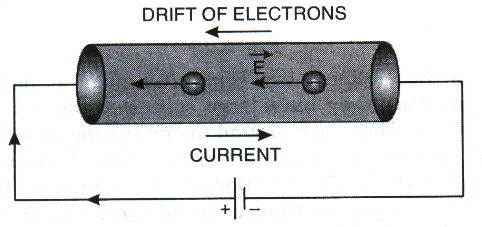
Let n = number of free electrons per unit volume of the conductor
\({ v }_{ d }\) = drift velocity of electrons charge flowing through the conductor wire,
q = nAle
Time taken by the electrons to cross the conductor,
\(t=\frac { Distance\quad }{ Velocity } =\frac { 1 }{ { v }_{ d } } \)
\( Current \ I=\frac { charge }{ time } =\frac { nAle }{ \frac { l }{ { v }_{ d } } } \)
7.
It states that current flowing through a conductor is proportional to the potential difference across its two ends provided the physical conditions of the conductor remain unchanged.
If V is the potential difference between two ends of a conductor and I is the current flowing through it, then
\(V\alpha I\)
\(V=RI\)
Where R is the constant of proportionality and is called the resistance of the conductor. Its value depends upon
(i) Shape of the conductor
(ii) Length of conductor
(iii) Nature of the material
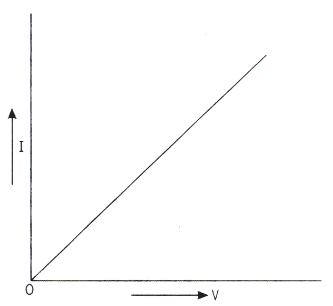
If a graph is plotted between V and I, the graph will be a straight line passing through the origin.
(b) Resistance is the property of a material by virtue of which it opposes the flow of current through it and quantitatively it is given by,
\(R=\frac { V }{ I }\)
\( =\frac { Potential \ difference }{ Current } \)
definition of ohm
Hence a conductor has a resistance of one ohm if a current of one ampere flows through it when a potential difference of one volt is maintained across its two ends.
8.
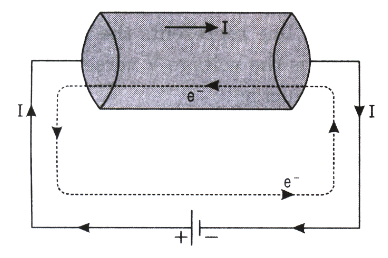
(a) Electric current: The flow of charge in a definite direction constitutes the electric current and the rate of flow of charge through any cross-section of a conductor is the measure of current i.e.,
\(=\frac { Total \ charge \ flowing \ (q) }{ Time \ taken \ (t) } \)
If dq charge is flowing through a section of a conductor in time dt, the electric current is given by
\(I=\frac { dq }{ dt } \)
Unit of electric current S.I unit of current is ampere. It is also called the practical unit of current. It is denoted by A,
\(1 \ ampere(A)=\frac { 1 \ coulomb }{ 1 \ second } = \ 1C{ s }^{ -1 }\)
Thus the current through a wire is said to be 1 ampere if one coulomb of charge is flowing per second through a section of the wire.
Current is a scalar quantity, the direction of flow of positive charges is considered as a conventional direction of the current.
In solids, positive charges being heavy do not move and currently is due to free electrons, therefore, the conventional direction of current is opposite to electronic current.
\(I=\frac { q }{ t } =\frac { ne }{ t } \)
\(n=\frac { It }{ e } =\frac { 1\times 1 }{ 1.6\times { 10 }^{ -19 } } \)
\(=6.25\times { 10 }^{ 18 }electrons \ per \ second.\)
9.
I1 = 2 I 3

12th Standard CBSE Syllabus & Materials
12th Standard CBSE
CBSE 12th Computer Science Python Revision Tour I - New Previous year Question Papers Study Material - QB365 Set A
NEW12th Standard CBSE
CBSE 12th Business Studies Planning Important Questions And Answers Study Material - QB365 Set A
NEW12th Standard CBSE
CBSE 12th Business Studies Business Environment Important Questions And Answers Study Material - QB365 Set A
NEW12th Standard CBSE
CBSE 12th Business Studies Principles of Management Important Questions And Answers Study Material - QB365 Set A



CBSE 12th Standard CBSE Subjects
CBSE Standards










