
 100% FREE ACCESS
12th Standard CBSE Syllabus & Materials
12th Standard CBSE
CBSE 12th Economics Government Budget and the Economy Previous year Question Papers Study Material - QB365 Set A
NEW12th Standard CBSE
CBSE 12th Computer Science Interface Python with MySQL - New Previous year Question Papers Study Material - QB365 Set A
NEW12th Standard CBSE
CBSE 12th Computer Science Database Concept - New Previous year Question Papers Study Material - QB365 Set A
NEW12th Standard CBSE
CBSE 12th Computer Science Data Communication - New Previous year Question Papers Study Material - QB365 Set A
NEW12th Standard CBSE
CBSE 12th Computer Science Data Structures - New Previous year Question Papers Study Material - QB365 Set A
NEW12th Standard CBSE
CBSE 12th Computer Science Functions - New Previous year Question Papers Study Material - QB365 Set A

Published on: 30/09/2019
Current Electricity
Download CBSE Class 12th Standard CBSE Physics question papers, sample papers, important questions, and previous year solved papers in PDF format. Get free study materials, NCERT solutions, and exam preparation resources for Class 12th Standard CBSE Physics
Questions + Answers key
Take MCQ Physics Test
1.
A silver wire has a resistance of 2.1\(\Omega\) at 27.5oC and a resistance of 2.7\(\Omega\) at 100oC. Determine the temperature coefficient of resistivity of silver.
2.
Current flowing through a wire varies with time t in second as I = (2t + 4) A. How much charge passes through a cross section of the wire in 2 sec?
3.
Ramaniamma was a childless window. She ran her life only by the pension for the Sr. citizens from the Government. When she switches ON one bulb in her house, all the other appliances get switched OFF. She could not even spend for an electrician. Sujatha living nearby decided to do something for her. She referred to Physics books and learned that the series combination for the household connection could be the reason. She called an electrician and had the circuit changed to parallel combination. The problem was solved and Ramaniamma was happy. She thanked Sujatha for her help to solve the problem.
Read the above passage and answer the following questions.
(i) What are the values possessed by Sujatha?
(ii) Why a parallel combination is used for household? Give two advantages.
4.
Define the term resistivity and write its S.I. unit. Derive the expression for the resistivity in terms of number density of free electrons and relaxation time.
5.
Establish the relation between current and drift velocity.
6.
How will you establish the electrons carry current?
7.
(a) State Ohm's law.
(b) Define resistance. Give its SI unit.
8.
A storage battery of emf 8.0 V and internal resistance 0.5 \(\Omega\) is being charged by a 120V dc supply using a series resistor of 15.5 \(\Omega\). What is the terminal voltage of the battery during charging? What is the purpose of having a series resistor in the charging circuit?
1.
Temperature, T1 = 27.5°C
Resistance of the silver wire at T1, R1 = 2.1 Ω
Temperature, T2 = 100°C
Resistance of the silver wire at T2, R2 = 2.7 Ω
Temperature coefficient of silver = α
It is related with temperature and resistance as
\(\alpha=\frac{R_{2}-R_{1}}{R_{2}\left(T_{2}-T_{1}\right)}\)
\(=\frac{2.7-2.1}{2.1(100-27.5)}=0.0039^{\circ} \mathrm{C}^{-1}\)
Therefore, the temperature coefficient of silver is 0.0039°C−1.
2.
Given: \(I=(2 t+4) \mathrm{A}\)
As we know dq = Idt
\(
\Rightarrow \ q=\int(2 t+4) d t
\)
\(q=\left(2 \cdot \frac{t^{2}}{2}+4 t\right)
\)
\(\text { At } t=2 \mathrm{~s}, q=2 \cdot \frac{4}{2}+4.2=12 \mathrm{C}
\)
3.
(i) Care for elderly people, empathy, willingness to gain knowledge.
(ii) A parallel circuit can run several devices using the full voltage.
The two advantages are as follows:
(a) If one appliance fails, then others can run normally.
(b) If one of the device shorts, the other devices will receive no voltage preventing overload damage.
4.
Since drift velocity \({ v }_{ d }\) and current, I flowing in a conductor are related by the relation:
\({ v }_{ d }=\frac { I }{ neA } ......(1)\)
Also drift velocity in terms of average relaxation time τ is given by
\({ v }_{ d }=\frac { eE\tau }{ m } .....(2)\)
From (1) and (2), we have
\(\frac { eE\tau }{ m } =\frac { I }{ neA }\)
\( \\ or\quad \frac { E }{ I } =\frac { m }{ n{ e }^{ 2 }A\tau } \)
\(or\quad \frac { V }{ lI } =\frac { m }{ n{ e }^{ 2 }A\tau }\)
\(or\quad \frac { V }{ I } =\frac { ml }{ n{ e }^{ 2 }A\tau } .......(3)\)
The R.H.S. of Eq(3) is constant
\(\frac { V }{ I } = \ Constant\)
This is Ohm′s law
\((But \ \frac { V }{ I } =R,\ \)the resistance of the conductor)
So Equation (3) becomes
\(R=\frac { ml }{ n{ e }^{ 2 }A\tau }\)
\(But\quad R=\rho \frac { l }{ A } \)
\(\therefore \quad \rho \frac { l }{ A } =\frac { ml }{ n{ e }^{ 2 }A\tau }\)
\(\rho =\frac { m }{ n{ e }^{ 2 }A\tau } )\)
5.
Consider that a wire of length l and area of cross-section A be subjected to an electric field of strength E.
If V = Potential difference applied across the end of the wire,
\(E=\frac { V }{ l } or \ V=El\)
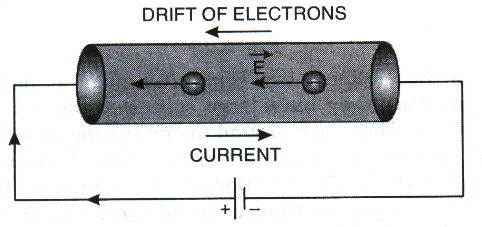
Let n = number of free electrons per unit volume of the conductor
\({ v }_{ d }\) = drift velocity of electrons charge flowing through the conductor wire,
q = nAle
Time taken by the electrons to cross the conductor,
\(t=\frac { Distance\quad }{ Velocity } =\frac { 1 }{ { v }_{ d } } \)
\( Current \ I=\frac { charge }{ time } =\frac { nAle }{ \frac { l }{ { v }_{ d } } } \)
6.
To establish that electrons carry current in a conductor, the \(\left( \frac { e }{ m } \right) \) of charge is measured from its angular momentum.
Let r = radius of circular loop
n = no. of electrons per unit length
I = strength of current flowing through the loop
v = drift velocity of charge flowing in the conductor
No.of charges flowing per unit length of the loop
= (nv)
If e = charge on each charged particle or current carrierTotal charge flowing per sec through any cross-section
= (nv) e
This is called current I = (nv) e
When charged particle goes along a circular loop its angular momentum is given by
L = mvr
Total angular momentum due to all current carriers is
L = (mvr)n = m(nv) r
\(L=m\times \frac { I }{ e } r\)
\( L=I\left( \frac { m }{ e } \right) r\)
\(\left( \frac { e }{ m } \right) \) can be measured by measuring L, I and r.
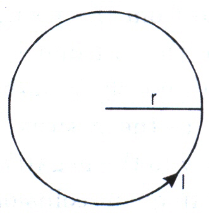
The angular momentum is measured by relating it to the twist produced in a suspension from which loop is hung. On reversing the direction of current, a twist is produced in suspension due to sudden change in angular momentum.
The value of twist depends upon the angular momentum.
It was found that \(\left( \frac { e }{ m } \right) \) determined by this experiment corresponds to electron from other experiment.
It thus experimentally established that current in metal is carried by negatively charged ions.
7.
It states that current flowing through a conductor is proportional to the potential difference across its two ends provided the physical conditions of the conductor remain unchanged.
If V is the potential difference between two ends of a conductor and I is the current flowing through it, then
\(V\alpha I\)
\(V=RI\)
Where R is the constant of proportionality and is called the resistance of the conductor. Its value depends upon
(i) Shape of the conductor
(ii) Length of conductor
(iii) Nature of the material
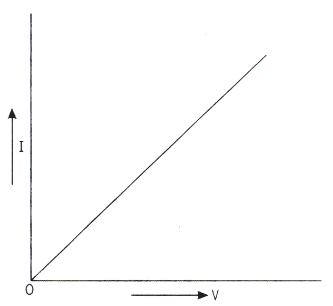
If a graph is plotted between V and I, the graph will be a straight line passing through the origin.
(b) Resistance is the property of a material by virtue of which it opposes the flow of current through it and quantitatively it is given by,
\(R=\frac { V }{ I }\)
\( =\frac { Potential \ difference }{ Current } \)
definition of ohm
Hence a conductor has a resistance of one ohm if a current of one ampere flows through it when a potential difference of one volt is maintained across its two ends.
8.
Emf of the storage battery, E = 8.0 V
Internal resistance of the battery, r = 0.5 Ω
DC supply voltage, V = 120 V
Resistance of the resistor, R = 15.5 Ω
Effective voltage in the circuit = V1
R is connected to the storage battery in series. Hence, it can be written as
V1 = V - E
V1 = 120 - 8 = 112 V
Current flowing in the circuit = I, which is given by the relation,
\(I=\frac{V^{1}}{R+r}\)
\(=\frac{112}{15.5+5}=\frac{112}{16}=7 A\)
Voltage across resistor R given by the product, IR = 7 x 15.5 = 108.5 V
DC supply voltage = Terminal voltage of battery + Voltage drop across R
Terminal voltage of battery = 120 - 108.5 = 11.5 V
A series resistor in a charging circuit limits the current drawn from the external source. The current will be extremely high in its absence. This is very dangerous.

12th Standard CBSE Syllabus & Materials
12th Standard CBSE
CBSE 12th Computer Science Python Revision Tour I - New Previous year Question Papers Study Material - QB365 Set A
NEW12th Standard CBSE
CBSE 12th Business Studies Planning Important Questions And Answers Study Material - QB365 Set A
NEW12th Standard CBSE
CBSE 12th Business Studies Business Environment Important Questions And Answers Study Material - QB365 Set A
NEW12th Standard CBSE
CBSE 12th Business Studies Principles of Management Important Questions And Answers Study Material - QB365 Set A



CBSE 12th Standard CBSE Subjects
CBSE Standards










