
 100% FREE ACCESS
12th Standard CBSE Syllabus & Materials
12th Standard CBSE
CBSE 12th Economics Government Budget and the Economy Previous year Question Papers Study Material - QB365 Set A
NEW12th Standard CBSE
CBSE 12th Computer Science Interface Python with MySQL - New Previous year Question Papers Study Material - QB365 Set A
NEW12th Standard CBSE
CBSE 12th Computer Science Database Concept - New Previous year Question Papers Study Material - QB365 Set A
NEW12th Standard CBSE
CBSE 12th Computer Science Data Communication - New Previous year Question Papers Study Material - QB365 Set A
NEW12th Standard CBSE
CBSE 12th Computer Science Data Structures - New Previous year Question Papers Study Material - QB365 Set A
NEW12th Standard CBSE
CBSE 12th Computer Science Functions - New Previous year Question Papers Study Material - QB365 Set A

Published on: 23/09/2019
Dual Nature of Radiation and Matter
Download CBSE Class 12th Standard CBSE Physics question papers, sample papers, important questions, and previous year solved papers in PDF format. Get free study materials, NCERT solutions, and exam preparation resources for Class 12th Standard CBSE Physics
Questions + Answers key
Take MCQ Physics Test
1.
In an experiment on photoelectric effect, the slope of the cut off voltage versus frequency of incident light is found to be \(4.12\times { 10 }^{ -15 }V-s\). Calculate the value of Plank's constant.
2.
M1 and M2 represent the masses of \(_{ 10 }{ { Ne }^{ 20 } }\)nucleus and \(_{ 20 }{ { Ca }^{ 40 } }\) nucleus respectively. State whether M2=2M1 or M2>2M1 or M2<2M1
3.
The binding energies per nucleon for deuteron and helium are 1.1 MeV and 7.0 MeV respectively. What would be the energy released when two deuterons fuse to form a helium nucleus?
4.
Calculate packing fraction of \(\alpha -particle\) from the following data:
\({ m }_{ \alpha }=4.0028a.m.u\)
\( { m }_{ p }=1.00758a.m.u.\)
\( { m }_{ n }=1.00897a.m.u.\)
5.
The wavelength of a photon is \(1.4\mathring { A } \) .It collides with an electron. Its wavelength after collision is \(4\mathring { A } \) . Calaculate the energy of scattered electron.
6.
The de-Broglie wavelength associated with a material particle when it is accelerated through a potential difference of 150 V is \(1\mathring { A } \)What will be the de-Broglie wavelength associated with the same particle when it is accelerated through a potential difference of 1350 V?
7.
The minimum light intensity that can be perceived by the eye is about \({ 10 }^{ -10 }{ Wm }^{ -2 }\)Find the number of photons of wavelength \(5.84\times { 10 }^{ -7 }m\)that must enter the pupil, of area \({ 10 }^{ -4 }{ m }^{ 2 }{ s }^{ -1 }\) for vision.
8.
The electric field associated with a monochromatic beam of light becomes zero, \(2.4\times { 10 }^{ 15 }\) times per second. Find the maximum kinetic energy of the photoelectrons when this light falls on a metal surface whose work function is 2.0eV, h=\(6.63\times { 10 }^{ -34 }Js\)
9.
Two particles A and B of de-Broglie wavelength \({ \lambda }_{ 1 } \ and \ { \lambda }_{ 2 }\) combine to form a particle C. The process conserves momentum. Find the de-Broglie wavelength of the particle C.(The motion is one dimensional).
10.
Define the term:
(a) (i)Work function
(ii) threshold frequency and
(iii) stopping potential with reference to photoelectric effect
(b) Calculate the maximum kinetic energy of electrons emitted from a photosensitive surface of work function 3.2 eV for the incident radiation of wavelength 300 nm.
11.
A 100W sodium lamp radiates energy uniformly in all directions.The lamp is located at the centre of a large sphere that absorbs all the sodium light which is incident on it.The wavelength of the sodium light is 589nm.
(a) What is energy associated per photon with the sodium light?
(b) At what rate are the photons delivered to the sphere?
12.
Answer the following question.
(a) Quarks inside protons and neutrons are thought to carry fractional charges \(\left( +\frac { 2 }{ 3 } e,-\frac { 1 }{ 3 } e \right) .\) Why do they not show up in Millikan's oil drop experiment?
(b) What is so special about the combination elm? Why do we not simply talk of e and \(m\) specially?
(c) Why should gases be insulators at ordinary pressure and start conducting at very low pressure.
(d) Every metal has a definite work function, Why do photoelectrons not come out all with same energy if incident radiations is monochromatic?Why is there an energy distribution of photoelectrons?
(e) The energy and momentum of an electron are related to the frequency and wavelength of the associated matter wave by the relations : \(E=hv,p=\frac { h }{ \lambda } \)
But while the value of \(\lambda \) is physically significant, the value of \(v\) (and therefore the value of the phase speed \(v\lambda \)) has no physical significance. Why?
13.
Estimating the following two numbers should be interesting. The first number will tell you why radio engineers do not need to worry much about photons. The second number tells you why our eye can never count photons,even in barely detectable light.
(a) The number of photons emitted per second by an MW transmitter of 10 kW power emitting radio waves of wavelength 500 m.
(b) The number of photons entering the pupil of our eye per second corresponding to the minimum intensity of while light that we humans can perceive (\(\sim \)\({ (10 }^{ -10 }Wm^{ -2 })\). Take the area of the pupil to be white light to be about 0.4 cm2 and the average frequency of white light to be about 6 x 10¹⁴ Hz.
1.
Given, slope of graph, tan \(\theta\) = 4.12 \(\times\) 10-15 V-s
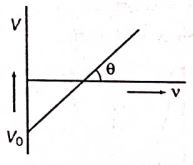
Charge on electron, e = 1.6 \(\times\)10-19 C
Slope of graph of cut off voltage versus frequency is tan \(\theta=\frac{V}{v}\)
We know that, bv = eV or \(\frac{V}{v}=\frac{b}{e}\)
\(\begin{aligned}
\therefore & \frac{h}{e}=4.12 \times 10^{-15}
\end{aligned}\)
\(\begin{aligned}
\Rightarrow & h=1.6 \times 10^{-19} \times 4.12 \times 10^{-15}
\end{aligned}\)
\(\begin{aligned}
=6.592 \times 10^{-34} \mathrm{~J}-\mathrm{s}
\end{aligned}\)
2.
M2>2M1
3.
23.6 MeV.
4.
\(7.58\times { 10 }^{ -3 }a.m.u./N\)
5.
\(9.23\times { 10 }^{ -16 }J\)
6.
(1/3)\(\mathring { A } \)
7.
\(3\times { 10 }^{ 4 }photons\)
8.
Given, \(\phi_{0}=2.0 \mathrm{eV} ; h-6.63 \times 10^{-34} \mathrm{~J}-\mathrm{s}, \mathrm{KE}_{\max }-?\)
In one complete vibration twice the electric field becomes zero, so the frequency of incident light is given by
\(\mathrm{V}=\frac{1}{2} \times 2.4 \times 10^{15}=1.2 \times 10^{15} \mathrm{~Hz}\)
Hence, maximum kinetic energy,
\(\mathrm{KE}_{\max }=h v-\phi_{0}=\frac{6.63 \times 10^{-34} \times 1.2 \times 10^{15}}{1.6 \times 10^{-19}}-2=2.97 \mathrm{eV}\)
9.
From law of conservation of momentum
\(\left| p \right| =\left| { p }_{ A } \right| +\left| { p }_{ B } \right| \)
or \(\frac { h }{ { \lambda }_{ c } } =\frac { h }{ \lambda _{ A } } +\frac { h }{ \lambda _{ B } } \)
or \({ \lambda }_{ c }=\frac { { \lambda }_{ A }{ \lambda }_{ B } }{ { \lambda }_{ A }{ +\lambda }_{ B } } \)
(i) If \({ p }_{ A }>0,{ p }_{ B }>0\)
\({ \lambda }_{ c }=\frac { { \lambda }_{ A }{ \lambda }_{ B } }{ { \lambda }_{ A }+{ \lambda }_{ B } } \)
(ii) \({ p }_{ A }<0,{ p }_{ B }<0\)
\({ \lambda }_{ c }=\frac { { (-\lambda }_{ A })(-{ \lambda }_{ B }) }{ -{ \lambda }_{ A }-{ \lambda }_{ B } } \)
(iii) \({ p }_{ A }>0,{ p }_{ B }<0\)
\({ \lambda }_{ c }=\frac { { \lambda }_{ A }(-{ \lambda }_{ B }) }{ { \lambda }_{ A }-{ \lambda }_{ B } }\)
\(=\frac { { \lambda }_{ A }-{ \lambda }_{ B } }{ -{ \lambda }_{ B }-{ \lambda }_{ A } } \)
(iv) \({ p }_{ A }<0,{ p }_{ B }<0\)
\({ \lambda }_{ c }=\frac { { (\lambda }_{ A }){ \lambda }_{ B } }{ { \lambda }_{ A }+{ \lambda }_{ B } } \)
\(\\ =\frac { { \lambda }_{ A }{ \lambda }_{ B } }{ -{ \lambda }_{ A }-{ \lambda }_{ B } } \)
10.
0.9 eV
11.
Power of the sodium lamp, P = 100 W
Wavelength of the emitted sodium light, λ = 589 nm = 589 x 10−9 m
Planck’s constant, h = 6.626 x 10⁻³⁴ Js
Speed of light, c = 3 x 10⁸ m/s
(a)The energy per photon associated with the sodium light is given as:
\(E=h \frac{c}{\lambda}\)
\(=\frac{6.626 \times 10^{-34} \times 3 \times 10^{8}}{589 \times 10^{-9}}=3.37 \times 10^{-19} \mathrm{~J}\)
\(=\frac{3.37 \times 10^{-19}}{1.6} \times 10^{-19}=2.11 \mathrm{eV}\)
(b) Number of photons delivered to the sphere = n
The equation for power can be written as:
P = nE
\(\therefore n=\frac{P}{E}\)
\(=\frac{100}{3.37 \times 10^{-19}}=2.96 \times 10^{20} \text { photons/s }\)
Therefore, every second, 2.96 x 10²⁰ photons are delivered to the sphere.
12.
(a) Quarks inside protons and neutrons carry fractional charges. This is because nuclear force increases extremely if they are pulled apart. Therefore, fractional charges may exist in nature; observable charges are still the integral multiple of an electrical charge.
(b) The basic relations for electric field and magnetic field are \(\left(e V=\frac{1}{2} m v^{2}\right) \text { and }\left(e B v=\frac{m v^{2}}{r}\right)\)respectively.
These relations include e (electric charge), v (velocity), m (mass), V (potential), r(radius), and B (magnetic field). These relations give the value of velocity of an electron as \(\left(v=\sqrt{2 v\left(\frac{e}{m}\right)}\right. \text { and }\left(v=B r\left(\frac{e}{m}\right)\right)\) respectively.
(c) At atmospheric pressure, the ions of gases have no chance of reaching their respective electrons because of collision and recombination with other gas molecules. Hence, gases are insulators at atmospheric pressure. At low pressures, ions have a chance of reaching their respective electrodes and constitute a current. Hence, they conduct electricity at these pressures.
(d) The work function of a metal is the minimum energy required for a conduction electron to get out of the metal surface. All the electrons in an atom do not have the same energy level. When a ray having some photon energy is incident on a metal surface, the electrons come out from different levels with different energies. Hence, these emitted electrons show different energy distributions.
(e) The absolute value of energy of a particle is arbitrary within the additive constant. Hence, wavelength (λ) is significant, but the frequency (ν) associated with an electron has no direct physical significance. Therefore, the product νλ (phase speed) has no physical significance.
Group speed is given as:
\(V_{G}=\frac{d v}{d k} \)
\(=\frac{\mathrm{d} \mathrm{v}}{d\left(\frac{1}{\lambda}\right)}=\frac{\mathrm{d} \mathrm{E}}{\mathrm{dp}}=\frac{d\left(\frac{p^{2}}{2} m\right)}{\mathrm{dp}}=\frac{p}{m}\)
This quantity has a physical meaning.
13.
(a) Power of the medium wave transmitter, P = 10 kW = 104 W = 104 J/s
Hence, energy emitted by the transmitter per second, E = 104
Wavelength of the radio wave, λ = 500 m
The energy of the wave is given as:
\(E_{1}=\frac{\mathrm{hc}}{\lambda}\)
Where,
h = Planck’s constant = 6.6 x 10⁻³⁴ Js
c = Speed of light = 3 x 10⁸ m/s
\(\therefore E_{1}=\frac{6.6 \times 10^{-34} \times 3 \times 10^{8}}{500}=3.96 \times 10^{-28} \mathrm{~J}\)
= 3 x 10 31
The energy (E1) of a radio photon is very less, but the number of photons (n) emitted per second in a radio wave is very large.
The existence of a minimum quantum of energy can be ignored and the total energy of a radio wave can be treated as being continuous.
(b)Intensity of light perceived by the human eye, I = 10−10 W m−2
Area of a pupil, A = 0.4 cm2 = 0.4 x 10⁻⁴ m2
Frequency of white light, ν= 6 x 10¹⁴ Hz
The energy emitted by a photon is given as:
E = hν
Where,
h = Planck’s constant = 6.6 x 10⁻³⁴ Js
∴ E = 6.6 x 10−34 x 6 x 1014
= 3.96 x 10⁻¹⁹ J
Let n be the total number of photons falling per second, per unit area of the pupil.
The total energy per unit for n falling photons is given as:
E = n x 3.96 x 10⁻¹⁹ J s−1 m−2
The energy per unit area per second is the intensity of light.
∴ E = I
n x 3.96 x 10−19 = 10−10
\(n=\frac{10^{-10}}{3.96 \times 10^{-19}}\)
= 2.52 x 10⁸ m2 s−1
The total number of photons entering the pupil per second is given as:
nA = n x A
= 2.52 x 108 x 0.4 x 10−4
= 1.008 x 10⁴ s−1
This number is not as large as the one found in problem (a), but it is large enough for the human eye to never see the individual photons.

12th Standard CBSE Syllabus & Materials
12th Standard CBSE
CBSE 12th Computer Science Python Revision Tour I - New Previous year Question Papers Study Material - QB365 Set A
NEW12th Standard CBSE
CBSE 12th Business Studies Planning Important Questions And Answers Study Material - QB365 Set A
NEW12th Standard CBSE
CBSE 12th Business Studies Business Environment Important Questions And Answers Study Material - QB365 Set A
NEW12th Standard CBSE
CBSE 12th Business Studies Principles of Management Important Questions And Answers Study Material - QB365 Set A



CBSE 12th Standard CBSE Subjects
CBSE Standards










