
 100% FREE ACCESS
12th Standard CBSE Syllabus & Materials
12th Standard CBSE
CBSE 12th Economics Government Budget and the Economy Previous year Question Papers Study Material - QB365 Set A
NEW12th Standard CBSE
CBSE 12th Computer Science Interface Python with MySQL - New Previous year Question Papers Study Material - QB365 Set A
NEW12th Standard CBSE
CBSE 12th Computer Science Database Concept - New Previous year Question Papers Study Material - QB365 Set A
NEW12th Standard CBSE
CBSE 12th Computer Science Data Communication - New Previous year Question Papers Study Material - QB365 Set A
NEW12th Standard CBSE
CBSE 12th Computer Science Data Structures - New Previous year Question Papers Study Material - QB365 Set A
NEW12th Standard CBSE
CBSE 12th Computer Science Functions - New Previous year Question Papers Study Material - QB365 Set A

Published on: 03/10/2019
Electromagnetic Induction and Alternating Currents
Download CBSE Class 12th Standard CBSE Physics question papers, sample papers, important questions, and previous year solved papers in PDF format. Get free study materials, NCERT solutions, and exam preparation resources for Class 12th Standard CBSE Physics
Questions + Answers key
Take MCQ Physics Test
1.
A circuit containing 80 mH inductor and a \(60\mu F\) capacitor in series is connected to a 230 V, 50 Hz supply. The resistance in the circuit is negligible.
(i) Obtain the current amplitude and rms value.
(ii) Obtain tha rms value of potential drop across each element.
(iii) What is the average power transferred to inductor?
(iv) What is the average power transferred to capacitor?
(v) What is the total average power absorbed by the circuit?
2.
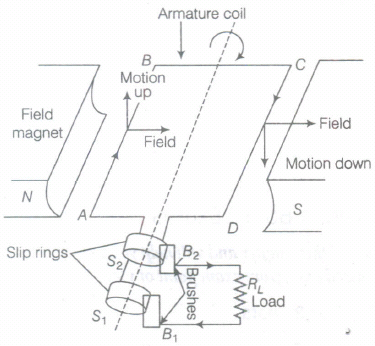
Ram is a student of class X in a village school. His uncle gifted him a bicycle with a dynamo fitted in it. He was very excited to get it. While cucling during night, he could light the bulb and see the objects on the road. He, however did not know how this device works. He asked this question to his teacher. The teacher considered it an opportunity to explain the working to the whole class.
Answer the following questions:
(i) State the principle and working of a dynamo.
(ii) Write two values each displayed by Ram and his shool teacher.
3.
Lenz's law gives us the direction of current induced in a circuit. According to this law, the polarity of induced e.m.f. is always such that is opposes the change in megnetic flux responsible for its production. It means if e.m.f. induced is such as to oppose the increase in magnetic flux. The reverse is also true.
Read the above passage and answer the following questions:
(i) Does Lenz's law violate the principle of conservation of energy?
(ii) Name any other rule for finding the direction of induced current.
(iii) What does Lenz's law imply in day to day life?
4.
What do you mean by quality factor or Q value of resonance circuit?
5.
What are conservative and non-conservative fields?
6.
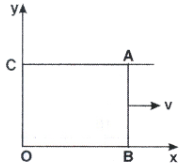
A magnetic field \(\overrightarrow { B } ={ B }_{ 0 }\sin { \left( \omega t \right) } \hat { k } \) covers a large region where a wire AB slides smoothly over two parallel conductors separated by a distance d. The wires are in the x-y plane. The wire AB (of length d) has resistance R and the parallel wires have negligible resistance. If AB is moving with velocity v. what is the current in the circuit. What is the force needed to keep the wire moving at constant velocity?
7.
Distinguish between reactance and impedance. When a series combination of a coil of inductance L and a resistor of resistance R is connected across a 12 V, 50 Hz supply, a current of 0.5 A flows through the circuit. The current differs in phase from applied voltage by \(\frac { \pi }{ 3 } \) radian. Calculate the value of L and R.
1.
Given,
\(L=80mH=80\times { 10 }^{ -3 }H, \ R=0, \ v=50Hz\)
\(C=60\mu F=60\times { 10 }^{ -6 }F,\)
\(\omega =2\pi v=100\pi \ rad/s \)
\({ V }_{ rms }=230 \ V,\)
and \(\\ { V }_{ 0 }=\sqrt { 2{ V }_{ rms } } =\sqrt { 2 } \times 230V\)
(i) I0 = ? and Irms = ?
\(\begin{aligned} \Rightarrow I_0 & =\frac{V_0}{Z}=\frac{V_0}{\left|\omega L-\frac{1}{\omega C}\right|} \\ \end{aligned}\)
\(\begin{aligned} & =\frac{230 \sqrt{2}}{\left|100 \pi \times 80 \times 10^{-3}-\frac{1}{100 \pi \times 60 \times 10^{-6}}\right|} \\ \end{aligned}\)
\(\begin{aligned} =\frac{230 \sqrt{2}}{\left|8 \pi-\frac{1000}{6 \pi}\right|}=-11.63 \mathrm{~A} \\ \end{aligned}\)
\(\begin{aligned} I_{\mathrm{rms}} & =\frac{I_0}{\sqrt{2}}=\frac{-11.63}{\sqrt{2}}=8.23 \mathrm{~A} \end{aligned}\)
(ii) For L, VL = Irms \(\omega \)L = 8.23 \(\times\) 100\(\pi\)\(\times\)80 \(\times\)10-3
= 206.84 V
For C, \(V_C=I_{\mathrm{rms}} \frac{1}{\omega C}=8.23 \times \frac{1}{100 \pi \times 60 \times 10^{-6}}\)
= 436.84 V
Since, voltage across L and C are 180° out of phase, therefore they are subtracted.
Thus, applied rms voltage = 436.84 - 206.84
= 230.0 V
(iii) Average power transferred per cycle by source to inductor is always zero because of phase difference of \(\pi\)/2 between voltage and current through inductor.
(iv) Average power transferred per cycle by source to inductor is always zero because of phase difference of \(\pi\)/2 between voltage and current through inductor
(v) \(\therefore\) Total average power absorbed by the circuit is also zero.
2.
(i) Principle: When amount of magnetic flux linked with a coil changes, an e.m.f. is induced in the coil. The induced e.m.f. lasts so long as change in magnetic flux continues. The bulb fitted in the dynamo lights due to e.m.f. induced in the coil of dynamo. The bulb stops glowing when the cycle stops.
(ii) Ram showed the sprit of learning. He also thought how his classmates could benefit alongwith him. The teacher discharged his responsibility of explaning things to the entire class, encouraging them to learn new things.
3.
(i) No, Lenz's law does not violate the principle of cnservation of energy.
(ii) Fleming's Right hand rule is yet another rule for finding the induced current.
(iii) In day to day life, Lenz's law implies that you cannot get something out of nothing. When we do mechanical work in moving the magnet towards/away from the coil, we obtain electrical energy in the form of induced current/ e.m.f. The moment we stop moving the magney, induced current/ e.m.f. disappears. If we ignor stray losses, energy obtained is always equal to energy spent or work done.
4.
Quality factor
The quality factor of LCR-circuit is the ratio of the potential difference across inductance (or capacitance) at resonance to the applied voltage. This is also called the figure of merit or Q-value of LCR series circuit
i.e. \(Q=\frac { Voltage \ across(L\ or\ C) }{ Voltage\ applied } \)
At resonance
Voltage across \(L=I{ X }_{ L }\)
Voltage across \(C=I{ X }_{ C }\)
Voltage applied = Voltage drop across \(R=IR\)
5.
Consider a closed loop in which a current is flowing. The fact that a current is flowing implies of course that an electric field E exists along the loop. Small amount of work done in moving a unit charge through dl is given by \(-\overrightarrow { E } .\overrightarrow { d } l\)
When the work is done in taking unit charge along the entire closed loop is emf \(=\oint { \overrightarrow { E } .\overrightarrow { d } l } \)
\(e=\oint { \overrightarrow { E } .\overrightarrow { d } l } \)
\(\therefore \oint { \overrightarrow { E } .\overrightarrow { d } l } =-\frac { d\phi }{ dt } =e\)
\(So\oint { \overrightarrow { E } .\overrightarrow { d } l } \neq 0\)
Such fields are called non-conservative fields.
\(-\oint { \overrightarrow { E } .\overrightarrow { d } l } =-\frac { d\phi }{ dt } ,\) ....(1)
where \(\phi \) is the flux across the loop
Consider in contrast, an electric field caused by a charge at rest. If we take a unit charge from point a to point b, such field have the property that the work done
\({ W }_{ ab }=-\int _{ a }^{ b }{ \overrightarrow { E } .\overrightarrow { d } l } \) ....(2)
is independent of the path taken from a to b. If charge is taken along a closed path
\(\oint { \overrightarrow { E } .\overrightarrow { d } l } =0\) ....(3)
This last equation is different from (2). The electric fields created by changing magnetic field thus have a somewhat different character compared to electric fields due to stationary charges.
The field where the closed line integral of electric field is zero \(\left( \oint { \overrightarrow { E } .\overrightarrow { d } l } =0 \right) \) is called conservative field.
6.
Motional emf in \(AB=\left( { B }_{ 0 }\sin { \omega t } \right) d\upsilon .\left( -\hat { j } \right) \)
The direction of motional emf is along y-axis as per Fleming's right-hand rule.
At time t, the wire AB covers a distance \(x=\upsilon t\)
E.M.F. due to change in magnetic field (along OBAC)
\(=-{ B }_{ 0 }\omega \left( \cos { \omega t } \right) x.d\)
Total emf induced, \(e=-{ B }_{ 0 }d\left[ \omega .x.\cos { \omega t+\upsilon \sin { \omega t } } \right] \)
Induced current \(I=\frac { { B }_{ 0 }d }{ R } \left[ \omega x\cos { \omega t+\upsilon \sin { \omega t } } \right] \)
Since the direction of the induced current is clockwise i.e. along OBAC hence the -ve sign is absorbed.
Force needed along \(\hat { i } ,F=BIl\)
or \(F=\frac { { B }_{ 0 }^{ 2 }{ d }^{ 2 } }{ R } \left[ \omega x\cos { \omega t+\upsilon \sin { \omega t } } \right] \sin { \omega t } \)
7.
0.066 H, \(12\Omega \)

12th Standard CBSE Syllabus & Materials
12th Standard CBSE
CBSE 12th Computer Science Python Revision Tour I - New Previous year Question Papers Study Material - QB365 Set A
NEW12th Standard CBSE
CBSE 12th Business Studies Planning Important Questions And Answers Study Material - QB365 Set A
NEW12th Standard CBSE
CBSE 12th Business Studies Business Environment Important Questions And Answers Study Material - QB365 Set A
NEW12th Standard CBSE
CBSE 12th Business Studies Principles of Management Important Questions And Answers Study Material - QB365 Set A



CBSE 12th Standard CBSE Subjects
CBSE Standards










