
 100% FREE ACCESS
12th Standard CBSE Syllabus & Materials
12th Standard CBSE
CBSE 12th Economics Government Budget and the Economy Previous year Question Papers Study Material - QB365 Set A
NEW12th Standard CBSE
CBSE 12th Computer Science Interface Python with MySQL - New Previous year Question Papers Study Material - QB365 Set A
NEW12th Standard CBSE
CBSE 12th Computer Science Database Concept - New Previous year Question Papers Study Material - QB365 Set A
NEW12th Standard CBSE
CBSE 12th Computer Science Data Communication - New Previous year Question Papers Study Material - QB365 Set A
NEW12th Standard CBSE
CBSE 12th Computer Science Data Structures - New Previous year Question Papers Study Material - QB365 Set A
NEW12th Standard CBSE
CBSE 12th Computer Science Functions - New Previous year Question Papers Study Material - QB365 Set A

Published on: 21/09/2019
Electromagnetic Induction and Alternating Currents
Download CBSE Class 12th Standard CBSE Physics question papers, sample papers, important questions, and previous year solved papers in PDF format. Get free study materials, NCERT solutions, and exam preparation resources for Class 12th Standard CBSE Physics
Questions + Answers key
Take MCQ Physics Test
1.
Define the term self-inductance of a solenoid. Obtain the expression for the magnetic energy stored in an inductor of self-inductance L to build up a current I through it.
2.
A charged 30\(\mu \)F capacitor is connected to a 27mH inductor. What is the angular frequency of free oscillations of the circuit?
3.
Obtain the resonant frequency \(\left( { \omega }_{ r } \right) \) of a series LCR circuit with L=2.0H, C = 32\(\mu\)F and R=10 ohm. What is the Q value of this circuit?
4.
A 100 resistor is connected to a 220V, 50Hz ac supply.
(a) What is the rms value of current in the circuit?
(b) What is the net power consumed over a full cycle?
5.
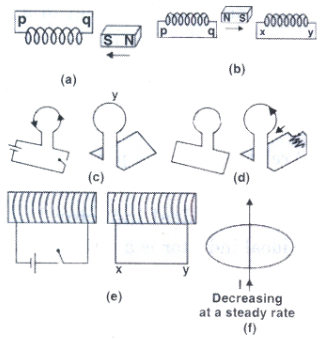
Predict the direction of induced current in the situations described by the following Fig.
6.
What is an ideal inductor?
7.
Define the term self inductance. Write two factors on which the self inductance of a coil depends.
8.
Explain why the coils of the resistance box are wound over themselves.
9.
A \(100\mu F\) capacitor in series with a \(40\Omega \) is connected to a 110 V, 60 Hz supply.
(a) What is the maximum current in the circuit?
(b) What is the time lag between the current maximum and the voltage maximum?
1.
Self-inductance of the solenoid is the flux associated with the solenoid when the unit amount of a current passes through it.
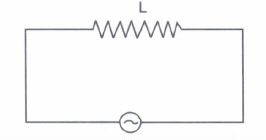
Consider a solenoid of self-inductance L, length e, area of cross-section A.
Let alternating voltage
ε = ε0 sin ωt applied across it, and back emf induced.
∴ e = -L \(\frac { dI }{ dt } \)
⇒ dL = \(\frac { e }{ L } \) dt
Small amount of work done i.e
dW = eI dt
Total work done
W = \(\int { el\ dt } \)
= \(\int _{ 0 }^{ 1 }{ LI\ dI\ =\frac { 1 }{ 2 } } \)
This work done will be stored in the form of magnetic energy in inductor
U = \(\frac { 1 }{ 2 } \) LI2
2.
Capacitance, C = 30μF = 30 × 10−6F
Inductance, L = 27 mH = 27 × 10−3 H
Angular frequency is given as:
\({ \omega }_{ r }=\frac { 1 }{ \sqrt { LC } } =\frac { 1 }{ \sqrt { 27\times { 10 }^{ -3 }\times 30\times { 10 }^{ -6 } } } =\frac { { 10 }^{ 4 } }{ 9 } =1.1\times { 10 }^{ 3 }rad/s\)
Hence, the angular frequency of free oscillations of the circuit is 1.11 × 10³ rad/s.
3.
\(Here, \ L=2.0H, \ C=32\mu F=32\times { 10 }^{ -6 }F \ and \ R=10ohm, \ { \omega }_{ r }=?, \ Q=?\)
\({ \omega }_{ r }=\frac { 1 }{ \sqrt { LC } } =\frac { 1 }{ \sqrt { 2.0\times 32\times { 10 }^{ -6 } } } =\frac { { 10 }^{ 3 } }{ 8 } =125rad/s\)
\(\\ Q=\frac { 1 }{ R } \sqrt { \frac { L }{ C } } =\frac { 1 }{ 10 } \sqrt { \frac { 2.0 }{ 32\times { 10 }^{ -6 } } } =\frac { { 10 }^{ 3 } }{ 40 } =25\)
4.
\(Here, \ R=100\Omega , \ { E }_{ v }=220V, \ v=50Hz\)
\((a) \ { I }_{ v }=?, \ { I }_{ v }=\frac { { E }_{ v } }{ R } =\frac { 220 }{ 100 } =2.2A\)
\((b) \ Net \ power \ consumed \ over \ a \ full \ cycle,\)
\(P={ E }_{ v }{ I }_{ v }=220\times 2.2=484W\)
5.
(a) According to Lenz's law south pole develops at q, current induced must be clockwise at q.
\(\therefore \) In the coil, induced current is from p to q.
(b) Coil pq in this case would develop S-pole at q and coil xy would also develop S pole at x. Therefore, induced current in the coil pq will be from y to x.
(c) Induced current in the right loop will be along xyz.
(d) Induced current in the left loop will be along xyz.
(e) Induced current in the right coil is from x to y.
(f) No induced current since fixed lines lie in the plane of the loop.
6.
An ideal inductor is a coil consisting of large number of turns wound in such a way that magnetic flux linked with it due to current passing through it is confined to a small region only. The ohmic resistance of such a coil is zero.
7.
Self-inductance is the phenomenon of production of opposing emf in a coil. When the current through the coil changes. The self-inductance depends upon
(i) size of coil (area of cross-section and number of turns/length).
(ii) Relative magnetic permeability of the core of the coil on which winding is done.
8.
They are wound over themselves to reduce the back emf. The current in the two limbs of the coil flows in opposite directions and so the net flux linked with the coil continues to be nearly zero, and no back emf is produced.
9.
(a) Io = 3.23A
(b) 1.55ms

12th Standard CBSE Syllabus & Materials
12th Standard CBSE
CBSE 12th Computer Science Python Revision Tour I - New Previous year Question Papers Study Material - QB365 Set A
NEW12th Standard CBSE
CBSE 12th Business Studies Planning Important Questions And Answers Study Material - QB365 Set A
NEW12th Standard CBSE
CBSE 12th Business Studies Business Environment Important Questions And Answers Study Material - QB365 Set A
NEW12th Standard CBSE
CBSE 12th Business Studies Principles of Management Important Questions And Answers Study Material - QB365 Set A



CBSE 12th Standard CBSE Subjects
CBSE Standards










