
 100% FREE ACCESS
12th Standard CBSE Syllabus & Materials
12th Standard CBSE
CBSE 12th Economics Government Budget and the Economy Previous year Question Papers Study Material - QB365 Set A
NEW12th Standard CBSE
CBSE 12th Computer Science Interface Python with MySQL - New Previous year Question Papers Study Material - QB365 Set A
NEW12th Standard CBSE
CBSE 12th Computer Science Database Concept - New Previous year Question Papers Study Material - QB365 Set A
NEW12th Standard CBSE
CBSE 12th Computer Science Data Communication - New Previous year Question Papers Study Material - QB365 Set A
NEW12th Standard CBSE
CBSE 12th Computer Science Data Structures - New Previous year Question Papers Study Material - QB365 Set A
NEW12th Standard CBSE
CBSE 12th Computer Science Functions - New Previous year Question Papers Study Material - QB365 Set A

Published on: 15/09/2018
Model Question Paper
Download CBSE Class 12th Standard CBSE Physics question papers, sample papers, important questions, and previous year solved papers in PDF format. Get free study materials, NCERT solutions, and exam preparation resources for Class 12th Standard CBSE Physics
Questions + Answers key
Take MCQ Physics Test
1.
A dc supply of 120V is connected to a large resistance X. A voltmeter of resistance 10k\(\Omega\)placed in series in the circuit reads 4V. What is the value of X? What so you think is the purpose in using a voltmeter instead of an ammeter to determine the large resistance X?
2.
Rajesh has an old two wheeler. One day he wanted to start his two wheeler but he could not do so. He observed carefully and found that its battery was defective. Then he arranged 6 V dry cell battery but it was also unable to start two wheeler. Then his friend Mahesh came and suggested him that this battery will not work because its internal resistance is more and it cannot give a desired current of 30 A which is required for starting the two wheelers. As per his suggestion, Rajesh got fitted a lead acid battery of 6 V and his problem was solved.
(a) According to you, what values were displayed by Mahesh?
(b) The storage battery of a car has an emf 12 V. If the internal resistance of the battery is 0.4 Ω, what is the maximum current that can be drawn from the battery?
3.
Kumaran wanted to pay electricity bill that day. He realized that the consumption shown by the meter was unbelievably low. He thought that the -meter must have been faulty. He wanted to check the meter. But unfortunately, he did not have any idea as to how to do this. There came his friend Subhash to help him. He told Kumaran to run only the electric heater rated 1kW in his house for some time keeping other appliances switched off. He also calculated the power consumed in kilowatt hour and compared the value with the meter. Kumaran as happy and thanked Subhash for his timely help and the knowledge.
(1) What are the values displayed by the friends?
(2) Express kWh in joules. Find the resistance of the heater.
4.
The unknown resistance of a conductor can be determined by Wheatstone bridge. The standard form of Wheatstone bridge is shown in the figure. It can be shown when the bridge is balanced.
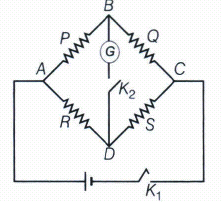
\(\frac { P }{ Q } =\frac { R }{ S } \quad or\quad S=\frac { Q }{ P } R\)
Knowing P,Q and R, unknown resistance S can be calculated.
Read the above passage and answer the following questions.
(i) Name any two applications of Wheatstone bridge.
(ii) What is the practical utility of the post office box in day to day life?
5.
That night Vaikunth was preparing for his physics exam. Suddenly, the light in his room went off and he could not continue his studies. His cousin brother Vasu who had come to visit him was quick to react. Vasu using the torch (an android application) installed in his mobile phone found that the fuse had blown out. He checked the wiring and located a short circuit. He checked the wiring and located a short circuit. He rectified it and put a fuse wire. The light came to life again. Vaikunth had a sign of releif and continued his studies.
Read the above passage and answer the following question.
(i) What are the values projected by Vaikunth and Vasu?
(ii) Why did Vasu have to check the wiring?
(iii) What is an electric fuse? What characteristics you would prefer for a fuse wire?
6.
A current of 500 \(\mu A\) deflects the coil of a moving coil galvanometer through 60o . What should be the current to cause the rotation through \(\pi /5\) radian ? What is the sensitivity of galvanometer ?
7.
The current sensitivity of a moving coil galvanometer increases by 20% when its resistance is increased by a factor does the voltage sensitivity change ?
8.
A rectangular coil of area 5.0 x 10⁻⁴ m2 and 60 turns is pivoted about one of its vertical sides. The coil is in a radial horizontal field of 90 G (radial here means the field lines are in the plane of the coil for any rotation). What is the torsional constant of the hair springs connected to the coil, if a current of 2.0 mA produces an angular deflection of 18o?
9.
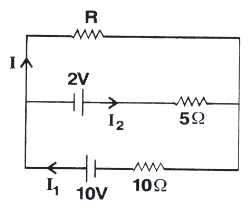
Two cells of voltages 10V and 2V and internal resistances \(10\Omega\ and\ 5\Omega \) respectively are connected in parallel with the positive end of 10V battery connected to negative pole of 2V battery. Find the effective voltage and effective resistance of the combination.
10.
A heating element using nichrome connected to a 230 V supply draws an initial current of 3.2 A which settles after a few seconds to a steady value of 2.8 A. What is the steady temperature of the heating element if the room temperature is \({ 27.0 }^{ \circ }C\)? Temperature coefficient of resistance of nichrome averaged over the temperature range involved is \(1.70\times { 10 }^{ -4\circ }{ C }^{ -1 }\)?
11.
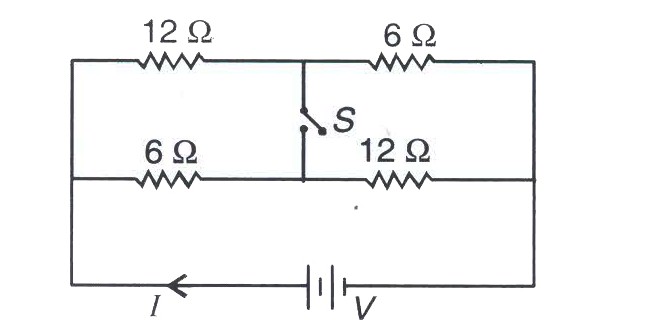
With switch S open the network of resistors shown here drawn a current I from the battery. How many times will this current become on closing the switch S?
12.
Two nichrome wires are connected in series with a battery. The length of nichrome wires are in the ratio of 1:2 whereas their resistance are in the ratio 2:1. Find the following
(a) ratio of their diameters
(b) ratio of drift velocity of free electrons in them.
13.
Distinguish between emf (\(\varepsilon \)) and terminal voltage (V) of a cell having internal resistance 'r'. Draw a plot showing the variation of terminal voltage (V) vs the current (I) drawn from the cell. Using this plot, how does one determine the internal resistance of the cell?
14.
AB is a potentiometer wire as shown in figure. If the value of R is increased, in which direction will the balance point J shift?

15.
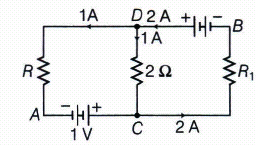
In the given circuit, assuming point A to be at zero potential, use Kirchhoff,s rules to determine the potential at point B.

16.
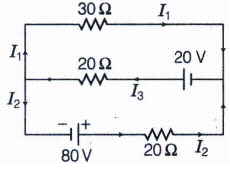
Use Kirchhoff,s rules to determine the value of the current I1 flowing in the circuit shown in the figure.
17.
Three identical resistors, each of resistance R, when connected in series with a d.c. source, dissipate power X. If the resistors are connected in parallel to the same d.c. source, how much power will be dissipated?
18.
What are superconductors? Write their two applications.
19.
Thermistors differ from ordinary resistors. Explain.
20.
Define the units of conductance and conductivity. Give their dimensional formulae.
21.
While making a standard resistance, the coil is made of manganin. The coil is double folded and is wound over a non-conducting frame. Why?
22.
Currents of the order of 0.1 A through the human body are fatal. What causes the death: heating of the body due to electric current or something else?
23.
What is the order of magnitude of the resistance of a (dry) human body?
24.
It is easier to start a car engine on a warm day than on a chilly day. Why?
25.
A 4 \(\Omega\) non-insulated resistance wire is bent in the middle by 180o and both the halves are twisted with each other. What will be its new resistance?
26.
How can you keep a constant current inside a conductor?
27.
What conclusion can you draw from the following observations on a resistor made of alloy manganin:
| Current (in A) | Voltage (in V) | Current (in A) | Voltage(in V) |
| 0.2 | 3.94 | 3.0 | 59.2 |
| 0.4 | 7.87 | 4.0 | 78.2 |
| 0.6 | 11.8 | 5.0 | 98.6 |
| 0.8 | 15.7 | 6.0 | 118.5 |
| 1.0 | 19.7 | 7.0 | 138.2 |
| 2.0 | 39.4 | 8.0 | 158.0 |
28.
The work done in turning a magnet of magnetic moment M by an angle of \({ 90 }^{ ° }\) from the magnetic meridian is n times the corresponding work done to turn it through an angle of \({ 60 }^{ ° },\) where n is
1/2
2
1/4
1.
29.
A magnetic needle lying parallel to a magnetic field requires W units of work to turn it through \({ 60 }^{ ° }.\) The torque required to keep the needle in this position will be
2 W
W
\(\frac { W }{ \sqrt { 2 } } \)
\(\frac { W }{ \sqrt { 3 } } \)
\(\sqrt { 3 } W\)
30.
If a copper wire carries a direct current, the magnetic field associated with the current will be
only outside the wire
only inside the wire
both inside and outside the wire
neither inside nor outside the wire
31.
A positive charge is moving towards an observer. The direction of magnetic induction lines is
clockwise
anticlockwise
right
left
32.
The magnetic field at a perpendicular distance of 2 cm from an infinite straight current carrying conductor is 2x10⁻⁶ T. The current in the wire is
0.1 A
0.2 A
0.4 A
0.8 A
1.
Reading of voltmeter = 4 V, Resistance of voltmeter \(=10^{4} \Omega\)
Current drawn by the voltmeter, \(I=\frac{4}{10^{4}}=4 \times 10^{-4} \mathrm{~A}\)
Again, \(I=\frac{E}{X+10^{4}}\)
\(
\Rightarrow \left(X+10^{4}\right) I =E
\)
\(\therefore X I =E-I \times 10^{4}
\)
\(\Rightarrow X =\frac{E}{I}-10^{4}=\frac{120}{4 \times 10^{-4}}-10^{4}
\)
\(\therefore X =29 \times 10^{4} \Omega=290 \mathrm{k} \Omega
\)
2.
(a) (i) Presence of mind.
(ii) High degree of general awareness.
(iii) Helping and caring nature. 2
(b) For maximum current, external resistance,
R = 0
\(I=\frac{E}{R+r}=\frac{12}{0.4}=\frac{12}{0.4}=30A\)
3.
(1) Honesty, sharing of knowledge, willingness to help.
(2) 1 kWh = 3.6 x 10⁶ J,R = V2/P = 48.45Ω
4.
(i) Post office box and meter bridge are two electrical appliances based on the principal of Wheatstone bridge.
(ii) The post office box is used practically in post and telegraph department to locate the snapping of telephone line.
The broken telephone line will touch the ground. Using post office box, resistance S of broken line is determined.
As resistance per unit length of line is known, the length of broken line can be calculated. Therefore, snapping of line is located.
5.
(i) Acknowledging the help from others with gratitude. Awareness of the technology, helping tendency, practical knowledge of the subject.
(ii) Vasu checked the wiring because he has practical knowledge and he can rectify the problem.
(iii) An electric fuse is a wire used as a safety device, which melts when current exceeds the limit. Fuse wire has low melting point, high resistivity
6.
Here, I1 = 500\(\mu A\) = 500 x 10-6 A,
\({ \theta }_{ 1 }={ 60 }^{ o },{ I }_{ 2 }=?,{ \theta }_{ 2 }=\frac { \pi }{ 5 } rad.=\frac { { 180 }^{ o } }{ 5 } ={ 36 }^{ o }\)
\({ I }_{ 1 }=\frac { k }{ nBA } { \theta }_{ 1 }\) and \({ I }_{ 2 }=\frac { k }{ nBA } { \theta }_{ 2 }\)
\(\therefore \frac { { I }_{ 2 } }{ { I }_{ 1 } } =\frac { { \theta }_{ 2 } }{ { \theta }_{ 1 } } or\)
\({ I }_{ 2 }=\frac { { \theta }_{ 2 } }{ { \theta }_{ 1 } } { I }_{ 1 }=\frac { 36 }{ 60 } \times 500\times { 10 }^{ -6 }=300\times { 10 }^{ -6 }\quad A\)
Current sensitivity \(=\frac { { \theta }_{ 2 } }{ { I }_{ 2 } } =\frac { 36^{ o } }{ 300\times { 10 }^{ -6 } } \)
= 0.12 x 10⁻⁶ degree/A = 0.12 degree/\(\mu A\)
7.
Given, \({ I' }_{ s }={ I }_{ s }+\frac { 20 }{ 100 } { I }_{ s }=\frac { 120 }{ 100 } { I }_{ s }\)
\(R'=2R\)
Then, initial voltage sensitivity, \({ V }_{ s }=\frac { { I }_{ s } }{ R } \)
New voltage sensitivity,
\({ V' }_{ s }=\frac { { I' }_{ s } }{ R' } =\left( \frac { 120 }{ 100 } { I }_{ s } \right) \times \frac { 1 }{ 2R } =\frac { 3 }{ 5 } { V }_{ s }\)
% decrease in voltage sensitivity
\(=\frac { { V }_{ s }-{ V' }_{ s } }{ { V }_{ s } } \times 100=\frac { { V }_{ s }-\frac { 3 }{ 5 } { V }_{ s } }{ { V }_{ s } } \times 100\)
= 40%
8.
Here, A = 5.0 x 10⁻⁴m2, n = 60 ;
B = 90 G = 90 x 10-4 T, K = ?
I = 2.0 mA = 2.0 x 10⁻³ A, \(\theta \) =18o,
As, \(I=\frac { k }{ nBA } \theta \)
\(\therefore k=\frac { nBAI }{ \theta } \)
\(=\frac { { 60\times 90\times 10 }^{ -4 }\times 5.0{ \times 10 }^{ -4 }\times 2.0\times { 10 }^{ -3 } }{ 18 } \)
= 3.0 x 10⁻⁹ Nm per degree
9.
From Kirchhoff's junction rule, we have
\( { I }_{ 1 }={ I }+{ I }_{ 2 }\) ...........(i)
Applying Kirchhoff's loop rule to outer loop containing 10V cell, we get
\(10=IR+{ 10I }_{ 1 }\) ............(ii)
Applying Kirchhoff's loop rule to outer loop containing 2V cell, we get
\(2={ 5I }_{ 2 }-RI\)
\(2=5\left( { I }_{ 1 }-I \right) -RI\)
\(4={ 10I }_{ 1 }-10I-2RI\)
Subtracting eq (ii) from eq (i), we get
\(6=3RI+10I\)
\(2=I\left( R+\frac { 10 }{ 3 } \right) \)
From Ohm's law, we have
\(V=I\left( R+{ R }_{ off } \right) \)
Comparing eq (iii) and (iv), we get
\({ R }_{ ef }=\frac { 10 }{ 3 } \Omega \)
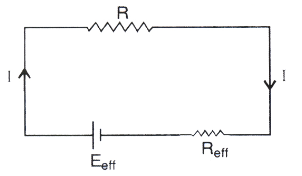
If \({ E }_{ eff }\) and \({ R }_{ eff }\) are the effective voltage and effective internal resistance of the combination, then the equivalent circuit is shown.
10.
Given, potential difference = 230 V
Initial current at 27°C = I27°C = 3.2 A
Final current at t°C = It°C = 2.8 A
Room temperature = 27°C
Temperature coefficient of resistance, \(\alpha=1.70 \times 10^{-4}{ }^{\circ} \mathrm{C}^{-1}\)
Resistance at 27°C, R27°C\(=\frac{V}{I_{27^{\circ} \mathrm{C}}}=\frac{230}{3.2}=\frac{2300}{32} \Omega\)
Resistance at t°C, Rt°C = \(\frac{V}{I_{t^{\circ} \mathrm{C}}}=\frac{230}{2.8}=\frac{2300}{28} \Omega\)
Temperature coefficient of resistance
\(\begin{aligned} \alpha & =\frac{R_t-R_{27}}{R_{27}(t-27)} \end{aligned}\)
\(\begin{aligned} \Rightarrow 1.70 \times 10^{-4} & =\frac{\frac{2300}{28}-\frac{2300}{32}}{\frac{2300}{32}(t-27)} \\ \end{aligned}\)
\(\begin{aligned} \text { or } \quad t-27 & =\frac{82.143-71.875}{71.875 \times 1.70 \times 10^{-4}}=840.347 \end{aligned}\)
or t = 840.3 + 27 = 867.3 °C
Thus, the steady temperature of heating element is 867.3 °C
11.
When key is open, then
\(
R_{e q}=(12+6) \|(6+12)=9 \Omega
\)
\(\therefore I_{1}=\frac{V}{9}
\)
When key is closed, then
\(
R_{e q \boldsymbol{x}} =(12 \| 6)+(6 \| 12)=8 \Omega
\)
\(
I_{2} =\frac{V}{8}
\)
\(\therefore \ \frac{I_{2}}{I_{1}} =\frac{V}{8} \times \frac{9}{V}
\)
\(I_{2}=\frac{9}{8} I_{1}, \text { i.e. current becomes } \frac{9}{8} \text { times. }\)
12.
Here, \(\frac{l_{1}}{l_{2}}=\frac{1}{2} \text { and } \frac{R_{1}}{R_{2}}=\frac{2}{1}\)
(a) \(
R =\rho \frac{l}{A}
\)
\(\frac{R_{1}}{R_{2}} =\frac{l_{1}}{l_{2}} \cdot \frac{A_{2}}{A_{1}}=\frac{l_{1}}{l_{2}} \cdot\left(\frac{d_{2}}{d_{1}}\right)^{2}
\)
here, d is the diameter.
\(
\Rightarrow \ \frac{d_{2}}{d_{1}}=\sqrt{\frac{R_{1}}{R_{2}} \times \frac{l_{2}}{l_{1}}}=\sqrt{2 \times 2}=\frac{2}{1}
\)
\(d_{1}: d_{2} =1: 2
\)
(b) \(v_{d}=\frac{e V}{m l} \tau=\frac{e I R}{m l} \tau\)
\(\frac{v_{d_{1}}}{v_{d_{2}}}=\frac{R_{1}}{R_{2}} \cdot \frac{l_{2}}{l_{1}}=\frac{2}{1} \times \frac{2}{1}=4: 1\)
13.
Difference between emf (\(\varepsilon \)) and terminal voltage (V)
| emf | terminal voltage |
|---|---|
| It is the potential difference between two terminals of the cells when no current is drawn from it. |
It is the potential difference between two terminals when current passes through it. |
| It is the cause, | It is the effect. |
(Anyone) or any other relevant difference
Negative of slope gives internal resistance
14.
As, the value of R is increased, the current flowing in the circuit will decrease. And the potential gradient, i.e. potential drop per unit length also decreases, so that the balance length will increase. Thus, J will shift towards B.
15.
By Kirchhoff's first law at D,
\({ I }_{ DC }=1A\) \([\because { I }_{ Dc }+1=2]\)
Along ACDBA,
\({ V }_{ A }+1+1\times 2-2={ V }_{ B }\) (VA = 0)
But, \({ V }_{ B }=1+2-2=1V\)
\({ V }_{ B }=1V\)
16.
According to the question,
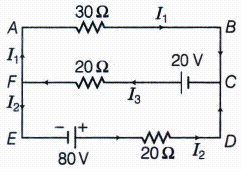
Applying Kirchhoff's junction rule at F,
I3 = \({ I }_{ 1 }\) +\({ I }_{ 2 }\) ......(i)
Applying Kirchhoff's second rule in loop ABCF,
-30I1+ 20-20I3 = 0
\(\Rightarrow \) 3I1+2I3 = 2 ....(ii)
In loop ABDE,
-30I1+20I2 - 80 =0
3I1 + 2I2 = 8 ......(iii) (1)
From Eqs. (i) and (ii), we have
3I1+ 2I1 + 2I2 = 2
\(\Rightarrow \) 5I1 + 2I2 = 2 .....(iv)
On subtracting Eq. (iii) from Eq. (iv), we get
8I1 = -6
\(\Rightarrow \)I1 = -\(\frac { 3 }{ 4 } \) A (1)
17.
Let V be the emf of the d.c. source in volt. \(R \ \Omega\) be the resistance of each resistor.
In series, total resistance = R + R + R = 3 R
Power dissipated = \(\frac{V^2}{3R}=X \ \ or \ \ \frac{V^2}{R}=3X\)
In parallel, total resistance, R' is given by
\(\frac{1}{R'}=\frac{1}{R}+\frac{1}{R}+\frac{1}{R}=\frac{3}{R} \ or \ \ R'=R/3\)
Power dissipated = \(\frac{V^2}{R'}=\frac{V^2}{R/3}=\frac{3V^2}{R}\)
= 3 x 3 x = 9
18.
As the temperature of certain metals and alloys decreases, their resistance also decreases. When the temperature reaches a certain critical value called critical temperature, the resistance of material completely disappears, i.e., it becomes zero. Then the material behaves as a superconductor.
Thus superconductors are those material conductors whose resistances disappear at critical temperature. The critical temperature is different materials.
Superconductors are used
(i) in power transmission
(ii) to produce very high speed computers.
19.
A thermistor differs from an ordinary resistance in the following ways.
(i) The resistivity and hence the resistance of the thermistor changes very rapidly with change of temperature.
(ii) The temperature coefficient of resistivity of the thermistor is very high.
(iii) The temperature coefficient of resistivity of the thermistor can be both, positive and negative.
20.
The units of conductance and conductivity are simen (denoted by S) and simen metre -1 (denoted by S m-1) respectively. We know that conductance = 1/resistance.
We know, electrical conductivity, \(\sigma = \frac{1}{\rho}=\frac{l}{RA}\)
If l = 1 m, R = 1 \(\Omega\), A = 1 m2 then \(\sigma\) = 1 S m-1
Thus 1 S m-1 is the electrical conductivity of a conductor of length 1 m, area of cross-section 1 m2 and resistance 1 \(\Omega\) or conductance 1S.
Dimensional formula of conductance,
\(G=\frac{1}{R}=\frac{1}{V}=\frac{[A]}{[ML^2T^{-3}A^{-1}]}=[M^{-1}L^{-2}T^{3}A^2]\)
Dimensional formula of conductivity,
\(\sigma=[M^{-1}L^{-3}T^3A^2]\)
21.
For manganin, the temperature coefficient of resistance is very low. Due to it, the resistance of manganin wire remains almost unchanged with a change in temperature. The resistivity of manganin is high. Therefore, for making a standard resistance of the given value, the smaller length of wire is needed. It is due to these facts, the wire of manganin is used for making standard resistance coil. The coil is double folded on itself to avoid the inductive effect and it wound over the non-conducting frame in order to avoid the conductive effect and the leakage of current.
22.
The cause of death is not heating due to the current passing through a person. Though he may receive burns if the currents are too large. The cause of death is the interference of the external currents with our highly sensitive nervous system which is basically electrical in nature, which in turn affects the heart beating. Beyond a certain point, this interference becomes fatal.
23.
About \(10 kΩ.\) This resistance is mainly due to skin through which current enters and leaves our body.
24.
With an increase in temperature (i.e., on a warm day) the internal resistance of a car battery decreases. Due to it, the battery can supply large current which helps in starting the car engine easily.
25.
Here \(R=\frac{\rho l}{A}=4\)
\(R^{\prime}=\frac{\rho(l / 2)}{2 A}=\frac{\rho l}{4 A}=\frac{R}{4}=\frac{4}{4}=1 \Omega\)
26.
A constant current can be kept inside a conductor by maintaining a constant potential difference across the two ends of conductor.
27.
Here, Ohm's law is valid because ratio of voltage and for different readings is same.
Also,the resistivity of alloy manganin is nearly independent of temperature.
28.
(b)
2
29.
(e)
\(\sqrt { 3 } W\)
30.
(a)
only outside the wire
31.
(b)
anticlockwise
32.
(b)
0.2 A

12th Standard CBSE Syllabus & Materials
12th Standard CBSE
CBSE 12th Computer Science Python Revision Tour I - New Previous year Question Papers Study Material - QB365 Set A
NEW12th Standard CBSE
CBSE 12th Business Studies Planning Important Questions And Answers Study Material - QB365 Set A
NEW12th Standard CBSE
CBSE 12th Business Studies Business Environment Important Questions And Answers Study Material - QB365 Set A
NEW12th Standard CBSE
CBSE 12th Business Studies Principles of Management Important Questions And Answers Study Material - QB365 Set A



CBSE 12th Standard CBSE Subjects
CBSE Standards










