
 100% FREE ACCESS
12th Standard CBSE Syllabus & Materials
12th Standard CBSE
CBSE 12th Economics Government Budget and the Economy Previous year Question Papers Study Material - QB365 Set A
NEW12th Standard CBSE
CBSE 12th Computer Science Interface Python with MySQL - New Previous year Question Papers Study Material - QB365 Set A
NEW12th Standard CBSE
CBSE 12th Computer Science Database Concept - New Previous year Question Papers Study Material - QB365 Set A
NEW12th Standard CBSE
CBSE 12th Computer Science Data Communication - New Previous year Question Papers Study Material - QB365 Set A
NEW12th Standard CBSE
CBSE 12th Computer Science Data Structures - New Previous year Question Papers Study Material - QB365 Set A
NEW12th Standard CBSE
CBSE 12th Computer Science Functions - New Previous year Question Papers Study Material - QB365 Set A

Published on: 29/12/2018
12th NEET Based Problems
Download CBSE Class 12th Standard CBSE Physics question papers, sample papers, important questions, and previous year solved papers in PDF format. Get free study materials, NCERT solutions, and exam preparation resources for Class 12th Standard CBSE Physics
Questions + Answers key
Take MCQ Physics Test
1.
A charge of \(+2.0\times 10^{-8}C\) is placed on the positive plate and a charge of \(-1.0\times 10^{-8}C\) on the negative plate of a parallel plate capacitor of capacitance \(1.2\times 10^{-3}\mu F\). Calculate the potential difference between the plates.
2.
A solenoid coil of 300 turns/m is carrying a current of 5 A. The length of the solenoid is 0.5 m and has a radius of 1 cm. Find the magnitude of the magnetic field well inside the solenoid.
3.
A particle of mass 10-4kg and charge \(5\mu C\) is thrown at a speed of 20 m/s against a uniform electric field of strength \(2\times 10^5NC^{-1}\). How much distance will it travel before coming to rest momentarily?
4.
A parallel beam of light of 600nm falls on a narrow slit and the resulting diffraction patterns are observed on a screen 1.2m away. It is observed that the first minimum is at a distance of 3mm from the center of the screen. Calculate the width of the slit.
5.
If in a nuclear fusion reaction, mass defect is 0.3%, then find energy released in fusion of 1kg mass.
6.
Calculate the peak values of electric and magnetic fields produced by the radiation coming from a 100 watt bulb at a distance of 3 m. Assume that the efficiency of the bulb is 2.5% and it is a point source?
7.
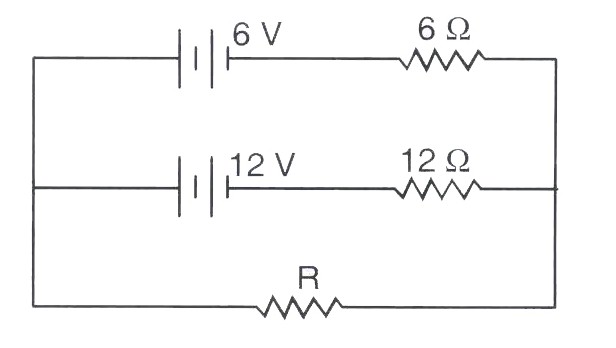
In the circuit diagram shown here what should be the value of R so that there is no current in the branch containing 6V battery?
8.
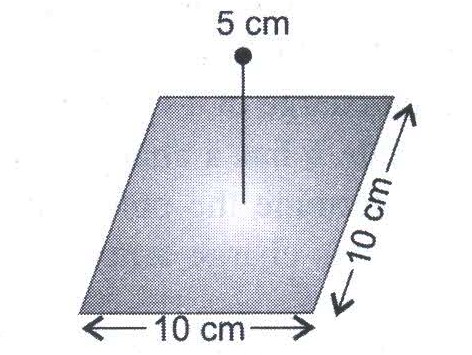
A point charge \(+10\mu \) is at a distance 5cm directly above the centre of square of side 10cm as shown in fig.What is the magnitude of the electric flux through the square?
9.
A proton placed in a uniform electric field of magnitude 2000N/C moves between two points in the direction of electric field. If the distance between the points is 0.2m, find the value of
(i) p.d between the points,
(ii) work done.
10.
Four point charge 10-8 C,\(−2×{{10}^{−8}}C\) and \(-4\times {{10}^{-8}}C\) and \(6\times {{10}^{-8}}C\) are placed at the four corners of a square of side \(2\sqrt { 2 }cm. \) Calculate the electric potential at the centre of square.
11.
What should be charge on a sphere of radius 2cm so that when it is brought in contact with another sphere of radius 5cm carrying a charge of \(10\mu C\), there is no net transfer of charge between the spheres?
12.
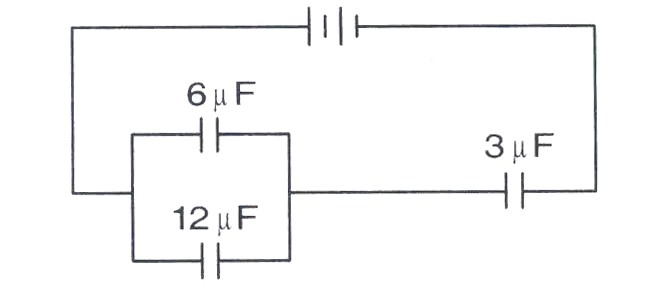
In the arrangement of capacitors shown here,the energy stored \(6\mu F\)capacitor is E. Find the following:
Energy stored in the \(12\mu F\) capacitor
Energy stored in the \(3\mu F\) capacitor
Total energy drawn from the battery.
1.
Here, \(q_1=2.0\times 10^{-8}C,\)
\(q_2=-1.0\times 10^{-8}C\)
\(C=1.2\times 10^{-3}\mu F=1.2\times 10^{-9}F, V=?\)
\(V={q_1-q_2\over 2C}={{2.0\times 10^{-8}}-(-1.0\times 10^{-8})\over2\times 1.2\times 10^{-9}}\)
=12.5 V
2.
n = 300 turns/m ;
I = 5 A ; l = 0.5 m, r = 10-2 m.
\({ B }={ \mu }_{ o }nI=\left( 4\pi \times { 10 }^{ -7 } \right) \times 300\times 5\)
= 1.9 x 10⁻³ T.
3.
Here, m = 10-4kg
\(q=5\mu C=5\times 10^{-6}C; v=20 ms^{-1}\)
E=\(2\times 10^5 N/C\)
Force on charged particle
\(F=qE=5\times 10^{-6}\times 2\times 10^5=1N\)
As particle is thrown against the field, so
\(a=-{F\over m}=-{1\over 10^{-4}}=-10^4m/s^2\)
From \(v^2-u^2=2as\)
\((0)^2-(20)^2=2(-10^4)s\)
s = 0.02m
4.
\(Here,\ \lambda =600nm=6\times { 10 }^{ -7 }m,\)
\( D=1.2m,\ n=1,\ x=3mm=3\times { 10 }^{ -3 }m,\ a=?\ \)
\(For \ first \ minimum, \ a \ sin\theta =n\lambda\)
\(a.\left( \frac { x }{ D } \right) =1\lambda\)
\( \\ a=\frac { \lambda D }{ x } =\frac { 6\times { 10 }^{ -7 }\times 1.2 }{ 3\times { 10 }^{ -3 } } =2.4\times { 10 }^{ -4 }m=0.24mm\)
5.
\(Here,\ \Delta m=0.3%(1kg)=\frac { 0.3 }{ 100 } kg\\ =3\times { 10 }^{ -3 }kg\\ E=(\Delta m){ c }^{ 2 }=(3\times { 10 }^{ -3 }){ \left( 3\times { 10 }^{ 8 } \right) }^{ 2 }\\ =27\times { 10 }^{ 13 }J\)%(1kg)
\(=\frac { 0.3 }{ 100 } kg\)
\(=3\times { 10 }^{ -3 }kg\)
\(E=(\Delta m){ c }^{ 2 }=(3\times { 10 }^{ -3 }){ \left( 3\times { 10 }^{ 8 } \right) }^{ 2 }\)
\(=27\times { 10 }^{ 13 }J\)
6.
Useful Intensity,
\(I=\frac { power }{ area } =\frac { 100\times \left( 2.5/100 \right) }{ 4\pi { \left( 3 \right) }^{ 2 } } =\frac { 2.5 }{ 36\pi } W{ m }^{ -2 }\)
Half of this intensity (I) belongs to electric field and half of that to magnetic field. Therefore,
\(\frac { I }{ 2 } =\frac { 1 }{ 4 } { \varepsilon }_{ 0 }{ E }_{ 0 }^{ 2 }c \ or \ { E }_{ 0 }=\sqrt { \frac { 2I }{ { \varepsilon }_{ 0 }c } } \)
\(=\sqrt { \frac { 2\times \left( 2.5/36\pi \right) }{ \left( \frac { 1 }{ 4\pi \times 9\times { 10 }^{ 9 } } \right) \times \left( 3\times { 10 }^{ 8 } \right) } } =4.08V{ m }^{ -1 }\)
\({ B }_{ 0 }=\frac { { E }_{ 0 } }{ c } =\frac { 4.08 }{ 3\times { 10 }^{ 8 } } =1.36\times { 10 }^{ -8 }T\)
7.
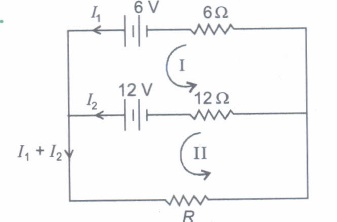
Applying KVL for loop I, we get
\(-6 I_{1}+12 I_{2}=6\) .....(i)
Applying KVL for loop II, we get
\(
R\left(I_{1}+I_{2}\right)+12 I_{2}=12
\)
\(R I_{1}+(R+12) I_{2}=12\) ..........(ii)
Putting I1 = 0, we get \(12 I_{2}=6 \Rightarrow I_{2}=\frac{1}{2} \mathrm{~A}\)
Putting \(I_{2}=\frac{1}{2} \mathrm{~A} \text { and } I_{1}=0 \text { in (ii), }\)
\(
(12+R) \frac{1}{2} =12
\)
\(\Rightarrow \ R =12 \Omega\)
8.
\(1.88\times {{10}^{5}}\)Nm2C-1
9.
(i) -400V
(ii) \(6.4\times {{10}^{-17}} J\)
10.
\(4.5\times {{10}^{3}}V\)
11.
\(4\mu C\)
12.
Energy stored in 6 μF capacitor = E
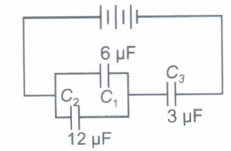
\( \therefore \ \frac{1}{2} C_{1} V_{1}^{2}=E \Rightarrow V_{1}^{2}=\frac{2 E}{C_{1}}=\frac{E}{3} \)
\(\because C_{1} \text { and } C_{2} \text { are in parallel, } \therefore V_{1}^{2}=V_{2}^{2}=\frac{E}{3} \)
Now, \(C_{12}=6+12=18 \mu \mathrm{F}\)
\( \therefore \text { Charge on } C_{12}=q_{12}=C_{12} . V_{12}=18 \times \sqrt{\frac{E}{3}} \)
\(\therefore \text { Charge on } C_{3}=q_{12}=18 \sqrt{\frac{E}{3}} \)
(a) Now, energy stored in 12 μF capacitor
\(=\frac{1}{2} C_{2} V_{1}^{2}=\frac{1}{2} \times 12 \times \frac{E}{3}=2 E\)
(b) Energy stored in 3 μF capacitor
\(=\frac{q_{3}^{2}}{2 C_{3}}=\frac{1}{2} \times\left(\frac{18}{3}\right)^{2} E=18 E\)
\((c) \because C_{e q}=\left(\frac{18 \times 3}{18+3}\right) \mu \mathrm{F}=\frac{18}{7} \mu \mathrm{F}, Q=18 \sqrt{\frac{E}{3}}\)
Energy drawn from the battery,
\(U=\frac{Q^{2}}{2 C_{e q}}=\frac{18 \times 18 \times E \times 7}{3 \times 18}=42 E\)

12th Standard CBSE Syllabus & Materials
12th Standard CBSE
CBSE 12th Computer Science Python Revision Tour I - New Previous year Question Papers Study Material - QB365 Set A
NEW12th Standard CBSE
CBSE 12th Business Studies Planning Important Questions And Answers Study Material - QB365 Set A
NEW12th Standard CBSE
CBSE 12th Business Studies Business Environment Important Questions And Answers Study Material - QB365 Set A
NEW12th Standard CBSE
CBSE 12th Business Studies Principles of Management Important Questions And Answers Study Material - QB365 Set A



CBSE 12th Standard CBSE Subjects
CBSE Standards










