
 100% FREE ACCESS
12th Standard CBSE Syllabus & Materials
12th Standard CBSE
CBSE 12th Economics Government Budget and the Economy Previous year Question Papers Study Material - QB365 Set A
NEW12th Standard CBSE
CBSE 12th Computer Science Interface Python with MySQL - New Previous year Question Papers Study Material - QB365 Set A
NEW12th Standard CBSE
CBSE 12th Computer Science Database Concept - New Previous year Question Papers Study Material - QB365 Set A
NEW12th Standard CBSE
CBSE 12th Computer Science Data Communication - New Previous year Question Papers Study Material - QB365 Set A
NEW12th Standard CBSE
CBSE 12th Computer Science Data Structures - New Previous year Question Papers Study Material - QB365 Set A
NEW12th Standard CBSE
CBSE 12th Computer Science Functions - New Previous year Question Papers Study Material - QB365 Set A

Published on: 21/09/2019
Magnetic Effects of Current
Download CBSE Class 12th Standard CBSE Physics question papers, sample papers, important questions, and previous year solved papers in PDF format. Get free study materials, NCERT solutions, and exam preparation resources for Class 12th Standard CBSE Physics
Questions + Answers key
Take MCQ Physics Test
1.
A magnetic field set up using Helmholts coils( described in Exercise ) is uniform in a small region and has a magnitude of 0.75 T. In the same region, a uniform electrostatic field is maintained in a direction normal to the common axis of the coils. A narrow beam of(single-species) charged particles all accelerated through 15 kV enters this region in a direction perpendicular to both the axis of the coils and the electrostatic field. If the beam remains undeflected when the electrostatic field is \(9.0\times { 10 }^{ -5 }{ Vm }^{ -1 }\), make a simple guess as to what the beam contains. Why is the answer not unique?
2.
A uniform magnetic field of 1.5 T exists in a cylindrical region of radius 10.0 cm, its direction is parallel to the axis along east to west. A wire carrying current of 7.0 A in the north to south direction passes through this region. What is the magnitude and direction of the force on the wire if,
(a) the wire intersects the axis,
(b) the wire is turned from N-S to northeast-southwest direction,
(c) the wire in the N-S direction is lowered from the axis by a distance of 6.0 cm?
3.
Calculate the magnetic field \(\vec { B } \) at a distance 0.1 from a long straight wire carrying a current of 5A.
4.
What is te magnitude of the equatorial and axial fields due to a bar magnet of length 5.0 cm at a distance of 50 cm from its mid-point? The magnetic moment of the bar magnet is \(0.40{ Am }^{ 2 }\)
5.
While watching Discovery channel Sheela was impressed that certain organisms have the ability to sense the field lines of earth's magnetic field. They use this ability to travel from one location to another, Sheela wanted to find the angle of dip at her place. She then mounted the compass on a cardboard and placed it vertically along the magnetic meridian. She was able to measure the angle of dip
(a) What values did Sheela have?
(b) Define the magnetic element of earth.
6.
A short bar magnet placed with its axis at \(30°\)to a uniform magnetic field of 0.2T experiences a torque of 0.06Nm.
(i) Calculate magnetic moment of the magnet and
(ii) Find out what orientation of the magnet corresponds to a stable equilibrium in the magnetic field.
7.
A sample of paramagnetic salt contains \(2.0\times { 10 }^{ 24 }\)atomic dipoles each of dipole moment \(1.5\times { 10 }^{ -34 }{JT}^{-1}\)The sample is placed under a homogeneous magnetic field of 0.84 Tand cooled to a temperature of 4.2 K.The degree of magnetic saturation achieved is equal to 15.8.What is the total dipole moment of the sample for a magnetic field of 0.98 T and a temperature of 2.8 K?(Assume Curie's law).
8.
A short bar magnet placed in a horizontal plane has its axis aligned along the magnetic north-south direction.Null points are found on the axis of the magnet at 14 cm from the centre of the magnet.The earth's magnetic field at the place is 0.36 G and the angle of dip is zero.What is the total magnetic field on the normal bisector of the magnet at the same distance as the null point(i.e. 14 cm from the centre of the magnet)?
9.
A compass needle free to turn in a horizontal plane is placed at the centre of circular coil of 30 turns and radius 12cm. The coil is in a vertical plane making an angle of 45o with the magnetic meridian. When the current in the coil is 0.35A, the needle points west to east
(a) Determine the horizontal component of the earth's magnetic field at the location.
(b) The current in the coil is reserved and the coil is rotated about its vertical axis by an angle of 90o in the anticlockwise sense looking from above. Predict the direction of the needle. Take the magnetic declination at the place to be zero.
10.
A long straight horizontal cable carries a current of 2.5A in the direction 10o south of west to 10o north of east. The magnetic meridian of the place happens to be 10o west of the geographic meridian, The earth's magnetic field at the location is 0.33G, and the angle of dip is zero. Locate the line of neutral points(Ignore the thickness of the cable).
11.
A circular coil of 20 turns and radius 10 cm is placed in a uniform magnetic field of 0.10 T normal to the plane of the coil. If the current in the coil is 5.0 A, what is the
(a) total torque on the coil,
(b) total force on the coil,
(c) average force on each electron in the coil due to the magnetic field?
(The coil is made of copper wire of cross-sectional area 10-5 m2, and the free electron density in copper is given to be about 1029 m-3)
1.
Magnetic field, B = 0.75 T
Accelerating voltage, V = 15 kV = 15 × 103 V
Electrostatic field, E = 9 × 10⁵ V m - 1
Mass of the electron = m
Charge of the electron = e
Velocity of the electron = v
Kinetic energy of the electron = eV
\(\frac{1}{2} m v^{2}=e V\)
\(\therefore \frac{e}{m}=\frac{v^{2}}{2 V}\) .........(1)
Since the particle remains undeflected by electric and magnetic fields, we can infer that the electric field is balancing the magnetic field.
\(\therefore\) eV = evB
\(v=\frac{E}{B}\) ..............(2)
Putting equation (2) in equation (1), we get
\(\frac{e}{m}=\frac{1}{2} \frac{\left(\frac{E}{B}\right)^{2}}{V}=\frac{E^{2}}{2 V B^{2}}\)
\(=\frac{\left(9.0 \times 10^{5}\right)^{2}}{2 \times 15000 \times(0.75)^{2}}=4.8 \times 10^{7} \mathrm{C} / \mathrm{kg}\)
This value of specific charge e/m is equal to the value of deuteron or deuterium ions. This is not a unique answer. Other possible answers are He++, Li++, etc.
2.
Magnetic field strength, B = 1.5 T
Radius of the cylindrical region, r = 10 cm = 0.1 m
Current in the wire passing through the cylindrical region, I = 7 A
(a) If the wire intersects the axis, then the length of the wire is the diameter of the cylindrical region.
Thus, l = 2r = 0.2 m
Angle between magnetic field and current, θ = 90°
Magnetic force acting on the wire is given by the relation,
F = BIl sin θ
= 1.5 x 7 x 0.2 x sin 90°
= 2.1 N
Hence, a force of 2.1 N acts on the wire in a vertically downward direction.
(b) New length of the wire after turning it to the Northeast-Northwest direction can be given as:
\(l_{1}=\frac{l}{\sin \theta}\)
Angle between magnetic field and current, θ = 45°
Force on the wire,
F = BIl1 sin θ
= BIl
= 1.5 x 7 x 0.2
= 2.1 N
Hence, a force of 2.1 N acts vertically downward on the wire. This is independent of angleθbecause l sinθ is fixed.
(c) The wire is lowered from the axis by distance, d = 6.0 cm
Suppose wire is passing perpendicularly to the axis of cylindrical magnetic field then lowering 6 cm means displacing the wire 6 cm from its initial position towards to end of cross sectional area.
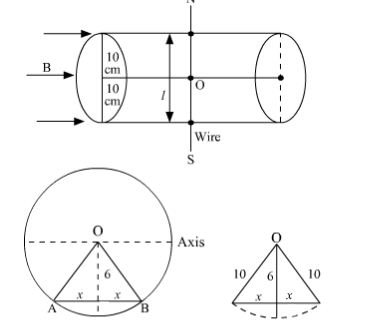
Thus the length of wire in magnetic field will be 16 cm as AB= L = 2x =16 cm
Now the force,
F = iLB sin90° as the wire will be perpendicular to the magnetic field.
F= 7 x 0.16 x 1.5 =1.68 N
The direction will be given by right hand curl rule or screw rule i.e. vertically downwards.
3.
\(Given \ r=0.1m,I=5A.\)
\(\\ \therefore \ d B=\frac { { \mu }_{ 0 }I }{ 2\pi r } =\frac { 4\pi \times { 10 }^{ -7 }\times 5 }{ 2\pi \times 0.1 }\)
\(={ 10 }^{ -5 }J\)
4.
Magnetic field at a point on the equatorial line is given by
\({ B }_{ eq }=\frac { { \mu }_{ 0 }M }{ 4\pi { r }^{ 3 } } =\frac { { 10 }^{ -7 }\times 0.40 }{ { \left( 0.5 \right) }^{ 2 } } =3.2\times { 10 }^{ -7 }T\)
Magnetic field at a point on the axial line is given by
\({ B }_{ axial }=\frac { { \mu }_{ 0 }2M }{ 4\pi { r }^{ 3 } } =\frac { { 10 }^{ -7 }\times 2\times 0.40 }{ { \left( 0.5 \right) }^{ 3 } } =6.2\times { 10 }^{ -7 }T\)
5.
(a) The values showed by Sheela were nature of appreciation, curiosity, diligence, and creative skill
(b)There are three magnetic elements of earth magnetic field.
(i) Declination at a place is the angle between magnetic and geographical meridian at that place.
(ii) Magnetic dip or inclination is the angle which the strength of earth's magnetic field makes with its horizontal component in the magnetic meridian.
(iii) Horizontal component of earth's magnetic field is the component of total intensity of earth's magnetic field in the horizontal direction in the magnetic meridian.
6.
(i) Given
\(d B=0.2T,\theta =30°,\tau =0.06Nm\)
\( \tau =MB\sin { \theta }\)
\( \therefore d M=\frac { \tau }{ B\sin { \theta } } =\frac { 0.06 }{ 0.2\times \sin { 60° } } =0.06{ Am }^{ 2 }\)
(ii) Potential energy of magnetic dipole in a uniform magnetic field B is given by
\(U=-MB\cos { \theta } \)
In stable equilibrium, the potential energy is minimum i.e.\(\cos { \theta } =1 \ or \ \theta =0°\)
So for stable equilibrium, the magnet must be aligned with its magnetic moment parallel to the magnetic field.
7.
Initially total dipole moment
\(=0.15\times 1.5\times { 10 }^{ -23 }\times 2.0\times { 10 }^{ 24 }\)
\(\\ =4.5{ JT }^{ -1 }\)
Using Curie's Law
\(M=k\frac { B }{ T }\)
\( \\ \frac { { M }_{ 1 } }{ { M }_{ 2 } } =\frac { { B }_{ 1 } }{ { T }_{ 1 } } \times \frac { { T }_{ 2 } }{ { B }_{ 2 } }\)
\( { M }_{ 2 }=\frac { { M }_{ 1 }{ T }_{ 1 }{ B }_{ 2 } }{ { B }_{ 1 }{ T }_{ 2 } } \)
\(=\frac { 2.0\times { 10 }^{ 24 }\times 1.5\times { 10 }^{ -23 }\times 4.2\times 0.98 }{ 0.84\times 2.8 }\)
\({ M }_{ 2 }=7.9{ JT }^{ -1 }\)
8.
Given, \(d=14cm=14\times { 10 }^{ -2 }m\)
\(\\ H=0.36\quad G=0.36\times { 10 }^{ -4 }T\)
Since null points are formed on the axis of the magnet, so, we have
\(\frac { { \mu }_{ 0 }2M }{ 4\pi { d }^{ 3 } } =H \ or\) \( \frac { { \mu }_{ 0 }M }{ 4\pi { d }^{ 3 } } =\frac { H }{ 2 } \)
Now on equatorial line at same distance d,
we have
\(\\ B=\frac { { \mu }_{ 0 }M }{ 4\pi { d }^{ 3 } } \)
Using Eq.(1).
\(\\ { B }_{ 1 }=\frac { H }{ 2 } =\frac { 0.36\times { 10 }^{ -4 } }{ 2 } \)
\(=0.18\times { 10 }^{ -4 }T\)
Total magnetic field at this point on the equatorial line will be
\(\\ { B }={ B }_{ 1 }+H=0.18\times { 10 }^{ -4 }+0.36\times { 10 }^{ -4 }\)
\(= 0.54\times { 10 }^{ -4 }T \ or\)
\(B=\ 0.54G\ in\ the\ direction\ of\ earth's\ field.\)
9.
(a) BH = 0.39G
(b) east to west
10.
Parallel to and above the cable at a distance of 1.5 cm)
11.
Number of turns on the circular coil, n = 20
Radius of the coil,r = 10 cm = 0.1 m
Magnetic field strength, B = 0.10 T
Current in the coil, I = 5.0 A
(a) The total torque on the coil is zero because the field is uniform.
(b) The total force on the coil is zero because the field is uniform.
(c) Cross-sectional area of copper coil, A = 10-5 m2
Number of free electrons per cubic meter in copper, N = 1029 /m3
Charge on the electron, e = 1.6 x 10⁻¹⁹ C
Magnetic force, F = Bevd
Where,
vd = Drift velocity of electrons
\(=\frac{I}{N e A}\)
\(\therefore F=\frac{B e I}{N e A}\)
\(=\frac{0.10 \times 5.0}{10^{29} \times 10^{-5}}=5 \times 10^{-25} \mathrm{~N}\)
Hence, the average force on each electron is 5 x 10-25 N.

12th Standard CBSE Syllabus & Materials
12th Standard CBSE
CBSE 12th Computer Science Python Revision Tour I - New Previous year Question Papers Study Material - QB365 Set A
NEW12th Standard CBSE
CBSE 12th Business Studies Planning Important Questions And Answers Study Material - QB365 Set A
NEW12th Standard CBSE
CBSE 12th Business Studies Business Environment Important Questions And Answers Study Material - QB365 Set A
NEW12th Standard CBSE
CBSE 12th Business Studies Principles of Management Important Questions And Answers Study Material - QB365 Set A



CBSE 12th Standard CBSE Subjects
CBSE Standards










