
 100% FREE ACCESS
12th Standard CBSE Syllabus & Materials
12th Standard CBSE
CBSE 12th Economics Government Budget and the Economy Previous year Question Papers Study Material - QB365 Set A
NEW12th Standard CBSE
CBSE 12th Computer Science Interface Python with MySQL - New Previous year Question Papers Study Material - QB365 Set A
NEW12th Standard CBSE
CBSE 12th Computer Science Database Concept - New Previous year Question Papers Study Material - QB365 Set A
NEW12th Standard CBSE
CBSE 12th Computer Science Data Communication - New Previous year Question Papers Study Material - QB365 Set A
NEW12th Standard CBSE
CBSE 12th Computer Science Data Structures - New Previous year Question Papers Study Material - QB365 Set A
NEW12th Standard CBSE
CBSE 12th Computer Science Functions - New Previous year Question Papers Study Material - QB365 Set A

Published on: 15/02/2020
12th Standard CBSE Physics Public Model Question Paper I 2020
Download CBSE Class 12th Standard CBSE Physics question papers, sample papers, important questions, and previous year solved papers in PDF format. Get free study materials, NCERT solutions, and exam preparation resources for Class 12th Standard CBSE Physics
Questions + Answers key
Take MCQ Physics Test
1.
The image formed by a convex mirror of focal length 30 cm is a quarter of the size of the object. The distance of the object from the mirror is
30 cm
90 cm
120 cm
60 cm
2.
If \(\oint _{ s }^{ }{ E.ds } =0\) over a surface, then
the electric field inside the surface and on it is zero
the electric field inside the surface is necessarily uniorm
the number of flux lines entering the surface must be equal to the number of flux lines leaving it
all charges must necessarily be outside the surface
3.
A galvanometer having a coil resistance of \(100\Omega \) gives a full scale deflection, when a current of 1 mA is passed through it. The value of the resistance, which can convert this galvanometer into ammeter giving a full scale deflection for a current of 10 A is
\(0.01\Omega \)
\(2\Omega \)
\(0.1\Omega \)
\(3\Omega \)
4.
A long straight wire of radius a carries a steady current i. The current is uniformly distributed across its cross-section. The ratio of the magnetic field at a/2 and 2 a is
1/2
1/4
4
1
5.
The input resistance of a silicon transistor is 100 ohm. Base current is changed by 40 \(\mu A\)which results in a change in collector current by 2 mA. This transistor is used as a common emitter amplifier with a load resistance of 4 \(k\Omega \) The voltage gain of the amplifier is:
2000
3000
4000
1000
6.
\({ \lambda }_{ e },{ \lambda }_{ p }\)and \({ \lambda }_{ \alpha }\)are the de-Broglie wavelengths of electron, proton and \(\alpha \) particle. If all are accelerated by potential, then
\({ \lambda }_{ e },{ <\lambda }_{ p }<{ \lambda }_{ \alpha }\)
\({ \lambda }_{ e },{ <\lambda }_{ p }>{ \lambda }_{ \alpha }\)
\({ \lambda }_{ e },{ >\lambda }_{ p }<{ \lambda }_{ \alpha }\)
\({ \lambda }_{ e },{ =\lambda }_{ p }>{ \lambda }_{ \alpha }\)
\({ \lambda }_{ e },{ >\lambda }_{ p }>{ \lambda }_{ \alpha }\)
7.
The dimensional formula of electric flux is
[M1L2T-2A-1]
[M-1L3T-3A]
[M1L3T-3A-1]
[M1L-3T-3A-1]
8.
Which is not true for the image formed in a plane mirror? The image is
virtual
erect
laterally inverted
closer to the mirror than the object
9.
Phase difference between voltage across L and C in series is
\({ 0 }^{ \circ }\)
\({9 0 }^{ \circ }\)
\({180 }^{ \circ }\)
\({ 360 }^{ \circ }\)
10.
Comparing the masses of the two photons, of red light and violet light
The mass of the photon of violet light is greater than the mass of the red light
The mass of the photon of violet light is lesser than the mass of the red light
The mass of the photon of violet light is equal the mass of the red light
The mass of the photon of violet light is greater or lesser than the mass of the red light depends upon surrounding conditions
11.
Taking the Bohr radius as a0 = 53pm, the radius of Li++ ion its ground state, on the basis of Bohr's model, will be about
53pm
27pm
18pm
13pm
12.
If sky wave with a frequency of 60 MHz is incident on D-region at an angle of 30°, then find the angle of refraction.
13.
A parallel plate air capacitor consists of two circular plates of diameter 8 cm. At what distance should the plates be held so as to have the same capacitance as that of a sphere of diameter 20 cm?
14.
The work function of caesium is 2.14 eV. Find
(a) the threshold frequency for caesium and
(b) wavelength of the incident light if the photocurrent is brought to zero by a stopping potential of 0.60 V
15.
A closely wound rectangular coil of 200 turns and size 0.30 x 0.05 m is placed perpedicular to a magnetic field of induction \(0.20 \ Wb \ { m }^{ -2 }.\) Calculate the induced e.m.f. in the coil, when magnetic induction e.m.f. in the coil, when magnetic induction drops to \(0.15 \ Wb \ { m }^{ -2 }\) in 0.02 s.
16.
Show that the energy density of em radiations is \(\varepsilon _{ 0 }{ { E }^{ 2 } }\) . Hence, find the intensity of radiations?
17.
The refractive index of water is 4/3. Obtain the value of the semivertical angle of the cone within which the entire outside view would be confined for a fish under water. Draw an appropriate ray diagram
18.
Figure (a), (b) and (c) Show three alternating circuits with equal currents. If frequency of alternating emf be increased, what will be the effect on currents In the three cases. Explain.

19.
A charged Particle q is shot towards another charged particle Q which is fixed , with a speed v. It approaches Q up to a closet distance r and then returns, If q were given a speed 2 v the n find the closet distance of approach.
20.
Name the constituent radiation of electromagnetic spectrum which is used for
(i) aircraft navigation
(ii) studying the crystal structure
Write the frequency range for each.
21.
A battery of emf 12 V and internal resistance 2Ω is connected to a 4Ω resistor as shown in the figure.
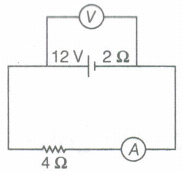
(i) Show that a voltmeter when placed across the cell and across the resistor, in turn, gives the same reading.
(ii) To record the voltage and the current in the circuit, why is voltmeter placed in parallel and ammeter in series in the circuit?
22.
The radii of curvature of the face of a double convex lens are 10 cm and 15 cm. If focal length of the length is 12 cm, find the refractive index of the material of the lens.
23.
A plane mirror is turned through \({ 10 }^{ o }\). Through what angle will the reflected ray turn?
24.
Write an expression for magnetic field intensity at any point an axial line of a bar magnet.
25.
What happens to the balance point if the position of the cell and the galvanometer are interchanged in balanced Wheatstone bridge?
26.
How is transistor biased to be in active state?
27.
A point charge q is placed at the origin. How does the electric field due to the charge vary with distance r from the origin?
28.
How does the drift velocity of electrons in a metal conductor vary with the increase in temperature?
29.
A small candle, 2.5 cm in size is placed at 27 cm in front of a concave mirror of radius of curvature 36 cm. At what distance from the mirror should a screen be placed in order to obtain a sharp image? Describe the nature and size of the image. If the candle is moved closer to the mirror, how would the screen have to be moved?
30.
(a) A point object is placed in front of a double convex lens (of refractive index n =n2/n1 with respect air) with its spherical faces of radii of curvature R1 and R2.. Show the path of rays due to surface to obtain the formation of the real image of the object.
Hence obtain the lens maker's formula for a thin lens.
(b) A double convex lens having both faces of the same radius of curvature has refractive index 1.55. Find out the radius of curvature of the lens required to get the focal length of 20 cm.
31.
For the past some time.Arti has been observing some erratic body movement, unsteadiness and lack of aoordination in the activities of hersister Radha, who also used to complain of serve headache occasionally.Aarti suggested to her parents to get a medical check-up of Radha. The doctor throughly examined Radha and diagnosed that she has a brain tumour
(a) What,according to you,are the value displayed by Arti?
(b) How can radioisotopes help a doctor to diagnose brain tumour?
32.
(a) calculate the potential at a point P due to a charge of \(4\times 10^{-7}C\) located 9 cm away.
(b) Hence obtain the work done in bringing a charge of \(2\times 10^{-9}C\) from infinity to the point P. Does the answer depend on the path along which the charge is brought?
33.
A capacitor of 1.0 \(\mu\)F is connected to series with a resistance of 104 ohm; and a battery of 2.0V. Find the maximum value of current and current after 0.02 s.
1.
(b)
90 cm
2.
(c)
the number of flux lines entering the surface must be equal to the number of flux lines leaving it
3.
(a)
\(0.01\Omega \)
4.
(d)
1
5.
(a)
2000
6.
(e)
\({ \lambda }_{ e },{ >\lambda }_{ p }>{ \lambda }_{ \alpha }\)
7.
(c)
[M1L3T-3A-1]
8.
(d)
closer to the mirror than the object
9.
(c)
\({180 }^{ \circ }\)
10.
(a)
The mass of the photon of violet light is greater than the mass of the red light
11.
(c)
18pm
12.
For D-region, N = 109 m-3 Here, v = 60 x 106 Hz
Refractive index of the atmospheric layer is
\(\mu =\left[ 1-\frac { 81.45N }{ { v }^{ 2 } } \right] ^{ 1/2 }=\sqrt { 1-\frac { 81.45\times { 10 }^{ 9 } }{ \left( 60\times { 10 }^{ 6 } \right) ^{ 2 } } } \approx 1\)
Now, \(\mu =\frac { \sin { i } }{ \sin { r } } =1\) or \(\sin { i } =\sin { r } \) or r = i = 30°
13.
\({\epsilon_oA\over A}={4\pi\epsilon_o R}\)
or \({\epsilon_o\pi(D^2)\over d4}=4\pi\epsilon_oR\)
\(d={D^2\over 16R}={(0.08)^2\over 16\times 0.10}=4\times 10^{-3}m=4mm\)
14.
(a) For the cut-off or threshold frequency, the energy h v0 of the incident radiation must be equal to work function Φ0, so that
\({ V }_{ 0 }=\frac { { \phi }_{ 0 } }{ h } =\frac { 2.14eV }{ 6.63\times { 10 }^{ -34 }Js }\)
\(=\frac { 2.14\times 1.6\times { 10 }^{ -19 }J }{ 6.63\times { 10 }^{ -34 }Js } =5.16\times { 10 }^{ 14 }Hz\)
Thus, for frequencies less than this threshold frequency, no photoelectrons are ejected.
(b) Photocurrent reduces to zero, when maximum kinetic energy of the emitted photoelectrons equals the potential energy eV0 by the retarding potential V0. Einstein’s Photoelectric equation is
\(e{ V }_{ 0 }=\frac { hc }{ \lambda } -{ \phi }_{ 0 }\)
\(or\ \lambda =\frac { hc }{ \left( e{ V }_{ 0 }+{ \phi }_{ 0 } \right) }\)
\(or \ \lambda =\frac { \left( 6.63\times { 10 }^{ -34 }Js \right) \times \left( 3\times { 10 }^{ 8 }m/s \right) }{ \left( e\times 0.6V+2.14eV \right) } \)
\(\lambda =\frac { 19.89\times { 10 }^{ -26 }Jm }{ 2.74\times 1.6\times { 10 }^{ -19 }J } =454nm\)
15.
\(Here,N=200,A=0.30x0.05=0.015{ m }^{ 2 }\)
\({ B }_{ 1 }=0.20Wb{ m }^{ -2 }e=?\)
\({ B }_{ 2 }=0.15Wb{ m }^{ -2 }dt=0.02s\)
\( e=\frac { -N({ \Phi }_{ 2 }-{ \Phi }_{ 1 }) }{ dt } =\frac { -N({ B }_{ 2 }-{ B }_{ 1 })A }{ dt }\)
\(=\frac { -200(0.15-0.20)0.015 }{ 0.02 } =7.5V\)
16.
Since \(\varepsilon _{ E }=\frac { 1 }{ 2 } \varepsilon _{ 0 }{ { E }^{ 2 } }\)
and \(\varepsilon _{ B }=\frac { { B }^{ 2 } }{ 2\mu _{ 0 } } \)
\(\therefore \) Total energy density \(u={ u }_{ E }+{ u }_{ B }=\frac { 1 }{ 2 } \varepsilon _{ 0 }{ E }_{ 2 }+\frac { 1 }{ 2 } \frac { { B }^{ 2 } }{ { \mu }_{ 0 } } \)
For a plane em wave, Band E are related as
\({ B }_{ v }=\frac { { E }_{ V } }{ C } \)
\(u=\frac { 1 }{ 2 } \varepsilon _{ 0 }{ E }_{ v2 }+\frac { 1 }{ 2\mu _{ 0 } } \left( \frac { { E }_{ v } }{ c } \right) ^{ 2 }\)
\(={ E^{ 2 } }_{ v }\frac { \left( { \mu }_{ 0 }\varepsilon _{ 0^{ c2 } }+1 \right) }{ 2{ \mu }_{ 0^{ c2 } } } ={ E }^{ 2 }_{ v }\)
or \(u=\frac { { E }^{ 2 }_{ v }(1+1) }{ 2{ \mu }_{ 0 }\frac { 1 }{ { \mu }_{ 0 }\varepsilon _{ 0 } } } \) \(\left[ \therefore { c }^{ 2 }=\frac { 1 }{ { \mu }_{ 0 }\varepsilon _{ 0 } } \right] \)
\(=\varepsilon _{ 0 }{ E }^{ 2 }_{ v }\)
So \(I=\frac { Energy/Time }{ Area } \)
or
\(I=\frac { Energy \ density/Time }{ Area } \times volume\)
\( =Energy\quad density\times \frac { length }{ Time } \)
\( =u\times c\)
Using eqn.(i), we get
\(\\ I=\varepsilon _{ 0 }{ E }^{ 2 }_{ v }\)
17.
Clearly , the fish can see the outside view of the cone with semi vertical angle
But \(\mu \) = 1.sin ic
or 1/3 = 1/ sin ic
or sin ic = 3/4 = 0.75
\(\theta\)/2 =ic = sin-1 (0.75 ) = 48.60
18.
(i) No effect
(ii) Current will decrease
(iii) Current will Increase.
19.
q \(\rightarrow\)_______Q
1/2 mv2 = kQq/r
Or, v2 a1/r
Or, r a 1/v2
Or, r' = r/4
20.
(i) Microwaves are used for aircraft navigation, their frequency range is 109 Hz to 1012 Hz.
(ii) X-rays are used to study crystal structure, their frequency range is 1016 Hz to 1020 Hz.
21.
According to question,
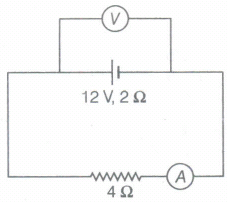
(i) Net current in the circuit = 12/6 = 2A
Voltage across the battery,
Vb = 12 - 2 x 2 = 8V
Voltage across the resistance
Vr = IR = 2 x 4 = 8V
(ii) In order to measure the device's voltage for a voltmeter, it must be connected in parallel to that device. This is necessary because device in parallel experiences the same potential difference. An ammeter is connected in series
with the circuit because the purpose of the ammeter is to measure the current through the circuit. Since, the ammeter is a low impedance device. Connecting in parallel with the circuit would cause a short-circuit, damaging, the ammeter of the circuit.
22.
R1 = 10 cm, R2 = -15 cm, f = 12 cm
\(\frac { 1 }{ f } =(\mu -1)(\frac { 1 }{ R_{ 1 } } -\frac { 1 }{ R_{ 2 } } )\)
\(\frac { 1 }{ 12 } =(\mu -1)(\frac { 1 }{ 10 } -\frac { 1 }{ 15 } )\)
\( \mu = \frac { 3 }{ 2 } \)
23.
\({20}^{o}\)
24.
\({ B }_{ 1 }=\frac { { \mu }_{ o } }{ 4\pi } \frac { 2Md }{ { \left( { d }^{ 2 }-{ l }^{ 2 } \right) }^{ 2 } } ;along \ SN\)
where symbols have usual meaning.
25.
There will be no depletion in the galvanometer as the condition of balanced bridge will still hold good.
26.
Transistor is said to be in active state when its emitter-base junction is suitably forward biased and base-collector junction is suitably reverse biased.
27.
Electric field varies inversely as square of distance from the point charge.
28.
With the increase in temperature, the drift velocity of free electrons in a metal conductor decreases due to increase in collision frequency of free electrons with the atom/ions of the conductor.
29.
Size of the candle, h = 2.5 cm
Image size = h’
Object distance, u = -27 cm
Radius of curvature of the concave mirror, R = -36 cm
\(f=\frac { R }{ 2 } =-18\)cm
Image distance = v
The image distance can be obtained using the mirror formula:
\(\frac { 1 }{ u } +\frac { 1 }{ v } =\frac { 1 }{ f } \)
\(\frac { 1 }{ v } =\frac { 1 }{ f } -\frac { 1 }{ u } \)
\(\frac { 1 }{ -18 } =\frac { 1 }{ -27 } =\frac { -3+2 }{ 54 } =-\frac { 1 }{ 54 } \)
∴ v = -54 cm
Therefore, the screen should be placed 54 cm away from the mirror to obtain a sharp image.
The magnification of the image is given as:
\(m=\frac { { h }^{ ' } }{ h } =-\frac { v }{ u } \)
\(\therefore { h }^{ ' }=-\frac { v }{ u } \times h\)
\(=-\left( \frac { -54 }{ -27 } \right) \times 2.5=-5\)cm
The height of the candle’s image is 5 cm. The negative sign indicates that the image is inverted and real.
If the candle is moved closer to the mirror, then the screen will have to be moved away from the mirror in order to obtain the image.
30.
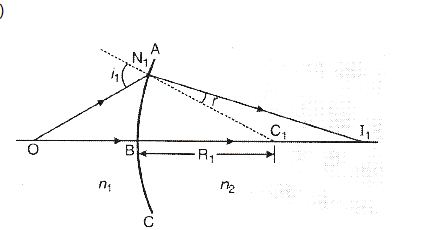
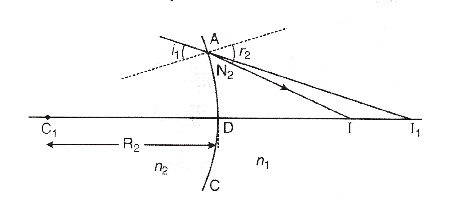
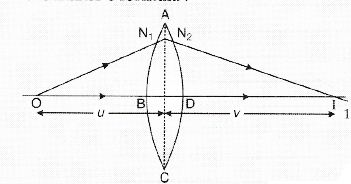
The first refracting ABC forms the image I1 of the object O. The image I1 acts as virtual object for the second refracting surface ADC, which forms the real image I as shown in the diagram
For refraction at ABC
\(\frac { { n }_{ 2 } }{ { v }_{ 1 } } -\frac { { n }_{ 1 } }{ u } =\frac { { n }_{ 2 }-{ n }_{ 1 } }{ { R }_{ 1 } } \)
For refraction at ADC
\(\frac { { n }_{ 1 } }{ v } -\frac { { n }_{ 2 } }{ { v }_{ 1 } } =\frac { { n }_{ 1 }-{ n }_{ 2 } }{ { R }_{ 2 } } \)
Adding equation (i) and equation (ii)
\(\frac { { n }_{ 1 } }{ v } -\frac { { n }_{ 2 } }{ u } =\left( { n }_{ 2 }-{ n }_{ 1 } \right) \left( \frac { 1 }{ { R }_{ 1 } } -\frac { 1 }{ { R }_{ 2 } } \right) \)
\(\frac { 1 }{ v } -\frac { 1 }{ u } =\left( \frac { { n }_{ 2 } }{ { n }_{ 1 } } -1 \right) \left( \frac { 1 }{ { R }_{ 1 } } -\frac { 1 }{ { R }_{ 2 } } \right) \)
We know, If \(u=\infty ,v=f\)
\(\frac { 1 }{ v } -\frac { 1 }{ u } =\frac { 1 }{ f } \)
\(\frac { 1 }{ f } =\left( \frac { { n }_{ 2 } }{ { n }_{ 1 } } -1 \right) \frac { 1 }{ { R }_{ 1 } } -\frac { 1 }{ { R }_{ 2 } } \)
\(\frac { 1 }{ f } =\left( { \mu }_{ 21 }-1 \right) \left( \frac { 1 }{ { R }_{ 1 } } -\frac { 1 }{ { R }_{ 2 } } \right) \)
\(\frac { 1 }{ f } =\left( { \mu }_{ 21 }-1 \right) \left( \frac { 1 }{ { R }_{ 1 } } -\frac { 1 }{ { R }_{ 2 } } \right) \)
\(\frac { 1 }{ f } =\left( 1.55-1 \right) \left( \frac { 1 }{ R } -\frac { 1 }{ -R } \right) \)
\(=0.55\times \frac { 2 }{ R } \)
\(R=0.55\times 2\times 20=22 \ cm\)
31.
(a) Keen observer/helpful/concerned/responsible/respectful towards elders(Any two)
(b) The doctor can trace and observe,the difference between the moment of an appropriate through a normal brain and a brain having tumour in it.
32.
\(V=\frac{1}{4 \pi \varepsilon_{0}} \frac{Q}{r}=9 \times 10^{9} \mathrm{Nm}^{2} \mathrm{C}^{-2} \times \frac{4 \times 10^{-7} \mathrm{C}}{0.09 \mathrm{~m}}\)
= 4 x 10⁴ V
(b) W = qV = 2 x 10−9C x 4 x 104 V
= 8 x 10⁻⁵ J
No, work done will be path independent. Any arbitrary infinitesimal path can be resolved into two perpendicular displacements: One along r and another perpendicular to r. The work done corresponding to the later will be zero.
33.
\(Here, \ C=1.0\mu F={ 10 }^{ -6 }F\)
\(R={ 10 }^{ 4 }ohm, \ { E }_{ 0 }=2.0volt\)
\(During \ charging \ of \ the \ condenser,\)
\(q={ q }_{ 0 }\left( 1-{ e }^{ -t/RC } \right) \ I=-{ I }_{ 0 }{ e }^{ -t/RC }, \ where\)
\({ I }_{ 0 }=\frac { E }{ R } =\frac { 2.0 }{ { 10 }^{ 4 } } =2.0\times { 10 }^{ -4 }amp\)
\(At \ t=0.02s, \ I={ I }_{ 0 }\left( { e }^{ -0.02/{ 10 }^{ 4 }\times { 10 }^{ -6 } } \right) =2\times { 10 }^{ -4 }{ e }^{ -2 }\)
\(=\frac { 2\times { 10 }^{ -4 } }{ { e }^{ 2 } } =\frac { 2\times { 10 }^{ -4 } }{ \left( 2.718 \right) ^{ 2 } } =0.27\times { 10 }^{ -4 }A\)
\(I=27\times { 10 }^{ -6 } \ A=27\mu A\)

12th Standard CBSE Syllabus & Materials
12th Standard CBSE
CBSE 12th Computer Science Python Revision Tour I - New Previous year Question Papers Study Material - QB365 Set A
NEW12th Standard CBSE
CBSE 12th Business Studies Planning Important Questions And Answers Study Material - QB365 Set A
NEW12th Standard CBSE
CBSE 12th Business Studies Business Environment Important Questions And Answers Study Material - QB365 Set A
NEW12th Standard CBSE
CBSE 12th Business Studies Principles of Management Important Questions And Answers Study Material - QB365 Set A



CBSE 12th Standard CBSE Subjects
CBSE Standards










