
 100% FREE ACCESS
12th Standard CBSE Syllabus & Materials
12th Standard CBSE
CBSE 12th Economics Government Budget and the Economy Previous year Question Papers Study Material - QB365 Set A
NEW12th Standard CBSE
CBSE 12th Computer Science Interface Python with MySQL - New Previous year Question Papers Study Material - QB365 Set A
NEW12th Standard CBSE
CBSE 12th Computer Science Database Concept - New Previous year Question Papers Study Material - QB365 Set A
NEW12th Standard CBSE
CBSE 12th Computer Science Data Communication - New Previous year Question Papers Study Material - QB365 Set A
NEW12th Standard CBSE
CBSE 12th Computer Science Data Structures - New Previous year Question Papers Study Material - QB365 Set A
NEW12th Standard CBSE
CBSE 12th Computer Science Functions - New Previous year Question Papers Study Material - QB365 Set A

Published on: 15/02/2020
12th Standard CBSE Physics Public Model Question Paper II 2019 - 2020
Download CBSE Class 12th Standard CBSE Physics question papers, sample papers, important questions, and previous year solved papers in PDF format. Get free study materials, NCERT solutions, and exam preparation resources for Class 12th Standard CBSE Physics
Questions + Answers key
Take MCQ Physics Test
1.
A ray of light passes through an equilateral glass prism, such that the angle of incidence is equal to the angle of emergence. If the angle of emergence is ¾ times the angle of the prism, Calculate the refractive index of the glass prism
2.
A copper wire is bent into a square of each side 6cm.If a current of 2A is passed through a wire what is the magnetic field at the centre of the square?
3.
Two Capacitors of capacitace 6\(\mu \)F and 12\(\mu \)F ae connnected in series with tha battery the volatage across the 6\(\mu \)F capacitor is 2 volt, Compute the total battery voltage.
4.
Deduce the expression for the electric field E due to a system of two charges q1 and q2 with position vectors r1 and r2 at a point r with respect to common origin.
5.
Under what condition is the heat produced in an electric circuit:
(i) directly proportional
(ii) inversely proportional to the resistance of the circuit?
6.
Do all the electrons that absorb a photon come out as photoelectrons?
7.
Write two applications of capacitors in electrical circuits?
8.
Why is the amplitude of modulating signal kept less than the amplitude of carrier wave?
9.
When cells are connected in parallel, what will be the effect on
(i) current capacity
(ii) e.m.f of the cells.
10.
How would you set up a circuit to obtain NOT gate using a transistor?
11.
A 800 pF capacitor is charged by a 100 V battery. Ater sometime, the battery is disconnected. The capacitor. What is the electrostatic energy stored?
12.
A radio set can be turned to any station in the frequency range 6 MHz to 12 MHz band.What is the corresponding wavelength band of radio set?
13.
A parallel plate capacitor has circular plates, each of radius 8 cm. It is being charged so that the electric field between the gap of two plates rises steadily at the rate of \({ 10 }^{ 13 }\quad V{ m }^{ -1 }{ s }^{ -1 }\) find the value of displacement current.
14.
Over a solenoid of 50cm length and 2cm radius having 500 turns, is wound another wire of 50 turns near the centre. Calculate mutual inductance of the two coils. If current in primary changes from 0 to 5 in 0.02 s, what is the emf induced in secondary coil?
15.
What should be the distance between the object in Exercise and the magnifying glass if the virtual image of each square in the figure is to have an area of 6.25 mm2 . Would you be able to see the squares distinctly with your eyes very close to the magnifier?
16.
An object is placed at (i) 10 cm, (ii) 5 cm in front of a concave mirror of radius of curvature 15 cm. Find the position, nature, and magnification of the image in each case.
17.
(a) A point object is placed in front of a double convex lens (of refractive index n =n2/n1 with respect air) with its spherical faces of radii of curvature R1 and R2.. Show the path of rays due to surface to obtain the formation of the real image of the object.
Hence obtain the lens maker's formula for a thin lens.
(b) A double convex lens having both faces of the same radius of curvature has refractive index 1.55. Find out the radius of curvature of the lens required to get the focal length of 20 cm.
18.
Bala and rama (Class X students), were assigned a project based on magnetism.In their project work, they had calculated the value of the earth's magnetic field.When they submitted their project for verification.Mr.Santosh, their Physics techer, corrected the mistakes. He also suggested few books which could be useful for them.
i) What values did Mr.Santosh exhibit towards his students? Mention any two.
ii) Mention the three magnetic elements required to calculate the value of the earth's magnetic field.
iii) What is the strength of the earth's magnetic fields at the surface of the earth?
19.
Two parallel plate air capacitors have their plate areas 100 and 500cm2 respectively. If they have the same charge and potential and the distance between the plates of the first capacitor is 0.5mm, what is the distance between the plates of second capacitor?
20.
Find the de-Broglie wavelength(in \(\overset { \circ }{ A } \) ) associated with an example with an electron moving with a velocity 0.6c, where c=\(3\times { 10 }^{ 8 }m/s\)and rest mass of electron=\(9.1\times { 10 }^{ -31 }kg\), \(h=6.6\times { 10 }^{ -34 }Js\)
21.
The dispersive powers of glasses of lenses used in an achromatic pair are in the ratio 5 : 3. If the focal length of the concave lens' is 15 ern, then the nature and focal length of the other lens would be
convex, 9 cm
concave, 9 cm
convex, 25 cm
concave, 25 cm
22.
Consider a region inside which there are various types of charges but the total charge is zero. At points outside the region
the electric field is necessarily zero
the electric field is due to the dipole moment of the charge distribution only
the dominant electric field is \(\alpha {1\over r^3}\) , for large r , where r is the distance from a origin in this region.
the work done to move a charged particle along a closed path, away from the region, will be zero.
23.
When two capacitors charged to different potentials are connected by a conducting wire, what is not true?
charge lost by one is equal to charge gained by the other
potential lost by one is equal to potential gained by the other
some energy is lost
both the capacitor acquire a common potential
24.
Two particles each of mass m and charge q are attached to the two ends of a light rigid rod of length 2 R. The rod is rotated at constant angular speed about a perpendicular axis passing through its centre. The ratio of the magnitudes of the magnetic moment of the system and its angular momentum about the centre of the rod is
q/2 m
q/m
2 q/m
\(q/\pi \ m.\)
25.
A coil having n turns and resistance R is connected with a galvanometer of resistance 4R. This combination is moved in time t seconds from a magnetic flux \({ \phi }_{ 1 }\) Weber to \({ \phi }_{ 2 }\) Weber. The induced current in the circuit is :
\(\frac { { \phi }_{ 2 }-{ \phi }_{ 1 } }{ 5Rnt } \)
\(\frac { -n\left( { \phi }_{ 2 }-{ \phi }_{ 1 } \right) }{ 5Rt } \)
\(\frac { -\left( { \phi }_{ 2 }-{ \phi }_{ 1 } \right) }{ Rnt } \)
\(\frac { -n\left( { \phi }_{ 2 }-{ \phi }_{ 1 } \right) }{ Rt } \)
26.
The magnetic field of earth can be modeled by that of a point dipole placed at the center of the earth. The dipole axis makes an angle of \(11.3°\)with the axis of the earth. At Mumbai, declination is nearly zero. Then,
the declination varies between \(11.3°\)W to \(11.3°\)
the least declination is \(\ 0°\)
the plane defined by dipole axis and earth axis passes through Greenwich.
declination averaged over the earth must be always negative.
27.
Photoelectric effect supports the quantum nature of light because
there is minimum frequency of light below which no photoelectrons are emitted
the maximum K.E. of photoelectrons emitted depends only on the frequency of the incident light and on its intensity
even when metal surface is faintly illuminated, the photoelectrons leave the surface immediately
electric charge of photoelectron is quantised
28.
If the ratio of the concentration of electrons and of holes in a semiconductor is 7/5 and the ratio of currents is 7/4 then what is the ratio of their drift velocities?
4/7
5/8
4/5
5/4
29.
Sound waves are not electromagnetic waves as
they cannot undergo interference
they cannot undergo diffraction
they cannot be polarized
they cannot pass through vacuum
30.
For a radioactive material, its activity A and rate of change of its activity R are defined as
\(A=-\frac { dN }{ dt } \quad and\quad R=-\frac { dA }{ dt } ,\)
where N (t) is the number of nuclei at time t. Two radioactive sources P (mean life \(\tau \)) and Q (mean life \(2\tau \)) have the same activity at t = 0. Their rates of change of activities at t = \(2\tau \) are \({ R }_{ P } \ and \ { R }_{ Q },\) respectively. If \(\frac { { R }_{ P } }{ { R }_{ Q } } =\frac { n }{ e } ,\) then the value of n is
1
2
3
4
31.
An electromagnetic wave going through vacuum is denoted by \(E={ E }_{ 0 } \ sin \ (kz-\omega t)\). Which of the following is/are independent of wavelength?
k
\(\omega \)
\(k/\omega \)
\(k\omega \)
32.
In hydroelectric power station, ....................of falling water is converted into................. .
33.
Electrons are transferred from the material whose ............. is ....... to the material whose ............ is ...............
34.
Resolving power of an optical instrument is the ability of the instrument to ___________ or ____________ the images of ____________.
1.
A = 600 , \(\delta \)m = 300
i = e = ¾ A = 450
as A + \(\delta \) = i + e
60 + \(\delta \) = 45 +45
or \(\delta \) = 300
Refractive index,
\(\mu \) = sin a + \(\delta \)m /2/sin A/2 = sin 600+300/2/sin 600/2
= sin 450/sin300 = 1\(\surd 2\) 1/2 = \(\surd 2\) = 1.414
2.
B1 = 4 x \({ \mu }_{ 0 }\) I/4\(\pi\) a/2 (sin 45 + sin 45)
= 4 x \({ \mu }_{ 0 }\) 2/4 \(\pi\) x 3 (1 / 1.414 + 1/414 )
= 2\({ \mu }_{ 0 }\)/3\(\pi\) (1/.414 ) + 1/414 ) T
3.
V = V1 + V2
Q = C1V = 6 x 10-6 x 2 = 12\(\mu \)C
As C2 is in series same amount of charge will also flow through it now V2 = Q/C2 = (12 x 10-6) /(12 x 10-6) = 1 volt
Total Battery voltage, V = 2 + 1 = 3 Volt
4.
Let two point charges q1 and q2 are situated at points A and B have position vectors r1 and r2.
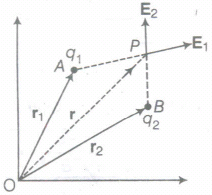
\(\because\) AP = r - r1
and BP = r - r2
Electric field intensity at point P due to q1,
E1 = \({{1}\over{4\pi{\epsilon}_{0}}}.{{{q}_{1}}\over{{|BP|}^{3}}}AP\)
Similarly, E2 = \({{1}\over{4\pi{\epsilon}_{0}}}.{{{q}_{1}}\over{{|AP|}^{3}}}BP\)
\(\therefore\) Net electric field intensity at point P,
E = E1 + E2
= \({{1}\over{4\pi{\epsilon}_{0}}}\left[ {{{q}_{1}}\over{{|r-{r}_{1}|}^{3}}}(r-{r}_{1})+{{{q}_{2}}\over{{|r-{r}_{2}|}^{3}}} (r-{r}_{2}) \right]\).
5.
(i) Heat produced in the circuit is directly proportional to the resistance if a constant current is flowing through a circuit, because H = I2Rt or H \(\propto\) R. It is so in series combination of resistors.
(ii) Heat produced in the circuit is inversely proportional to the resistance if a constant pot. diff. is applied across the circuit, because
\(H=\frac{V^2}{R}t \)
or \(H \propto \frac{1}{R}\)
It is so in parallel combination of resistors.
6.
In photoelectric effect, We can observe that most electrons get scattered into the metal by absorbing a photon.
Thus, all the electrons that absorb a photon does not come out as photoelectron. Only a few comes out of metal whose energy becomes greater than the work functibn of metal.
7.
(i) Capacitors are used in radio circuits for tuning purposes.
(ii) Capacitors are used in power supplies for smoothing the rectified current.
8.
If amplitude of modulating signal \(({ A }_{ m })\)exceeds the amplitude of carrier wave \(({ A }_{ c })\) is the carrier is over modulated \(({ \mu }_{ a }>1)\) .This causes distortion during reception.
9.
(i) Current capacity from the combination of cells is the total current available from the cell. Current capacity increases for the parallel combination of cells.
(ii) The effect e.m.f. of the cells of equal e.m.f. in parallel will be equal to e.m.f. of one cell.
10.
The NOT gate is a device which has only one input and one output i.e. \(\bar { A } \)= Y means Y equals NOT A.
This gate cannot be realised by using diodes. However, it can be realised by making the use of a transistor. This can be seen in the figure given below:
| A | Y |
| 0 | 1 |
| 1 | 0 |
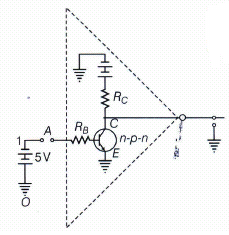
Here, the base B of the transistor is connected to the input A through a resistance RB and the emitter E is earthed. The collector is connected to 5 V battery. The output Y is the voltage at C with respect to the earth.
The resistors, RB and RC are so chosen that, if emitter-base junction is unbiased, the transistor is in cut-off mode and if emitter-base junction is forward biased by 5 V, the transistor is in saturation state.
11.
Here \(C_1=C_2=800pF=8\times 10^{-10}F\)
\(V_1=100V, V_2=0\)
Common potential, V = \({C_1V_1+C_2V_2\over C_1+C_2}\)
\(={8\times 10^{-10}\times 100\over (800+800)10^{-12}}=50V\)
Energy stored, \(u_f={1\over 2}(C_1+C_2)V^2\)
\(={1\over 2}(800+800)10^{-12}(50)^2\)
\(u_f=2\times 10^{-6}J\)
12.
For v = 6MHz ,\(\lambda =\frac { c }{ v } =\frac { 3\times{ 10 }^{ 8 } }{ 6\times{ 10 }^{ 6 } } =50\ m\)
for v = 12 MHz,\(\lambda =\frac { c }{ v } =\frac { 3\times{ 10 }^{ 8 } }{ 12\times{ 10 }^{ 6 } } =25\ m\)
Thus the corresponding wavelength band is 25 m to 50 m band.
13.
\(Here,\ r=8cm=8\times { 10 }^{ -2 }m\)
\(\frac { dE }{ dt } ={ 10 }^{ 13 }V{ m }^{ -1 }{ s }^{ -1 }\)
Displacement current.
\({ I }_{ D }={ \epsilon }_{ 0 }\frac { { d\phi }_{ E } }{ dt } { { \epsilon }_{ 0 } }\frac { d }{ dt } (EA)\)
\( ={ \epsilon }_{ 0 }A\frac { { d }E }{ dt } ={ { \epsilon }_{ 0 }\pi { r }^{ 2 } }\frac { dE }{ dt } \)
\( =(8.85\times { 10 }^{ -12 })\times 3.14\times ({ 8\times { 10 }^{ -2 }) }^{ 2 }\times { 10 }^{ 13 }\)
\( =1.78\ A\)
14.
\(7.896 \times { 10 }^{ -5 }H;19.74mV\)
15.
Area of the virtual image of each square, A = 6.25 mm2
Area of each square, A0 = 1 mm2
Hence, the linear magnification of the object can be calculated as:
\(m=\sqrt { \frac { A }{ { A }_{ o } } } \)
\(\sqrt { \frac { 6.25 }{ 1 } } =2.5\)
But m = \(\frac{Image \ distance \ (v)}{Object \ distance \ (u)}\)
∴ v = mu
= 2.5 u ....(1)
Focal length of the magnifying glass, f = 10 cm
According to the lens formula, we have the relation:
\(\frac { 1 }{ { f } } =\frac { 1 }{ { v } } -\frac { 1 }{ { u } } \)
\(\frac { 1 }{ 10 } =\frac { 1 }{ 2.5u } -\frac { 1 }{ u } =\frac { 1 }{ u } \left( \frac { 1 }{ 2.5 } -\frac { 1 }{ 1 } \right) =\frac { 1 }{ u } \left( \frac { 1-2.5 }{ 2.5 } \right) \)
\(\therefore u=-\frac { 1.5\times 10 }{ 2.5 } =-6\)
And v = 2.5u
= 2.5 x 6 = -15 cm
The virtual image is formed at a distance of 15 cm, which is less than the near point (i.e., 25 cm) of a normal eye. Hence, it cannot be seen by the eyes distinctly.
16.
The focal length f = -15/2 cm = -7.5 cm
(i) The object distance u = -10 cm. Then Eq gives
\(\frac { 1 }{ v } +\frac { 1 }{ 10 } =\frac { 1 }{ -7.5 } \)
or \(v=\frac { 10\times 7.5 }{ -2.5 } =-30\) cm
The image is 30 cm from the mirror on the same side as the object
Also, magnification m = \(\frac { v }{ u } =-\frac { (-30) }{ (-10) } =-3\)
The image is magnified, real and inverted.
(ii) The object distance u = -5 cm. Then from Eq
\(\frac { 1 }{ v } +\frac { 1 }{ -5 } =\frac { 1 }{ -7.5 } \)
or \(v=\frac { 5\times 7.5 }{ (7.5-5) } =15\) cm
This image is formed at 15 cm behind the mirror. It is a virtual image.
Magnification m = 15 \(-\frac { v }{ u } =-\frac { 15 }{ (-5) } =3\)
The image is magnified, virtual and erect.
17.
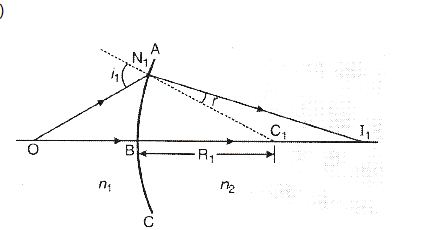
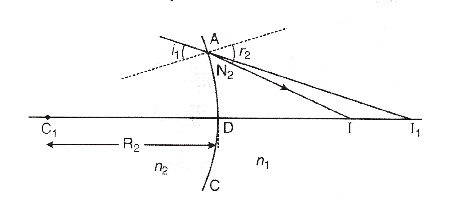
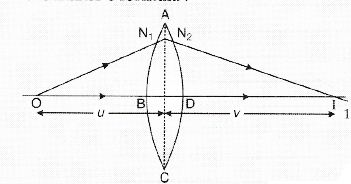
The first refracting ABC forms the image I1 of the object O. The image I1 acts as virtual object for the second refracting surface ADC, which forms the real image I as shown in the diagram
For refraction at ABC
\(\frac { { n }_{ 2 } }{ { v }_{ 1 } } -\frac { { n }_{ 1 } }{ u } =\frac { { n }_{ 2 }-{ n }_{ 1 } }{ { R }_{ 1 } } \)
For refraction at ADC
\(\frac { { n }_{ 1 } }{ v } -\frac { { n }_{ 2 } }{ { v }_{ 1 } } =\frac { { n }_{ 1 }-{ n }_{ 2 } }{ { R }_{ 2 } } \)
Adding equation (i) and equation (ii)
\(\frac { { n }_{ 1 } }{ v } -\frac { { n }_{ 2 } }{ u } =\left( { n }_{ 2 }-{ n }_{ 1 } \right) \left( \frac { 1 }{ { R }_{ 1 } } -\frac { 1 }{ { R }_{ 2 } } \right) \)
\(\frac { 1 }{ v } -\frac { 1 }{ u } =\left( \frac { { n }_{ 2 } }{ { n }_{ 1 } } -1 \right) \left( \frac { 1 }{ { R }_{ 1 } } -\frac { 1 }{ { R }_{ 2 } } \right) \)
We know, If \(u=\infty ,v=f\)
\(\frac { 1 }{ v } -\frac { 1 }{ u } =\frac { 1 }{ f } \)
\(\frac { 1 }{ f } =\left( \frac { { n }_{ 2 } }{ { n }_{ 1 } } -1 \right) \frac { 1 }{ { R }_{ 1 } } -\frac { 1 }{ { R }_{ 2 } } \)
\(\frac { 1 }{ f } =\left( { \mu }_{ 21 }-1 \right) \left( \frac { 1 }{ { R }_{ 1 } } -\frac { 1 }{ { R }_{ 2 } } \right) \)
\(\frac { 1 }{ f } =\left( { \mu }_{ 21 }-1 \right) \left( \frac { 1 }{ { R }_{ 1 } } -\frac { 1 }{ { R }_{ 2 } } \right) \)
\(\frac { 1 }{ f } =\left( 1.55-1 \right) \left( \frac { 1 }{ R } -\frac { 1 }{ -R } \right) \)
\(=0.55\times \frac { 2 }{ R } \)
\(R=0.55\times 2\times 20=22 \ cm\)
18.
i) Mr.Santosh is helping in nature, honest and has concern for the students to create interest in the subject.
ii) Magnetic declination, magnetic inclination and horizontal component of the earth's magnetic field.
iii) It is of the order of 10-5 T.
19.
Here, two parallel plate capacitors have same charge q and same potential V, so they have equal capacitances as
C = q/V
C1 = C2
\({\epsilon_oA_1\over d_1}={\epsilon_oA_2\over d_2}\)
or \(d_2={A_2\over A_1}d_1\)
Now, \(A_1=100 cm^2, A_2=500cm^2\)
\(d_1=0.5mm=0.05cm\)
\(d_2={500\times 0.05\over 100}=0.25cm=2.5mm\)
20.
Rest mass of electron,
\({ m }_{ 0 }=9.1\times { 10 }^{ -31 }kg\)
\(v=0.6c=0.6,\times 3\times { 10 }^{ 8 }=1.8\times { 10 }^{ 8 }{ ms }^{ -1 }\)
As v is comparable to c, hence mass of the electron in motion will be a relativistic mass. So,
\(m=\frac { { m }_{ 0 } }{ \sqrt { 1-{ v }^{ 2 }/{ c }^{ 2 } } } =\frac { { m }_{ 0 } }{ \sqrt { 1-\frac { { \left( 0.6 \right) }^{ 2 } }{ { c }^{ 2 } } } } =\frac { { m }_{ 0 } }{ 0.8 } \)
De-Broglie wavelength,
\(\lambda =\frac { h }{ mv } =\frac { h }{ \left( { m }_{ 0 }/0.8 \right) \times v } =\frac { h\times 0.8 }{ { m }_{ 0 }v } \)
\(=\frac { \left( 6.6\times { 10 }^{ -34 } \right) \times 0.8 }{ \left( 9.1\times { 10 }^{ -31 } \right) \times \left( 1.8\times { 10 }^{ 8 } \right) }\)
\( =0.322\times { 10 }^{ -11 }m=0.0322\times { 10 }^{ -10 }m\)
\(=0.032\overset { \circ }{ A } \)
21.
(a)
convex, 9 cm
22.
(c)
the dominant electric field is \(\alpha {1\over r^3}\) , for large r , where r is the distance from a origin in this region.
23.
(b)
potential lost by one is equal to potential gained by the other
24.
(a)
q/2 m
25.
(b)
\(\frac { -n\left( { \phi }_{ 2 }-{ \phi }_{ 1 } \right) }{ 5Rt } \)
26.
(a)
the declination varies between \(11.3°\)W to \(11.3°\)
27.
(a)
there is minimum frequency of light below which no photoelectrons are emitted
28.
(d)
5/4
29.
(d)
they cannot pass through vacuum
30.
(b)
2
31.
(c)
\(k/\omega \)
32.
()
kinetic energy; electrical energy
33.
()
work function; lower, work function ; higher
34.
()
resolve; see as separate; two closely spaced objects.

12th Standard CBSE Syllabus & Materials
12th Standard CBSE
CBSE 12th Computer Science Python Revision Tour I - New Previous year Question Papers Study Material - QB365 Set A
NEW12th Standard CBSE
CBSE 12th Business Studies Planning Important Questions And Answers Study Material - QB365 Set A
NEW12th Standard CBSE
CBSE 12th Business Studies Business Environment Important Questions And Answers Study Material - QB365 Set A
NEW12th Standard CBSE
CBSE 12th Business Studies Principles of Management Important Questions And Answers Study Material - QB365 Set A



CBSE 12th Standard CBSE Subjects
CBSE Standards










