
 100% FREE ACCESS
12th Standard CBSE Syllabus & Materials
12th Standard CBSE
CBSE 12th Economics Government Budget and the Economy Previous year Question Papers Study Material - QB365 Set A
NEW12th Standard CBSE
CBSE 12th Computer Science Interface Python with MySQL - New Previous year Question Papers Study Material - QB365 Set A
NEW12th Standard CBSE
CBSE 12th Computer Science Database Concept - New Previous year Question Papers Study Material - QB365 Set A
NEW12th Standard CBSE
CBSE 12th Computer Science Data Communication - New Previous year Question Papers Study Material - QB365 Set A
NEW12th Standard CBSE
CBSE 12th Computer Science Data Structures - New Previous year Question Papers Study Material - QB365 Set A
NEW12th Standard CBSE
CBSE 12th Computer Science Functions - New Previous year Question Papers Study Material - QB365 Set A

Published on: 15/02/2020
12th Standard CBSE Physics Public Model Question Paper II 2020
Download CBSE Class 12th Standard CBSE Physics question papers, sample papers, important questions, and previous year solved papers in PDF format. Get free study materials, NCERT solutions, and exam preparation resources for Class 12th Standard CBSE Physics
Questions + Answers key
Take MCQ Physics Test
1.
An electric current is flowing in circular coil of radius a. At what distance from the centre on the axis of the coil will the magnetic field be \(\cfrac { 1 }{ 8 } \) th of its value at the centre?
2.
Calculate the capacitance of a parallel plate capacitor having circular discs of radii 0.05 m each. The separation between the discs is 1 mm.
3.
A wheel with 10 metallic spokes each 0.5 m long is rotated with a speed of 120 rev/min in a plane normal to the horizontal component of earth’s magnetic field HE at a place. If H = 0.4 G at the place, what is the induced emf between the axle and the rim of the wheel? Note that 1 G = 10-4 T.
4.
The refractive index of water is 4/3. Obtain the value of the semivertical angle of the cone within which the entire outside view would be confined for a fish under water. Draw an appropriate ray diagram
5.
A charged Particle q is shot towards another charged particle Q which is fixed , with a speed v. It approaches Q up to a closet distance r and then returns, If q were given a speed 2 v the n find the closet distance of approach.
6.
Show, by giving a simplex example, how EM waves carry energy and momentum.
7.
A ball of superconducting material is dipped in liquid nitrogen and placed near a bar magnet.
(i) In which direction will it move?
(ii) What will be the direction of it's magnetic moment?
8.
What is the range of frequencies used for TV transmission?What is common between these waves and light waves?
9.
When is a Wheatstone bridge said to be balanced?
10.
What is the relation between electric intensity and electric flux?
11.
What happens to light energy when light waves interfere destructively at a point?
12.
Why is \(n\)-type semiconductor of Ge so called?
13.
To get three images of single object, one should have two plane mirrors at an angle of
60°
90°
120°
30°
14.
Two circular coils 1 and 2 are made from the same wire but the radius of the Ist coil twice that of the 2nd coil. What potential difference ratio should be applied across them so that the magnetic field at their centres is the same?
2
3
4
6
15.
In a common-emitter configuration, a transistor \(\beta =50\) and input resistance \(1k\ \Omega \) if the peak value of a.c.input is 0.01 V then the peak value of collector currents is
\(0.01\mu A\)
\(0.25\mu A\)
\(100 \ \mu A\)
\(10 \ \mu A\)
16.
If a copper wire carries a direct current, the magnetic field associated with the current will be
only outside the wire
only inside the wire
both inside and outside the wire
neither inside nor outside the wire
17.
The angle between pass axis of polarizer and analyzer is \(45°\)The percentage of polarized light passing through analyzer is
100%
50%
25%
75%
18.
When an electric dipole is held at an angle in a uniform electric field, the net force F and torque \(\tau\) on the dipole are
F = 0, \(\tau=0\)
\(F\ne 0,\tau\ne 0\)
F = 0, \(\tau\ne0\)
\(F\ne0,\tau=0\)
19.
Electric field due to a single charge is
asymmetric
cylindrically symmetric
spherically symmetric
None of the above
20.
If \(M\left( A,Z \right) ,\ { M }_{ p }\ and\ { M }_{ n }\) denote the masses of the nucleus \(_{ Z }{ { X }^{ A } },\) proton and neutron respectively in units of U \(\left( where\ 1\ U=931.5\quad MeV/{ c }^{ 2 } \right) \) and B.E. represents its B.E. in MeV, then
\(M\left( A,Z \right) =Z{ M }_{ p }+\left( A-Z \right) { M }_{ n }-BE/{ c }^{ 2 }\)
\(M\left( A,Z \right) =Z{ M }_{ p }+\left( A-Z \right) { M }_{ n }+BE\)
\(M\left( A,Z \right) =Z{ M }_{ p }+\left( A-Z \right) { M }_{ n }-BE\)
\(M\left( A,Z \right) =Z{ M }_{ p }+\left( A-Z \right) { M }_{ n }+BE/{ c }^{ 2 }\)
21.
The power factor of an a.c. circuit is given by cos \(\phi \)=
\(\frac { R }{ Z } \)
\(\frac { Z }{ R } \)
\(\frac { R }{ { X }_{ L } } \)
\(\frac { R }{ { X }_{ C } } \)
22.
Two photons, each of energy 2.5eV are simultaneously incident on the metal surface. If the work function of the metal is 4.5eV, then from the surface of metal
one electron will be emitted with energy 0.5eV
two electrons will be emitted with energy 0.25eV
more than two electrons will be emitted
not a single electron will be emitted.
23.
Consider the following statements about electromagnetic waves and choose the correct ones
\({ S }_{ 1 }\) e.m. waves having wavelength 1000 times smaller than light waves are called x-rays
\({ S }_{ 2 }\) ultraviolet waves are used in the treatment of swollen joints
\({ S }_{ 3 }\) alpha and gamma rays are electromagnetic waves
\({ S }_{ 4 }\) de-Broglie waves are not electromagnetic in nature
\({ S }_{ 5 }\) electromagnetic waves exhibits polarisation while sound waves do not
\({ S }_{ 1 }\),\({ S }_{ 4 }\) and \({ S }_{ 5 }\)
\({ S }_{ 3 }\),\({ S }_{ 4 }\)and \({ S }_{ 5 }\)
\({ S }_{ 1 }\),\({ S }_{ 3 }\)and \({ S }_{ 5 }\)
\({ S }_{ 4 }\),\({ S }_{ 3 }\) and \({ S }_{ 4 }\)
24.
A Cassegrain telescope uses two mirrors as shown in Fig.Such a telescope is built with the mirrors 20mm apart. If the radius of curvature of the large mirror is 220mm and the small mirror is 140mm, where will the final image of an object at infinity be?
25.
An object is placed at (i) 10 cm, (ii) 5 cm in front of a concave mirror of radius of curvature 15 cm. Find the position, nature, and magnification of the image in each case.
26.
(a) A point object is placed in front of a double convex lens (of refractive index n =n2/n1 with respect air) with its spherical faces of radii of curvature R1 and R2.. Show the path of rays due to surface to obtain the formation of the real image of the object.
Hence obtain the lens maker's formula for a thin lens.
(b) A double convex lens having both faces of the same radius of curvature has refractive index 1.55. Find out the radius of curvature of the lens required to get the focal length of 20 cm.
27.
Dimpi's class was shown a video on effects of magnetic field on a current carrying straight conductor. She noticed that the force on the straight current carrying conductor becomes zero when it is oriented parallel to the magnetic field and this force becomes maximum when it is perpendicular to the field. She shared this interesting information with her grandfather in the evening. The grandfather could immediately relate it to something similar in real life situations. He explained it to Dimpi that similar things happen in real life too. When we align and orient our thinking and actions in an adaptive and accommodating way our lives become more peaceful and happy. However, when we adopt an unaccommodating and stubborn attitude, life becomes troubled and miserable. We should therefore always be careful in our response to different situations in life and avoid unnecessary conflicts.
Answer the following based on above information:
(a) Express the force acting on a straight current carrying conductor kept in a magnetic field in vector form. State the rule used to find the direction of this force.
(b) Which one value is displayed and conveyed by the grandfather as well as Dimpi?
(c) Mention one specific situation from your own life which reflects similar values shown by you towards your elders.
28.
Einstein was the first to establish the equivalence between mass energy. According to him, whenever a certain mass \(\left( \Delta m \right) \) disappears in some process, the amount of energy released is \(E=\left( \Delta m \right) { c }^{ 2 },\) where c is velocity of light vacuum \(\left( =3\times { 10 }^{ 8 }m/s \right) .\) The reverse is also true, i.e., whenever energy E disappears, an equivalent mass \(\left( \Delta m \right) ={ E/c }^{ 2 }\) appears.
Read the above passage and answer the following questions :
(i) What is the energy released when 1 a.m.u. of mass disappears in a nuclear reaction?
(ii) Do you know any phenomenon in which energy materialises?
(iii) What values of life do you learn from this famous relation?
29.
The extent of localisation of a particle is determined by its de-Broglie wavelength.If an electron is localised within the nucleus(of size about \({ 10 }^{ -14 }\))of an atom, what is it energy? Compare this energy with the typical binding energies(of the order of a few MeV) in a nucleus and hence argue why electron cannot reside in a nucleus.
1.
Magnetic field induction at a point on the axis at distance x from the centre of the circular coil carrying current is
\({ B }_{ 1 }=\cfrac { { \mu }_{ 0 } }{ 4\pi } .\cfrac { { 2\pi nIa }^{ 2 } }{ ({ a }^{ 2 }+{ x }^{ 2 })^{ 3/2 } } \)
Magnetic field induction at the centre of the circular coil carrying current is
\({ B }_{ 2 }=\cfrac { { \mu }_{ 0 } }{ 4\pi } .\cfrac { 2\pi nI }{ a } \)
But as per question,\({ B }_{ 1 }=\cfrac { { B }_{ 2 } }{ 8 } \)
\(\Rightarrow \ \cfrac { { \mu }_{ 0 } }{ 4\pi } .\cfrac { { 2\pi nIa }^{ 2 } }{ ({ a }^{ 2 }+{ x }^{ 2 })^{ 3/2 } } =\cfrac { { \mu }_{ 0 } }{ 4\pi } .\cfrac { 2\pi nl }{ a } X\frac { 1 }{ 8 } \)
\(\Rightarrow \ \cfrac { { a }^{ 2 } }{ ({ a }^{ 2 }+{ x }^{ 2 })^{ 3/2 } } =\cfrac { 1 }{ 8a } \quad \Rightarrow { 8 }a^{ 3 }=({ a }^{ 2 }+{ x }^{ 3 })^{ 3/2 }\)
\(\Rightarrow \) 2a = (a2 + x2)1/2
\(\Rightarrow \) 4a2 = a2+x2 \(\Rightarrow x=\sqrt { 3a }\)
2.
Here r = 0.05 m d = 1 mm = 10-3m
Capacitance \(C={\epsilon_oA\over d}={\epsilon_o\pi r^2\over d}\)
= \(8.85\times 10^{-12}\times{22\over 7}\times {(0.05)^2\over 10^{-3}}=0.69\times 10^{-10}\)
3.
Induced emf = (1/2)\(\omega\)BR2
= (1/2) \(\times\)4\(\pi\)\(\times\)0.4\(\times\)10-4 \(\times\)(0.5)2
= 6.28 \(\times\)10-5 V
The number of spokes is immaterial because the emf’s across the spokes are in parallel.
4.
Clearly , the fish can see the outside view of the cone with semi vertical angle
But \(\mu \) = 1.sin ic
or 1/3 = 1/ sin ic
or sin ic = 3/4 = 0.75
\(\theta\)/2 =ic = sin-1 (0.75 ) = 48.60
5.
q \(\rightarrow\)_______Q
1/2 mv2 = kQq/r
Or, v2 a1/r
Or, r a 1/v2
Or, r' = r/4
6.
Consider a plane perpendicular to the direction of propagation of the wave. An electric charge, on the plane, will be set in motion by the electric and magnetic fields of em wave, incident on this plane. This illustrates that em waves carry energy and momentum.
7.
A superconducting material and nitrogen are diamagnetic in nature. when a ball of superconducting material is dipped in liquid nitrogen, it behaves as a diamagnetic material. When it is placed near a bar magnet, it will be feebly magnetized opposite to the direction of the magnetising field. Due to it,
(i) it will be repelled, i.e., moving away from the magnet
(ii) its direction of magnetic field of the magnet.
8.
Range of frequency used for TV transmission is 54 MHz to 890 MHz (VHF and UHF).These waves and light waves are electromagnetic waves.The ionosphere is unable to reflect back these waves to earth.
9.
Welcome bridge is said to be balanced, when no current flows through the galvanometer arm of Wheatstone bridge. In balanced bridge,
\(\frac{P}{Q}=\frac{R}{S}\)
10.
The surface integral of electric field intensity over a closed surface in free space is \(1\epsilon_o\) times the total charge q enclosed by the surface \(\phi =\oint { \overrightarrow { E } .\overrightarrow { ds } = } q/\epsilon _{ o }\)
11.
Energy is not lost. It gets transferred from regions of destructive interference to the regions of constructive interference.
12.
Because in n-type semiconductor, electrons (having negative charge) are majority carriers which are responsible for the conduction
13.
(b)
90°
14.
(c)
4
15.
(d)
\(10 \ \mu A\)
16.
(a)
only outside the wire
17.
(b)
50%
18.
(c)
F = 0, \(\tau\ne0\)
19.
(c)
spherically symmetric
20.
(a)
\(M\left( A,Z \right) =Z{ M }_{ p }+\left( A-Z \right) { M }_{ n }-BE/{ c }^{ 2 }\)
21.
(a)
\(\frac { R }{ Z } \)
22.
(d)
not a single electron will be emitted.
23.
(a)
\({ S }_{ 1 }\),\({ S }_{ 4 }\) and \({ S }_{ 5 }\)
24.
The following figure shows a Cassegrain telescope consisting of a concave mirror and a convex mirror.
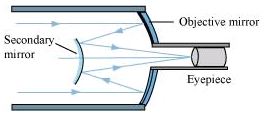
Distance between the objective mirror and the secondary mirror, d = 20 mm
Radius of curvature of the objective mirror, R1 = 220 mm
Hence, focal length of the objective mirror, \({ f }_{ 1 }=\frac { { R }_{ 1 } }{ 2 } =110\)
Radius of curvature of the secondary mirror, R1 = 140 mm
Hence, focal length of the secondary mirror, \({ f }_{ 2 }=\frac { { R }_{ 2 } }{ 2 } =\frac { 140 }{ 2 } \) = 70 mm
The image of an object placed at infinity, formed by the objective mirror, will act as a virtual object for the secondary mirror.
Hence, the virtual object distance for the secondary mirror, u = f1 - d
= 110 - 20
= 90 mm
Applying the mirror formula for the secondary mirror, we can calculate image distance (v) as:
\(\frac { 1 }{ v } +\frac { 1 }{ u } =\frac { 1 }{ { f }_{ 2 } } \)
\(\frac { 1 }{ v } =\frac { 1 }{ { f }_{ 2 } } -\frac { 1 }{ u } \)
\(\frac { 1 }{ 70 } -\frac { 1 }{ 90 } =\frac { 9-7 }{ 630 } =\frac { 2 }{ 630 } \)
∴ v = \(\frac{630}{2}\) = 315 mm
Hence, the final image will be formed 315 mm away from the secondary mirror.
25.
The focal length f = -15/2 cm = -7.5 cm
(i) The object distance u = -10 cm. Then Eq gives
\(\frac { 1 }{ v } +\frac { 1 }{ 10 } =\frac { 1 }{ -7.5 } \)
or \(v=\frac { 10\times 7.5 }{ -2.5 } =-30\) cm
The image is 30 cm from the mirror on the same side as the object
Also, magnification m = \(\frac { v }{ u } =-\frac { (-30) }{ (-10) } =-3\)
The image is magnified, real and inverted.
(ii) The object distance u = -5 cm. Then from Eq
\(\frac { 1 }{ v } +\frac { 1 }{ -5 } =\frac { 1 }{ -7.5 } \)
or \(v=\frac { 5\times 7.5 }{ (7.5-5) } =15\) cm
This image is formed at 15 cm behind the mirror. It is a virtual image.
Magnification m = 15 \(-\frac { v }{ u } =-\frac { 15 }{ (-5) } =3\)
The image is magnified, virtual and erect.
26.
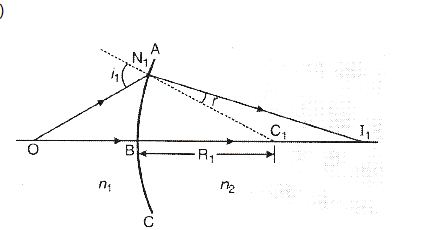
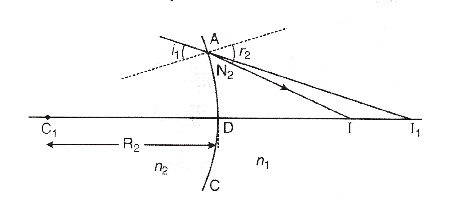
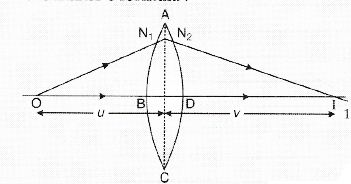
The first refracting ABC forms the image I1 of the object O. The image I1 acts as virtual object for the second refracting surface ADC, which forms the real image I as shown in the diagram
For refraction at ABC
\(\frac { { n }_{ 2 } }{ { v }_{ 1 } } -\frac { { n }_{ 1 } }{ u } =\frac { { n }_{ 2 }-{ n }_{ 1 } }{ { R }_{ 1 } } \)
For refraction at ADC
\(\frac { { n }_{ 1 } }{ v } -\frac { { n }_{ 2 } }{ { v }_{ 1 } } =\frac { { n }_{ 1 }-{ n }_{ 2 } }{ { R }_{ 2 } } \)
Adding equation (i) and equation (ii)
\(\frac { { n }_{ 1 } }{ v } -\frac { { n }_{ 2 } }{ u } =\left( { n }_{ 2 }-{ n }_{ 1 } \right) \left( \frac { 1 }{ { R }_{ 1 } } -\frac { 1 }{ { R }_{ 2 } } \right) \)
\(\frac { 1 }{ v } -\frac { 1 }{ u } =\left( \frac { { n }_{ 2 } }{ { n }_{ 1 } } -1 \right) \left( \frac { 1 }{ { R }_{ 1 } } -\frac { 1 }{ { R }_{ 2 } } \right) \)
We know, If \(u=\infty ,v=f\)
\(\frac { 1 }{ v } -\frac { 1 }{ u } =\frac { 1 }{ f } \)
\(\frac { 1 }{ f } =\left( \frac { { n }_{ 2 } }{ { n }_{ 1 } } -1 \right) \frac { 1 }{ { R }_{ 1 } } -\frac { 1 }{ { R }_{ 2 } } \)
\(\frac { 1 }{ f } =\left( { \mu }_{ 21 }-1 \right) \left( \frac { 1 }{ { R }_{ 1 } } -\frac { 1 }{ { R }_{ 2 } } \right) \)
\(\frac { 1 }{ f } =\left( { \mu }_{ 21 }-1 \right) \left( \frac { 1 }{ { R }_{ 1 } } -\frac { 1 }{ { R }_{ 2 } } \right) \)
\(\frac { 1 }{ f } =\left( 1.55-1 \right) \left( \frac { 1 }{ R } -\frac { 1 }{ -R } \right) \)
\(=0.55\times \frac { 2 }{ R } \)
\(R=0.55\times 2\times 20=22 \ cm\)
27.
(a) \(\overrightarrow{F}=I(\overrightarrow{l} \times \overrightarrow{B})\), where \(\overrightarrow{l}\) is a vector of magnitude l, the length of the rod, and with a direction identical to the current I. Note that the current I is not a vector. According to Fleming's left hand rule,\(\overrightarrow{B}\) must act horizontally in a direction perpendicular to the wire carrying current.
(b) Adaptation to different situations and flexible and adjustable attitude.
(c) Avoiding unnecessary arguments in conflicting situations in everyday life.
28.
(i) Here, \(\Delta m=1\quad a.m.u.=1.66\times { 10 }^{ -27 }kg\)
\(E=\left( \Delta m \right) { c }^{ 2 }=1.66\times { 10 }^{ -27 }{ \left( 3\times { 10 }^{ 8 } \right) }^{ 2 }=1.49\times { 10 }^{ -10 }J\)
(ii) Yes, in the phenomenon of pair production. Under suitable conditions, a photon materialises into an electron and a position : \(\gamma ={ e }^{ -1 }+{ e }^{ +1 }\)
(iii) Einstein's relation, \(E=\left( \Delta m \right) { c }^{ 2 }\) emphasis that when certain mass disappears, an equivalent amount of energy appears. The reverse is also true. It Implies that to gain something, you have to lose another in equivalent amount. No one can have all gains together or all losses together. It also implies that nothing come for free. You have to pay the price in one form and acquire something in the desired form.
29.
Since the electron has been localised within the nucleus (of size about \({ 10 }^{ -14 }\) m)of an atom, so \({ \lambda =10 }^{ -14 }\)
Momentum of electron,
\(p=\frac { h }{ \lambda } =\frac { 6.63\times { 10 }^{ -34 } }{ { 10 }^{ -14 } } =6.63\times { 10 }^{ -20 }kg{ ms }^{ -1 }\)
The relativistic relation for the energy of an electron is
\(E=\sqrt { { p }^{ 2 }{ c }^{ 2 }+{ { m }_{ 0 } }^{ 2 }{ c }^{ 4 } } \)
Neglecting the rest-mass energy term(i.e., second term), we have
\(E=pc=(6.63\times { 10 }^{ -20 })\times (3\times { 10 }^{ 8 })J\)
\( =\frac { 6.63\times 3\times { 10 }^{ -12 } }{ 1.6\times { 10 }^{ -13 } } MeV=124.3MeV\)
This energy E(=124.3MeV) is very large as compared to the binding energy which is provided by Coulomb's force within the nucleus. Since the energy of electron inside the nucleus, hence the electron does not reside the nucleus.

12th Standard CBSE Syllabus & Materials
12th Standard CBSE
CBSE 12th Computer Science Python Revision Tour I - New Previous year Question Papers Study Material - QB365 Set A
NEW12th Standard CBSE
CBSE 12th Business Studies Planning Important Questions And Answers Study Material - QB365 Set A
NEW12th Standard CBSE
CBSE 12th Business Studies Business Environment Important Questions And Answers Study Material - QB365 Set A
NEW12th Standard CBSE
CBSE 12th Business Studies Principles of Management Important Questions And Answers Study Material - QB365 Set A



CBSE 12th Standard CBSE Subjects
CBSE Standards










