
 100% FREE ACCESS
12th Standard CBSE Syllabus & Materials
12th Standard CBSE
CBSE 12th Economics Government Budget and the Economy Previous year Question Papers Study Material - QB365 Set A
NEW12th Standard CBSE
CBSE 12th Computer Science Interface Python with MySQL - New Previous year Question Papers Study Material - QB365 Set A
NEW12th Standard CBSE
CBSE 12th Computer Science Database Concept - New Previous year Question Papers Study Material - QB365 Set A
NEW12th Standard CBSE
CBSE 12th Computer Science Data Communication - New Previous year Question Papers Study Material - QB365 Set A
NEW12th Standard CBSE
CBSE 12th Computer Science Data Structures - New Previous year Question Papers Study Material - QB365 Set A
NEW12th Standard CBSE
CBSE 12th Computer Science Functions - New Previous year Question Papers Study Material - QB365 Set A

Published on: 15/02/2020
12th Standard CBSE Physics Public Model Question Paper II 2020
Download CBSE Class 12th Standard CBSE Physics question papers, sample papers, important questions, and previous year solved papers in PDF format. Get free study materials, NCERT solutions, and exam preparation resources for Class 12th Standard CBSE Physics
Questions + Answers key
Take MCQ Physics Test
1.
Use Biot-Savart's law to derive the expression for the magnetic field on the axis of a current carrying circular loop of radius R. Draw the magnetic field lines due to a circular wire carrying current (I).
2.
An inductor of inductance 200 mH is connected to an a.c source of peak emf 210 V and frequency 50 Hz. Calculate the peak current. What is the instantaneous value of voltage when current is at its peak value?
3.
Given a uniform electric field
\(\overrightarrow { E } =5\times 10^{ 3 }\hat { i } NC^{ -1 }\)
Find the flux of this field through a square of 10 cm on a side., whose plane is parallel to Y-Z plane. What would be the flux through the same square if plane makes an angle of 30o with X-axis?
4.
An electrical technician requires a capacitance of \(2\mu F\) in his circuit across a potential difference of 1 kV.A large number of \(1\mu F\) capacitor are available to him each of which can withstand a potential difference of not more than 400 V.Suggest a possible arrangement that requires the minimum number of capacitors.
5.
An AC source of voltage V = V0 sin rot is connected to a series combination of L, C and R. Use the phasor diagram to obtain expressions for impedance of the circuit and phase angle between voltage and current. Find the condition when current will be in phase with the voltage. What is the circuit in the condition called?
6.
The electron in a hydrogen atom circles around the proton with a speed of 2.18 x 10⁶ ms-1 in an orbit of radius 5.3 x 10⁻¹¹ m. Calculate (a) the equivalent current (b) magnetic field produced at the proton. Give charge on electron is 1.6 x 10⁻¹⁹ C and \({ \mu }_{ o }=4\pi \times { 10 }^{ -7 }Tm{ A }^{ -1 }.\)
7.
Four persons went on an excursion on a hilltop where the temperature was quite low. one of them fell sick. The other persons put a blanket on him, collected the pieces of dry wood and ignited a fire in his vicinity. After some time the sick person felt better
Read the above passage and answer the following question
(i) What is the type of rays coming from fire?
(ii) Why did the sick person feel better while seating near the fire?
(iii) What basic values do you learn from this study?
8.
What is the root mean square value of current or effective current of an a.c. having a peak value of 5.0 amp? What will be the reading shown for this current by
(i) an a.c. ammeter
(ii) an ordinary moving coil ammeter?
9.
When a current of 10 ampere is flowing through a resistance of 20 ohm and inductance of 10 henry, the battery is switched off. Find
(i) current after 0.4 sec
(ii) the time the current takes to fall to 60% of its initial value.
10.
A parallel plate capacitor made of circular plates each of radius 10 cm has a capacity 200 pF. The capacitor is connected to a 230 V a.c. supply with an angular frequency of 400 rad s-1.
(i) What is the rms value of the conduction current?
(ii) Find the amplitude of \(\overrightarrow { B } \) at a point 2.0 cm from the axis of the plates.
11.
Calculate the peak values of electric and magnetic fields produced by the radiation coming from a 100 watt bulb at a distance of 3 m. Assume that the efficiency of the bulb is 2.5% and it is a point source?
12.
Derive an expression for average power in an A.C. circuit containing resistor only.
13.
A charged Particle q is shot towards another charged particle Q which is fixed , with a speed v. It approaches Q up to a closet distance r and then returns, If q were given a speed 2 v the n find the closet distance of approach.
14.
A point charge of 2.0 \(\mu\)C is at the centre of a cubic Gaussian surface 9.0 cm on edge. What is the net electric flux through the surface?
15.
Using the concept of force between two infinitely long parallel current carrying conductors, define one ampere of current.
16.
At 0oC, the resistance of a conductor B is n times that of conductor A. The temperature coefficients of resistance of A and B are \(\alpha_1\) and \(\alpha_2\) respectively. For the series combination of the two conductors find (a) the resistance at 0oC (b) the temperature coefficient of resistance.
17.
Why is choke coil needed in the use of fluorescent tubes with ac mains?
18.
The car battery is 12 volts. 8 simple cells connected in series can give 12 volt. But such cells are not used in starting a car; why?
19.
When a number of capacitors are connected in parallel between two points, the equivalent capacitance
increases
decreases
remains the same
none of the above
20.
A long straight wire of radius a carries a steady current i. The current is uniformly distributed across its cross-section. The ratio of the magnetic field at a/2 and 2 a is
1/2
1/4
4
1
21.
The total e.m. power of the sun is
\(5.6\times { 10 }^{ 20 }W\)
\(5.6\times { 10 }^{ 22 }W\)
\(5.6\times { 10 }^{ 26 }W\)
\(5.6\times { 10 }^{ 30 }W\)
22.
A wire of length 2m moves with a speed of 5m/s perpendicular to a magnetic field of induction 0.1 Wb/m2. The e.m.f. induced in the wire is
1 V
10 V
5 V
2 V
23.
The torque acting on an electric dipole of moment p held at an angle \(\theta\) with an electric field E is ............
1.
Let us consider a circular loop of radius a with centre C. Let the plane of the coil be
perpendicular to the plane of the paper and current I be flowing in the direction as shown in the figure. Suppose P is any point on the axis at a direction from the centre.
s.png)
Now, consider a current element Idl on top (L) where current comes out of paper normally, whereas at bottom (M) enters into the plane of paper normally.
\(\because LP \bot Idl\)
Also \(MP \bot Idl\)
\(\because LP=MP=\sqrt{r^{2}+a^{2}}\)
The magnetic field at point P due to current element Idl. According to Biot-Savart's law,
dB = \(\frac{\mu_0}{4\pi}.\frac{Idl sin 90^{0}}{(r^{2}+a^{2})}\)
where, a = radius of circular loop,
r = distance of point P from centre along the axis. The direction of dB is perpendicular to LP and along PQ, where \(PQ \bot LP\) Similarly, the same magnitude of magnetic field is obtained due to current element Idl at the bottom and direction is along PQ', where \(PQ^{'} \bot MP\).
Now, resolving dB due to current clement at Land M dB cos \(\phi\) components balance each other and net magnetic field is given by
B = \(\oint dB sin \phi = \oint \frac{\mu_0 }{4\pi} (\frac{Idl}{r{2}+a^{2}}).\frac{a}{\sqrt{r^{2}+a^{2}}}\)
\([\therefore In \Delta PCL, sin \phi = \frac{a}{\sqrt{r^{2}+a^{2}}}]\)
\(=\frac{\mu_0}{4\pi} \frac{Ia}{(r^{2}+a^{2})^{3/2}} \oint dl=\frac{\mu_0}{4\pi}\frac{Ia}{(r^{2}+a^{2})^{3/2}}(2\pi a)\)
or \(B=\frac{\mu_0Ia^{2}}{2(r^{2}+a^{2})^{3/2}}\)
For N turns, B = \(\frac{\mu_0 N Ia^{2}}{2(r^{2}+a^{2})^{3/2}}\) Tesla.
The diagram of magnetic field lines due to a circular wire carrying current I is.
s.png)
2.
Here, \(L=200mH=200\times 10^{ -3 }H\) , \(E_{ 0 }=210\ V\),
\(v=50\ Hz,\ I_{ 0 }=?\)
\(I_{ 0 }=\frac { E_{ 0 } }{ { X }_{ L } } =\frac { E_{ 0 } }{ \omega L } =\frac { E_{ 0 } }{ 2\pi vL } =\frac { 210 }{ 2\times 3.14\times 50\times 0.2 } \)
\(=3.3 \ A\)
Through L, current lags behind the voltage by a phase angle of 90o. Therefore, when current is at its peak value, voltage must be zero.
3.
Here \(\overrightarrow { E } =5\times 10^{ 3 }\hat { i } NC^{ -1 }\)
A = (10 cm)2 = (10-1m)2 = 10-2m2
When plane is || to Y-Z plane, \(\theta =0^o\)
\(\phi=EA \ cos \theta=(5\times 10^3)\times 10^{-2}cos \ 0^o\)
= 50 Nm2C-1
When plane makes an angle of 30o with X-axis,
\(\theta =60^o\)
\(\phi'=EA \ cos\theta=5\times 10^3\times10^{-2}cos \ 60^o\)
\(=25 Nm^2C^{-1}\)
4.
Total required capacitance, C = 2 µF
Potential difference, V = 1 kV = 1000 V
Capacitance of each capacitor, C1 = 1 µF
Each capacitor can withstand a potential difference, V1 = 400 V
Suppose a number of capacitors are connected in series and these series circuits are connected in parallel (row) to each other. The potential difference across each row must be 1000 V and potential difference across each capacitor must be 400 V. Hence, number of capacitors in each row is given as \(\frac{1000}{400}=2.5\)
Hence, there are three capacitors in each row.
Capacitance of each row \(=\frac{1}{1+1+1}=\frac{1}{3} \mu \mathrm{F}\)
Let there are n rows, each having three capacitors, which are connected in parallel. Hence, equivalent capacitance of the circuit is given as
\(\frac{1}{3}+\frac{1}{3}+\frac{1}{3}+\ldots \ldots \ldots \ldots \ldots \ldots . n \text { terms }\)
\(=\frac{n}{3}\)
However, capacitance of the circuit is given as 2 \(\mu \) F
\(\therefore \frac{n}{3}=2\)
n = 6
Hence, 6 rows of three capacitors are present in the circuit. A minimum of 6 x 3 i.e., 18 capacitors are required for the given arrangement.
5.
If I is the current in the circuit containing inductor of inductance L, capacitor of capacitance C and resistor of resistance R in series, then the voltage drop across the inductor is
s.png)
which leads current I by phase angle of \(\pi/2\), and voltage drop across the capacitor is V2 = 1 X XC. which lags behind current I by phase angle of \(\pi/2\) and voltage drop across the resistor is VR = IR which is in phase with current I. So the net voltage E across the circuit is (using phasor diagram)
s.png)
E = \(\sqrt{{V }_{ R }^{ 2 }+{({V}_{L}-{V}_{C})}^{2}}\)
\(\Rightarrow\) \(E=I\sqrt{{R}^{2}+{({X}_{L}-{X}_{C})}^{2}}\Rightarrow E=IZ\)
where,Z = \(\sqrt{{R}^{2}+{({X}_{L}-{X}_{C})}^{2}}\) is known as impedance, Phase angle between voltage and current is given by \(tan\ \phi={{{V}_{L}-{V}_{C}}\over{{V}_{R}}}={{{X}_{L}-{X}_{C}}\over{{R}}}.\) A series L-C-R circuit its natural angular frequency, \(\omega={{1}\over{\sqrt{LC}}}\) and natural ( resonating ) frequency, v = \({{1}\over{2\pi\sqrt{LC}}}\)
when the applied AC in the circuit has this frequency the series L-C-R circuit offers minimum impedance i.e. only R and current at this frequency flows maximum. In the case of resonance, voltage and current are in same phase. Above mentioned condition is known as condition of resonance. In this condition (1)
Inductive and capacitive reactances are equal
\({X}_{L}={X}_{C}\Rightarrow\omega L={{1}\over{\omega C}}\Rightarrow \omega={{1}\over{\sqrt{LC}}}\) \([\because \ \omega=2\pi v]\)
\(\Rightarrow\) v = \({ { 1 }\over{ 2\pi\sqrt{LC} } }\)
Potential. drop across inductor and capacitor are equal. VL = VC
The series resonant circuit is also called an acceptor circuit because when a number of different frequency currents are into the circuit, the circuit offers minimum impedance to natural frequency current.
For L-R circuit, XL = R
Power factor,P1= cos\(\phi\)
= \({{R}\over{\sqrt{{R}^{2}+{({X}_{L}-{X}_{C})}^{2}}}}={{R}\over{\sqrt{{R}^{2}+{({X}_{L}-{X}_{L})}^{2}}}}={{R}\over{R}}=1\)
Required ratio = \({{{P}_{1}}\over{{P}_{2}}}={{1}\over{\sqrt{2}}}\)
6.
Here, v=2.18 x 10⁶ ms-1,
r=5.3 x 10⁻¹¹ m, e=1.6 x 10⁻¹⁹ C.
(a) Time period of revolution of electron is given by,
\(T=\frac { 2\pi r }{ v } =\frac { 2\pi \times 5.3\times { 10 }^{ -11 } }{ 2.18\times { 10 }^{ 6 } } =1.528\times { 10 }^{ -16 }s\)
Equivalent current, \(I=\frac { charge }{ time } =\frac { e }{ T } \)
\(=\frac { 1.6\times { 10 }^{ -19 } }{ 1.528\times { 10 }^{ -16 } } =1.05\times { 10 }^{ -3 }A\)
\((b)B=\frac { { \mu }_{ o } }{ 4\pi } \frac { 2\pi I }{ r } =\frac { { 10 }^{ -7 }\times 2\pi \times 1.05\times { 10 }^{ -3 } }{ 5.3\times { 10 }^{ -11 } } \)
=12.4 T
7.
(i) The rays coming from fire are yellow, red and infrared rays
(ii) The infrared rays coming from fire provide soothing effect to the body muscles of the sick person sitting near the fire, Due to it, the sick person feel better after some time
(iii) From the above study we learn that presence of mind and proper use of the things available help ton save a difficult situation
8.
Here, Iv = ? I0 = 5.0 A
As \({ I }_{ v }=\frac { { I }_{ 0 } }{ \sqrt { 2 } } \)
\(\therefore \ \ { I }_{ v }=\frac { 5 }{ \sqrt { 2 } } \times \frac { \sqrt { 2 } }{ \sqrt { 2 } } =\frac { 5\times 1.414 }{ 2 } =3.54A\)
(i) An a.c. ammeter will read 3.54 ampere
(ii) An ordinary moving coil ammeter will read zero because it records average value of current over a complete cycle, which is zero in case of alternating current.
9.
Here, I0 = 10A, R = 20\(\Omega \), L = 10H
(i) I = ?, t = 0.4 sec.
During decay, I = I0 e-(R/L) t = 10e-20\(\times\)0.4/10 = 10e-0.8
log10 I = log1010 - 0.8 log10e
= 1-0.8\(\times\)log10 2.718 = 1-0.8\(\times\)0.4343
log10 I = 1-0.3474 = 0.6526
I = antilog 0.6526 = 4.49A
(ii) t = ? I =\(\frac { 60 }{ 100 } \) I0 From I = I0 e(-R/L) t
\(\frac { I }{ { I }_{ 0 } } ={ e }^{ (-R/L)t }\ ;\ \frac { 60 }{ 100 } \ { e }^{ \frac { -20 }{ 10 } t }\ =\ { e }^{ -2t }\)
log10 6 - log1010 = -2t log10e
0.7782 - 1.0000 = 1.0000 = -2 t\(\times\) 0.4343
or -0.2218 = -t\(\times\)0.8686
t = \(\frac { 2.2218 }{ 0.8686 } \) = 0.255s
10.
Here, R = 10 cm = 0.10 cm;
C = 200 pF = 200 x 10-12 F,
\(\omega\)=400 rad s-1 , Vrms = 230 V.
(i) \({ I }_{ rms }=\frac { { V }_{ rms } }{ { X }_{ C } } =\frac { { V }_{ rms } }{ 1/\omega C } ={ V }_{ rms }\times \omega C\)
= 230 x 400 x (200 x 10-12)
= 18.4 x 10⁻⁶ A = 18.4 \(\mu A\)
(ii) Magnetic field at a distance r from the axis of plates is
\(B=\frac { { \mu }_{ 0 } }{ 2\pi } \frac { r }{ { R }^{ 2 } } I\) [See Solved Example 5]
Amplitude of \(\overrightarrow { B } \) is given by
\({ B }_{ 0 }=\frac { { \mu }_{ 0 } }{ 2\pi } \frac { r }{ { R }^{ 2 } } { I }_{ 0 }=\frac { { \mu }_{ 0 } }{ 2\pi } \frac { r }{ { R }^{ 2 } } { I }_{ rms }\sqrt { 2 } \)
\(\left[ \because { I }_{ rms }={ I }_{ 0 }/\sqrt { 2 } \right] \)
Here, r = 2.0 cm = 2.0 x 10⁻² m ; R = 0.10 m.
\(\therefore { B }_{ 0 }=\frac { \left( 4\pi \times { 10 }^{ -7 } \right) }{ 2\pi } \times \frac { 2.0\times { 10 }^{ -2 } }{ { \left( 0.10 \right) }^{ 2 } } \times \left( 18.4\times { 10 }^{ -6 } \right) \)
= 1.04 x 10⁻¹¹
11.
Useful Intensity,
\(I=\frac { power }{ area } =\frac { 100\times \left( 2.5/100 \right) }{ 4\pi { \left( 3 \right) }^{ 2 } } =\frac { 2.5 }{ 36\pi } W{ m }^{ -2 }\)
Half of this intensity (I) belongs to electric field and half of that to magnetic field. Therefore,
\(\frac { I }{ 2 } =\frac { 1 }{ 4 } { \varepsilon }_{ 0 }{ E }_{ 0 }^{ 2 }c \ or \ { E }_{ 0 }=\sqrt { \frac { 2I }{ { \varepsilon }_{ 0 }c } } \)
\(=\sqrt { \frac { 2\times \left( 2.5/36\pi \right) }{ \left( \frac { 1 }{ 4\pi \times 9\times { 10 }^{ 9 } } \right) \times \left( 3\times { 10 }^{ 8 } \right) } } =4.08V{ m }^{ -1 }\)
\({ B }_{ 0 }=\frac { { E }_{ 0 } }{ c } =\frac { 4.08 }{ 3\times { 10 }^{ 8 } } =1.36\times { 10 }^{ -8 }T\)
12.
Power is the rate of doing work. In A.C current and voltage change at every moment. Since power is the product of instantaneous voltage and current, therefore it changes at every moment.
To determine average power in a circuit containing pure resistor, determine total energy spent in one cycle and divide it by the period.
Instantaneous power \(=EI=\left[ { E }_{ 0 }sin\omega t \right] \left[ { I }_{ 0 }sin\omega t \right] \)
Instantaneous work done in small interval dt is
\( \ dW=EI \ dt={ E }_{ 0 }{ I }_{ 0 }{ sin }^{ 2 }\omega t \ dt\)
\(W=\int _{ 0 }^{ T }{ { E }_{ 0 }{ I }_{ 0 }{ sin }^{ 2 }\omega t \ dt }\)
\(W={ E }_{ 0 }{ I }_{ 0 }\int _{ 0 }^{ T }{ { \left( \frac { 1-cos2\omega t }{ 2 } \right) }dt } \)
\(=\left[ \because \int _{ 0 }^{ T }{ dt } -\int _{ 0 }^{ T }{ cos2\omega t } \right]\)
\(or \ \ W=\frac { { E }_{ 0 }{ I }_{ 0 } }{ 2 } \left[ T-0 \right] =\frac { { E }_{ 0 }{ I }_{ 0 } }{ 2 } T\)
\( \left[ \because \int _{ 0 }^{ T }{ dt } -\int _{ 0 }^{ T }{ cos2\omega t } \right] =0\)
\(or \ \ { P }_{ av }=\frac { W }{ T } =\frac { { E }_{ 0 }{ I }_{ 0 } }{ 2 } =\frac { { E }_{ 0 } }{ \sqrt { 2 } } .\frac { { I }_{ 0 } }{ \sqrt { 2 } } \)
\(\ {P }_{ av }={ E }_{ v }{ I }_{ v }\)
\(\therefore\) Average power over a complete cycle of a.c through a resistor is the product of virtual voltage and virtual current.
13.
q \(\rightarrow\)_______Q
1/2 mv2 = kQq/r
Or, v2 a1/r
Or, r a 1/v2
Or, r' = r/4
14.
Let us consider a charge q is placed at the centre of a cubic Gaussian surface. As per the question,
q = 2 \(\mu\)C = 2 \(\times\) 10-6 C
Length of edge of = 9 cm ....(1)
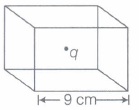
According to Gauss' theorem, the net electric flux \((\phi)\) through the surface is given by
\(\phi=\frac { q }{ { \varepsilon }_{ 0 } }=\frac { 2\times { 10 }^{ -6 } }{ 8.854\times { 10 }^{ -12 } }=2.26\times{ 10 }^{ 5 }\) N - m2 /c
Thus, the net electric flux through the surface is 2.26 \(\times\) 105 N-m2 /C.
15.
One ampere of current can be defined as the amount of current which when flows through two infinitely long parellel wires seperated by one metere produces an attractive foce 2 x 10⁻⁷N/m.
16.
Let R0 be the resistance of the conductor at 0oC. Then resistance of conductor B at 0oC = n R0.
Resistance of conductor A at \(\theta^oC\),
R1 = R0(1 + \(\alpha_1 \theta\))
Resistance of conductor A at \(\theta^oC\) ,
R2 = n R0(1 + \(\alpha_2 \theta\))
Total resistance,
Rs = R1 + R2
= R0(1 + \(\alpha_1 \theta\)) + n R0(1 + \(\alpha_2 \theta\))
= \((1+n)R_0[1+\frac{\alpha_1+n \alpha_2}{1+n}\theta]\)
Comparing this relation with
Rs = Rs0 [ 1 + \(\alpha_s \theta\))
We have, resistance of series combination at \(\theta^oC\)
Rs0 = (1 + n)R0
Temperature coefficient of resistance of the series combination is
\(\alpha_s=\frac{\alpha_1+n\alpha_2}{1+n}\)
17.
A choke coil reduces the voltage across the fluorescent tube without wastage of power.
18.
To start a car, a high current is required which cannot be obtained from the series combination of 8 simple cells, because their internal resistance is of the order of \(10 Ω \) while the resistance of the car battery is only of the order of \(0.1 Ω.\)
19.
(a)
increases
20.
(d)
1
21.
(c)
\(5.6\times { 10 }^{ 26 }W\)
22.
(a)
1 V
23.
()
\(\tau=pE sin\theta\)

12th Standard CBSE Syllabus & Materials
12th Standard CBSE
CBSE 12th Computer Science Python Revision Tour I - New Previous year Question Papers Study Material - QB365 Set A
NEW12th Standard CBSE
CBSE 12th Business Studies Planning Important Questions And Answers Study Material - QB365 Set A
NEW12th Standard CBSE
CBSE 12th Business Studies Business Environment Important Questions And Answers Study Material - QB365 Set A
NEW12th Standard CBSE
CBSE 12th Business Studies Principles of Management Important Questions And Answers Study Material - QB365 Set A



CBSE 12th Standard CBSE Subjects
CBSE Standards










