
 100% FREE ACCESS
12th Standard CBSE Syllabus & Materials
12th Standard CBSE
CBSE 12th Economics Government Budget and the Economy Previous year Question Papers Study Material - QB365 Set A
NEW12th Standard CBSE
CBSE 12th Computer Science Interface Python with MySQL - New Previous year Question Papers Study Material - QB365 Set A
NEW12th Standard CBSE
CBSE 12th Computer Science Database Concept - New Previous year Question Papers Study Material - QB365 Set A
NEW12th Standard CBSE
CBSE 12th Computer Science Data Communication - New Previous year Question Papers Study Material - QB365 Set A
NEW12th Standard CBSE
CBSE 12th Computer Science Data Structures - New Previous year Question Papers Study Material - QB365 Set A
NEW12th Standard CBSE
CBSE 12th Computer Science Functions - New Previous year Question Papers Study Material - QB365 Set A

Published on: 15/02/2020
12th Standard CBSE Physics Public Model Question Paper III 2019 - 2020
Download CBSE Class 12th Standard CBSE Physics question papers, sample papers, important questions, and previous year solved papers in PDF format. Get free study materials, NCERT solutions, and exam preparation resources for Class 12th Standard CBSE Physics
Questions + Answers key
Take MCQ Physics Test
1.
The refractive index of water is 4/3. Obtain the value of the semivertical angle of the cone within which the entire outside view would be confined for a fish under water. Draw an appropriate ray diagram
2.
A charged Particle q is shot towards another charged particle Q which is fixed , with a speed v. It approaches Q up to a closet distance r and then returns, If q were given a speed 2 v the n find the closet distance of approach.
3.
Why should electrostatic field be zero inside a conductor?
4.
Can a.c. source be connected to a circuit and yet deliver no power to it? If so, under what circumstances?
5.
When a transistor is used as an oscillator, why is it necessary to feed back energy to \(L-C\) circuit?
6.
When cells are connected in parallel, what will be the effect on
(i) current capacity
(ii) e.m.f of the cells.
7.
What should be charge on a sphere of radius 2cm so that when it is brought in contact with another sphere of radius 5cm carrying a charge of \(10\mu C\), there is no net transfer of charge between the spheres?
8.
Band width refers to ------------- over which the communication system works.
9.
According to.............law, the polarity of.............is such that it..............responsible for.............. .
10.
The velocity of electromagnetic waves in free space can be given by relation......
11.
If the reflected ray is rotated by an angle of 4\(\theta\) in clockwise direction then the mirror was rotated by
2\(\theta\) in anti-clockwise direction
4\(\theta\) in anti-clockwise direction
2\(\theta\) in clockwise direction
4\(\theta\) in clockwise direction
12.
In a cyclotron a charged particle
undergoes acceleration all the time
speeds up between the dees because of the magnetic field.
speeds up in a dee
slows down within a dee and speeds up between dees.
13.
The lens used for correcting myopia is
concave
convex
Plano concave
none of these
14.
In the Bohr model of the hydrogen atom, let R, V and E represent the radius of the orbit, speed of the \({ e }^{ - }\) and total energy of the \({ e }^{ - }\) respectively. Which of the following quantities are proportional to the quantum number n?
VR
RE
\(\frac { V }{ E } \)
\(\frac { R }{ E } \)
15.
Ampere's circuital law can be derived from
Ohm's law
Biot-Savart's law
Kirchhoff's law
Gauss's law
16.
The correct relation between electric intensity E and electric potential V is
\(E=-{dV\over dr}\)
\(E={dV\over dr}\)
\(V=-{dE\over dr}\)
\(V={dE\over dr}\)
17.
Force \(\overrightarrow { F } \) acting on a test charge qo in a uniform electric field \(\overrightarrow { E } \) is
\(\overrightarrow { F } =q_{ o }\overrightarrow { E } \)
\(\overrightarrow { F } =\frac { \overrightarrow { E } }{ q_{ o } } \)
\(\overrightarrow { F } =\frac { \overrightarrow { q_o } }{\overrightarrow { E } } \)
\(\overrightarrow { F } =q_{ o }^{ 2 }\overrightarrow { E } \)
18.
An n-p-n transistor having a.c. current gain of 50 to be used to make an amplifier of power gain of 300. What will be the voltage gain of the amplifier
8.5
6
4
3
19.
Consider a beam of electrons (each with energy E0) incident on a metal surface kept in an evacuated chamber. Then
no electrons will be emitted as only photons can emit electrons
electrons can be emitted but all with an energy E0
electrons can be emitted with any energy, with a maximum of \({ E }_{ 0 }-\phi \)(\(\phi \)is the work function)
electrons can be emitted with any energy, with a maximum of E0
20.
The sun delivers of electromagnetic\({ 10 }^{ 3 } \ W/{ m }^{ 2 }\) flux to the earth surface. The total power that is incident on a roof of dimension 8 m\(\times \) 20 m, will be
\(2.56\times { 10 }^{ 4 }W\)
\(6.4\times { 10 }^{ 5 }W\)
\(4.0\times { 10 }^{ 5 }W\)
\(1.6\times { 10 }^{ 5 }W\)
21.
The cause of induced e.m.f. is
magnetic flux
magnetic field
area
change in magnetic flux
22.
A Cassegrain telescope uses two mirrors as shown in Fig.Such a telescope is built with the mirrors 20mm apart. If the radius of curvature of the large mirror is 220mm and the small mirror is 140mm, where will the final image of an object at infinity be?
23.
(i) If f = 0.5 m for a glass lens, what is the power of the lens?
(ii) The radii of curvature of the faces of a double convex lens are 10 cm and 15 cm. Its focal length is 12 cm. What is the refractive index of glass?
(iii) A convex lens has 20 cm focal length in air. What is focal length in water? (Refractive index of air-water = 1.33, refractive index for air-glass = 1.5.)
24.
(a) A point object is placed in front of a double convex lens (of refractive index n =n2/n1 with respect air) with its spherical faces of radii of curvature R1 and R2.. Show the path of rays due to surface to obtain the formation of the real image of the object.
Hence obtain the lens maker's formula for a thin lens.
(b) A double convex lens having both faces of the same radius of curvature has refractive index 1.55. Find out the radius of curvature of the lens required to get the focal length of 20 cm.
25.
Niyaz was using galvanometer in the practical class. Unfortunately, it fell from his hand and broke. He was upset, some of his friends advised him not to tell the teacher but Niyaz decided to tell his teacher. Teacher listened to him patiently and on knowing that the act was not intentional, but just an accident, did not scold him and used the opportunity to show the internal structure of galvanometer.
(i) What are the values displayed by Niyaz?
(ii) Give the principle of moving coil galvanometer.
(iii) How can you increase the sensitivity of a galvanometer?
26.
Photoelectrons are emitted from a metal surface when ultraviolet light of wavelength 300nm is incident on it. The minimum negative potential required to stop the emission of electrons is 0.54V. Calculate:
(i) the energy of the incident photons
(ii) the maximum kinetic energy of the photoelectrons emitted
(iii) the work function of the metal
Express all answers in eV.
\(Use\ h=6.63\times { 10 }^{ -34 }Js\)
27.
The self inductance of a coil having 200 turns is 10mH. Compute the total flux linked with the coil. Also, determine the magnetic flux through the cross section of the coil, corresponging to curent of 4mA.
28.
A long straight horizontal cable carries a current of 3.3 A in the direction 10o south of west to 10o north of east. The magnetic meridian of the place happens to be 10o west of the geographic meridian. The earth's magnetic field and location is 0.33 G and the angle of dip is zero degree. Locate the positions of neutral points?
29.
The carrier frequency of a station is 50 MHz.A resistor of \(10k\Omega \)and a capacitor drops to 10 pF are available in the detector circuit.Is it good enough for detection?
1.
Clearly , the fish can see the outside view of the cone with semi vertical angle
But \(\mu \) = 1.sin ic
or 1/3 = 1/ sin ic
or sin ic = 3/4 = 0.75
\(\theta\)/2 =ic = sin-1 (0.75 ) = 48.60
2.
q \(\rightarrow\)_______Q
1/2 mv2 = kQq/r
Or, v2 a1/r
Or, r a 1/v2
Or, r' = r/4
3.
Electric field lines do not pass through a conductor.Hence, the interior of the conductor is free from the influence of the electric field
4.
Yes, this would happen when phase difference between alternating voltage and alternating current is \({ 90 }^{ \circ }.\) It can happen when the circuit contains pure L or pure C.
5.
This is done in order to compensate for loss of energy due to resistance in L-C oscillatory circuit and hence to produce undamped electromagnetic waves or carriers waves.
6.
(i) Current capacity from the combination of cells is the total current available from the cell. Current capacity increases for the parallel combination of cells.
(ii) The effect e.m.f. of the cells of equal e.m.f. in parallel will be equal to e.m.f. of one cell.
7.
\(4\mu C\)
8.
()
range of frequencies
9.
()
Lenz's; emf induced; opposes the change in magnetic flux; its production.
10.
()
\(c=\frac { 1 }{ \sqrt { { \mu }_{ 0 }{ \epsilon }_{ 0 } } } \)
11.
(a)
2\(\theta\) in anti-clockwise direction
12.
(a)
undergoes acceleration all the time
13.
(a)
concave
14.
(a)
VR
15.
(b)
Biot-Savart's law
16.
(a)
\(E=-{dV\over dr}\)
17.
(a)
\(\overrightarrow { F } =q_{ o }\overrightarrow { E } \)
18.
(b)
6
19.
(d)
electrons can be emitted with any energy, with a maximum of E0
20.
(d)
\(1.6\times { 10 }^{ 5 }W\)
21.
(d)
change in magnetic flux
22.
The following figure shows a Cassegrain telescope consisting of a concave mirror and a convex mirror.
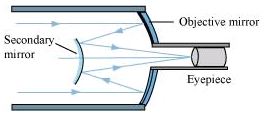
Distance between the objective mirror and the secondary mirror, d = 20 mm
Radius of curvature of the objective mirror, R1 = 220 mm
Hence, focal length of the objective mirror, \({ f }_{ 1 }=\frac { { R }_{ 1 } }{ 2 } =110\)
Radius of curvature of the secondary mirror, R1 = 140 mm
Hence, focal length of the secondary mirror, \({ f }_{ 2 }=\frac { { R }_{ 2 } }{ 2 } =\frac { 140 }{ 2 } \) = 70 mm
The image of an object placed at infinity, formed by the objective mirror, will act as a virtual object for the secondary mirror.
Hence, the virtual object distance for the secondary mirror, u = f1 - d
= 110 - 20
= 90 mm
Applying the mirror formula for the secondary mirror, we can calculate image distance (v) as:
\(\frac { 1 }{ v } +\frac { 1 }{ u } =\frac { 1 }{ { f }_{ 2 } } \)
\(\frac { 1 }{ v } =\frac { 1 }{ { f }_{ 2 } } -\frac { 1 }{ u } \)
\(\frac { 1 }{ 70 } -\frac { 1 }{ 90 } =\frac { 9-7 }{ 630 } =\frac { 2 }{ 630 } \)
∴ v = \(\frac{630}{2}\) = 315 mm
Hence, the final image will be formed 315 mm away from the secondary mirror.
23.
(i) Power = +2 dioptre.
(ii) Here, we have f = +12 cm, R1 = +10 cm, R2 = -15 cm.
Refractive index of air is taken as unity.
We use the lens formula. The sign convention has to be applied for f, R1 and R2.
Substituting the values, we have
\(\frac { 1 }{ 12 } =(n-1)\left( \frac { 1 }{ 10 } -\frac { 1 }{ 15 } \right) \)
This gives n = 1.5.
(iii) For a glass lens in air, n2 = 1.5, n1 = 1, f = +20 cm. Hence, the lens formula gives
\(\frac { 1 }{ 20 } =0.5\left( \frac { 1 }{ { R }_{ 1 } } -\frac { 1 }{ { R }_{ 2 } } \right) \)
For the same glass lens in water, n2 = 1.5, n1 = 1.33. Therefore \(\frac { 1.33 }{ f } =(1.5-1.33)\left[ \frac { 1 }{ { R }_{ 1 } } -\frac { 1 }{ { R }_{ 2 } } \right] \)
Combining these two equations, we find f = + 78.2 cm.
24.
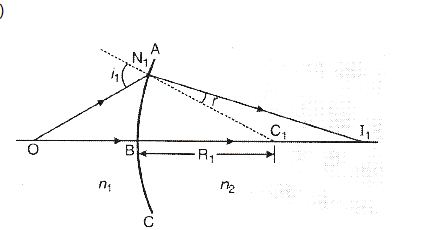
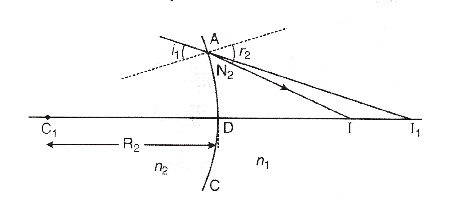
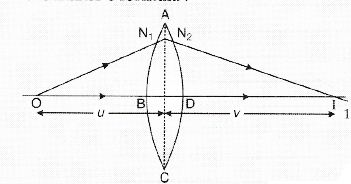
The first refracting ABC forms the image I1 of the object O. The image I1 acts as virtual object for the second refracting surface ADC, which forms the real image I as shown in the diagram
For refraction at ABC
\(\frac { { n }_{ 2 } }{ { v }_{ 1 } } -\frac { { n }_{ 1 } }{ u } =\frac { { n }_{ 2 }-{ n }_{ 1 } }{ { R }_{ 1 } } \)
For refraction at ADC
\(\frac { { n }_{ 1 } }{ v } -\frac { { n }_{ 2 } }{ { v }_{ 1 } } =\frac { { n }_{ 1 }-{ n }_{ 2 } }{ { R }_{ 2 } } \)
Adding equation (i) and equation (ii)
\(\frac { { n }_{ 1 } }{ v } -\frac { { n }_{ 2 } }{ u } =\left( { n }_{ 2 }-{ n }_{ 1 } \right) \left( \frac { 1 }{ { R }_{ 1 } } -\frac { 1 }{ { R }_{ 2 } } \right) \)
\(\frac { 1 }{ v } -\frac { 1 }{ u } =\left( \frac { { n }_{ 2 } }{ { n }_{ 1 } } -1 \right) \left( \frac { 1 }{ { R }_{ 1 } } -\frac { 1 }{ { R }_{ 2 } } \right) \)
We know, If \(u=\infty ,v=f\)
\(\frac { 1 }{ v } -\frac { 1 }{ u } =\frac { 1 }{ f } \)
\(\frac { 1 }{ f } =\left( \frac { { n }_{ 2 } }{ { n }_{ 1 } } -1 \right) \frac { 1 }{ { R }_{ 1 } } -\frac { 1 }{ { R }_{ 2 } } \)
\(\frac { 1 }{ f } =\left( { \mu }_{ 21 }-1 \right) \left( \frac { 1 }{ { R }_{ 1 } } -\frac { 1 }{ { R }_{ 2 } } \right) \)
\(\frac { 1 }{ f } =\left( { \mu }_{ 21 }-1 \right) \left( \frac { 1 }{ { R }_{ 1 } } -\frac { 1 }{ { R }_{ 2 } } \right) \)
\(\frac { 1 }{ f } =\left( 1.55-1 \right) \left( \frac { 1 }{ R } -\frac { 1 }{ -R } \right) \)
\(=0.55\times \frac { 2 }{ R } \)
\(R=0.55\times 2\times 20=22 \ cm\)
25.
(i) Niyaz shows the values of courage to tell truth and determination.
(ii) It is based on the principle when a current carrying coil placed in external magnetic field, it develops torque.
(iii) Sensitivity of galvanometer can be increased by
(a) increasing number of turns in the coil and
(b) by increasing current in the coil.
26.
\(Here,\lambda =300nm=300\times { 10 }^{ -9 }m\)
\(=3\times { 10 }^{ -7 }m,{ V }_{ 0 }=0.54V\)
(i) Energy of the incident photon,
\(E=\frac { hc }{ \lambda } =\frac { \left( 6.63\times { 10 }^{ -34 }Js \right) \times \left( 3\times { 10 }^{ 8 }m/s \right) }{ 3\times { 10 }^{ -7 } } =6.63\times { 10 }^{ -19 }J\)
\(=\frac { 6.63\times { 10 }^{ -19 } }{ 1.6\times { 10 }^{ -19 } } eV=4.14eV\)
(ii) Max. K.E. of emitted photoelectron is
\({ K }_{ max }=e{ V }_{ 0 }=e\times 54V=0.54eV\)
(iii) \({ As\ K }_{ max }=\frac { hc }{ \lambda } -{ \phi }_{ 0 }\ or{ \ \phi }_{ 0 }=\frac { hc }{ \lambda } -{ K }_{ max }\)
\(=4.14eV-0.54eV=3.6eV\)
27.
Here, N = 200, L = 10mH = 10\(\times\)10-3H, I = 4mA = 4\(\times\)10-3 A;\(\phi \) = ?
Total magnetic flux linked with the coil \(\phi \) = NLI = 200\(\times\)(10\(\times\)10-3)4\(\times\)10-3 = 8\(\times\)10-3 Wb.
Magnetic flux through the cross-section of the coil=magnetic flux linked with each turn
= \(\frac { \phi }{ N } =\frac { 8\times { 10 }^{ -3 } }{ 200 } =4\times { 10 }^{ -5 }Wb\)
28.
Here, I = 3.3 A; B = 0.33 G = 0.33 x 10⁻⁴ T, \(\delta \) = 0o. Horizontal component of earth's magnetic field H = B cos \(\delta \) = 0.33 x 10⁻⁴ cos 0o = 0.33 x 10⁻⁴ T. the neutral points will be parallel and above the cable. Let r be the distance of neutral point from the cable. Then
\(H=\frac { { \mu }_{ o } }{ 4\pi } \frac { 2I }{ r } \ or \ r=\frac { { \mu }_{ o } }{ 4\pi } \times \frac { 2I }{ H } \)
\(r={ 10 }^{ -7 }\times \frac { 2\times 3.3 }{ 0.33\times { 10 }^{ -4 } } =2\times { 10 }^{ -2 }m=2 \ cm\)
Thus the set of neutral points will lie parallel to cable, and above the cable at distance of 2 cm from cable.
29.
Here, \( (RC={ 10 }^{ 4 }\times{ 10 }^{ -11 }={ 10 }^{ -7 }s\ \frac { 1 }{ { v }_{ c } } =\frac { 1 }{ 50\times{ 10 }^{ 6 } } ={ 2 }\times10^{ -8 }s\), the circuit is good enough for the detection.

12th Standard CBSE Syllabus & Materials
12th Standard CBSE
CBSE 12th Computer Science Python Revision Tour I - New Previous year Question Papers Study Material - QB365 Set A
NEW12th Standard CBSE
CBSE 12th Business Studies Planning Important Questions And Answers Study Material - QB365 Set A
NEW12th Standard CBSE
CBSE 12th Business Studies Business Environment Important Questions And Answers Study Material - QB365 Set A
NEW12th Standard CBSE
CBSE 12th Business Studies Principles of Management Important Questions And Answers Study Material - QB365 Set A



CBSE 12th Standard CBSE Subjects
CBSE Standards










