
 100% FREE ACCESS
12th Standard CBSE Syllabus & Materials
12th Standard CBSE
CBSE 12th Economics Government Budget and the Economy Previous year Question Papers Study Material - QB365 Set A
NEW12th Standard CBSE
CBSE 12th Computer Science Interface Python with MySQL - New Previous year Question Papers Study Material - QB365 Set A
NEW12th Standard CBSE
CBSE 12th Computer Science Database Concept - New Previous year Question Papers Study Material - QB365 Set A
NEW12th Standard CBSE
CBSE 12th Computer Science Data Communication - New Previous year Question Papers Study Material - QB365 Set A
NEW12th Standard CBSE
CBSE 12th Computer Science Data Structures - New Previous year Question Papers Study Material - QB365 Set A
NEW12th Standard CBSE
CBSE 12th Computer Science Functions - New Previous year Question Papers Study Material - QB365 Set A

Published on: 15/02/2020
12th Standard CBSE Physics Public Model Question Paper IV 2019 - 2020
Download CBSE Class 12th Standard CBSE Physics question papers, sample papers, important questions, and previous year solved papers in PDF format. Get free study materials, NCERT solutions, and exam preparation resources for Class 12th Standard CBSE Physics
Questions + Answers key
Take MCQ Physics Test
1.
An object is placed at (i) 10 cm, (ii) 5 cm in front of a concave mirror of radius of curvature 15 cm. Find the position, nature, and magnification of the image in each case.
2.
(a) A point object is placed in front of a double convex lens (of refractive index n =n2/n1 with respect air) with its spherical faces of radii of curvature R1 and R2.. Show the path of rays due to surface to obtain the formation of the real image of the object.
Hence obtain the lens maker's formula for a thin lens.
(b) A double convex lens having both faces of the same radius of curvature has refractive index 1.55. Find out the radius of curvature of the lens required to get the focal length of 20 cm.
3.
(i) Explain giving reasons, the basic difference in converting a galvanometer into
(a) a voltmeter and
(b) an ammeter
(ii) Two long straight parallel conductors carrying steady currents I1 and I2 are separated by a distance d. Explain briefly, with the help of a suitable diagram, how the magnetic field due to one conductor acts on the other. Hence, deduce the expression for the force acting between the two conductors. Mention the nature of this force.
4.
A transformer has 500 turns in the primary and 1000 turns in its secondary. The primary voltage is 200 V and load in secondary is 100ohm. Calculate the current in primary assuming it to be ideal transformer.
5.
A stopping potential of 0.82 volt is required to stop the emission of photoelectrons from the surface of a metal by light of wavelength.\(4000\overset { \circ }{ A } \)For light of wavelength, \(3000\overset { \circ }{ A } \) the stopping potential is 1.85 volt.Find the value of Plank's constant
\(\left[ 1eV=1.6\times { 10 }^{ -19 }J \right] \)
(ii) At stopping potential if the wavelength of light is kept fixed at \(4000\overset { \circ }{ A } \), but the intensity of light increased two times, will photoelectric current be obtained? Give reason for your answer.
6.
Suppose that the electric field amplitude of an electromagnetic wave is E0 = 120 N/C and that its frequency is n = 50.0 MHz.
(a) Determine, B0 ,ω, k, and ⋌.
(b) Find expressions for E and B.
7.
A ray of light passes through an equilateral glass prism, such that the angle of incidence is equal to the angle of emergence. If the angle of emergence is ¾ times the angle of the prism, Calculate the refractive index of the glass prism
8.
Two Capacitors of capacitace 6\(\mu \)F and 12\(\mu \)F ae connnected in series with tha battery the volatage across the 6\(\mu \)F capacitor is 2 volt, Compute the total battery voltage.
9.
In standard AM broadcast, What mode of propagation is used for transmitting a signal? Why is this mode of propagation limited to frequencies upto a few MHz?
10.
The deviation produced for violet, yellow and red lights in case of prism are 3.320, 3.270 and 3.220, respectively. Calulate dispersive power of flint glass.
11.
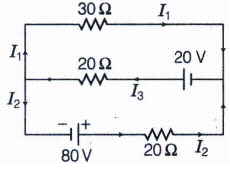
Use Kirchhoff,s rules to determine the value of the current I1 flowing in the circuit shown in the figure.
12.
A metal oil of negligible thickness is introduced between two plates of a capaitor at the centre. What will be the new capacitance of the capaitor?
13.
A heating element is marked 210 V, 630 W. What is the value of the current drawn by the element when connected to a 210 V dc source?
14.
Distinguish between kilowatt and kilowatt hour.
15.
Identify the parts of the electromagnetic spectrum which is
(i) suitable for radar systems used in aircraft navigation
(ii) Adjacent to the frequency end of the electromagnetic spectrum
(iii) Produced by bombarding a metal target with high-speed electrons
16.
A hydrogen ion of mass m and charge q travels with a speed v along a circle of radius r in a uniform magnetic field of flux density B. Obtain the expression for the magnetic force on the ion and determine its time period.
17.
What is the time period of the light for which the eye is more sensitive?
18.
A solenoid with an iron core and a bulb are connected to a.d.c source. How does the brightness of bulb change when iron core is removed from the solenoid ?
19.
How does the energy gap of an intrinsic semiconductor vary, when doped with a pentavalent impurity?
20.
Why is the aperture of objective lens of a telescope taken large?
21.
The image of a small electric bulb fixed on the wall of a room is to be obtained on the opposite wall 3m away by means of a large convex lens. What is the maximum possible focal length of the lens required for the purpose?
22.
Relative permeability of a material, \(\mu\)r = 0.5. Identify the nature of the magnetic material and write its relation to magnetic susceptibility.
23.
100 J of work is done in moving an electric charge of magnitude 4 C from a place A, where potential is -10 V to another place B where potential is V volt. Find the value of V.
24.
Find the binary numbers of \({ \left( 32.25 \right) }_{ 10 }\) and \({ \left( 24.25 \right) }_{ 10 }\) and give subtraction of the binary numbers obtained.
25.
The magnifying power of a microscope with an objective of 5 mm focal length is 400. The length of its tube is 20 cm. Then, the focal length of the eye-piece is
200 cm
160 cm
2.5 cm
0.1 cm
26.
Consider a region inside which there are various types of charges but the total charge is zero. At points outside the region
the electric field is necessarily zero
the electric field is due to the dipole moment of the charge distribution only
the dominant electric field is \(\alpha {1\over r^3}\) , for large r , where r is the distance from a origin in this region.
the work done to move a charged particle along a closed path, away from the region, will be zero.
27.
In a uniform magnetic field of induction B, a wire in the form of semicirclr of radius r rotates about the diameter of the circle with angulat frequency. The axis of rotation is perpendicular to the field. If the total resistance of the circuit is R, then the mean power generated per period of rotation is
\(\frac { B\pi { r }^{ 2 }\omega }{ 2R } \)
\(\frac { \left( B\pi { r }^{ 2 }\omega \right) ^{ 2 } }{ 8R } \)
\(\frac { \left( B\pi { r }\omega \right) ^{ 2 } }{ 2R } \)
\(\frac { \left( B\pi { r^{ 2 } }\omega \right) ^{ 2 } }{ 8R } \)
28.
In a cyclotron a charged particle
undergoes acceleration all the time
speeds up between the dees because of the magnetic field.
speeds up in a dee
slows down within a dee and speeds up between dees.
29.
During a nuclear fusion reaction :
a heavy nucleus breaks into two fragments by itself
a light nucleus bombarded by thermal neutrons breaks up
a heavy nucleus bombarded by thermal neutrons breaks up
two light nuclei combine to give a heavier nucleus and possibly other products
30.
Charge on a body which carries 200 excess electrons is
\(-3.2\times 10^{-18}C\)
\(9\times10^{-9}Nm^2C^{-2}\)
\(3.2\times 10^{-17}C\)
\(3.2\times 10^{-17}C\)
31.
Optical fibres are based on the phenomenon of
reflection
refraction
dispersion
total internal reflection
32.
When light of wavelength 400nm is incident on the cathode of a potential is 6V. If the wavelength of incident light is increased by 600nm, the new value of stopping potential is: [use hc = 1240 eVnm]
4.97V
4.76V
4.56V
4.14V
33.
To get an OR gate from a NAND gate, we need
Only two NAND gates
Two NOT gates obtained from NAND gates and one NAND gate
Four NAND gates and two AND gates obtained from NAND gates
Three NAND gates i.e., three NOT gates obtained from NAND gates
34.
If \({ u }_{ E },{ u }_{ m }\) are the energy density of electromagnetic wave due to electric and magnetic field vectors, \({ E }_{ rms },{ B }_{ rms }\) are the rms value of electric and magnetic field vectors in an electromagnetic wave. then the total energy density of a sinusoidal electromagnetic wave is
\({ u }_{ E }\)
\({ u }_{ E }{ +u }_{ m }\)
\(\frac { 1 }{ 2 } { \epsilon }_{ 0 }{ E }_{ rms }^{ 2 }+\frac { { E }_{ rms }^{ 2 } }{ { 2\mu }_{ 0 } } \)
\(\frac { 1 }{ 2 } { \epsilon }_{ 0 }{ E }_{ 0 }^{ 2 }+\frac { 1 }{ 2 } \frac { { E }_{ 0 }^{ 2 } }{ { \mu }_{ 0 } } \)
35.
Where the two wire transmission line, Coaxial cable, Optical fiber are employed.
1.
The focal length f = -15/2 cm = -7.5 cm
(i) The object distance u = -10 cm. Then Eq gives
\(\frac { 1 }{ v } +\frac { 1 }{ 10 } =\frac { 1 }{ -7.5 } \)
or \(v=\frac { 10\times 7.5 }{ -2.5 } =-30\) cm
The image is 30 cm from the mirror on the same side as the object
Also, magnification m = \(\frac { v }{ u } =-\frac { (-30) }{ (-10) } =-3\)
The image is magnified, real and inverted.
(ii) The object distance u = -5 cm. Then from Eq
\(\frac { 1 }{ v } +\frac { 1 }{ -5 } =\frac { 1 }{ -7.5 } \)
or \(v=\frac { 5\times 7.5 }{ (7.5-5) } =15\) cm
This image is formed at 15 cm behind the mirror. It is a virtual image.
Magnification m = 15 \(-\frac { v }{ u } =-\frac { 15 }{ (-5) } =3\)
The image is magnified, virtual and erect.
2.
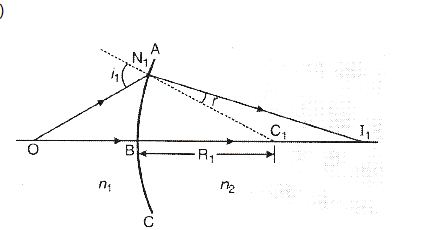
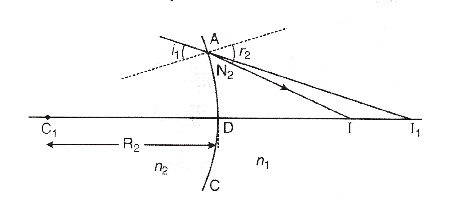
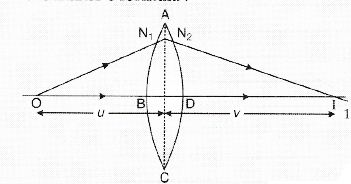
The first refracting ABC forms the image I1 of the object O. The image I1 acts as virtual object for the second refracting surface ADC, which forms the real image I as shown in the diagram
For refraction at ABC
\(\frac { { n }_{ 2 } }{ { v }_{ 1 } } -\frac { { n }_{ 1 } }{ u } =\frac { { n }_{ 2 }-{ n }_{ 1 } }{ { R }_{ 1 } } \)
For refraction at ADC
\(\frac { { n }_{ 1 } }{ v } -\frac { { n }_{ 2 } }{ { v }_{ 1 } } =\frac { { n }_{ 1 }-{ n }_{ 2 } }{ { R }_{ 2 } } \)
Adding equation (i) and equation (ii)
\(\frac { { n }_{ 1 } }{ v } -\frac { { n }_{ 2 } }{ u } =\left( { n }_{ 2 }-{ n }_{ 1 } \right) \left( \frac { 1 }{ { R }_{ 1 } } -\frac { 1 }{ { R }_{ 2 } } \right) \)
\(\frac { 1 }{ v } -\frac { 1 }{ u } =\left( \frac { { n }_{ 2 } }{ { n }_{ 1 } } -1 \right) \left( \frac { 1 }{ { R }_{ 1 } } -\frac { 1 }{ { R }_{ 2 } } \right) \)
We know, If \(u=\infty ,v=f\)
\(\frac { 1 }{ v } -\frac { 1 }{ u } =\frac { 1 }{ f } \)
\(\frac { 1 }{ f } =\left( \frac { { n }_{ 2 } }{ { n }_{ 1 } } -1 \right) \frac { 1 }{ { R }_{ 1 } } -\frac { 1 }{ { R }_{ 2 } } \)
\(\frac { 1 }{ f } =\left( { \mu }_{ 21 }-1 \right) \left( \frac { 1 }{ { R }_{ 1 } } -\frac { 1 }{ { R }_{ 2 } } \right) \)
\(\frac { 1 }{ f } =\left( { \mu }_{ 21 }-1 \right) \left( \frac { 1 }{ { R }_{ 1 } } -\frac { 1 }{ { R }_{ 2 } } \right) \)
\(\frac { 1 }{ f } =\left( 1.55-1 \right) \left( \frac { 1 }{ R } -\frac { 1 }{ -R } \right) \)
\(=0.55\times \frac { 2 }{ R } \)
\(R=0.55\times 2\times 20=22 \ cm\)
3.
(i) A galvanometer of range Ig and resistance G1 can be converted into
(a) a voltmeter of range V, by connecting a high resistance R in series with galvanometer whose value is given by
\(R=\frac { V }{ { I }_{ g } } -G\)
(b) an ammeter of range I, by connecting a very low resistance (shunt) in parallel with galvanometer whose value is given by
\(S=\frac { { I }_{ g }G }{ I-{ I }_{ g } } -G\)
Thus, the nature of force is attractive.
When direction of flow of current is in opposite direction, the nature of force becomes repulsive.
4.
\(\therefore \ Here, \ { n }_{ p }=500, \ { n }_{ s }=1000 \ { E }_{ p }=200V, \ { E }_{ S }=100\Omega , \ { I }_{ p }=?\)
\(In \ an \ ideal \ transformer, \ \frac { { E }_{ s } }{ { E }_{ p } } =\frac { { n }_{ s } }{ { n }_{ p } } =\frac { 1000 }{ 500 } =2\)
\({ E }_{ S }=2 \ { E }_{ P }=2\times 200=400V\)
\(\ Also, \ \frac { { I }_{ p } }{ { I }_{ s } } =\frac { { n }_{ s } }{ { n }_{ p } } =2, \ { I }_{ p } \ = \ 2{ I }_{ s }=2\left( \frac { { E }_{ S } }{ { E }_{ S } } \right) =\frac { 2\times 400 }{ 100 } =8A\)
5.
\(Here, \ { \lambda }_{ 1 }=4000\overset { \circ }{ A } =4\times { 10 }^{ -7 }m;{ V }_{ 1 }=0.82V;\)
\({ \lambda }_{ 2 }=3000\overset { \circ }{ A } =3\times { 10 }^{ -7 }m;{ V }_{ 2 }=1.85V\)
\( As \ \frac { hc }{ { \lambda }_{ 1 } } ={ \phi }_{ 1 }+e{ V }_{ 1 } \ and \ \frac { hc }{ { \lambda }_{ 2 } } ={ \phi }_{ 1 }+e{ V }_{ 2 }\)
\(\therefore \ \frac { hc }{ { \lambda }_{ 2 } } -\frac { hc }{ { \lambda }_{ 1 } } =e\left( { V }_{ 2 }-{ V }_{ 1 } \right)\)
\( or \ hc\left( \frac { { \lambda }_{ 1 }-{ \lambda }_{ 2 } }{ { \lambda }_{ 1 }{ \lambda }_{ 2 } } \right) =e\left( { V }_{ 2 }-{ V }_{ 1 } \right) \)
\(or \ \ h=\frac { e\left( { V }_{ 2 }-{ V }_{ 1 } \right) { \lambda }_{ 1 }{ \lambda }_{ 2 } }{ \left( { \lambda }_{ 1 }-{ \lambda }_{ 2 } \right) c }\)
\( =\frac { \left( 1.6\times { 10 }^{ -19 } \right) \times \left( 1.85-0.82 \right) \times 4\times { 10 }^{ -7 }\times 3\times { 10 }^{ -7 } }{ \left( 4\times { 10 }^{ -7 }-3\times { 10 }^{ -7 } \right) \times 3\times { 10 }^{ 8 } }\)
\( =6.592\times { 10 }^{ -34 }Js\)
6.
Given, amplitude of an electromagnetic wave,
E0 = 120 N/C
Frequency of wave, v = 50 MHz = 50 \(\times\) 106 Hz
(i) Speed of light in vacuum, \(c=\frac{E_0}{B_0}\)
\(\begin{aligned} B_0=\frac{E_0}{c}= & \frac{120}{3 \times 10^8}=40 \times 10^{-8} \end{aligned}\)
= 400 \(\times\) 10-9 T = 400 nT
Angular frequency of electromagnetic wave,
\(\omega=2 \pi \nu=2 \times 3.14 \times 50 \times 10^6\)
\(\omega=3.14 \times 10^8 \mathrm{rad} / \mathrm{s}\)
Wave number of electromagnetic wave,
\(k=\frac{\omega}{c}=\frac{3.14 \times 10^8}{3 \times 10^8}=1.05 \mathrm{rad} / \mathrm{m}\)
Wavelength of electromagnetic wave,
\(\lambda=\frac{c}{v}=\frac{3 \times 10^8}{50 \times 10^6}=6.00 \mathrm{~m}\)
(ii) Expression of electric field, E = E0 sin (kx - \(\omega\)t)
E = 120 sin (1.05x - 3.14 \(\times\)108 t)
Expression of magnetic field B,
B = B0 sin (kx - \(\omega\)t)
E = 120 sin (kx - \(\omega\)t)
B = 4 \(\times\)10-7 sin (1.05x - 3.14 \(\times\) 108 t)
7.
A = 600 , \(\delta \)m = 300
i = e = ¾ A = 450
as A + \(\delta \) = i + e
60 + \(\delta \) = 45 +45
or \(\delta \) = 300
Refractive index,
\(\mu \) = sin a + \(\delta \)m /2/sin A/2 = sin 600+300/2/sin 600/2
= sin 450/sin300 = 1\(\surd 2\) 1/2 = \(\surd 2\) = 1.414
8.
V = V1 + V2
Q = C1V = 6 x 10-6 x 2 = 12\(\mu \)C
As C2 is in series same amount of charge will also flow through it now V2 = Q/C2 = (12 x 10-6) /(12 x 10-6) = 1 volt
Total Battery voltage, V = 2 + 1 = 3 Volt
9.
In standard AM broadcast, ground wave propagation is used for transmitting a signal. Attenuation of surface wave increase very rapidly with upto a few MHz. In AM broadcast, range of frequencies are limited to 30 MHz.
10.
Given, \({ \delta }_{ V }={ 3.32 }^{ 0 },{ \delta }_{ Y }={ 3.27 }^{ 0 },{ \delta }_{ R }=\ { 3.22 }^{ 0 }\quad \)
Dispersive power \(=\frac { { \delta }_{ V }-{ \delta }_{ R } }{ { \delta }_{ Y } } \)
\(\frac { { 3.32 }^{ 0 }-{ 3.22 }^{ 0 } }{ { 3.27 }^{ 0 } } =\frac { { 0.10 }^{ 0 } }{ { 3.27 }^{ 0 } } ={ 0.0306 }^{ 0 }\)
11.
According to the question,
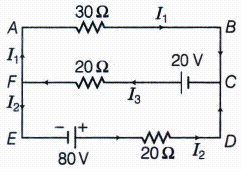
Applying Kirchhoff's junction rule at F,
I3 = \({ I }_{ 1 }\) +\({ I }_{ 2 }\) ......(i)
Applying Kirchhoff's second rule in loop ABCF,
-30I1+ 20-20I3 = 0
\(\Rightarrow \) 3I1+2I3 = 2 ....(ii)
In loop ABDE,
-30I1+20I2 - 80 =0
3I1 + 2I2 = 8 ......(iii) (1)
From Eqs. (i) and (ii), we have
3I1+ 2I1 + 2I2 = 2
\(\Rightarrow \) 5I1 + 2I2 = 2 .....(iv)
On subtracting Eq. (iii) from Eq. (iv), we get
8I1 = -6
\(\Rightarrow \)I1 = -\(\frac { 3 }{ 4 } \) A (1)
12.
On introducing a thin metal oil, d is halved. Arrangement is equivalent to two condensor each of capacity 2 C in series.
\({1\over C_s}={1\over 2C}={1\over 2C}={1\over C}\)
\(C_s=C\)
Capacity is unchanged.
13.
\( \mathrm{V}=210 \mathrm{~V}, \mathrm{P}=630 \mathrm{~W} ; \\ \text {Current } \mathrm{I}=\frac{P}{V}=\frac{630}{210}=3 \mathrm{~A} \)
14.
Kilowatt is the unit of power. 1 kilowatt = 100 watt. Kilowatt hour is the unit of electric energy, where
1 kilowatt hour = 1000 watt x 1 hour
= 1000 watt x 60 x 60 second
= 3.6 x 10⁶ J
15.
(i) Microwaves
(ii) radio waves
(iii) Gamma rays
(iv) x-rays
Infrared are used in weather forecasting. Ultraviolet rays are used in burglar alarm. X-rays are used in scientific research
16.
As hydrogen ion is describing a circular path in a uniform magnetic field, hence force on hydrogen ion due to perpendicular magnetic field is providing the centripetal force. So
\(Bqvsin{ 90 }^{ o }=\frac { m{ v }^{ 2 } }{ r } \ or\ r=\frac { mv }{ qB } \)
Time period of revolution of hydrogen ion
\(T=\frac { 2\pi r }{ v } =\frac { 2\pi }{ v } \times \frac { mv }{ qB } =\frac { 2\pi m }{ qB } \)
17.
Eye is most sensitive to the light of wavelength \(\lambda=5600 \dot{A}\)
\(
T=\frac{1}{v}=\frac{\lambda}{c}=\frac{5600 \times 10^{-10}}{3 \times 10^8} \\
=1.87 \times 10^{-15} \mathrm{~s}
\)
18.
In a.d.c. circuit, reactance of inductor/solenoid is zero. Therefore, removal of iron core does not affect the brightness of bulb.
19.
When an intrinsic semiconductor is doped with the impurity atoms of valence five like As, P or Sb, some additional energy levels are produced, situated in the energy gap slightly below the conduction band which are called donor energy levels. Due to it, energy gap in semiconductor decreases.
20.
This is done to increase the light gathering capacity and hence brightness of image.
21.
Distance between the object and the image, d = 3 m
Maximum focal length of the convex lens = fmax
For real images, the maximum focal length is given as:
fmax = \(\frac{d}{4}\)
= \(\frac{3}{4}\) = 0.75 m
Hence, for the required purpose, the maximum possible focal length of the convex lens is 0.75 m.
22.
Diamagnetic material
\({ \mu }_{ r }=1+{ x }_{ m }\)
23.
Given, WAB = 100 J, q = 4C, VA =- 10 V, VB = V = ?
Since, WAB = q(VB - VA )
\(\Rightarrow \) 100 = 4(V +10) \(\Rightarrow \) V = 15 V
24.
\({ \left( 100000.01 \right) }_{ 2 }{ ,\left( 11000.01 \right) }_{ 2 }{ ,\left( 1000 \right) }_{ 2 }\)
25.
(c)
2.5 cm
26.
(c)
the dominant electric field is \(\alpha {1\over r^3}\) , for large r , where r is the distance from a origin in this region.
27.
(d)
\(\frac { \left( B\pi { r^{ 2 } }\omega \right) ^{ 2 } }{ 8R } \)
28.
(a)
undergoes acceleration all the time
29.
(d)
two light nuclei combine to give a heavier nucleus and possibly other products
30.
(c)
\(3.2\times 10^{-17}C\)
31.
(d)
total internal reflection
32.
(d)
4.14V
33.
(b)
Two NOT gates obtained from NAND gates and one NAND gate
34.
(b)
\({ u }_{ E }{ +u }_{ m }\)
35.
()
Two wire transmission line and coaxial cable are employed for AF and UHF region. For optical fiber is employed for optical frequency

12th Standard CBSE Syllabus & Materials
12th Standard CBSE
CBSE 12th Computer Science Python Revision Tour I - New Previous year Question Papers Study Material - QB365 Set A
NEW12th Standard CBSE
CBSE 12th Business Studies Planning Important Questions And Answers Study Material - QB365 Set A
NEW12th Standard CBSE
CBSE 12th Business Studies Business Environment Important Questions And Answers Study Material - QB365 Set A
NEW12th Standard CBSE
CBSE 12th Business Studies Principles of Management Important Questions And Answers Study Material - QB365 Set A



CBSE 12th Standard CBSE Subjects
CBSE Standards










