
 100% FREE ACCESS
12th Standard CBSE Syllabus & Materials
12th Standard CBSE
CBSE 12th Economics Government Budget and the Economy Previous year Question Papers Study Material - QB365 Set A
NEW12th Standard CBSE
CBSE 12th Computer Science Interface Python with MySQL - New Previous year Question Papers Study Material - QB365 Set A
NEW12th Standard CBSE
CBSE 12th Computer Science Database Concept - New Previous year Question Papers Study Material - QB365 Set A
NEW12th Standard CBSE
CBSE 12th Computer Science Data Communication - New Previous year Question Papers Study Material - QB365 Set A
NEW12th Standard CBSE
CBSE 12th Computer Science Data Structures - New Previous year Question Papers Study Material - QB365 Set A
NEW12th Standard CBSE
CBSE 12th Computer Science Functions - New Previous year Question Papers Study Material - QB365 Set A

Published on: 15/02/2020
12th Standard CBSE Physics Public Model Question Paper IV 2020
Download CBSE Class 12th Standard CBSE Physics question papers, sample papers, important questions, and previous year solved papers in PDF format. Get free study materials, NCERT solutions, and exam preparation resources for Class 12th Standard CBSE Physics
Questions + Answers key
Take MCQ Physics Test
1.
A 100 MHz carrier is modulated by a 12 kHz sine wave so as to cause a frequency swing of +50kHz. Find the modulation index
2.
A lens forms a real image of an object. The distance of the object to the lens is 4 cm and the distance of the image from the lens is v cm. The given graph shows the variation of v with u.
(i) What is the nature of the lens?
(ii) Using this graph, find the focal length of this lens.
3.
What is the ratio of speed of infrared and ultraviolet rays in vacuum?
4.
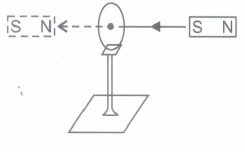
Give the direction in which the induced current flows in the coil mounted on an insulating stand when a bar magnet is quickly moved along the axis of the coil from one side to the other as shown.
5.
A charged Particle q is shot towards another charged particle Q which is fixed , with a speed v. It approaches Q up to a closet distance r and then returns, If q were given a speed 2 v the n find the closet distance of approach.
6.
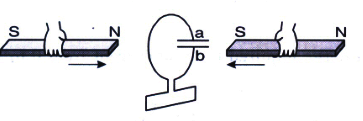
Equal currents I = 2A are flowing through the infinitely long wires parallel to Y-axis located at x = +1m, x = +2m, x = +4m and so on, but in opposite directions as shown in figure. Find the magnetic field at the origin O.
7.
A photon and an electron have been same de-Broglie wavelength which one has higher total energy?
8.
A short object of length L is placed along the principal axis of a concave mirror away from focus. The object distance is u. If the mirror has a focal length f, what will be the length of the image? You may take L <, |v - f|.
The length of image is the separation between the images formed by mirror of the extremities of object.
9.
Find the wavelength of electromagnetic waves frequency in \(4\times { 10 }^{ 9 } \ Hz\) free space. give its two application.
10.
For what basic purpose the cells are connected
(i) in series
(ii) in parallel and
(iii) in mixed grouping?
11.
How can you keep a constant current inside a conductor?
12.
A proton is moved in a uniform electric field of \(1.7\times { 10 }^{ -4 }N/C\) between two points A and B separated by a distance of 0.1m.
(i) What is the potential difference between the points?
(ii) How much work is done in the above process?
13.
Double-convex lenses are to be manufactured from a glass of refractive index 1.55, with both faces of the same radius of curvature. What is the radius of curvature required if the focal length is to be 20cm?
14.
(a) A point charge (+ Q) is kept in the vicinity of an uncharged conducting plate. Sketch electric field lines between the barge and the plate.
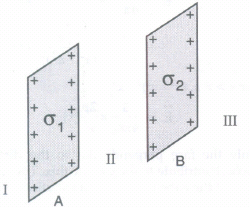
(b) Two infinitely large plane thin parallel sheets having surface charge densities \(\sigma\)1 and \(\sigma\)2 (\(\sigma\)1 > \(\sigma\)2) are shown in the figure. Write the magnitudes and directions of the fields in the regions marked II and III
15.
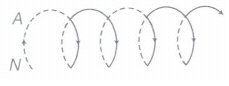
An observation to the left of a solenoid of N turns each of cross-section area A observes that a steady current I in it flows in the clockwise direction. Depict the magnetic field lines due to the solenoid specifying its polarity and show that it acts as a bar magnet of magnetic moment m = NIA.
16.
A plane em wave of frequency 40 mHz travel in free space in the x-direction. At some point, at some instant, the electric field \(\overset { \rightarrow }{ E } \) has its maximum value at \(750 \ NC^{ -1 }\) in y-direction.
(a) What is the period of the wave?
(b) What is the value of magnitude and direction of magnetic field in 2-direction?
(c) What is the angular frequency of the em wave?
17.
(i) If f = 0.5 m for a glass lens, what is the power of the lens?
(ii) The radii of curvature of the faces of a double convex lens are 10 cm and 15 cm. Its focal length is 12 cm. What is the refractive index of glass?
(iii) A convex lens has 20 cm focal length in air. What is focal length in water? (Refractive index of air-water = 1.33, refractive index for air-glass = 1.5.)
18.
(a) A point object is placed in front of a double convex lens (of refractive index n =n2/n1 with respect air) with its spherical faces of radii of curvature R1 and R2.. Show the path of rays due to surface to obtain the formation of the real image of the object.
Hence obtain the lens maker's formula for a thin lens.
(b) A double convex lens having both faces of the same radius of curvature has refractive index 1.55. Find out the radius of curvature of the lens required to get the focal length of 20 cm.
19.
A solenoid of length 40cm, area of cross section 20cm2 and total number of turns 800 is is connected to a source that supplies current changing at the rate of 0.2 A/s. What is the emf induced across the solenoid?
20.
The magnification produced by an astronomical telescope for normal adjustment is 10 and the length of the telescope is 1.1 m. The magnification, when the image is formed at least distance of distinct vision is
6
14
16
18
21.
Two particles X and Y having equal charges after being accelerated through the same potential difference, enter a region of uniform magnetic field and describe circular paths of radii \({ R }_{ 1 }\quad and\quad { R }_{ 2 }\) respectively. The ratio of the mass of X to that Y is
\(\frac { { R }_{ 1 } }{ { R }_{ 2 } } \)
\(\frac { { R }_{ 2 } }{ { R }_{ 1 } } \)
\({ \left( \frac { { R }_{ 1 } }{ { R }_{ 2 } } \right) }^{ 1/2 }\)
\({ \left( \frac { { R }_{ 1 } }{ { R }_{ 2 } } \right) }^{ 2 }\)
22.
The output of a step-down transformer is measured to be 24V when connected to a 12 watt light blub. The value of the peak current is
\(1/\sqrt { 2 } A\)
\(\sqrt { 2 } A\)
2 A
\(2\sqrt { 2 } A\)
23.
To write the decimal number 37 in binary, how many binary digits are required?
5
6
7
4
24.
A telescope uses an objective lens of focal length \(f_{ 0 }\) and an eye lens of focal length \(f_{ e }\). In normal adjustment, distance between the two lenses is
\(f_{ o }/f_{ e }\)
\(f_{ e }/f_{ o }\)
\((f_{ o }-f_{ e })\)
\((f_{ o }+f_{ e })\)
25.
The value of absolute electrical permittivity of free space is
\(9\times 10^9Nm^2C^{-2}\)
\(9\times 10^{-9}Nm^2C^{-2}\)
\(8.85\times 10^{-12}C^2N^{-1}m^{-2}\)
\(8.85\times 10^{-12}C^2Nm^{-2}\)
26.
The dimensional formula of electric flux is
[M1L2T-2A-1]
[M-1L3T-3A]
[M1L3T-3A-1]
[M1L-3T-3A-1]
27.
A nucleus \(_{ n }{ { X }^{ m } }emits \ one \ \alpha \ particle \ and \ one \ \beta \ particle.\)The mass number and atomic number of product nucleus, are
(m-4),n
(m-4),(n-1)
(m-3),n+1
(m-3),(n-1)
28.
In an electromagnetic wave, the average energy density due to magnetic field is.
\(8.85\times { 10 }^{ -30 }J{ m }^{ -3 }\)
\(4.42\times { 10 }^{ -30 }J{ m }^{ -3 }\\ \)
\(2.21\times { 10 }^{ -30 }J{ m }^{ -3 }\\ \)
\(6.63\times { 10 }^{ -30 }J{ m }^{ -3 }\)
29.
When radiation is incident on a photoelectron emitter, the stopping potential is found to be 9V.If e/m for the electron is \(1.8\times { 10 }^{ 11 }C/kg\) the maximum velocity of the ejected electron is
\(6\times { 10 }^{ 5 }m/s\)
\(8\times { 10 }^{ 5 }m/s\)
\({ 10 }^{ 6 }{ ms }^{ -1 }\)
\(1.8\times { 10 }^{ 6 }m/s\)
30.
Electric flux over an area in an electric field represents the ................ crossing this area.
31.
A real image can be..............but a................cannot be............. .
1.
Modulation index ,mf = \(\frac { Maximum\ frequency\ deviation }{ minimum\ signal\ freqency } \)
2.
(i) As the lens forms a real iamge, it must be a convex lens.
(ii) From the graph, when u = 20 cm , we have v = 20 cm.
For the convex lens forming a real iamge, u is negative and v and f are positive.
U = -20 cm v = +20cm
Using this lens formula,
1/f = 1/v – 1/u = 1/20 – 1/-20 = 1/10 or f = + 10 cm
3.
Same as velocity of light
4.
Anticlockwise
5.
q \(\rightarrow\)_______Q
1/2 mv2 = kQq/r
Or, v2 a1/r
Or, r a 1/v2
Or, r' = r/4
6.
Magnetic field at O due to current through one infinitely long wire is
\(B=\frac { \mu _{ 0 } }{ 4\pi } \times\frac { 2I }{ r } \hat{k}\)(i.e. along + Z-direction)
So, magnetic field at O due to all the wires is
\(B=\frac { \mu _{ 0 } }{ 4\pi } \times2\times2[\frac { 1 }{ 1 } -\frac { 1 }{ 2 } +\frac { 1 }{ 4 } -\frac { 1 }{ 8 } +\frac { 1 }{ 16 } +...] \hat{ k } \\ =\frac { { \mu }_{ 0 } }{ \pi } [(1+\frac { 1 }{ 4 } +\frac { 1 }{ 16 } +...)\hat{ k } -(\frac { 1 }{ 2 } +\frac { 1 }{ 8 } +...)\hat{ k } ]\\ =\frac { { \mu }_{ 0 } }{ \pi } [(\frac { 1 }{ 1-\frac { 1 }{ 4 } } )\hat{ k } \frac { 1 }{ 2 } (\frac { 1 }{ 1-\frac { 1 }{ 4 } } )\hat{ k } ]\\ \Rightarrow B=\frac { { \mu }_{ 0 } }{ \pi } \times\frac { 2 }{ 3 } \hat{ k } =\frac { { \mu }_{ 0 } }{ 4\pi } \times\frac { { { 8 }\hat{k} } }{ 3 } \)
7.
Total energy of an electron Ee = mc2
Total energy of a photon, \(E_p=\frac{h c}{\lambda}\)
de-Broglie wavelength of electron of mass m moving with velocity V
\(
\lambda=\frac{h}{m v} \\
\Rightarrow m=\frac{h}{\lambda v}
\)
\(E_e=m c^2=\frac{h c^2}{\lambda v}\)
\(\therefore \frac{E_e}{E_p}=\frac{\frac{h_0^2}{\lambda v}}{\frac{h o}{\lambda}}=\frac{c}{v}\)
As c > > v, therefore the total energy of electron is more than the total energy of photon.
8.
Since, the object distance is u. Let us consider the two ends of the object be at distance \({ u }_{ 1 }=u-L/2\) and \({ u }_{ 2 }=u+L/2\), respectively, so that \(|{ u }_{ 1 }-{ u }_{ 2 }|=L\). Let the image of the two ends be formed at \({ v }_{ 1 } \ and \ { v }_{ 2 }\), respectively so that the image length would be
\({ L }^{ ' }=|{ v }_{ 1 }-{ v }_{ 2 }|\)
Applying mirror formula, we have
\(\frac { 1 }{ u } +\frac { 1 }{ v } =\frac { 1 }{ f } \ or\ v=\frac { fu }{ u-f } \)
On shoving, the positions of two images are given by
\({ v }_{ 1 }=\frac { f\left( u-L/2 \right) }{ u-f-L/2 } ,{ v }_{ 2 }=\frac { f\left( u+L/2 \right) }{ u-f+L/2 } \)
For length, substituting these values in Eq. (i), we have
\({ L }^{ ' }=|{ v }_{ 1 }-{ v }_{ 2 }|=\frac { { f }^{ 2 }L }{ \left( u-f \right) ^{ 2 }-{ L }^{ 2 }/4 } \)
Since, the object is short and kept away from focus, we have \({ L }^{ 2 }/4<<\left( u-f \right) ^{ 2 }\)
Hence, finally, \({ L }^{ ' }=\frac { { f }^{ 2 } }{ \left( u-f \right) ^{ 2 } } L\)
This is the required expression of length of an image.
9.
\(\lambda =\frac { c }{ v } =\frac { 3\times { 10 }^{ 8 } }{ 4\times { 10 }^{ 9 } } =0.075 \ m.\) This wavelength belongs to microwave region the microwaves are used
(i) In microwave ovens
(ii) in a radar system for the navigation aircraft
10.
This cells are connected
(i) in series, to get maximum voltage,
(ii) in parallel, to get maximum current and
(iii) in mixed grouping, to get maximum power.
11.
A constant current can be kept inside a conductor by maintaining a constant potential difference across the two ends of conductor.
12.
(i) \(1.7\times {{10}^{-5}}V\)
(ii) \(2.72\times {{10}^{-24}}J\)
13.
Refractive index of glass, μ
Focal length of the double-convex lens, f = 20 cm
Radius of curvature of one face of the lens = R1
Radius of curvature of the other face of the lens = R2
Radius of curvature of the double-convex lens = R The value of R can be calculated as:
∴ R1 = R and R2 = -R
The value of R can be calculated as:
\(\frac { 1 }{ f } =(\mu -1)\left[ \frac { 1 }{ { R }_{ 1 } } -\frac { 1 }{ { R }_{ 2 } } \right] \)
\(\frac { 1 }{ 20 } =(1.55)\left[ \frac { 1 }{ R } +\frac { 1 }{ R } \right] \)
\(\frac { 1 }{ 20 } =0.55\times \frac { 2 }{ R } \)
∴ R = 0.55 x 2 x 20 = 22 cm
Hence, the radius of curvature of the double-convex lens is 22 cm.
14.
.png)
(i) Fot region II,
\(E_{II} = \frac{1}{2\pi\epsilon_0}(\sigma_1-\sigma_2)\)
towards tight side/from sheet A to sheet B
(ii) For region III,
\(E_{III} = \frac{1}{2\pi\epsilon_0}(\sigma_1+\sigma_2)\)
towards tight side/away from the two sheets
15.
Since, it is given that the current flows in the clockwise direction for an observer on the left side of the solenoid.
It means that the left face of the solenoid acts as south pole and right face acts as North pole. Inside a bar, the magnetic field lines are directed from South to North. \(\left( { 1\frac { 1 }{ 2 } } \right) \)
Therefore, the magnetic field lines are directed from left to right in the solenoid.
Magnetic moment of a single current carrying loop is given by, \({ m }^{ ' }={ IA }\)
So, magnetic moment of the whole solenoid is given by
\({ m }={ N{ m }^{ ' } }=N\left( IA \right) \)
16.
Given \(v=40\times { 10 }^{ 6 }Hz\)
\(\therefore \)\(T=\frac { 1 }{ v } =\frac { 1 }{ 40\times 10^{ -6 } } =0.25\times 10^{ -6 }/s\)
Magnetic field
\({ B }_{ 0 }=\frac { E_{ 0 } }{ c } =\frac { 750 }{ 3\times 10^{ 18 } } =2.5\times 10^{ -6 }T \ along \ (z \ direction)\)
And angular frequency
\(\omega =2\pi v=2\times \pi \times 40\times { 10 }^{ 6 }=8\pi \times { 10 }^{ 7 } \ Hz\)
17.
(i) Power = +2 dioptre.
(ii) Here, we have f = +12 cm, R1 = +10 cm, R2 = -15 cm.
Refractive index of air is taken as unity.
We use the lens formula. The sign convention has to be applied for f, R1 and R2.
Substituting the values, we have
\(\frac { 1 }{ 12 } =(n-1)\left( \frac { 1 }{ 10 } -\frac { 1 }{ 15 } \right) \)
This gives n = 1.5.
(iii) For a glass lens in air, n2 = 1.5, n1 = 1, f = +20 cm. Hence, the lens formula gives
\(\frac { 1 }{ 20 } =0.5\left( \frac { 1 }{ { R }_{ 1 } } -\frac { 1 }{ { R }_{ 2 } } \right) \)
For the same glass lens in water, n2 = 1.5, n1 = 1.33. Therefore \(\frac { 1.33 }{ f } =(1.5-1.33)\left[ \frac { 1 }{ { R }_{ 1 } } -\frac { 1 }{ { R }_{ 2 } } \right] \)
Combining these two equations, we find f = + 78.2 cm.
18.
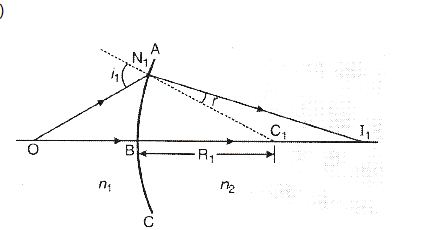
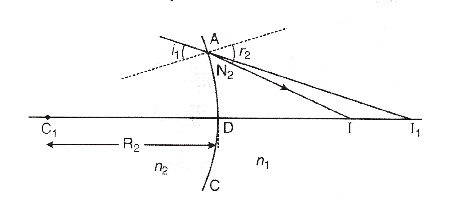
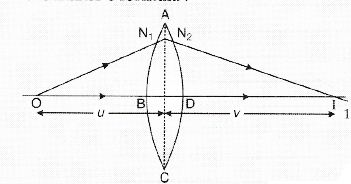
The first refracting ABC forms the image I1 of the object O. The image I1 acts as virtual object for the second refracting surface ADC, which forms the real image I as shown in the diagram
For refraction at ABC
\(\frac { { n }_{ 2 } }{ { v }_{ 1 } } -\frac { { n }_{ 1 } }{ u } =\frac { { n }_{ 2 }-{ n }_{ 1 } }{ { R }_{ 1 } } \)
For refraction at ADC
\(\frac { { n }_{ 1 } }{ v } -\frac { { n }_{ 2 } }{ { v }_{ 1 } } =\frac { { n }_{ 1 }-{ n }_{ 2 } }{ { R }_{ 2 } } \)
Adding equation (i) and equation (ii)
\(\frac { { n }_{ 1 } }{ v } -\frac { { n }_{ 2 } }{ u } =\left( { n }_{ 2 }-{ n }_{ 1 } \right) \left( \frac { 1 }{ { R }_{ 1 } } -\frac { 1 }{ { R }_{ 2 } } \right) \)
\(\frac { 1 }{ v } -\frac { 1 }{ u } =\left( \frac { { n }_{ 2 } }{ { n }_{ 1 } } -1 \right) \left( \frac { 1 }{ { R }_{ 1 } } -\frac { 1 }{ { R }_{ 2 } } \right) \)
We know, If \(u=\infty ,v=f\)
\(\frac { 1 }{ v } -\frac { 1 }{ u } =\frac { 1 }{ f } \)
\(\frac { 1 }{ f } =\left( \frac { { n }_{ 2 } }{ { n }_{ 1 } } -1 \right) \frac { 1 }{ { R }_{ 1 } } -\frac { 1 }{ { R }_{ 2 } } \)
\(\frac { 1 }{ f } =\left( { \mu }_{ 21 }-1 \right) \left( \frac { 1 }{ { R }_{ 1 } } -\frac { 1 }{ { R }_{ 2 } } \right) \)
\(\frac { 1 }{ f } =\left( { \mu }_{ 21 }-1 \right) \left( \frac { 1 }{ { R }_{ 1 } } -\frac { 1 }{ { R }_{ 2 } } \right) \)
\(\frac { 1 }{ f } =\left( 1.55-1 \right) \left( \frac { 1 }{ R } -\frac { 1 }{ -R } \right) \)
\(=0.55\times \frac { 2 }{ R } \)
\(R=0.55\times 2\times 20=22 \ cm\)
19.
Here, l = 40cm = 0.4m,
A = 20cm2 = 20\(\times\)10-4m2, N = 800
dI/dt = 0.2 A/s, e = ?
e = \(L\frac { dI }{ dt } =\frac { { \mu }_{ 0 }{ N }^{ 2 }A }{ l } .\frac { dI }{ dt } \)
\(=\frac { 4\pi \times { 10 }^{ -7 }\times \left( 800 \right)\ ^{ 2 }\times 20\times { 10 }^{ -4 } }{ 0.4 } \times 0.2\ =\ 8.03\times { 10 }^{ -4 }\ V\)
20.
(b)
14
21.
(d)
\({ \left( \frac { { R }_{ 1 } }{ { R }_{ 2 } } \right) }^{ 2 }\)
22.
(a)
\(1/\sqrt { 2 } A\)
23.
(b)
6
24.
(d)
\((f_{ o }+f_{ e })\)
25.
(c)
\(8.85\times 10^{-12}C^2N^{-1}m^{-2}\)
26.
(c)
[M1L3T-3A-1]
27.
(b)
(m-4),(n-1)
28.
(c)
\(2.21\times { 10 }^{ -30 }J{ m }^{ -3 }\\ \)
29.
(d)
\(1.8\times { 10 }^{ 6 }m/s\)
30.
()
total number of electric lines of force
31.
()
Taken on a screen ; virtual image ; taken on screen.

12th Standard CBSE Syllabus & Materials
12th Standard CBSE
CBSE 12th Computer Science Python Revision Tour I - New Previous year Question Papers Study Material - QB365 Set A
NEW12th Standard CBSE
CBSE 12th Business Studies Planning Important Questions And Answers Study Material - QB365 Set A
NEW12th Standard CBSE
CBSE 12th Business Studies Business Environment Important Questions And Answers Study Material - QB365 Set A
NEW12th Standard CBSE
CBSE 12th Business Studies Principles of Management Important Questions And Answers Study Material - QB365 Set A



CBSE 12th Standard CBSE Subjects
CBSE Standards










