
 100% FREE ACCESS
12th Standard CBSE Syllabus & Materials
12th Standard CBSE
CBSE 12th Economics Government Budget and the Economy Previous year Question Papers Study Material - QB365 Set A
NEW12th Standard CBSE
CBSE 12th Computer Science Interface Python with MySQL - New Previous year Question Papers Study Material - QB365 Set A
NEW12th Standard CBSE
CBSE 12th Computer Science Database Concept - New Previous year Question Papers Study Material - QB365 Set A
NEW12th Standard CBSE
CBSE 12th Computer Science Data Communication - New Previous year Question Papers Study Material - QB365 Set A
NEW12th Standard CBSE
CBSE 12th Computer Science Data Structures - New Previous year Question Papers Study Material - QB365 Set A
NEW12th Standard CBSE
CBSE 12th Computer Science Functions - New Previous year Question Papers Study Material - QB365 Set A

Published on: 15/02/2020
12th Standard CBSE Physics Public Model Question Paper IV 2020
Download CBSE Class 12th Standard CBSE Physics question papers, sample papers, important questions, and previous year solved papers in PDF format. Get free study materials, NCERT solutions, and exam preparation resources for Class 12th Standard CBSE Physics
Questions + Answers key
Take MCQ Physics Test
1.
Draw a labelled diagram of a step-down transformer. State the principle of its working.
Express the turn ratio in terms of voltages.
Find the ratio of primary and secondary currents in terms of turn ratio in an ideal transformer.
How much current is drawn by the primary of a transformer Connected to 220 V supply when it delivers power to a 110 V-550 W refrigerator?
2.
Based on the previous knowledge learnt in the class, two students of class XII (A and B) were asked to conduct an experiment in the laboratory using a meter bridge one made of Nichrome and the other one made of Copper, of same length and same diameter, of constant potential difference. The student A could not give explanation for not achieving the result whereas student B, could get the result and was also able to explain.
(a) What made student B to perform successfully?
(b) Give the formula to calculate the rate of heat production.
3.
(a) Define electric flux. Write its S.I. unit.
(b) Using Gauss's law, prove that the electric field at a point due to a uniformly charged infinite plane sheet is independent of the distance from it.
(c) How is the field directed if
(i) the sheet is positively charged,
(ii) negatively charged?
4.
A resistance of 1980 \(\Omega \) is connected in series with a voltmeter, after which the scale division becomes 100 times larger. Find the resistance of voltmeter.
5.
It is required to construct a \(10\mu F\) capacitor which can be connected across a 200 V battery. Capacitors of capacitance \(10\mu F\) are available but they can with stand only 50V. Design a combination which can yield the desired result.
6.
A resistor of 200 ohm and a capacitor of 15.0 \(\mu\) F are connected in series to a 220V, 50Hz a.c. source.
(a) Calculate the current in the circuit
(b) Calculate the r.m.s. voltage across the resistor and the capacitor. Is the algebraic sum of these voltages more than the source voltage? If yes, resolve the paradox.
7.
A 60 V-10 W electric lamp is to be run on 100 V-60Hz mains. Calculate the inductance of the choke coil to achieve the same result, calculate its value.
8.
How would you establish an instantaneous displacement current of 2.0 A in the space between the two parallel plates of \(1\mu F\) capacitor?
9.
At what temperature a hot body will emit an e.m. wave of wavelength \(1\mu m\) ?
10.
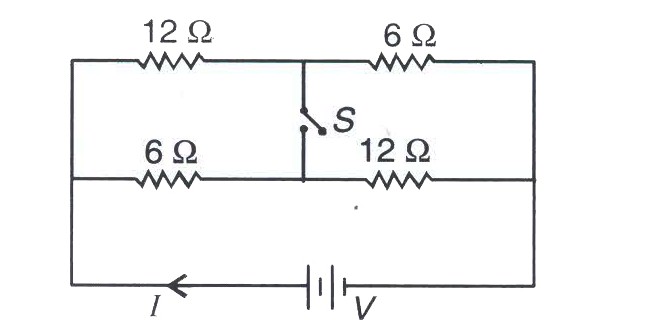
With switch S open the network of resistors shown here drawn a current I from the battery. How many times will this current become on closing the switch S?
11.
When 1 x 10¹² electrons are transferred from one conductor to another, a potential difference of 10 V appears between the conductors. Find the capacitance of the two conductors.
12.
A plane electromagnetic wave of frequency 25 MHz travels in free space along the x-direction. At a particular point in space and time, \( { E } =6.3 \hat { j } \)V/m. What is B at this point?
13.
What is the advantages of using thick metallic strips to join wires in a potentiometer?
14.
Considering the case of a parallel plate capacitor being charged, show how one is required to generalize Ampere's circuital law to include the term due to displacement current.
15.
Can we control direct current without much loss of energy? Can a choke coil do so?
16.
In a metre bridge, the length of the wire is 100 cm. At what position will the balance point be obtained if the two resistances are in the ratio 1 : 3?
17.
How much work is done in moving a 500\(\mu C\) charge between two points on an equipotential surface?
18.
A current of one ampere is passed through a straight wire of length 2.0 metre. Find the magnetic field at a point in air at a distance 3 metre from one end of wire but lying on the axis of the wire.
19.
When two capacitors charged to different potentials are connected by a conducting wire, what is not true?
charge lost by one is equal to charge gained by the other
potential lost by one is equal to potential gained by the other
some energy is lost
both the capacitor acquire a common potential
20.
Which of the following combinations should be selected for better tuning of an LCR circuit used for communication?
R = 20\(\Omega \), L = 1.5H, C = 35\(\mu\)F
R = 25\(\Omega \), L = 2.5H, C = 45\(\mu\)F
R = 15\(\Omega \), L = 3.5H, C = 30\(\mu\)F
R = 25\(\Omega \), L = 1.5H, C = 45\(\mu\)F
21.
In an electromagnetic wave, electric and magnetic fields are 200 V/m and 0.365 A/m. The maximum rate of energy flow is
\(73.0 \ W/{ m }^{ 2 }\)
\(36.5 \ W/{ m }^{ 2 }\)
\(54.7 \ W{ /m }^{ 2 }\)
\(77.8 \ W/{ m }^{ 2 }\)
1.
Step down transformer:
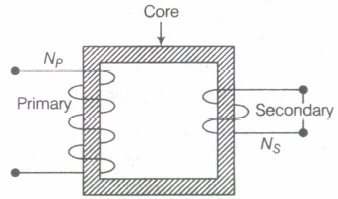
Principle: When the current flowing through the primary coil changes, an emf is induced in the secondary coil due to the change in magnetic flux linked with it i.e., it works on the principle of mutual induction. For step down transformer,
Ns < Np, hence \({\epsilon}_{s}<{\epsilon}_{p}\).
\({ { {\epsilon}_{s} }\over{ {\epsilon}_{p} } }={{{N}_{s}}\over{{N}_{p}}}\)
For an ideal transformer, Pin = Pout
\({\epsilon }_{p }{ I}_{p }={ \epsilon}_{s }{I }_{s }\Rightarrow{{{I}_{p}}\over{{I}_{s}}}={{{\epsilon}_{s}}\over{{\epsilon}_{p}}}={{{N}_{s}}\over{{N}_{p}}}\)
Pin = Pout = 550 W = \({\epsilon}_{p}{I}_{p}\) = 550
\(220\times{I}_{p}=550\Rightarrow{I}_{p}={{550}\over{220}}={{5}\over{2}}=2.5 \ A\)
2.
(a) Student B had concentrated in the class room teaching and also had studied again to remember what was taught.
(b) H = I2Rt
3.
(a) Electric flux is defined as the number of electric field lines passing through an area normal to the surface.
Alternatively
Surface integral of the electric field is defined as the electric flux through a closed surface
\(\phi= \oint \overrightarrow{E}. \overrightarrow{ds}\)
SI unit : \(\frac{N.m^2}{C}\) or volt. metre
(a)
.png)
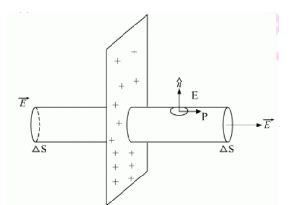
Outward flux through the Gaussian surface, is
\(2EA =\sigma A/\epsilon_0\)
\(\therefore\) \(E =\sigma A/2\epsilon_0\)
Vectorically \(\overrightarrow{E} = \frac{\sigma}{2\epsilon_0}\hat{n}\),
where \(\hat{n}\) is a unit vector normal to the plane, away from it.
Hence, electric field is independent of the distance from the sheet.
(c) For positively charged sheet \(\longrightarrow\) away from the sheet
For negatively charged sheet \(\longrightarrow\) towards the plane sheet
4.
Let R be the resistance of voltmeter. Let n be the number of divisions in the voltmeter. The voltage (V) recorded by each division of voltmeter when current ig flows through it is
ig R/n = V .......(i)
When resistance is connected in series with voltmeter, then
ig(R + 1980)/n = 100 V ...(ii)
Dividing (ii) by (i), we get
R + 1980 = 100 R or R = 1980/99 = 20 \(\Omega \)
5.
Capacitor of 10\(\mu\)F can withstand only 50 V, therefore to be connected across a 200 V battery, four capacitors must be connected in series in a row. Capacitor C1 of each row of four capacitors is
\({1\over C_1}={1\over 10}+{1\over 10}+{1\over10}+{1\over 10}={4\over 10}\)
\(C_1={10\over 4}=2.5\mu F\)
For a total capacity of 10\(\mu F\), four such rows of capacitors must be connected in parallel so that
\(C_p=4C_1=4\times 2.5=10\mu F\)
Hence, we need 16 capacitors with 4 capacitors in series in each row and 4 such rows in parallel.
6.
\(Here, \ R=200 \ ohm, \ C=15.0\mu F=15\times { 10 }^{ -6 }F\)
\({ E }_{ v }=220V, \ v=50Hz, \ { I }_{ v }=? \ { V }_{ R }=?, \ { V }_{ C }=?\)
\( Now \ { X }_{ C }=\frac { 1 }{ \omega C } =\frac { 1 }{ 2\pi vC } =\frac { 1 }{ 2\times 3.14\times 50\times 15\times { 10 }^{ -6 } } =212.2\Omega \)
\((a) \ Impedance \ of \ the \ circuit,\)
\(Z=\sqrt { { R }^{ 2 }+{ X }_{ C }^{ 2 } } =\sqrt { { 200 }^{ 2 }+\left( 212.3 \right) ^{ 2 } } =291.7 \ ohm\)
\( \therefore \ \ Current \ in \ the \ circuit, \ { I }_{ v }=\frac { { E }_{ v } }{ Z } =\frac { 220 }{ 291.7 } =0.75A\)
\( (b) \ { V }_{ R }={ I }_{ v }\times R=0.75\times 200=150.8 \ V\)
\({ V }_{ C }={ I }_{ v }{ X }_{ C }=0.75\times 212.3=159.2 \ V\)
\( { V }_{ R }+{ V }_{ C }=150.8+159.2=310V, \ which \ is \ more \ than \ the \ source \ voltage \ of \ 220 \ V.\)
This paradox is resolved by the fact that the two voltage are not in same phase. Therefore, they cannot be added like ordinary numbers. As VR and VC are out of phase by \({ 90 }^{ \circ }\), therefore
\({ V }_{ RC }=\sqrt { { V }_{ R }^{ 2 }+{ V }_{ C }^{ 2 } } =\sqrt { \left( 150.8 \right) ^{ 2 }+\left( 159.2 \right) ^{ 2 } }\)
\(=220V,\ the\ source\ voltage\)
7.
\(Here, \ { E }_{ v }=60V, \ P=10W\)
\(R=\frac { { E }_{ v }^{ 2 } }{ P } =\frac { 60\times 60 }{ 10 } =360\Omega \)
\(Current \ through \ the \ lamp,\)
\({ I }_{ v }=\frac { { E }_{ v } }{ R } =\frac { 60 }{ 360 } =\frac { 1 }{ 6 } A\)
\(Let \ L \ be \ the \ inductance \ of \ the \ choke \ required.\)
\( \therefore \ \ Z=\frac { { E }_{ v } }{ { I }_{ v } } =\frac { 100 }{ 1/6 } =600\Omega \)
\( From \ \ { R }^{ 2 }+{ X }_{ L }^{ 2 }={ Z }^{ 2 }\)
\({ X }_{ L }=\sqrt { { Z }^{ 2 }-{ R }^{ 2 } } =\sqrt { { \left( 600 \right) }^{ 2 }-{ \left( 360 \right) }^{ 2 } } =480\Omega \)
\({ X }_{ L }=\omega L=2\pi vL=480\)
\(L=\frac { 480 }{ 2\pi v } =\frac { 480 }{ 2\times 3.14\times 60 } \)
\(L=1.274 \ H\)
\(To \ achive \ the \ same \ result \ resistance \ required\)
\({ R }^{ ' }=Z-R=600-360=240\Omega \)
8.
Here, \({ I }_{ D }=2.0A, \ C=1\mu F={ 10 }^{ -6 }F.\)
We know, \({ I }_{ D }={ \epsilon }_{ 0 }\frac { d{ \phi }_{ E } }{ dt } ={ \epsilon }_{ 0 }\frac { d }{ dt } \left( EA \right) \)
\(={ \epsilon }_{ 0 }A\frac { dE }{ dt } ={ \epsilon }_{ 0 }A\frac { d }{ dt } \left( \frac { V }{ d } \right) ={ \epsilon }_{ 0 }\frac { A }{ d } \frac { dV }{ dt } =C\frac { dV }{ dt } \)
\(\left( \because E=\frac { V }{ d } \right) and \ \left( C=\frac { { \epsilon }_{ 0 }A }{ d } \right) \)
\(or \ \frac { dV }{ dt } =\frac { { I }_{ D } }{ D } =\frac { 2.0 }{ { 10 }^{ -6 } } =2\times { 10 }^{ -6 }V{ s }^{ -1 }\)
Thus a displacement current of 2.0 A can be set up by changing the potential difference across the parallel plates of capacitor at the rate of 2 x 10⁶ Vs-1 .
9.
Given
\(\lambda _{ m }=1\mu m=10^{ -6 }\)
\(b \ =0.2a \ cm \ k\)
\(=0.29\times 10^{ -2 }mK\)
Since \(\lambda _{ m }T=b\)
\(\therefore \) \(T=\frac { b }{ \lambda _{ m } } \)
\(=\frac { 0.29\times 10^{ -2 } }{ 10^{ -6 } } =2900 \ K\)
10.
When key is open, then
\(
R_{e q}=(12+6) \|(6+12)=9 \Omega
\)
\(\therefore I_{1}=\frac{V}{9}
\)
When key is closed, then
\(
R_{e q \boldsymbol{x}} =(12 \| 6)+(6 \| 12)=8 \Omega
\)
\(
I_{2} =\frac{V}{8}
\)
\(\therefore \ \frac{I_{2}}{I_{1}} =\frac{V}{8} \times \frac{9}{V}
\)
\(I_{2}=\frac{9}{8} I_{1}, \text { i.e. current becomes } \frac{9}{8} \text { times. }\)
11.
Given, number of electrons, n = 1 x 10¹²
\( \therefore \) Charge transferred, Q = ne = 1 x 1012 x 1.6 x 10-19
= 1.6 x 10⁻⁷ \(C\left[ \because e=1.6\times { 10 }^{ -19 }C \right] \)
Capacitance between two conductors,
\(C=\frac { Q }{ v } =\frac { 1.6\times { 10 }^{ -7 } }{ 10 } =1.6\times { 10 }^{ -8 }F\)
12.
Using Eq, the magnitude of B is
\(B=\frac { E }{ c } \)
\(=\frac { 6.3V/m }{ 3\times { 10 }^{ 8 }m/s } =2.1\times { 10 }^{ -8 }T\)
To find the direction, we note that E is along y-direction and the wave propagates along x-axis. Therefore, B should be in a direction perpendicular to both x- and y-axes. Using vector algebra, E × B should be along x-direction.
Since, \((+\overrightarrow{\mathbf{j}}) \times(+\hat{\mathbf{k}})=\overrightarrow{\mathbf{i}}, \mathbf{B}\) is along the z-direction.
Thus, \(\mathbf{B}=2.1 \times 10^{-8} \hat{\mathbf{k}} \mathrm{T}\)
13.
The resistance of thick metallic strips is negligible and hence do not affect the resistance of the potentiometer wire. So we can increase the length of potentiometer wire hence sensitivity of potentiometer can be increase d which leads to accurate measurement.
14.
Ampere circuit law,
\(\oint { \overrightarrow { B } .\overrightarrow { dl } } ={ \mu }_{ 0 }I\)
\(b/\omega \) the plates of capacitor,
I = 0
\(\oint { \overrightarrow { B } .\overrightarrow { dl } } =0\)
Which is impossible.
Modified ampere circuital law,
\(\oint { \overrightarrow { B } .\overrightarrow { dl } } ={ \mu }_{ 0 }\left( I+{ I }_{ D } \right) \)
Where ID = Displacement current = \({ \varepsilon }_{ 0 }\frac { d\Phi E }{ dt } \)
15.
No. there is no such device that can control DC without any energy loss. Even a choke coil cannot control DC.
16.
Here \(\frac{X}{R}=\frac{1}{3}\)
Let the balance point be obtained at length l of bridge wire from the end having resistance X. Then
\(\frac{X}{R}=\frac{l}{(100-l)} \text { or } \frac{1}{3}=\frac{l}{(100-l)} \text { or } l=25 \mathrm{~cm}\)
17.
Zero. As \(W = q\Delta V= 500\mu C \times 0 = 0 \)
18.
When a point P lies on the axis of wire conductor in air, then \(I\overrightarrow { dl } \ and \ \overrightarrow { r } \) for each element of the straight wire conductor are parallel. Therefore, \(I\overrightarrow { dl } \times \overrightarrow { r } =0,\) so the magnetic field induction at given point is zero.
19.
(b)
potential lost by one is equal to potential gained by the other
20.
(c)
R = 15\(\Omega \), L = 3.5H, C = 30\(\mu\)F
21.
(a)
\(73.0 \ W/{ m }^{ 2 }\)

12th Standard CBSE Syllabus & Materials
12th Standard CBSE
CBSE 12th Computer Science Python Revision Tour I - New Previous year Question Papers Study Material - QB365 Set A
NEW12th Standard CBSE
CBSE 12th Business Studies Planning Important Questions And Answers Study Material - QB365 Set A
NEW12th Standard CBSE
CBSE 12th Business Studies Business Environment Important Questions And Answers Study Material - QB365 Set A
NEW12th Standard CBSE
CBSE 12th Business Studies Principles of Management Important Questions And Answers Study Material - QB365 Set A



CBSE 12th Standard CBSE Subjects
CBSE Standards










