
 100% FREE ACCESS
12th Standard CBSE Syllabus & Materials
12th Standard CBSE
CBSE 12th Economics Government Budget and the Economy Previous year Question Papers Study Material - QB365 Set A
NEW12th Standard CBSE
CBSE 12th Computer Science Interface Python with MySQL - New Previous year Question Papers Study Material - QB365 Set A
NEW12th Standard CBSE
CBSE 12th Computer Science Database Concept - New Previous year Question Papers Study Material - QB365 Set A
NEW12th Standard CBSE
CBSE 12th Computer Science Data Communication - New Previous year Question Papers Study Material - QB365 Set A
NEW12th Standard CBSE
CBSE 12th Computer Science Data Structures - New Previous year Question Papers Study Material - QB365 Set A
NEW12th Standard CBSE
CBSE 12th Computer Science Functions - New Previous year Question Papers Study Material - QB365 Set A

Published on: 15/02/2020
12th Standard CBSE Physics Public Model Question Paper V 2019 - 202
Download CBSE Class 12th Standard CBSE Physics question papers, sample papers, important questions, and previous year solved papers in PDF format. Get free study materials, NCERT solutions, and exam preparation resources for Class 12th Standard CBSE Physics
Questions + Answers key
Take MCQ Physics Test
1.
In which way you can establish an instantaneous displacement current of 1.0A in the space between the parallel plates of 1 \(\mu\)F capacitor?
2.
Three capacitors of 1\(\mu F\), 2\(\mu F\) and 3\(\mu F\) are joined in series.
(i) How many times will the capacity become when they are joined in parallel?
(ii) Determine the charge supplied by the battery of 100 V to the maximum resultant capacitor among both the arrangement.
3.
A bar magnet when suspended horizontally and perpendicular to the earth's magnetic field experience a torque of 3 x 10⁻⁴ N-m. What is the magnetic moment of the magnetic moment of the magnetic field at that place is 0.4 x 10⁻⁴ T.
4.
A resistance coil is made by joining in parallel two resistance each of 10 \(\Omega \) . An emf of 1 V is applied between the two ends of coil for 5 minutes. Calculate the heat produced in calories.
5.
A plane electromagnetic wave of frequency 25 MHz travels in free space along the x-direction. At a particular point in space and time, \( { E } =6.3 \hat { j } \)V/m. What is B at this point?
6.
why does a motor take more current when we start it?
7.
Sushil is in the habit of charging his mobile and then leaving the charger connected through the mains with the switch on.
When his sister Asha pointed it out him, he replied there was no harm as the mobile had been disconnected. Asha then explained to him and convinced him, how the energy was still being wasted as the charger was continuously consuming energy. Answer the following questions.
What values did Asha display in convincing her brother?
What measures in your view, should be adopted to minimise the wastage of electric energy in your households?
Imagine an electric appliance of 2 W, left connected to the mains for 20 hours. Estimate the amount of electrical energy wasted.
8.
A woman and her daughter of class XII in KV were in the kitchen, preparing a feast for visitors using the new microwave oven purchased last evening. Suddenly, the daughter noticed sparks inside the oven and inplugs the connection after switching it off. She found that inside the microwave oven a metallic container ha been kept to cook vegetable. She informs her mother that no metallic object must be used while cooking in microwave oven and explains the reasons for inspires you?
(a) What attitude of the daughter inspires you?
(b) Give another use of a microwave oven.
(c) The frequency of microwave is \(3\times 10^{ 11 }Hz\) . Calculate its wavelength.
9.
Dimpi's class was shown a video on effects of magnetic field on a current carrying straight conductor. She noticed that the force on the straight current carrying conductor becomes zero when it is oriented parallel to the magnetic field and this force becomes maximum when it is perpendicular to the field. She shared this interesting information with her grandfather in the evening. The grandfather could immediately relate it to something similar in real life situations. He explained it to Dimpi that similar things happen in real life too. When we align and orient our thinking and actions in an adaptive and accommodating way our lives become more peaceful and happy. However, when we adopt an unaccommodating and stubborn attitude, life becomes troubled and miserable. We should therefore always be careful in our response to different situations in life and avoid unnecessary conflicts.
Answer the following based on above information:
(a) Express the force acting on a straight current carrying conductor kept in a magnetic field in vector form. State the rule used to find the direction of this force.
(b) Which one value is displayed and conveyed by the grandfather as well as Dimpi?
(c) Mention one specific situation from your own life which reflects similar values shown by you towards your elders.
10.
(i) Calculate the value of R in the balance condition of the Wheatstone bridge, if the carbon resistor connected across the arm CD has the colour sequence red, red and orange as shown in the figure.
(ii) Use Kirchhoff's rules to obtain the balance condition in a Wheatstone bridge.
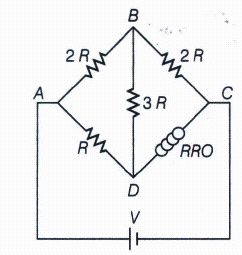
(ii) If now the resistance of the arms BC and CD are interchanged, to obtain the balance condition another carbon resistor is connected in place of R. What would now be sequence of colour bands of the carbon resistor? What is the current through the circuit?
11.
A circular coil of 120 turns has a radius of 18 cm and carries a current of 3 A. What is the magnitude of the magnetic field at a point on the axis of the coil at a distance from the centre equal to the radius of the circular coil?
12.
A series LCR circuit is connected to an a.c. source of 220V-50hz. If the readings of voltages across resistor, capacitor and inductor are 65 V, 415 V and 204 volt respectively; and R = 100\(\Omega \), calculate
(i) current in the circuit
(ii) value of L
(iii) value of C and
(iv) capacitance required to produce resonance with the given inductor L.
13.
Find the maximum value of current when inductance of two henry is connetced to 150 volt, 50 cycle supply.
14.
A parallel plate capacitor has circular plates each of radius 6.0 cm. It is charged such that the electric field in the gap between its plates rises constantly at the rate of 1010 V cm-1 s-1. What is the displacement current?
15.
What do you mean by quality factor or Q value of resonance circuit?
16.
A charged Particle q is shot towards another charged particle Q which is fixed , with a speed v. It approaches Q up to a closet distance r and then returns, If q were given a speed 2 v the n find the closet distance of approach.
17.
Does the charge given to a metallic sphere depend on whether it is hollow or solid? Give reason for your answer.
18.
A parallel plate capacitor of capacitance C is charged to a potential V. It is then connected to another uncharged capacitor having the same capacitance. Find out the ratio of the energy stored in the combined system to that stored initially in the single capacitor.
19.
A boy has two wires of iron and copper of equal length and diameter. He first joins the two wires in series and passes electric current through this combination which increases gradually with time. After that he joins them in parallel and repeat the process of passing the current in this arrangement also. Which wire will glow first in each case and why?
20.
Some times balance point may not be obtained on the potentiometer wire. Why?
21.
A circular brass loop of radius a and resistance R is placed with its plane perpendicular to a magnetic field, which varies with time as \(B={ B }_{ 0 }sin\omega t.\) Obtain the expression for the induced current in the loop.
22.
The north pole of a magnet is brought near a stationary negatively charged conductor. Will the pole experience any force?
23.
A magnet with moment M is given. If it is bent into a semicircular form, its new magnetic moment will be :
\(M/\pi \)
\(M/2\)
\(M\)
\(2M/\pi \)
24.
Electric field due to an electric dipole is
spherically symmetric
cylindrically symmetric
asymmetric
none of the above
25.
A flood light is covered with a filter that transmits red light. The electric field of the emerging beam is represented by a sinusoidal wave.
\({ E }_{ x }=36 \ sin\quad (1.20\times { 10 }^{ 7 }z=3.6\times { 10 }^{ 15 }t) \ V/m\)
the average intensity of the beam is watt/\({ (metre) }^{ 2 }\) will be:
6.88
3.44
1.72
0.86
1.
∴ Displacement current,
Id = \(\varepsilon _{ 0 }\frac { d\phi _{ E } }{ dt } \) = \(\varepsilon _{ 0 }\frac { d }{ dt } \) (EA) \(\left[\because \phi_E=E A\right]\)
where, E is electric field and A is the area of cross-section
= \(\varepsilon _{ 0 }A\frac { d }{ dt } \)\(\left( \frac { V }{ d } \right) \)
\(\Rightarrow \) Id =\(\frac { \varepsilon _{ 0 }A }{ d } \)x\(\frac { dV }{ dt } \)= \(\frac { CdV }{ dt } \) \(\left[\because C=\frac{\varepsilon_{0} A}{d}\right]\)
\(\Rightarrow \) \(\frac { dV }{ dt } \) = \(\frac { I_{ d } }{ C } \) = \(\frac { 1.0 }{ 10^{ -6 } } \)
= 106 Vs-1
Thus, an instantaneous displacement current of I A can be set up changing the potentil difference across the paralled plates of capcitor at the rate of 106 Vs-1..
2.
(i) Given, C1 = 1\(\mu F\) C2 = 2\(\mu F\) C3 = 3\(\mu F\)
The combined capacity (Cs) in series combination is given by
\(\frac { 1 }{ { C }_{ s } } =\frac { 1 }{ { C }_{ 1 } } +\frac { 1 }{ { C }_{ 2 } } +\frac { 1 }{ { C }_{ 3 } } =\frac { 1 }{ 1 } +\frac { 1 }{ 2 } +\frac { 1 }{ 3 } =\frac { 11 }{ 6 } \)
\(\Rightarrow { C }_{ s }=\frac { 6 }{ 11 } \mu F\)
The combined capacity (Cp) in parallel combination is given by
Cp = C1 + C2 +C3 = 1 + 2 + 3 = 6\(\mu F\)
\(\Rightarrow { C }_{ p }=11{ C }_{ s }\)
(ii) As, \({ \ C }_{ p }>{ C }_{ s }\)
\(\therefore \) The charge supplied by 100 V battery
\({ q }_{ p }={ C }_{ p }V=6\mu F\times 100=6\times { 10 }^{ -6 }\times 100\)
\(\\ { q }_{ p }=6\times { 10 }^{ -4 }C\)= 600 \(\mu\)C
3.
Given = 900 = 3 x 10⁻⁴ N-m
and B = 0.4 x 10⁻⁴T
Since, torque is given by
\( \tau = MB\sin { \theta } \)
\(\Rightarrow \ M\ =\frac { 3\times { 10 }^{ -4 } }{ 0.4\times { 10 }^{ -4 }\sin { \theta } } \)
\(\Rightarrow M\ =\ 7.5\ { jT }^{ -1 }\)
4.
Given, resistance, \({ R }_{ 1 }=10\Omega ,\ { R }_{ 2 }=10\Omega \)
Voltage, V = 1V
Time t = 5 x 60 s = 300 s
Since, effective resistance in parallel combination will be
\({ R }_{ p }=\frac { { R }_{ 1 }{ R }_{ 2 } }{ { R }_{ 1 }+{ R }_{ 2 } } =\frac { 10\times 10 }{ 10+10 } =5\Omega \)
Heat produced = \(\frac { { v }^{ 2 }t }{ { R }_{ p } } =\frac { { 1 }^{ 2 } }{ 5 } \times 5\times 60=\frac { 60 }{ 4.2 } cal=14.3\ \)cal
5.
Using Eq, the magnitude of B is
\(B=\frac { E }{ c } \)
\(=\frac { 6.3V/m }{ 3\times { 10 }^{ 8 }m/s } =2.1\times { 10 }^{ -8 }T\)
To find the direction, we note that E is along y-direction and the wave propagates along x-axis. Therefore, B should be in a direction perpendicular to both x- and y-axes. Using vector algebra, E × B should be along x-direction.
Since, \((+\overrightarrow{\mathbf{j}}) \times(+\hat{\mathbf{k}})=\overrightarrow{\mathbf{i}}, \mathbf{B}\) is along the z-direction.
Thus, \(\mathbf{B}=2.1 \times 10^{-8} \hat{\mathbf{k}} \mathrm{T}\)
6.
When we start the motor, there is no back emf as the motor is at rest. So, a large current flows through the coil. As the motor rotates, the back emf increases and intake of current decreases.
7.
Asha displayed the values of awareness towards energy saving and her concern towards wastage of energy
Following measures should be adopted to minimize the wastage of electric energy in Our households:
We should switch off the electrical appliances which are not in use.
The old electrical appliances should be repaired time to time, as they often consume more electricity.
Condensers of electrical appliances should be replaced time to time.
New electrical and electronic appliances must be purchased in accordance with their efficiency to consume less energy.
Use of solar devices like solar heater and cookers must be encouraged rather than the use of conventional electrical appliances.
Electrical energy dissipated by an appliance is
given by E = P x t
where, P is the power and t is the time.
P = 2 W, t = 20 h = 20 X 60 X 60 s
So, E = 2 x 20 x 60 x 60
\(\Rightarrow\) E =1.44 x 10⁵ J
8.
(a) Presence of mind, knowledge of subject.
(b) Used in telecommunication.
(c) \(\lambda =e/v=(3\times 10^{ 8 })/(3\times 10^{ 11 })={ 10 }^{ -3 }\)
9.
(a) \(\overrightarrow{F}=I(\overrightarrow{l} \times \overrightarrow{B})\), where \(\overrightarrow{l}\) is a vector of magnitude l, the length of the rod, and with a direction identical to the current I. Note that the current I is not a vector. According to Fleming's left hand rule,\(\overrightarrow{B}\) must act horizontally in a direction perpendicular to the wire carrying current.
(b) Adaptation to different situations and flexible and adjustable attitude.
(c) Avoiding unnecessary arguments in conflicting situations in everyday life.
10.
(i) Lat carbon resistor S is given to the bridge. Then,
\(\frac { 2R }{ R } =\frac { 2R }{ S } \Rightarrow \frac { R }{ S } =1\)
R = S = 22 x 103 \(\Omega =22k\Omega \)
(ii) After interchanging the resistance, the balanced bridge would be
\(\frac { 2R }{ X } =\frac { 22\times { 10 }^{ 3 } }{ 2\times 22\times { 10 }^{ 3 } } =\frac { 1 }{ 2 }\)
X = 4R = 4 x 22 x 103
= 88 x 103 \(\Omega \)
The colour sequence of X is grey, grey and orange. Thus, equivalent resistance of Wheatstone bridge,
\(\frac { 1 }{ { R }_{ eq } } =\frac { 1 }{ 3R } +\frac { 1 }{ 6R } =\frac { 3 }{ 6R } \)
\( { R }_{ eq }=2R\)
\(\therefore \ Current \ through \ the \ circuit,I=\frac { 1 }{ 3 } \times \frac { V }{ 2R } =\frac { V }{ 6R } A\)
11.
Given, number of turns N = 120, current I = 3 A, radius of coil, r = 18 cm = 0.18 m and distance from the centre to a point on axis,
a = r = 0.18 m
As, \(\begin{aligned} B=\frac{\mu_0 N I a^2}{2\left(a^2+r^2\right)^{3 / 2}} \\ \end{aligned}\)
\(\begin{aligned} =\frac{4 \pi \times 10^{-7} \times 120 \times 3 \times(0.18)^2}{2\left[(0.18)^2+(0.18)^2\right]^{3 / 2}} \\ \end{aligned}\)
\(\begin{aligned} \Rightarrow \quad B & =4.4 \times 10^{-4} \mathrm{~T} \end{aligned}\)
12.
\(Here, \ { E }_{ v }=200V,\ v=50hz,\ R=100\Omega ,\ { V }_{ R }=65V,\ { V }_{ C }=415V,\ { V }_{ L }=204V\)
(i) If Iv is current in the circuit, then
\({ V }_{ R }={ I }_{ V }\times R; \ 65={ I }_{ V }\times 100, \ { I }_{ V }=0.65A\)
\( (ii) \ { V }_{ L }={ I }_{ V }{ X }_{ L }; \ { X }_{ L }=\frac { { V }_{ L } }{ { I }_{ v } } =\frac { 204 }{ 0.65 } =313.85\Omega\)
\({ X }_{ L }=\omega L=2\pi vL=313.85\)
\(L=\frac { 313.85 }{ 2\pi v } =\frac { 313.85 }{ 3.14\times 50 } =1.0H\)
\( (iii) \ { V }_{ C }={ I }_{ v }{ X }_{ C }, \ { X }_{ C }=\frac { { V }_{ C } }{ { I }_{ v } } =\frac { 415 }{ 0.65 } =638.5\Omega \)
\({ X }_{ C }=\frac { 1 }{ \omega C } =\frac { 1 }{ 2\pi vC } ; \ C=\frac { 1 }{ 2\pi v \ { X }_{ c } } =\frac { 1 }{ 2\times 3.14\times 50\times 638.5 } =4.99\times { 10 }^{ -6 }F\)
(iv) Let C′ be the capacitance that would produce resonance with L= 1.0H, then
\( v=\frac { 1 }{ 2\pi \sqrt { LC' } } ; \ C'=\frac { 1 }{ 4{ \pi }^{ 2 }{ v }^{ 2 }L } =\frac { 1 }{ 4\times \left( 3.14 \right) ^{ 2 }\times \left( 50 \right) ^{ 2 }\times 1 } =10.1\times { }^{ }F=10.1\mu F\)
13.
Here, inductance, L = 2 henry
r.m.s. voltage, EV = 150 volt
frequency of A.C. supply, v = 50 c/s.
\(\therefore\) Inductive reactance, XL = \(\omega\)L
\(=2\pi vL=2\times \frac { 22 }{ 7 } \times 50\times 2=\frac { 4400 }{ 7 } \ ohm\)
If E0 is the peak value of the alternating voltage, then maximum value of current (I0) is given by
\({ I }_{ 0 }=\frac { { E }_{ 0 } }{ { X }_{ L } } \ or \ { I }_{ 0 }=\frac { \sqrt { 2 } \times { E }_{ v } }{ { X }_{ L } } =\frac { \sqrt { 2 } \times 150 }{ 4400/7 } =0.337A\)
14.
Here, \(r=6\times { 10 }^{ -2 }m;\)
\(A=\pi \times \left( 6\times { 10 }^{ -2 } \right) ^{ 2 }=36\pi \times { 10 }^{ -4 }{ m }^{ 2 }\)
\(\frac { dE }{ dt } ={ 10 }^{ 10 }V{ cm }^{ -1 }{ s }^{ -1 }={ 10 }^{ 12 }V{ m }^{ -1 }{ s }^{ -1 }\)
Displacement current,
\({ I }_{ D }={ \epsilon }_{ 0 }\frac { d{ \phi }_{ E } }{ dt } ={ \epsilon }_{ 0 }A\frac { dE }{ dt } \)
\(=\left( 8.85\times { 10 }^{ -12 } \right) \times \left( 36\pi \times { 10 }^{ -4 } \right) \times { 10 }^{ 12 }\)
= 0.1 A
15.
Quality factor
The quality factor of LCR-circuit is the ratio of the potential difference across inductance (or capacitance) at resonance to the applied voltage. This is also called the figure of merit or Q-value of LCR series circuit
i.e. \(Q=\frac { Voltage \ across(L\ or\ C) }{ Voltage\ applied } \)
At resonance
Voltage across \(L=I{ X }_{ L }\)
Voltage across \(C=I{ X }_{ C }\)
Voltage applied = Voltage drop across \(R=IR\)
16.
q \(\rightarrow\)_______Q
1/2 mv2 = kQq/r
Or, v2 a1/r
Or, r a 1/v2
Or, r' = r/4
17.
In case of metallic sphere, charge given to it mostly resides on its surface. Therefore, there is no difference whether the sphere is hollow or solid. As in both the cases, the charge that will reside will be same.
18.
Let q be the charge on the charged capacitor.
\(\therefore \) Energy stored in it is given by, \(U=\frac { { q }^{ 2 } }{ 2C } \)
When another uncharged similar capacitor is connected, then the net capacitance of the system is given by, C' = 2C
The charge on the system remains constant.
So, the energy stored in the system is given by
\(U'=\frac { { q }^{ 2 } }{ 2C' } =\frac { { q }^{ 2 } }{ 4C } \) \(\left[ \because { C'={ 2C } } \right] \)
Thus, the required ratio is given by \({ \frac { U' }{ U } }\ =\frac { { { q }^{ 2 }/{ 4C } } }{ { q }^{ 2 }/{ 2C } } =\frac { 1 }{ 2 } \)
19.
We know that resistivity of iron is more than that of copper.
In series combination, the same current I flows through iron and copper wires.
Heat produced,
H = I2Rt
= \(I^2\frac{\rho l}{A}\) i.e., \(H \propto \rho\)
As \(\rho_{iron}>\rho_{cu}\)
so \(H_{iron}>H_{cu}\).
Therefore, iron will start glowing first in series combination. In parallel combination, the voltage V is same across iron and copper wires. So
Heat produced,
\(H=\frac{V^2}{R}t=\frac{V^2t}{\rho l/A}\) i.e., \(H \propto \frac{1}{\rho}\)
As \(\rho_{iron}>\rho_{cu}\)
Therefore, copper will start glowing first in parallel combination of wires.
20.
It is possible only if the fall of potential across the potentiometer wire is less than the potential difference to be balanced by the potentiometer wire.
21.
Induced current,
\(I=\frac { induced \ e.m.f/ }{ resistance } =\frac { e }{ R } \\ =\frac { d\Phi /dt }{ R } =\frac { -1 }{ R } \frac { d }{ dt } (BA \ cos{ 0 }^{ \circ })\\ I=-\frac { A }{ R } \frac { d }{ dt } ({ B }_{ 0 }sin\omega t)=-\frac { { AB }_{ 0 } }{ R } cos\omega t(\omega )\\ =-\frac { { A\omega B }_{ 0 } }{ R } cos\omega t\)
22.
No, a stationary charge does not produce magnetic field.
23.
(d)
\(2M/\pi \)
24.
(b)
cylindrically symmetric
25.
(c)
1.72

12th Standard CBSE Syllabus & Materials
12th Standard CBSE
CBSE 12th Computer Science Python Revision Tour I - New Previous year Question Papers Study Material - QB365 Set A
NEW12th Standard CBSE
CBSE 12th Business Studies Planning Important Questions And Answers Study Material - QB365 Set A
NEW12th Standard CBSE
CBSE 12th Business Studies Business Environment Important Questions And Answers Study Material - QB365 Set A
NEW12th Standard CBSE
CBSE 12th Business Studies Principles of Management Important Questions And Answers Study Material - QB365 Set A



CBSE 12th Standard CBSE Subjects
CBSE Standards










