
 100% FREE ACCESS
12th Standard CBSE Syllabus & Materials
12th Standard CBSE
CBSE 12th Economics Government Budget and the Economy Previous year Question Papers Study Material - QB365 Set A
NEW12th Standard CBSE
CBSE 12th Computer Science Interface Python with MySQL - New Previous year Question Papers Study Material - QB365 Set A
NEW12th Standard CBSE
CBSE 12th Computer Science Database Concept - New Previous year Question Papers Study Material - QB365 Set A
NEW12th Standard CBSE
CBSE 12th Computer Science Data Communication - New Previous year Question Papers Study Material - QB365 Set A
NEW12th Standard CBSE
CBSE 12th Computer Science Data Structures - New Previous year Question Papers Study Material - QB365 Set A
NEW12th Standard CBSE
CBSE 12th Computer Science Functions - New Previous year Question Papers Study Material - QB365 Set A

Published on: 15/02/2020
12th Standard CBSE Physics Public Model Question Paper V 2019 - 2020
Download CBSE Class 12th Standard CBSE Physics question papers, sample papers, important questions, and previous year solved papers in PDF format. Get free study materials, NCERT solutions, and exam preparation resources for Class 12th Standard CBSE Physics
Questions + Answers key
Take MCQ Physics Test
1.
The refractive index of water is 4/3. Obtain the value of the semivertical angle of the cone within which the entire outside view would be confined for a fish under water. Draw an appropriate ray diagram
2.
A charged Particle q is shot towards another charged particle Q which is fixed , with a speed v. It approaches Q up to a closet distance r and then returns, If q were given a speed 2 v the n find the closet distance of approach.
3.
Why is potentiometer preferred over a voltmeter for determining the emf of a cell?
4.
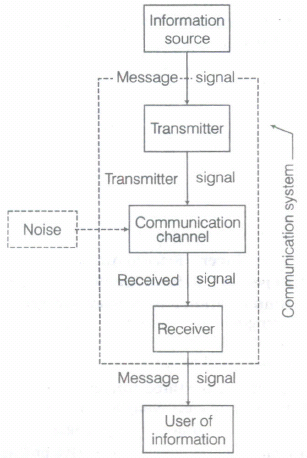
Draw a block diagram showing the important component in a communication system. What is the function of a transducer?
5.
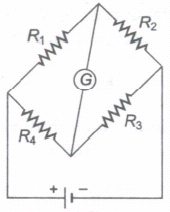
For the circuit diagram of a Wheatstone bridge shown in the figure, use Kirchhoff's laws to obtain its balance condition
6.
Name the electromagnetic radiations having the wavelength range from 1 mm to 700 nm. Give its two important applications.
7.
For a given photosensitive material and with a source of constant frquency of incident radiation, how does the photocurrent vary with the intensity of incident light?
8.
How does electric field at a point charge vary with distance r from an infinitely long charged wire?
9.
At what angle of incidence should a light beam strike a glass slab of \(\mu =\sqrt { 3 } \), such that reflected and refracted rays are perpendicular to each other?
10.
How does inductive reactance vary when frequency of a.c. source in the circuit is halved?
11.
What are the materials generally used for making standard resistances? Give their compositions.
12.
The following data was obtained for a given transistor :
| VCE⇢ | 10.0V | 10.0V |
| VBE⇢ | 0.82V | 0.72V |
| IB⇢ | 80μA | 30μA |
For this data calculate the input resistance of given transistor.
13.
An electromagnetic wave is travelling in vacum with a speed 3 x 10⁸ m / s. Find its velocity in a medium having relative electric and magnetic permeability 2 and 1, respectively.
14.
A. T.V transmission tower at a particular station has a height of 160 m.
(a) What is its coverage range?
(b) How much population is covered by transmission if the average population density around the tower is 1200 \(km^{ -2 }\) ?
(c) By how much the height of tower be increased to double its coverage range?
Given radius of earth = 6400 km
15.
The work function of caesium is 2.14 eV. Find
(a) the threshold frequency for caesium and
(b) wavelength of the incident light if the photocurrent is brought to zero by a stopping potential of 0.60 V
16.
Two point charges of +10\(\mu C\) and +20\(\mu C\) are placed in free space 2 cm apart. Find the electric potential at the middle point of the line joining the two charges.
17.
If the image formed by a convex mirror of focal length 30 cm is a quarter of the size of the object, then the distance of the object from the mirror will be
30 cm
60 cm
90 cm
120 cm
18.
Two similar coils of radius R, are lying concentrically with their planes at right angles to each other. The currents flowing in them are I and 2 I respectively. The resultant magnetic field at the centre will be :
\(\frac { \sqrt { 5 } { \mu }_{ 0 }I }{ 2R } \)
\(\frac { 3{ \mu }_{ 0 }I }{ 2R } \)
\(\frac { { \mu }_{ 0 }I }{ 2R } \)
\(\frac { { \mu }_{ 0 }I }{ R } \)
19.
Which of the following statements concerning the depletion zone of an unbiased p-n junction is (are) true?
The width of the zone is independent of the densities of the dopants(impurities)
The width of the zone is dependent on the densities of the dopants
The electric field in the zone is provided by the electrons in the conduction band and holes in the valence band
The electric field in the zone is produced by the ionized dopant atoms.
20.
What is not true?
It is not possible to create or destroy net charge carries by any isolated system
Charges can be created or destroyed in equal and unlike pairs only
proper signs have to be used while adding the charges in a system
Excess of electrons over protons in a body is responsible for positive charge of the body.
21.
A beam of light of wavelength 400nm and power 1.55 mW is directed at the cathode of a photoelectric cell. If only 10% of the incident photons effectively produce photoelectron, then find current due to these electrons. (Given, \( hc=1240eVnm,e=1.6\times { 10 }^{ -19 }C)\)
\(5\mu A\)
\(40\mu A\)
\(50\mu A\)
\(114\mu A\)
22.
A circular coil carrying current behaves as a
bar magnet
horse shoe magnet
magnetic shell
solenoid
23.
Which one of the following phenomena confirms that light waves are transverse?
interference
diffraction
dispersion
polarization
24.
When an electric dipole is held at an angle in a uniform electric field, the net force F and torque \(\tau\) on the dipole are
F = 0, \(\tau=0\)
\(F\ne 0,\tau\ne 0\)
F = 0, \(\tau\ne0\)
\(F\ne0,\tau=0\)
25.
The frequency of a.c. generated depends on
speed of rotation of coil
amplitude of a.c
size of coil
all the above
26.
An electromagnetic wave going through vacuum is denoted by \(E={ E }_{ 0 } \ sin \ (kz-\omega t)\). Which of the following is/are independent of wavelength?
k
\(\omega \)
\(k/\omega \)
\(k\omega \)
27.
For a normal eye, the least distance of distinct vision is................and far point is..................... .
28.
In \(p-type \) semiconductors, the..........are majority carriers and ..................are minority carriers
29.
(a) Determine the ‘effective focal length’ of the combination of the two lenses in Exercise, if they are placed 8.0cm apart with their principal axes coincident. Does the answer depend on which side of the combination a beam of parallel light is incident? Is the notion of effective focal length of this system useful at all?
(b) An object 1.5 cm in size is placed on the side of the convex lens in the arrangement (a) above. The distance between the object and the convex lens is 40 cm. Determine the magnification produced by the two-lens system, and the size of the image.
30.
An object is placed at (i) 10 cm, (ii) 5 cm in front of a concave mirror of radius of curvature 15 cm. Find the position, nature, and magnification of the image in each case.
31.
(a) A point object is placed in front of a double convex lens (of refractive index n =n2/n1 with respect air) with its spherical faces of radii of curvature R1 and R2.. Show the path of rays due to surface to obtain the formation of the real image of the object.
Hence obtain the lens maker's formula for a thin lens.
(b) A double convex lens having both faces of the same radius of curvature has refractive index 1.55. Find out the radius of curvature of the lens required to get the focal length of 20 cm.
32.
A rectangular coil of 200 turns of wire 15\(\times\)40cm2 makes 50 r.p.s. ab out an axis in its plane parallel to its longer side and perpendicular to a magnetic field of intensity 0.08 Wb/m2. What are the instantaneous values of induced e.m.f. when the plane of the coil makes an angle with magnetic field of
(a) \({ 0 }^{ \circ }\)
(b) \({ 60 }^{ \circ }\)
(c) \({ 90 }^{ \circ }\) ?
1.
Clearly , the fish can see the outside view of the cone with semi vertical angle
But \(\mu \) = 1.sin ic
or 1/3 = 1/ sin ic
or sin ic = 3/4 = 0.75
\(\theta\)/2 =ic = sin-1 (0.75 ) = 48.60
2.
q \(\rightarrow\)_______Q
1/2 mv2 = kQq/r
Or, v2 a1/r
Or, r a 1/v2
Or, r' = r/4
3.
Potentiometer does not draw any (net) current front-the cell. Voltmeter draws some current from cell, when connected across at, hence measures terminal voltage.
4.
Range of frequency suitable for space wave propagation is 100 MHz to 220 MHz.
5.
No current flows through the galvanometer G when circuit is balanced.
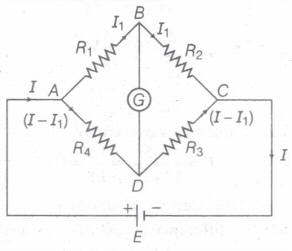
On distributing currents as per Kirchhoff's first rule.
Applying Kirchhoff's second rule
(i) In mesh ABDA,
∴ -I1R1 + (I - I1)R4 = 0
⇒ I1R1 = (I - I1)R4 .......(i)
(ii) In mesh BCDB,
-I1R2 + (I - I1)R3 = 0
I1R2 = (I - I1)R3 .......(ii)
On dividing Eq. (i) by Eq. (ii), we get
\(\frac { { I }_{ 1 }{ R }_{ 1 } }{ { I }_{ 1 }{ R }_{ 2 } } =\frac { (I-{ I }_{ 1 }){ R }_{ 4 } }{ (I-{ I }_{ 1 }){ R }_{ 3 } } \)
\(\frac { { R }_{ 1 } }{ { R }_{ 2 } } =\frac { { R }_{ 4 } }{ { R }_{ 3 } } \)
This is necessary and required balanced condition of balanced Wheatstone bridge.
6.
Infrared waves have the wavelength between 1 mm to 700 nm.
Application:
(i) In knowing the molecular structure therapy to heat muscular pain.
(ii) In remote control of TV, VCR, etc.
7.
The photocurrent increase linearly with the intensity of incident radiation.
8.
The electric field due to a line charge falls of with distance as 1/r.
9.
The reflected and refracted rays will be perpendicular when \(i={ i }_{ p },\)
where \(\tan { { i }_{ p } } =\mu =\sqrt { 3 } \ \therefore \ { i }_{ p }={ 60 }^{ ° }\)
10.
\(X_L=\omega L=2 \pi v L,\)
11.
(i) Constantan [Cu (60%) + Ni (40%)]
(ii) Manganin [Cu (84%) + Mn (12%) + Ni (4%)]
12.
Input Resistance ri = \({ \left( \frac { \Delta { V }_{ BE } }{ \Delta { I }_{ B } } \right) }_{ { V }_{ CE } }\)
= \(\frac { \left( 0.82-0.72 \right) V }{ \left( 80-30 \right) \times { 10 }^{ -6 } } \)
= \(\frac{0.10}{50\times{10}^{-6}}\)
= \(\frac{100\times{10}^{3}}{50}\)
= 2000 Ω
13.
Given, velocity of electromagnetic wave in vacum, c = 3 X 10⁸ m / s
Relative electric permeability,\(\varepsilon _{ r }\) = 2
and magnetic permeability, \(\mu _{ r }\) = 1
Since, velocity of electromagnetic wave in a medium can be calculated by
v = \(\frac { 1 }{ \sqrt { \varepsilon _{ 0 }\varepsilon _{ r }\mu _{ 0 }\mu _{ r } } } =\frac { 1 }{ \sqrt { \varepsilon _{ 0 }\mu _{ 0 } } \quad x \quad \sqrt { \mu _{ r }\varepsilon _{ r } } } \)
Where,
\(\frac { 1 }{ \sqrt { \varepsilon _{ 0 }\mu _{ 0 } } } =c \ \Rightarrow \ v \ = \ \frac { c }{ \sqrt { \mu _{ r }\varepsilon _{ r } } } \) ...(i)
Therefore, v \(=\frac { 3x10^{ 8 } }{ \sqrt { 2x1 } } \Rightarrow \) \(v=\frac { 3 }{ \sqrt { 2 } } \times10^{ 8 }\) m/s.
14.
(a) Coverage range
\(d=\sqrt { 2hR } =\sqrt { 2\times160\times6.4\times{ 10 }^{ 6 } }\)
\(=45255m=45.255\ km\)
(b) Population Covered = \(\rho \times \pi d^{ 2 }\)
\(=1200\times\frac { 22 }{ 7 } \times(45.255){ 10 }^{ 6 }\)
\(=77.24\times{ 10 }^{ 5 }=77.24\ lakh\)
(c) \(d^{ ' }=\sqrt { 2h^{ ' }R } =2d=2\sqrt { 2hr } \)
\(\ or \ { h }^{ ' }=4h=4\times160=640m\)
Increase in height of tower =\(h^{ ' }=h\)
\(=640-160=480m\)
15.
(a) For the cut-off or threshold frequency, the energy h v0 of the incident radiation must be equal to work function Φ0, so that
\({ V }_{ 0 }=\frac { { \phi }_{ 0 } }{ h } =\frac { 2.14eV }{ 6.63\times { 10 }^{ -34 }Js }\)
\(=\frac { 2.14\times 1.6\times { 10 }^{ -19 }J }{ 6.63\times { 10 }^{ -34 }Js } =5.16\times { 10 }^{ 14 }Hz\)
Thus, for frequencies less than this threshold frequency, no photoelectrons are ejected.
(b) Photocurrent reduces to zero, when maximum kinetic energy of the emitted photoelectrons equals the potential energy eV0 by the retarding potential V0. Einstein’s Photoelectric equation is
\(e{ V }_{ 0 }=\frac { hc }{ \lambda } -{ \phi }_{ 0 }\)
\(or\ \lambda =\frac { hc }{ \left( e{ V }_{ 0 }+{ \phi }_{ 0 } \right) }\)
\(or \ \lambda =\frac { \left( 6.63\times { 10 }^{ -34 }Js \right) \times \left( 3\times { 10 }^{ 8 }m/s \right) }{ \left( e\times 0.6V+2.14eV \right) } \)
\(\lambda =\frac { 19.89\times { 10 }^{ -26 }Jm }{ 2.74\times 1.6\times { 10 }^{ -19 }J } =454nm\)
16.
Electric potential at middle point V = V1 + V2
\(V={1\over 4\pi\epsilon_o}[{q_1\over r_1}+{q_2\over r_2}]\)
\(=9\times10^9[{10\times 10^{-6}\over 0.01}+{20\times10^{-6}\over 0.01}]\)
\(=27\times 10^6V=27 MV\)
17.
(c)
90 cm
18.
(a)
\(\frac { \sqrt { 5 } { \mu }_{ 0 }I }{ 2R } \)
19.
(a)
The width of the zone is independent of the densities of the dopants(impurities)
20.
(d)
Excess of electrons over protons in a body is responsible for positive charge of the body.
21.
(c)
\(50\mu A\)
22.
(c)
magnetic shell
23.
(d)
polarization
24.
(c)
F = 0, \(\tau\ne0\)
25.
(a)
speed of rotation of coil
26.
(c)
\(k/\omega \)
27.
()
25 cm ; at infinity
28.
()
holes,electrons
29.
Focal length of the convex lens, f1 = 30 cm
Focal length of the concave lens, f2 = -20 cm
Distance between the two lenses, d = 8.0 cm
(a) When the parallel beam of light is incident on the convex lens first:
According to the lens formula, we have:
\(\frac { 1 }{ { v }_{ 1 } } -\frac { 1 }{ { u }_{ 1 } } =\frac { 1 }{ { f }_{ 1 } } \)
Where,
u1 = Object distance = ∞
v1 = Image distance
\(\frac { 1 }{ { v }_{ 1 } } =\frac { 1 }{ 30 } -\frac { 1 }{ \infty } =\frac { 1 }{ 30 } \)
∴ v1 = 30 cm
The image will act as a virtual object for the concave lens.
Applying lens formula to the concave lens, we have:
\(\frac { 1 }{ { v }_{ 2 } } -\frac { 1 }{ { u }_{ 2 } } =\frac { 1 }{ { f }_{ 2 } } \)
Where,
u2 = Object distance
= (30 - d) = 30 - 8 = 22 cm
v2= Image distance
\(\frac { 1 }{ { v }_{ 2 } } =\frac { 1 }{ 22 } -\frac { 1 }{ 20 } =\frac { 10-11 }{ 220 } =\frac { -1 }{ 220 } \)
∴ v2 = -220 cm
The parallel incident beam appears to diverge from a point that is \(\left( 220-\frac { d }{ 2 } =220-4 \right) 216\) cm from the centre of the combination of the two lenses.
(ii) When the parallel beam of light is incident, from the left, on the concave lens first:
According to the lens formula, we have:
\(\frac { 1 }{ { v }_{ 2 } } -\frac { 1 }{ { u }_{ 2 } } =\frac { 1 }{ { f }_{ 2 } } \)
\(\frac { 1 }{ { v }_{ 2 } } =\frac { 1 }{ { f }_{ 2 } } +\frac { 1 }{ { u }_{ 2 } } \)
Where,
u2 = Object distance = -∞
v2 = Image distance
\(\frac { 1 }{ { v }_{ 2 } } =\frac { 1 }{ -20 } +\frac { 1 }{ -\infty } =-\frac { 1 }{ 20 } \)
∴ v2 = -20 cm
The image will act as a real object for the convex lens.
Applying lens formula to the convex lens, we have:
\(\frac { 1 }{ { v }_{ 1 } } -\frac { 1 }{ { u }_{ 1 } } =\frac { 1 }{ { f }_{ 1 } } \)
Where,
u1 = Object distance
= -(20 + d) = -(20 + 8) = -28 cm
v1 = Image distance
\(\frac { 1 }{ { v }_{ 1 } } =\frac { 1 }{ 30 } +\frac { 1 }{ -28 } =\frac { 14-15 }{ 420 } =\frac { -1 }{ 420 } \)
∴ v2 = - 420 cm
Hence, the parallel incident beam appear to diverge from a point that is (420 - 4) 416 cm from the left of the centre of the combination of the two lenses
The answer does depend on the side of the combination at which the parallel beam of light is incident. The notion of effective focal length does not seem to be useful for this combination.
(b) Height of the image, h1 = 1.5 cm
Object distance from the side of the convex lens, u1 = -40 cm
|u1| = 40 cm
According to the lens formula:
\(\frac { 1 }{ { v }_{ 1 } } -\frac { 1 }{ { u }_{ 1 } } =\frac { 1 }{ { f }_{ 1 } } \)
Where,
v1 = Image distance
\(\frac { 1 }{ { v }_{ 1 } } =\frac { 1 }{ 30 } +\frac { 1 }{ -40 } =\frac { 4-3 }{ 120 } =\frac { 1 }{ 120 } \)
∴ v1 = 120 cm
\(m=\frac { { v }_{ 1 } }{ \left| { u }_{ 1 } \right| } \)
= \(\frac { 120 }{ 40 } =3\)
Hence, the magnification due to the convex lens is 3.
The image formed by the convex lens acts as an object for the concave lens.
According to the lens formula:
\(\frac { 1 }{ { v }_{ 2 } } -\frac { 1 }{ { u }_{ 2 } } =\frac { 1 }{ { f }_{ 2 } } \)
Where,
u2 = Object distance
= +(120 - 8) = 112 cm.
v2 = Image distance
\(\frac { 1 }{ { v }_{ 2 } } =\frac { 1 }{ -20 } +\frac { 1 }{ 112 } =\frac { -112+20 }{ 2240 } =\frac { -92 }{ 2240 } \)
∴ v2 = \(\frac { 2240 }{ 92 } \) cm
Magnification, \({ m }^{ ' }=\left| \frac { { v }_{ 2 } }{ { u }_{ 2 } } \right| \)
\(=\frac { 2240 }{ 92 } \times \frac { 1 }{ 112 } =\frac { 20 }{ 92 } \)
Hence, the magnification due to the concave lens is \(\frac { 20 }{ 92 } \)
The magnification produced by the combination of the two lenses is calculated as:
m x m'
\(=3\times \frac { 20 }{ 92 } =\frac { 60 }{ 92 } =0.652\)
The magnification of the combination is given as:
\(\frac { { h }_{ 2 } }{ { h }_{ 1 } } =0.652\)
h2 = 0.652 x h1
Where,
h1 = Object size = 1.5 cm
h2 = Size of the image
∴ h2 = 0.652 x 1.5 = 0.98 cm
Hence, the height of the image is 0.98 cm
30.
The focal length f = -15/2 cm = -7.5 cm
(i) The object distance u = -10 cm. Then Eq gives
\(\frac { 1 }{ v } +\frac { 1 }{ 10 } =\frac { 1 }{ -7.5 } \)
or \(v=\frac { 10\times 7.5 }{ -2.5 } =-30\) cm
The image is 30 cm from the mirror on the same side as the object
Also, magnification m = \(\frac { v }{ u } =-\frac { (-30) }{ (-10) } =-3\)
The image is magnified, real and inverted.
(ii) The object distance u = -5 cm. Then from Eq
\(\frac { 1 }{ v } +\frac { 1 }{ -5 } =\frac { 1 }{ -7.5 } \)
or \(v=\frac { 5\times 7.5 }{ (7.5-5) } =15\) cm
This image is formed at 15 cm behind the mirror. It is a virtual image.
Magnification m = 15 \(-\frac { v }{ u } =-\frac { 15 }{ (-5) } =3\)
The image is magnified, virtual and erect.
31.
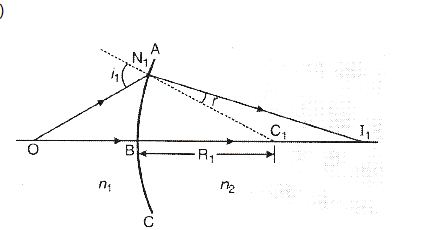
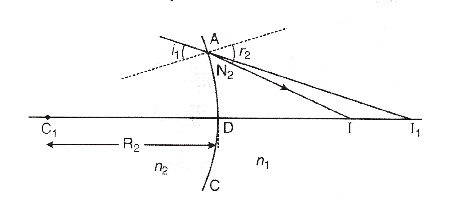
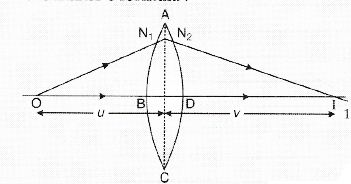
The first refracting ABC forms the image I1 of the object O. The image I1 acts as virtual object for the second refracting surface ADC, which forms the real image I as shown in the diagram
For refraction at ABC
\(\frac { { n }_{ 2 } }{ { v }_{ 1 } } -\frac { { n }_{ 1 } }{ u } =\frac { { n }_{ 2 }-{ n }_{ 1 } }{ { R }_{ 1 } } \)
For refraction at ADC
\(\frac { { n }_{ 1 } }{ v } -\frac { { n }_{ 2 } }{ { v }_{ 1 } } =\frac { { n }_{ 1 }-{ n }_{ 2 } }{ { R }_{ 2 } } \)
Adding equation (i) and equation (ii)
\(\frac { { n }_{ 1 } }{ v } -\frac { { n }_{ 2 } }{ u } =\left( { n }_{ 2 }-{ n }_{ 1 } \right) \left( \frac { 1 }{ { R }_{ 1 } } -\frac { 1 }{ { R }_{ 2 } } \right) \)
\(\frac { 1 }{ v } -\frac { 1 }{ u } =\left( \frac { { n }_{ 2 } }{ { n }_{ 1 } } -1 \right) \left( \frac { 1 }{ { R }_{ 1 } } -\frac { 1 }{ { R }_{ 2 } } \right) \)
We know, If \(u=\infty ,v=f\)
\(\frac { 1 }{ v } -\frac { 1 }{ u } =\frac { 1 }{ f } \)
\(\frac { 1 }{ f } =\left( \frac { { n }_{ 2 } }{ { n }_{ 1 } } -1 \right) \frac { 1 }{ { R }_{ 1 } } -\frac { 1 }{ { R }_{ 2 } } \)
\(\frac { 1 }{ f } =\left( { \mu }_{ 21 }-1 \right) \left( \frac { 1 }{ { R }_{ 1 } } -\frac { 1 }{ { R }_{ 2 } } \right) \)
\(\frac { 1 }{ f } =\left( { \mu }_{ 21 }-1 \right) \left( \frac { 1 }{ { R }_{ 1 } } -\frac { 1 }{ { R }_{ 2 } } \right) \)
\(\frac { 1 }{ f } =\left( 1.55-1 \right) \left( \frac { 1 }{ R } -\frac { 1 }{ -R } \right) \)
\(=0.55\times \frac { 2 }{ R } \)
\(R=0.55\times 2\times 20=22 \ cm\)
32.
\(Here,\quad N=200,\quad A=15\times 40{ cm }^{ 2 }=600\times { 10 }^{ -4 }{ m }^{ 2 }\)
\(A=15\times 40{ cm }^{ 2 }=600\times { 10 }^{ -4 }{ m }^{ 2 },\quad v-50r.p.s.,\quad B=0.08Wb/{ m }^{ 2 },\quad e=?\)
\(\\ { e }_{ 0 }=NAB\omega =NAB\left( 2\pi v \right) =\left( 200 \right) \times \left( 6\times { 10 }^{ -2 } \right) \times 0.08\times 2\times \frac { 22 }{ 7 } \times 50=301.7volt\)
In the question, angle are given between the plane of the coil and magnetic field. We have to use angles which normal to the plane of coil makes with the field. Therefore, from e = e0 sin \(\omega \)t = e0 sin\(\theta \)
\((a) \ Here \ \theta ={ 90 }^{ \circ }-{ 0 }^{ \circ }={ 90 }^{ \circ }\)
\(\\ \therefore \ e=301.7 \ sin \ { 90 }^{ \circ }=301.7 \ volt\)
\( (b) \ Here, \ \theta ={ 90 }^{ \circ }-{ 60 }^{ \circ }={ 30 }^{ \circ }\)
\( \therefore \ e=301.7sin \ { 30 }^{ \circ }=301.7\times \frac { 1 }{ 2 } =150.85 \ volt\)
\( (c) \ Here, \ \theta ={ 90 }^{ \circ }-{ 90 }^{ \circ }={ 0 }^{ \circ }\)
\(\therefore \ e=301.7sin \ { 0 }^{ \circ }=zero\)

12th Standard CBSE Syllabus & Materials
12th Standard CBSE
CBSE 12th Computer Science Python Revision Tour I - New Previous year Question Papers Study Material - QB365 Set A
NEW12th Standard CBSE
CBSE 12th Business Studies Planning Important Questions And Answers Study Material - QB365 Set A
NEW12th Standard CBSE
CBSE 12th Business Studies Business Environment Important Questions And Answers Study Material - QB365 Set A
NEW12th Standard CBSE
CBSE 12th Business Studies Principles of Management Important Questions And Answers Study Material - QB365 Set A



CBSE 12th Standard CBSE Subjects
CBSE Standards










