
 100% FREE ACCESS
12th Standard CBSE Syllabus & Materials
12th Standard CBSE
CBSE 12th Economics Government Budget and the Economy Previous year Question Papers Study Material - QB365 Set A
NEW12th Standard CBSE
CBSE 12th Computer Science Interface Python with MySQL - New Previous year Question Papers Study Material - QB365 Set A
NEW12th Standard CBSE
CBSE 12th Computer Science Database Concept - New Previous year Question Papers Study Material - QB365 Set A
NEW12th Standard CBSE
CBSE 12th Computer Science Data Communication - New Previous year Question Papers Study Material - QB365 Set A
NEW12th Standard CBSE
CBSE 12th Computer Science Data Structures - New Previous year Question Papers Study Material - QB365 Set A
NEW12th Standard CBSE
CBSE 12th Computer Science Functions - New Previous year Question Papers Study Material - QB365 Set A

Published on: 03/09/2019
Magnetic Effects of Current
Download CBSE Class 12th Standard CBSE Physics question papers, sample papers, important questions, and previous year solved papers in PDF format. Get free study materials, NCERT solutions, and exam preparation resources for Class 12th Standard CBSE Physics
Questions + Answers key
Take MCQ Physics Test
1.
A long straight horizontal cable carries a current of 2.5A in the direction 10o south of west to 10o north of east. The magnetic meridian of the place happens to be 10o west of the geographic meridian, The earth's magnetic field at the location is 0.33G, and the angle of dip is zero. Locate the line of neutral points(Ignore the thickness of the cable).
2.
An electron travels in a circular path of radius 20 cm in a magnetic field of 2 \(\times\) 10-3 T. Calculate the speed of the electron. What is the potential difference through which the electron must be accelerated to acquire this speed?
3.
Assume the dipole model for earth's magnetic field B which by \({ B }_{ v }=\)vertical component of magnetic field = \(\frac { { \mu }_{ 0 } }{ 4\pi } \frac { 2M\cos { \theta } }{ { r }^{ 3 } } { B }_{ H }=\) Horizontal component of magnetic field = \(\frac { { \mu }_{ 0 } }{ 4\pi } \frac { 2M\sin { \theta M } }{ { r }^{ 3 } } ,\theta ={ 90 }^{ \circ }=\) lattitude as measured from magnetic equator. Find loci of points for which
(i) \(\left| B \right| \) is minimum
(ii) dip angle is zero and
(iii) dip angle is\(\pm { 45 }^{ \circ }\).
4.
(a) What is the importance of a radical magnetic field and how is it produced?
(b) Why is it that while using a moving coil galvanometer as a voltmeter, a high resistance in series is required whereas in an ammeter a shunt is used?
(c) With the help of a diagram, explain the principle and working of a moving coil galvanometer.
5.
A wire of length l metre carries a current I ampere along the Y-axis. A magnetic field, \(\overset { \rightarrow }{ B } ={ B }_{ o }\left( \hat { i } +\hat { j } +\hat { k } \right) \)tesla exists in space. Find the magnitude of the force on the wire.
6.
An \(\alpha \) -particle and a proton are moving in the plane of the paper in a region where there is a uniform magnetic field \(\overset { \rightarrow }{ B } \) directed normal to the plane of paper. If the two particles have equal linear momenta, what will be the ratio of their trajectories in the field?
7.
A current is set up in a long copper pipe. Is there a magnetic field
(a) inside
(b) outside the pipe ?
8.
How will the magnetic field strength at the centre of the circular coil carrying current change, if the current through the coil is doubled and the radius of the coil is halved?
9.
Where is the magnetic field due to current through circular loop is
(i) uniform and
(ii) non-uniform ?
10.
Where is the magnetic field of a current element (i) minimum and (ii) maximum?
11.
Name the physical quantity whose unit is tesla. Hence define a tesla.
12.
Ampere's circuital law can be derived from
Ohm's law
Biot-Savart's law
Kirchhoff's law
Gauss's law
13.
A thin ring of radius R metre has charge q coulomb uniformly spread on it. The ring rotates about its axis with a constant frequency of f revolutions/s. The value of magnetic field induction in Wb/m2 at the centre of the ring is
\(\frac { { \mu }_{ o }qf }{ 2\pi R } \)
\(\frac { { \mu }_{ o }q }{ 2\pi fR } \)
\(\frac { { \mu }_{ o }q }{ 2fR } \)
\(\frac { { \mu }_{ o }qf }{ 2R } \)
14.
If a copper wire carries a direct current, the magnetic field associated with the current will be
only outside the wire
only inside the wire
both inside and outside the wire
neither inside nor outside the wire
15.
A positive charge is moving towards an observer. The direction of magnetic induction lines is
clockwise
anticlockwise
right
left
16.
The magnetic field at a perpendicular distance of 2 cm from an infinite straight current carrying conductor is 2x10⁻⁶ T. The current in the wire is
0.1 A
0.2 A
0.4 A
0.8 A
1.
Parallel to and above the cable at a distance of 1.5 cm)
2.
7.04 \(\times\) 107 ms-1
3.
\({ B }_{ v }=\frac { { \mu }_{ 0 } }{ 4\pi } \frac { 2M\cos { \theta } }{ { r }^{ 3 } } \)
\({ \ B }_{ H }=\frac { { \mu }_{ 0 } }{ 4\pi } \frac { M\sin { \theta } }{ { r }^{ 3 } } \)
\(B=\sqrt { \begin{matrix} { { B }_{ v } }^{ 2 } & + & { { B }_{ H } }^{ 2 } \end{matrix} } =\frac { { \mu }_{ 0 }M }{ 4\pi { r }^{ 3 } } \left[ 4\cos ^{ 2 }{ \theta } +\sin ^{ 2 }{ \theta } \right] \)
\(B=\frac { { \mu }_{ 0 }M }{ 4\pi { r }^{ 3 } } \left[ 3\cos ^{ 2 }{ \theta } +1 \right] \)
Now B will be minimum if \(\cos { \theta } =0 \ or \ \theta ={ 90 }^{ \circ }\)
i.e. B will be minimum at magnetic equator.
(ii) Angle of dip is given by
\(\tan { \delta =\frac { { B }_{ V } }{ { B }_{ H } } } =\frac { 2\cos { \theta } }{ \sin { \theta } } =2\cot { \theta } \)
\(\delta =0,if \ \cot { \theta =0 \ or \ \theta =\frac { \pi }{ 2 } } \)
i.e. angle of dip is zero at magnetic equator(iii) \(\delta ={ 45 }^{ \circ },\cot { \theta =\frac { 1 }{ 2 } } or \ \tan { \theta =2 } \)
\( \theta =\tan ^{ -1 }{ 2is \ the \ locus. } \)
4.
(a) Importance and production of radial magnetic field : In a radial magnetic field magnetic torque ramains maximum for all positions of the coils.
It is produced due to cylindrical pole pieces and soft iron core.
(b) Reason:
Voltmeter: This ensures that a very low current passes through the voltmeter and hence does not change (much) the original potential difference to be measured.
Ammeter: This ensures that the total resistance of the circuit does not change much and the current flowing remains (almost) at its original value.
(c)
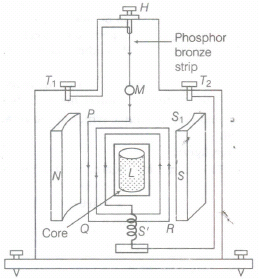
The coil remains suspended in radial magnetic field so that it always experiences maximum torque.
When current passes through the coil, deflection torque \(\tau(\theta)\) is produced given by
\(\tau_{deflection}=NLAB sin 90^{o}\) --- (i)
As a result, coil rotates and phosphor bronze strip gets twisted. As a result restoring torque given by
\(\tau_{restoring}=k\theta\) --- (ii)
where, k = torsional restoring constant
∴ In equilibrium,
\(t_{deflecting}=\tau_{restoring}\Rightarrow NIAB=k\theta\)
\(I=(\frac{k}{NAB})\theta \Rightarrow I\propto \theta\)
greater the current, greater the deflection.
(ii) In radial magnetic field, the plane of the coil is always parallel to the plane of the magnetic field and area vector of coil is perpendicular to magnetic field. It is always exerts maximum torque on the coil.
(iii) The voltmeter connected in parallel with the electrical circuit elements to measure potential difference. For exact measurement of PD voltmeter must draw minimum current which is possible only when it has high resistance. Ammeter is connected in series with the electrical circuit and current to be measured passes through it.
In order to protect the galvanometer, a feeble current must pass through the galvanometer, it is possible only when a low resistance (shunt) is connected in parallel with galvanometer to allow the major part of the current to pass through it.
5.
As the wire carries current I along the y-axis, so \(\overset { \rightarrow }{ l } =l\hat { j } .\) Magnitude force on wire is
\(\overset { \rightarrow }{ F } =I\left( \overset { \rightarrow }{ l } \times \overset { \rightarrow }{ B } \right) =I[l\hat { j } \times [{ B }_{ o }(\hat { i } +\hat { j } +\hat { k } )]]\)
\(=Il{ B }_{ o }\left[ \hat { j } \times \hat { i } +\hat { j } \times \hat { j } +\hat { j } \times \hat { k } \right] \)
\(=Il{ B }_{ o }\left[ -\hat { k } +0+\hat { i } \right] =Il{ B }_{ o }\left[ \hat { i } -\hat { k } \right] \)
Magnitude of the magnetic force is
\(F=Il{ B }_{ o }\left[ { \left( 1 \right) }^{ 2 }+{ \left( -1 \right) }^{ 2 } \right] ^{ 1/2 }=Il{ B }_{ o }\sqrt { 2 } N\)
6.
When a charged particle of charged q moving with velocity v is subjected to normal magnetic field B, then it describe a circular path of radius r given by
\(Bqv=\frac { m{ v }^{ 2 } }{ r } \ or\ r=\frac { mv }{ Bq } =\frac { p }{ Bq } \)
where p = momentum of the particle
For the same values of p and B, r\(\propto \) 1/q
\(\therefore \frac { { r }_{ \alpha } }{ { r }_{ p } } =\frac { { q }_{ p } }{ { q }_{ \alpha } } =\frac { e }{ 2e } =\frac { 1 }{ 2 } \)
7.
Inside the pipe, the magnetic field is zero, but there is a finite value of the magnetic field outside the pipe.
8.
Magnetic field induction at the centre of the circular coil carrying current is
\(B=\frac { { \mu }_{ o } }{ 4\pi } \frac { 2\pi nI }{ r } \ i.e.\ B\propto \frac { n }{ r } \)
\( \therefore \frac { B' }{ B } =\frac { 2n }{ \left( r/2 \right) } \times \frac { r }{ n } =4 \ or \ B'=4B\)
9.
Magnetic field due to current through circular loop is uniform at the centre of the current loop and non-uniform near the circular coil.
10.
(i) The magnetic field of a current element is minimum (which is zero) along the axis of a current element.
(ii) The magnetic field of a current element is maximum in a plane passing through the element and perpendicular to its axis.
11.
Tesla is the SI unit of magnetic field induction or magnetic flux density at a point in the magnetic field. The magnetic field induction at a point in a magnetic field is said to be 1 tesla if one-coulomb charge while moving with a velocity of 1 m/s, perpendicular to the magnetic field experiences a force of 1 N at that point.
12.
(b)
Biot-Savart's law
13.
(d)
\(\frac { { \mu }_{ o }qf }{ 2R } \)
14.
(a)
only outside the wire
15.
(b)
anticlockwise
16.
(b)
0.2 A

12th Standard CBSE Syllabus & Materials
12th Standard CBSE
CBSE 12th Computer Science Python Revision Tour I - New Previous year Question Papers Study Material - QB365 Set A
NEW12th Standard CBSE
CBSE 12th Business Studies Planning Important Questions And Answers Study Material - QB365 Set A
NEW12th Standard CBSE
CBSE 12th Business Studies Business Environment Important Questions And Answers Study Material - QB365 Set A
NEW12th Standard CBSE
CBSE 12th Business Studies Principles of Management Important Questions And Answers Study Material - QB365 Set A



CBSE 12th Standard CBSE Subjects
CBSE Standards










