
 100% FREE ACCESS
12th Standard CBSE Syllabus & Materials
12th Standard CBSE
CBSE 12th Economics Government Budget and the Economy Previous year Question Papers Study Material - QB365 Set A
NEW12th Standard CBSE
CBSE 12th Computer Science Interface Python with MySQL - New Previous year Question Papers Study Material - QB365 Set A
NEW12th Standard CBSE
CBSE 12th Computer Science Database Concept - New Previous year Question Papers Study Material - QB365 Set A
NEW12th Standard CBSE
CBSE 12th Computer Science Data Communication - New Previous year Question Papers Study Material - QB365 Set A
NEW12th Standard CBSE
CBSE 12th Computer Science Data Structures - New Previous year Question Papers Study Material - QB365 Set A
NEW12th Standard CBSE
CBSE 12th Computer Science Functions - New Previous year Question Papers Study Material - QB365 Set A

Published on: 26/07/2019
Magnetic Effects of Current
Download CBSE Class 12th Standard CBSE Physics question papers, sample papers, important questions, and previous year solved papers in PDF format. Get free study materials, NCERT solutions, and exam preparation resources for Class 12th Standard CBSE Physics
Questions + Answers key
Take MCQ Physics Test
1.
A voltmeter reads 5.0 V at full scale deflection and is graded according to its resistance per volt at full scale deflection as 2000 \(\Omega\)/V. How will you convert it into a voltmeter that reads 15V at full scale deflection?
2.
Find the force on a wire (of negligible mass) of length 4.0 cm placed inside a solenoid near its centre, making an angle of 60o with its axis. The wire carries a current of 12 A and magnetic field due to solenoid has a magnitude of 0.25 T. Find also the direction of the force experienced by the wire.
3.
A circular loop of 2 turns carries a current of 5.0 A. If the magnetic field at the centre of loop is 0.40 mT, find the radius of the loop.
4.
Assume the dipole model for earth's magnetic field B which by \({ B }_{ v }=\)vertical component of magnetic field = \(\frac { { \mu }_{ 0 } }{ 4\pi } \frac { 2M\cos { \theta } }{ { r }^{ 3 } } { B }_{ H }=\) Horizontal component of magnetic field = \(\frac { { \mu }_{ 0 } }{ 4\pi } \frac { 2M\sin { \theta M } }{ { r }^{ 3 } } ,\theta ={ 90 }^{ \circ }=\) lattitude as measured from magnetic equator. Find loci of points for which
(i) \(\left| B \right| \) is minimum
(ii) dip angle is zero and
(iii) dip angle is\(\pm { 45 }^{ \circ }\).
5.
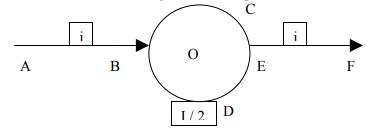
What will be the direction of magnetic field at point O
6.
Out of Ammeter and Milliammeter, which has the higher resistance?
7.
Proton is moving along the axis of a solenoid carrying current of 2 A and 50 number of turns per unit length. What will be the force acting on the particle
8.
Out of Voltmeter and Millivoltmeter, which has the higher resistance?
9.
Suppose a helical spring is suspended from the roof of a room and very small weight is attached to its lower end what will happen to the spring when a current is passed through it?Give reason to support your answer?
10.
Write the relation for the magnetic field induction at a point due to a linear conductor carrying current and hence deduce the relation for the magnetic field induction at a point due to a very long linear conductor carrying current.
11.
A current of one ampere is passed through a straight wire of length 2.0 metre. Find the magnetic field at a point in air at a distance 3 metre from one end of wire but lying on the axis of the wire.
12.
In what respect does a wire carrying a current differ from a wire, which carries no current?
13.
What is magnetic flux density? Define its units and give its dimensions.
14.
Write the relation for the force \(\overset { \rightarrow }{ F } \) acting on a charge carrier q moving with a velocity \(\overset { \rightarrow }{ v } \) through a magnetic field \(\overset { \rightarrow }{ B } \) in vector notation. Using this relation, deduce the conditions under which this force will be (i) maximum (ii) minimum.
15.
What are the dimensions of \({ \mu }_{ o }/4\pi \) ?
16.
Explain, how moving charge is a source of magnetic field.
17.
An electron moving with a velocity of 107 ms-1 enters a uniform magnetic field of 1 T, along a direction parallel to the field. What would be its trajectory?
18.
What is the unit of magnetic field strength in cgs system and SI? State the relation between them.
19.
The north pole of a magnet is brought near a stationary negatively charged conductor. Will the pole experience any force?
20.
A circular coil of n turns and radius r carries a current I. The magnetic field at the centre is
\(\frac { { \mu }_{ o }nI }{ r } \)
\(\frac { { \mu }_{ o }nI }{ 2r } \)
\(\frac { { 2\mu }_{ o }nI }{ r } \)
\(\frac { { \mu }_{ o }nI }{ 4r } \)
21.
Current carrying wire produces
Only electric field
Only magnetic field
Both electric and magnetic field
None of the above
22.
If a copper wire carries a direct current, the magnetic field associated with the current will be
only outside the wire
only inside the wire
both inside and outside the wire
neither inside nor outside the wire
23.
A positive charge is moving towards an observer. The direction of magnetic induction lines is
clockwise
anticlockwise
right
left
24.
The magnetic field at a perpendicular distance of 2 cm from an infinite straight current carrying conductor is 2x10⁻⁶ T. The current in the wire is
0.1 A
0.2 A
0.4 A
0.8 A
1.
By using R = 2 \(\times\) 104\(\Omega\) in series
2.
F = 0.104 N
3.
Here, n = 2, I = 5.0 A,
B = 0.4 x 10⁻³ T, r = ?
Magnetic field at the centre of current loop is
\(B=\frac { { \mu }_{ o } }{ 4\pi } \frac { 2\pi nI }{ r } \ or \ r=\frac { { \mu }_{ o } }{ 4\pi } \frac { 2\pi nI }{ B } \)
\(\therefore \ r={ 10 }^{ -7 }\times 2\times \frac { 22 }{ 7 } \times \frac { 2\times 5.0 }{ 0.4\times { 10 }^{ -3 } } \)
= 157.1 x 10⁻⁴m = 1.57 cm
4.
\({ B }_{ v }=\frac { { \mu }_{ 0 } }{ 4\pi } \frac { 2M\cos { \theta } }{ { r }^{ 3 } } \)
\({ \ B }_{ H }=\frac { { \mu }_{ 0 } }{ 4\pi } \frac { M\sin { \theta } }{ { r }^{ 3 } } \)
\(B=\sqrt { \begin{matrix} { { B }_{ v } }^{ 2 } & + & { { B }_{ H } }^{ 2 } \end{matrix} } =\frac { { \mu }_{ 0 }M }{ 4\pi { r }^{ 3 } } \left[ 4\cos ^{ 2 }{ \theta } +\sin ^{ 2 }{ \theta } \right] \)
\(B=\frac { { \mu }_{ 0 }M }{ 4\pi { r }^{ 3 } } \left[ 3\cos ^{ 2 }{ \theta } +1 \right] \)
Now B will be minimum if \(\cos { \theta } =0 \ or \ \theta ={ 90 }^{ \circ }\)
i.e. B will be minimum at magnetic equator.
(ii) Angle of dip is given by
\(\tan { \delta =\frac { { B }_{ V } }{ { B }_{ H } } } =\frac { 2\cos { \theta } }{ \sin { \theta } } =2\cot { \theta } \)
\(\delta =0,if \ \cot { \theta =0 \ or \ \theta =\frac { \pi }{ 2 } } \)
i.e. angle of dip is zero at magnetic equator(iii) \(\delta ={ 45 }^{ \circ },\cot { \theta =\frac { 1 }{ 2 } } or \ \tan { \theta =2 } \)
\( \theta =\tan ^{ -1 }{ 2is \ the \ locus. } \)
5.
The magnetic Field due to AB and EF is as the direction of length vector is along the radius vector. Also the magnetic field due to BCE and BDE are equal opposite and equal so they cancel the effect of each other. So the net magnetic field at O is 0.
6.
We know the resistance connected to galvanometer to convert it into ammeter is S =(Ig/( I – Ig))xG
So for higher resistance, the range of I should be small, therefore milliammeter has the higher resistance.
7.
As the magnetic field produced by solenoid is always along its axis, so direction of velocity of proton is along the direction of field, therefore
F = qvB Sin 0 = 0
8.
We know the resistance connected to galvanometer to Convert it into voltmeter is R - (V/Ig) - G
So if R is higher, range of V will also be higher, so a Voltmeter has the higher resistance.
9.
Spring Will Contract due to the magnetic field produced by the turns of the coil and the weights will be lifted up
10.
Magnetic field induction at a point P in space at a perpendicular distance a from a linear conductor carrying current i is
\(B=\frac { { \mu }_{ o } }{ 4\pi a } \left( sin{ \phi }_{ 1 }+sin{ \phi }_{ 2 } \right) \)
Where \({ \phi }_{ 1 }\) and \({ \phi }_{ 2 }\) are the angles subtended by the lines joining the ends of linear conductor with point P and perpendicular drawn on the conductor from point P.
In case of infinitely long conductor,
\( { \phi }_{ 1 }=\frac { \pi }{ 2 } ={ \phi }_{ 2 }\)
\(\\ \therefore \quad \quad B=\frac { { \mu }_{ o } }{ 4\pi } \frac { i }{ a } \left( sin\frac { \pi }{ 2 } +sin\frac { \pi }{ 2 } \right) =\frac { { \mu }_{ o } }{ 4\pi } \frac { 2i }{ a } \)
11.
When a point P lies on the axis of wire conductor in air, then \(I\overrightarrow { dl } \ and \ \overrightarrow { r } \) for each element of the straight wire conductor are parallel. Therefore, \(I\overrightarrow { dl } \times \overrightarrow { r } =0,\) so the magnetic field induction at given point is zero.
12.
A current carrying wire produces magnetic field but the wire, which does not carry current has no magnetic field.
13.
Magnetic flux density at a point in a magnetic field means magnetic field induction at that point. It is defined as the force experienced by a unit charge while moving with a unit velocity, perpendicular to the direction of magnetic field at that point. Force experienced by the charged particle having charge q moving with velocity \(\overset { \rightarrow }{ v } \) through a magnetic field \(\overset { \rightarrow }{ B } \) is given by
\( \left| \overset { \rightarrow }{ F } \right| =q\left| \overset { \rightarrow }{ v } \times \overset { \rightarrow }{ B } \right| =qvBsin\theta\)
\(or \ B=\frac { F }{ qvsin\theta } \)
The SI unit of B is tesla, where 1 tesla is the magnetic flux density at a point if 1 coulomb charge while moving with a velocity of 1 ms-1, perpendicular to a magnetic field experiences a force of 1 N at that point.
The dimensional formula of B
\(=\frac { \left[ { MLT }^{ -2 } \right] }{ \left[ AT \right] \left[ { LT }^{ -1 } \right] } =\left[ { ML }^{ o }{ T }^{ -2 }{ A }^{ -1 } \right] \)
14.
\(\overset { \rightarrow }{ F } =q\left( \overset { \rightarrow }{ v } \times \overset { \rightarrow }{ B } \right) \)
\(\\ or \ \left| \overset { \rightarrow }{ F } \right| =q\left| \overset { \rightarrow }{ v } \times \overset { \rightarrow }{ B } \right| =qvBsin\theta \)
(i) F will be maximum, when \(sin\theta =1 \ or \ \theta ={ 90 }^{ o }\) , i.e., the charged particle is moving perpendicular to the direction of magnetic field.
(ii) F will be minimum, when \(sin\theta =0 \ or \ \theta ={ 0 }^{ o } \ or \ { 180 }^{ o }\) i.e., the charged particle is moving parallel to the direction of magnetic field.
15.
[M1L1T-2A-2].
16.
The direction of magnetic field is along the +Z-axis, as per right hand rule or Fleming's Left hand rule.
17.
Straight line.
18.
Unit of magnetic field in cgs system is gauss and in SI is tesla or NA-1m-1 or weber m-2. 1 tesla = 104 gauss.
19.
No, a stationary charge does not produce magnetic field.
20.
(b)
\(\frac { { \mu }_{ o }nI }{ 2r } \)
21.
(b)
Only magnetic field
22.
(a)
only outside the wire
23.
(b)
anticlockwise
24.
(b)
0.2 A

12th Standard CBSE Syllabus & Materials
12th Standard CBSE
CBSE 12th Computer Science Python Revision Tour I - New Previous year Question Papers Study Material - QB365 Set A
NEW12th Standard CBSE
CBSE 12th Business Studies Planning Important Questions And Answers Study Material - QB365 Set A
NEW12th Standard CBSE
CBSE 12th Business Studies Business Environment Important Questions And Answers Study Material - QB365 Set A
NEW12th Standard CBSE
CBSE 12th Business Studies Principles of Management Important Questions And Answers Study Material - QB365 Set A



CBSE 12th Standard CBSE Subjects
CBSE Standards










