
 100% FREE ACCESS
12th Standard CBSE Syllabus & Materials
12th Standard CBSE
CBSE 12th Economics Government Budget and the Economy Previous year Question Papers Study Material - QB365 Set A
NEW12th Standard CBSE
CBSE 12th Computer Science Interface Python with MySQL - New Previous year Question Papers Study Material - QB365 Set A
NEW12th Standard CBSE
CBSE 12th Computer Science Database Concept - New Previous year Question Papers Study Material - QB365 Set A
NEW12th Standard CBSE
CBSE 12th Computer Science Data Communication - New Previous year Question Papers Study Material - QB365 Set A
NEW12th Standard CBSE
CBSE 12th Computer Science Data Structures - New Previous year Question Papers Study Material - QB365 Set A
NEW12th Standard CBSE
CBSE 12th Computer Science Functions - New Previous year Question Papers Study Material - QB365 Set A

Published on: 05/09/2019
Dual Nature of Radiation and Matter
Download CBSE Class 12th Standard CBSE Physics question papers, sample papers, important questions, and previous year solved papers in PDF format. Get free study materials, NCERT solutions, and exam preparation resources for Class 12th Standard CBSE Physics
Questions + Answers key
Take MCQ Physics Test
1.
The main aim of Davisson and Germer was to study about nickel surface by directing beam of electrons at its surface and note the number of electrons that bounced off at different angles. The carried out their experiment inside a vacuum chamber where an air after entering the chamber gives an oxide film on nickel surface. Again the does their experiment and found that the electrons which hits the nickel surface were scattered by atoms that appears from crystal planes in nickel crystal. By doing their regular experiment, Davisson and Germer's at once found diffraction of electrons which was an initial proof that confirm about de Broglie's hypothesis and shows wave properties in particles.
(a) What can we infer about the values shown by Davisson and Germer?
(b) Write the expression to find the wavelength of an electron when accelerated through a potential difference of V volts.
2.
Radiation has dual nature,i.e., it possesses the properties of both; wave and particle.This prompted de-Broglie to predict dual nature of moving material particles.Thus waves are associated with moving material particles which are called matter waves. The wavelength of matter wave is given by \(\lambda =\frac { h }{ mv } \), where m is the mass, v is the speed of the particle and h is Plank's constant. Read the above paragraph and answer the following questions;
(i) How was the wave nature of the electron established?
(ii) What are the de-Broglie wavelength associated with a particle (i) at rest (ii) moving with infinite speed?
(iii) What are the basic values displayed with this study?
3.
The extent of localisation of a particle is determined by its de-Broglie wavelength.If an electron is localised within the nucleus(of size about \({ 10 }^{ -14 }\))of an atom, what is it energy? Compare this energy with the typical binding energies(of the order of a few MeV) in a nucleus and hence argue why electron cannot reside in a nucleus.
4.
Answer the following question.
(a) Quarks inside protons and neutrons are thought to carry fractional charges \(\left( +\frac { 2 }{ 3 } e,-\frac { 1 }{ 3 } e \right) .\) Why do they not show up in Millikan's oil drop experiment?
(b) What is so special about the combination elm? Why do we not simply talk of e and \(m\) specially?
(c) Why should gases be insulators at ordinary pressure and start conducting at very low pressure.
(d) Every metal has a definite work function, Why do photoelectrons not come out all with same energy if incident radiations is monochromatic?Why is there an energy distribution of photoelectrons?
(e) The energy and momentum of an electron are related to the frequency and wavelength of the associated matter wave by the relations : \(E=hv,p=\frac { h }{ \lambda } \)
But while the value of \(\lambda \) is physically significant, the value of \(v\) (and therefore the value of the phase speed \(v\lambda \)) has no physical significance. Why?
5.
An Electron gun with its collector at a potential of 100 V fires out electrons in a spherical bulb containing hydrogen gas at low pressure (\(-{ 10 }^{ 2 }\) mm of Hg).A magnetic field of 2.83 x 10⁻⁴ T curves the path of the electrons in a circular orbit of radius 12.0 cm. Determine e/m from the data.
6.
The maximum velocity of an electron emitted by light of wavelength \(\lambda \)incident on the surface of a metal of wor4k function \(\phi \) is[h = Plank's constant, c = speed of light and m = mass of electron]
\({ \left[ \frac { 2\left( hc+\lambda \phi \right) }{ m\lambda } \right] }^{ 1/2 }\)
\(\frac { 2\left( hc-\lambda \phi \right) }{ m } \)
\({ \left[ \frac { 2\left( hc-\lambda \phi \right) }{ m\lambda } \right] }^{ 1/2 }\)
\({ \left[ \frac { 2\left( hc-\lambda \phi \right) }{ m } \right] }^{ 1/2 }\)
7.
Photons absorbed in matter are converted to heat.A source emitting n photon/sec frequency v is used to convert 1 kg of ice at \({ 0 }^{ 0 }c \) . Then the time t taken for the conversation.
decreases with increasing n, with \(v\) fixed.
decreases with n fixed, \(v\) increasing
remains constant with n and \(v\) changing such that \(nv\) = constant
increases when the product \(nv\) increases.
8.
An electron is moving with an initial velocity \(\frac { h }{ mv } ={ v }_{ 0 }\overset { \wedge }{ L } \) and is in a magnetic field \(\vec { B= } \ { B }_{ 0 }\vec { j } \) Then its de-Broglie wavelength
remains constant
increases with time.
decreases with time.
increases and decreases periodically.
9.
Consider figure for photoemission. How would you reconcile with momentum conservation? Note light (photons) have momentum in a different direction than the emitted electrons.
10.
Write two characteristic features observed in photoelectric effect which support the photon picture of electromagnetic radiation.
11.
If we go on increasing the wavelength of light incident on a metal surface, what changes in the number of electrons and the energy take place?
12.
For a photosensitive surface, threshold wavelength is.\({ \lambda }_{ 0 }\) Does photoemission occur if the wavelength of the incident radiation is (i) more than \({ \lambda }_{ 0 }\) (ii) less than\({ \lambda }_{ 0 }\) Justify your answer?
13.
In Davisson-Germer experiment, if the angle of diffraction is then\(52°,\) find the glancing angle.
14.
The de-Broglie Wavelength of a particle of kinetic energy K is \({ \lambda }\) What would be the de-Broglie wavelength of the particle, if its kinetic energy were K/4?
15.
The photoelectric current at a distance \({ r }_{ 1 }and{ r }_{ 2 }\)of light source from the photoelectric cell is respectively\({ I }_{ 1 }and{ I }_{ 2 }\). Find the value of.\({ I }_{ 1 }/{ I }_{ 2 }\)
16.
What is the effect of a decrease in frequency of incident radiation on the stopping potential in photoelectric emission?
1.
(a) Perseverance, not giving up and patience.
(b) \(\lambda =\frac { 12.27 }{ \sqrt { V } } \)\(\overset { o }{ A } \)
2.
(i) Davisson and Germer observed diffraction patterns of slow moving electrons. And G.P. Thomson observed a diffraction pattern of fast moving electrons. As diffraction is essentially a wave phenomenon, therefore, it was concluded that wave must be associated with moving electrons.
(ii) (a) At rest, v = 0, \(=\frac { h }{ mv } =\frac { h }{ m\times 0 } =\infty \)
(b) Particle moving with infinite speed, v = \(\infty \)
\(\lambda =\frac { h }{ mv } =\frac { h }{ m\times \infty } \)
(iii) The dual nature of moving material particles reveals in a way the nature of Almighty God. He is in a visible form (i.e., Sakar) like a visible particle and also without any form (i.e., Nirakar) like a wave.It depends on us how we realize him.
3.
Since the electron has been localised within the nucleus (of size about \({ 10 }^{ -14 }\) m)of an atom, so \({ \lambda =10 }^{ -14 }\)
Momentum of electron,
\(p=\frac { h }{ \lambda } =\frac { 6.63\times { 10 }^{ -34 } }{ { 10 }^{ -14 } } =6.63\times { 10 }^{ -20 }kg{ ms }^{ -1 }\)
The relativistic relation for the energy of an electron is
\(E=\sqrt { { p }^{ 2 }{ c }^{ 2 }+{ { m }_{ 0 } }^{ 2 }{ c }^{ 4 } } \)
Neglecting the rest-mass energy term(i.e., second term), we have
\(E=pc=(6.63\times { 10 }^{ -20 })\times (3\times { 10 }^{ 8 })J\)
\( =\frac { 6.63\times 3\times { 10 }^{ -12 } }{ 1.6\times { 10 }^{ -13 } } MeV=124.3MeV\)
This energy E(=124.3MeV) is very large as compared to the binding energy which is provided by Coulomb's force within the nucleus. Since the energy of electron inside the nucleus, hence the electron does not reside the nucleus.
4.
(a) Quarks inside protons and neutrons carry fractional charges. This is because nuclear force increases extremely if they are pulled apart. Therefore, fractional charges may exist in nature; observable charges are still the integral multiple of an electrical charge.
(b) The basic relations for electric field and magnetic field are \(\left(e V=\frac{1}{2} m v^{2}\right) \text { and }\left(e B v=\frac{m v^{2}}{r}\right)\)respectively.
These relations include e (electric charge), v (velocity), m (mass), V (potential), r(radius), and B (magnetic field). These relations give the value of velocity of an electron as \(\left(v=\sqrt{2 v\left(\frac{e}{m}\right)}\right. \text { and }\left(v=B r\left(\frac{e}{m}\right)\right)\) respectively.
(c) At atmospheric pressure, the ions of gases have no chance of reaching their respective electrons because of collision and recombination with other gas molecules. Hence, gases are insulators at atmospheric pressure. At low pressures, ions have a chance of reaching their respective electrodes and constitute a current. Hence, they conduct electricity at these pressures.
(d) The work function of a metal is the minimum energy required for a conduction electron to get out of the metal surface. All the electrons in an atom do not have the same energy level. When a ray having some photon energy is incident on a metal surface, the electrons come out from different levels with different energies. Hence, these emitted electrons show different energy distributions.
(e) The absolute value of energy of a particle is arbitrary within the additive constant. Hence, wavelength (λ) is significant, but the frequency (ν) associated with an electron has no direct physical significance. Therefore, the product νλ (phase speed) has no physical significance.
Group speed is given as:
\(V_{G}=\frac{d v}{d k} \)
\(=\frac{\mathrm{d} \mathrm{v}}{d\left(\frac{1}{\lambda}\right)}=\frac{\mathrm{d} \mathrm{E}}{\mathrm{dp}}=\frac{d\left(\frac{p^{2}}{2} m\right)}{\mathrm{dp}}=\frac{p}{m}\)
This quantity has a physical meaning.
5.
Potential of an anode, V = 100 V
Magnetic field experienced by the electrons, B = 2.83 x 10⁻⁴ T
Radius of the circular orbit r = 12.0 cm = 12.0 x 10⁻² m
Mass of each electron = m
Charge on each electron = e
Velocity of each electron = v
The energy of each electron is equal to its kinetic energy, i.e.,
\(\frac{1}{2} m v^{2}=e V\)
\(v^{2}=\frac{2 e V}{m}\)
It is the magnetic field, due to its bending nature, that provides the centripetal force
\(\left(F=m \frac{v^{2}}{r}\right)\) for the beam. Hence, we can write:
Centripetal force = Magnetic force
\(m \frac{v^{2}}{r}=e v B\)
\(e B=m \frac{v}{r}\)
\(v=\frac{e B r}{m}\)
Putting the value of v in equation (1), we get:
\(\frac{2 \mathrm{eV}}{m}=\frac{e^{2} B^{2} r^{2}}{m^{2}}\)
\(\frac{e}{m}=\frac{2 \mathrm{~V}}{B^{2} r^{2}}\)
\(=\frac{2 \times 100}{\left(2.83 \times 10^{-4}\right)^{2} \times\left(12 \times 10^{-2}\right)^{2}}=1.73 \times 10^{11} \mathrm{Ckg}^{-1}\)
Therefore, the specific charge ratio (e/m) is = 1.73 x 10¹¹Ckg-1.
6.
(c)
\({ \left[ \frac { 2\left( hc-\lambda \phi \right) }{ m\lambda } \right] }^{ 1/2 }\)
7.
8.
(a)
remains constant
9.
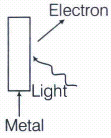
During photelectric emission, the momentum of incident photon is transferred to the metal. At microscopic level, atoms of a metal absorb the photon and its momentum is transferred mainly to the nucleus and electrons.
The excited electron is emitted. Therefore, the conservation of momentum is to be considerd as the momentum of incident photon transferred to the nucleus and electrons.
10.
The following features observed in photoelectric effect helped to establish the photon picture of the electromagnetic radiation.
(i) The maximum kinetic energy of the emitted photoelectron is independent of the intensity of the incident light but depends upon the frequency of the incident light.
(ii) For every metal, there is a certain minimum frequency of the incident light below which, no photoelectric emission takes place.
(iii) The photoelectric emission is an instantaneous process.
11.
If we increase the wavelength of incident light then the energy of incident photon \(E=\frac { hc }{ \lambda } \)will decrease. Due to it, the energy of photoelectron emitted decreases, but the number of electrons emitted will not change. When the wavelength of the incident light becomes greater than the threshold wavelength then no photoelectron will be emitted.
12.
The maximum kinetic energy of the emitted photoelectron from a metal surface is given by
\({ K }_{ max }=\frac { 1 }{ 2 } { mv }_{ max }^{ 2 }=\frac { hc }{ \lambda } -\ \frac { hc }{ { \lambda }_{ 0 } } =hc\left( \frac { { \lambda }_{ 0 }-\lambda }{ \lambda { \lambda }_{ 0 } } \right) \)
(i)When is \(\lambda >{ \lambda }_{ 0 }\)\({ K }_{ max }\) negative is imaginary. Thus photoelectric emission will not occur.
(ii)When \(\lambda <{ \lambda }_{ 0 }\)\({ K }_{ max }\) is positive, \({ v }_{ max }\) is positive.Thus photoelectric emission will take place and K.E. of photoelectron increases as \(\lambda \)decreases.
13.
\( \theta=90^{\circ}-\frac{\phi}{2}=90^{\circ}-\frac{52^{\circ}}{2} \\ =64^{\circ} \)
14.
As we know, de-Broglie wavelength \(\lambda=\frac{h}{p}=\frac{h}{\sqrt{2 m K}}\)
\(K_1=\frac{h^2}{2 m \lambda_1^2}\)
If according of the questions
\( K_2 =\frac{K_1}{4} \\ K_2 =\frac{h^2}{2 \lambda_2^2} \\ \frac{K_1}{4} =\frac{h^2}{2 m \lambda_2^2} \)
From Eqs. (i) and (ii), we get
\( \frac{\frac{K_1}{4}}{K_1}=\frac{h^2}{2 m \lambda_2^2} \times \frac{2 m \lambda_1^2}{h^2} \\ \frac{1}{4}=\frac{\lambda_1^2}{\lambda_2^2} \\ \Rightarrow \quad \frac{\lambda_1}{\lambda_2}=\frac{1}{2} \)
Hence, wavelength of the particle double the wavelength when kineettiic energy is 1/4th.
15.
\(I \alpha \frac{I}{r^2}\)
\(\frac{I_1}{I_2}=\left(\frac{r_2}{r_1}\right)^2\)
16.
The value of stopping potential in photoelectric emission from a metal surface decreases with the decrease in frequency of incident radiation, provided the frequency of radiation is greater than a threshold frequency.
When the frequency of incident radiations becomes equal to a threshold frequency, stopping potential becomes zero.

12th Standard CBSE Syllabus & Materials
12th Standard CBSE
CBSE 12th Computer Science Python Revision Tour I - New Previous year Question Papers Study Material - QB365 Set A
NEW12th Standard CBSE
CBSE 12th Business Studies Planning Important Questions And Answers Study Material - QB365 Set A
NEW12th Standard CBSE
CBSE 12th Business Studies Business Environment Important Questions And Answers Study Material - QB365 Set A
NEW12th Standard CBSE
CBSE 12th Business Studies Principles of Management Important Questions And Answers Study Material - QB365 Set A



CBSE 12th Standard CBSE Subjects
CBSE Standards










