
 100% FREE ACCESS
12th Standard CBSE Syllabus & Materials
12th Standard CBSE
CBSE 12th Economics Government Budget and the Economy Previous year Question Papers Study Material - QB365 Set A
NEW12th Standard CBSE
CBSE 12th Computer Science Interface Python with MySQL - New Previous year Question Papers Study Material - QB365 Set A
NEW12th Standard CBSE
CBSE 12th Computer Science Database Concept - New Previous year Question Papers Study Material - QB365 Set A
NEW12th Standard CBSE
CBSE 12th Computer Science Data Communication - New Previous year Question Papers Study Material - QB365 Set A
NEW12th Standard CBSE
CBSE 12th Computer Science Data Structures - New Previous year Question Papers Study Material - QB365 Set A
NEW12th Standard CBSE
CBSE 12th Computer Science Functions - New Previous year Question Papers Study Material - QB365 Set A

Published on: 03/10/2019
Wave Optics
Download CBSE Class 12th Standard CBSE Physics question papers, sample papers, important questions, and previous year solved papers in PDF format. Get free study materials, NCERT solutions, and exam preparation resources for Class 12th Standard CBSE Physics
Questions + Answers key
Take MCQ Physics Test
1.
School arrange an educational trip to Kavalur in Tamil Nadu where an observatory having Indias largest telescope. On hearing this, the whole class got excited and left for their way to kavalur. In the observatory, the physics teacher' was explaining about the type of telescope, with diameter of objective (2.34 m) and several other details. Everyone was ready to look through the telescope.
(i) What type of telescope is the teacher referring to?
(ii) Mention any two advantages of this telescope
(iii) Why are such a field trips important?
2.
(a) In Young's double slit experiment, describe briefly how bright and dark fringes are obtained
on the screen kept in front of a double slit. Hence obtain the expression for the fringe width.
(b) The ratio of the intensities at minima to the maxima in the Young's double slit experiment is 9 : 25. Find the ratio of the width of the slits
3.
(i) Draw a diagram showing the 'Young's arrangement' for producing 'a sustained interference pattern'. Hence obtained the expression for the width of the interference fringes obtained in this pattern.
(ii) If the principal source point S were to be moved a little upwards, towards the slit SI from its usual symmetrical position, with respect to the two slits S1 and S2, discuss how the interference pattern, obtained on the screen, would get affected
4.
(i) In a double slit experiment using light of wavelength 600 nm, the angular width of the fringe formed on a distant screen is \(0.1^o\) . Find the spacing between the two slits.
(ii) Light of wavelength 5000\(\dot { A } \) propagating in air gets partly reflected from the surface of water. How will the wavelengths and frequencies of the reflected and refracted light be affected?
5.
Answer the following questions.
(i) You have learnt that plane and convex mirrors produce virtual images of objects. Can they produce real images under some circumstances? Expalin.
(ii) A virtual image, we always say, cannot be caught on a screen. Yet when we see a virtual image, we are obviously bringing it on to the screen (i.e. the retina) of our eye. Is there a contradiction?
(iii) A diver under water, looks obliquely at a fisherman standing on the bank of a lake. Would the fisherman look taller or shorter to the diver than what he actually is?
(iv) Does the apparent depth of a tank of water change, if viewed obliquely? If so, does the apparent depth increase or decrease?
6.
Kanchan while driving her scooty sees a woman behind driving a moped through his rear view mirror. She sees that her saree is almost touching the wheels of the vehicle. She stops her and alert that it may cause a severe accident.
Read the above passage and answer the folllowing questions:
(i) What values do you observe in Kanchan?
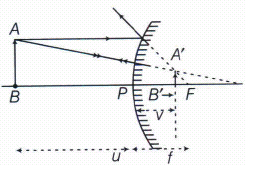
(ii) Name the mirror used in rear view in scooty. Draw a ray diagram for the same.
7.
A screen is placed 2m away from the single narrow slit. Calculate the slit width if the first minimum lies 5mm on either side of the central maximum. Incident plane waves have a wavelength of \(5000\mathring { A } \)
8.
An astronomical telescope is designed to have a magnifying power of 50 in normal adjustment. If the length pf the tube is 120cm, find the powers of objective and eye piece.
9.
The magnifying power of an astronomical telescope in the normal adjustment position is 100. The distance between the objective and eye piece is 101 cm. Calculate the focal lengths of objective and eye piece.
1.
(i) Reflecting telescope
(ii) No chromatic aberration, mirrors are relatively lighter and cheaper compared to the lens.
(iii) First hand experience, inculcating a scientific temper, team work, enthusiasm, finding curiosity.
2.
(a) The light rays from the two (coherent) slits, reaching a point 'P' on the screen, have a path
difference (S2P - S1P). The point 'P' would, therefore be a
(i) Point of maxima (bright fringe), If
S2P - S1P = n\(\lambda\) .
(ii) Point of minima (dark fringle), If
S2P- S1P = (2n + 1) \(\lambda\)/2
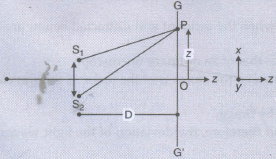
We have (S2P)2- (S1P)2
\(=\left\{D^2-\left(x+{d\over2}\right)^2\right\}-\left\{D^2+\left(x-{d\over2}\right)^2\right\}\)
= 2 xd
\(S_2P-S_1P={2xd\over S_3P+S_1P}={2xd\over 2D}={xd\over D}\)
We have maxima at point, where
\({xd\over D}=n\lambda\)
and minima at points where
\({xd\over D}=\left(2n+1\over 2\right)\lambda\)
Now, fringe width \(\beta\) = separation between two successive maxima (or two successaive minima)
= xn - xn-1
\(\beta={\lambda D\over d}\)
(b) We have \({I_{max}\over {I_{min}}}={(a_1+a_2)^2\over (a_1-a_2)^2}={25\over 9}\)
\(\therefore\ \ {a_1+a_2\over a_1-a_2}={5\over 3}\Rightarrow{a_1\over a_2}={4\over 1}\)
\(\therefore\ {W_1\over W_2}={I_1\over I_2}={(a_1)^2\over (a_2)^2}={16\over 1}\)
3.
(i)
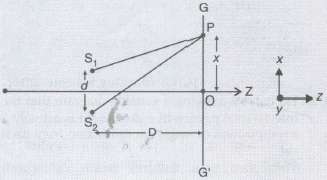
From figure
(S2P)2-(S1P2) =
\(\left[D_2+\left(x+{d\over 2}\right)^2\right]-\left[D_2+\left(x-{d\over 2}^2\right)\right]\)
= 2xd
\(\Rightarrow\ S_2P-S_1P={2xd\over (S_2P+S_1P)}\)
Since S2P \(\approx \) S1P\(\approx \)D
For constructive interference,
S2P- S1P = n\(\lambda_1\), n = 0, 1, 2, 3
\(\Rightarrow{xd\over D}=n\lambda\)
\(x={n\lambda D\over d}\)
Position of the nth bright fringe on screen:
\(={n\lambda D\over d}\)
And position of the (n + 1)th bright fringe on screen
\(={(n+1)\lambda D\over d}\)
Fringe Width
\(={(n+1)\lambda D\over d}-{n\lambda D\over d}\)
\(={\lambda D\over d}\)
(ii) On shifting principal source point '5' little upwards i.e., towards SI, the position of the central maximum on the screen will shift downwards on the screen, i.e., below its previous position, Hence whole interference pattern will get shifted little downwards but Fringe width will remain same as that of the initial arrangement.
4.
(i) Here,
\(\lambda =600 \ nm=600\times { 10 }^{ -9 }m=6\times { 10 }^{ -7 }m\)
\(\theta ={ 0.1 }^{ \circ }=\frac { 0.1\pi }{ 180 } rad,d=?\)
From angular width,\(\theta =\frac { \lambda }{ d } \)
\(\Rightarrow \ d=\frac { \lambda }{ \theta } =\frac { 6\times { 10 }^{ -7 } }{ \frac { \pi }{ 180 } \times 0.1 } =3.44\times { 10 }^{ -4 }m\)
(ii) The frequency and wavelength of reflected wave will not change. The refracted wave will have same frequency. The velocity of light in water is given by \(v=f\lambda \)
where, v = velocity of light
f = frequency of light
\( lambda =wavelength \ of \ light\)
If velocity will decrease, then wavelength (\(\lambda \)) will also decrease.
5.
(i) Yes, plane and convex mirrors can produce the real image, if the rays incident on the plane or convex mirror are converging to a point behind the mirror. A plane or convex mirror can produce a real image, if object is virtual.
(ii) No, there is no contradiction because virtual image formed by the spherical mirror acts as virtual object for eye lens. Our eye lens is convergent and it forms a real image of virtual object on retina.
(iii) As, the fisherman is in air, the rays of light travels from rarer to denser medium, so they bend towards the normal. Therefore, the fisherman appears taller.

(iv) Yes, the apparent depth decreases, further when water tank is viewed obliquely as compared to the depth when seen normally.
6.
(i) The values we observe in Kanchan are as follows:
(a) Concern about others
(b) Observation of traffic rules
(c) Resposible citizen
(ii) Convex mirror is used in rear viwe in scooties. The ray diagram for convex mirror is
7.
Here, distance of the screen from the slit, D = 2m,
a = ?, x = 5 mm = \(5\times { 10 }^{ -3 }m\),
\(\lambda =5000\mathring { A } =5000\times { 10 }^{ -10 }m\)
\(For \ the \ first \ secondary \ minima,\)
\( sin\theta =\frac { \lambda }{ a } =\frac { x }{ D } \)
\(a=\frac { D\lambda }{ x } =\frac { 2\times 5000\times { 10 }^{ -10 } }{ 5\times { 10 }^{ -3 } } =2\times { 10 }^{ -4 }m\)
8.
Here m =-50, L = 102cm
As \(m=-{f_0\over f_e}=-50, f_0=50f_e\)
Also, L = f0 + fe= 102;
50f0 + fe= 102, fe = 2 cm
f0 = 50 fe= 50 x 2= 100 cm
\(P_o={100\over f_0}={100\over100}\)= 1D,
\(P_e={100\over f_e}={100\over2}\)= 50D
9.
m = -100, f0 + fe = 101 cm, f0 = ?, fe = ?
\(m=-{f_0\over f_e}=-100\ \ \therefore f_0=100 f_3\)
Now f0 + fe = 101
100 fe + fe = 101,
fe = 1 cm,
f0 = 100 fe = 100 cm

12th Standard CBSE Syllabus & Materials
12th Standard CBSE
CBSE 12th Computer Science Python Revision Tour I - New Previous year Question Papers Study Material - QB365 Set A
NEW12th Standard CBSE
CBSE 12th Business Studies Planning Important Questions And Answers Study Material - QB365 Set A
NEW12th Standard CBSE
CBSE 12th Business Studies Business Environment Important Questions And Answers Study Material - QB365 Set A
NEW12th Standard CBSE
CBSE 12th Business Studies Principles of Management Important Questions And Answers Study Material - QB365 Set A



CBSE 12th Standard CBSE Subjects
CBSE Standards










