
 100% FREE ACCESS
12th Standard CBSE Syllabus & Materials
12th Standard CBSE
CBSE 12th Economics Government Budget and the Economy Previous year Question Papers Study Material - QB365 Set A
NEW12th Standard CBSE
CBSE 12th Computer Science Interface Python with MySQL - New Previous year Question Papers Study Material - QB365 Set A
NEW12th Standard CBSE
CBSE 12th Computer Science Database Concept - New Previous year Question Papers Study Material - QB365 Set A
NEW12th Standard CBSE
CBSE 12th Computer Science Data Communication - New Previous year Question Papers Study Material - QB365 Set A
NEW12th Standard CBSE
CBSE 12th Computer Science Data Structures - New Previous year Question Papers Study Material - QB365 Set A
NEW12th Standard CBSE
CBSE 12th Computer Science Functions - New Previous year Question Papers Study Material - QB365 Set A

Published on: 23/09/2019
Wave Optics
Download CBSE Class 12th Standard CBSE Physics question papers, sample papers, important questions, and previous year solved papers in PDF format. Get free study materials, NCERT solutions, and exam preparation resources for Class 12th Standard CBSE Physics
Questions + Answers key
Take MCQ Physics Test
1.
A beam of white light on passing through a hollow prism gives no spectrum. Why?
2.
A breaker is filled with water to a height of 12.5 cm. The apparent depth of a needle lying at the bottom of the beaker is measured by a microscope to be 9.4 cm. What is the refractive index of water ? If water is If water is replaced by a liquid of refractive index 1.63 upto the same height, by what distance would the microscope have to be moved to focus on the needle again ?
3.
In the normal adjustment of an astronomical telescope, the distance between the objective lens and the eye lens is 10 sm. The magnifying power of the telescope is 4. Calculate the focal lengths of objective and eye lens.
4.
Use the lens equation to deduce algebraically what you know otherwise from explicit ray diagrams.
(a) An object placed within the focus of a convex lens produce a virtual and enlarged image.
(b) A concave lens produces a virtual and diminished image independent of the location of the object
5.
Show that a convex lens produces an N times magnified image when the objet distances, from the lens, have magnitudes (f ± f / N). Here f is the magnitude of the focal length of the lens. Hence find the two values of object distance, for which a convex lens, of power 2.5D, will produce am image that is four times as large as the object?
6.
(a) Good quality sun-glasses made of polaroids are preferred over ordinary coloured glasses. Justifying your answer.
(b) Two polaroids P1 and P2 are placed in crossed positions. A third polaroid P3 is kept between P1 and P2 such that pass axis of P3 is parallel to that of P1 How would the intensity of light 10 transmitted through P2 vary as P3 is rotated? Draw a plot of intensity '\(\theta\)' Vs the angle 'e', between pass axes of P1 and P3.
7.
Explain by drawing a suitable diagram that the interference pattern in a double slit is actually a superposition of single slit diffraction from each slit.
Write two basic features which distinguish the interference pattern from those seen in a coherently illuminated single slit
8.
A beam of unpolarised light is incident on the boundary between two transparent media. If the reflected light is completely plane polarised, how is its direction related to the direction of the corresponding refracted light? Define Brewster's angle. Obtain the relation between this angle and the refractive index for the given pair of media.
9.
Unpolarised light of intensity 10 passes through two polaroids P1 and P2 such that pass axis of P2 makes an angle e with the pass axis of P2. Plot a graph showing the variation of intensity of light transmitted through P2 as the angle e varies from 0° to 180°.
A third polaroid P3 is placed between Pl and P2 with pass axis of Ps making angle \(\beta\) with that of P1 and the angle between P1 and P2 is \(\theta\). If l1, I2 and I3 represents the intensities of light transmitted by P1, P2 and P3, then determine the values of angle \(\theta\) and \(\beta\) for which I1 = I2 = I3.
10.
A ray of light is incident on one face of Ii glass prism and emerges out from the other face. Trace the path of the ray and derive an expression for refractive index of the glass prism.
11.
Explain how corpuscular theory predicts the speed of light in a medium, say water, is greater than the speed of light in vacuum. Is the prediction confirmed by experimental determination of the speed of light in water? If not, which alternative picture of light is consistent with experiment?
12.
(a) A point object is placed in front of a double convex lens (of refractive index n =n2/n1 with respect air) with its spherical faces of radii of curvature R1 and R2.. Show the path of rays due to surface to obtain the formation of the real image of the object.
Hence obtain the lens maker's formula for a thin lens.
(b) A double convex lens having both faces of the same radius of curvature has refractive index 1.55. Find out the radius of curvature of the lens required to get the focal length of 20 cm.
1.
A hollow prism contains air which does not cause dispersion. The faes AB and AC of the hollow prism behave like parallel sides of glass plates. The beam is laterally deviated at each of the two refracting faces. However, the rays of different colours emerge parallel to each other. So there is no dispersion.
2.
1.33; 1.7 cm
3.
fe = 2 cm, fo = 8 cm
4.
(a) for a convex lens, f >>0 and for an object on left, u < 0. when the object is placed within the focus of a convex lens,
0 < |u| < f or 0 < 1|u| > 1/f
1/v = 1/f+1/u=1/f-1/|u| < 0
i.e. v < 0 so a virtual image is formed on left.
Now as u<0 and v < 0, so 1/v = 1/f + 1/u
= - 1/ |v| = 1/f – 1/|u| or 1/|u| - 1/|v| = 1/f
As f > 0
1/|u| - 1/|v| > 0 or 1/|u| > 1/|v| or |u|< |u|
i.e |v| > |u| = |v/u| > 1
Hence image is enlarged
(b) For a concave lens f<0 and for an object on left, u<0
1/v = 1/f +1/u = 1/|f| - 1/|u|
= - [1/|f| +1/|u|] < 0 for all u
i.e v < 0 for all values of u. hence a virtual image is formed on the left.
Also 1/|v| = 1/|f| + 1/|u| 1/|v| > 1/|u|
or |v|<|u |m| = |v/u| < 1
i.e. the image is diminished in size
5.
Magnification produced by any lens,
m = v/u = f / f + u
given m = ± N ±N = f / f + u
or f + u = ± f / N or u = - f ± f / N
hence magnitude of object distances,
|u| = f ± f / N
given P = 1/f = + 2.5 D
f = 1/ 2.5 = 0.4 m = 40 cm
Also N = 4
|u| = 40 ± 40/4 = 40 ± 10 = 50 cm or 30 cm
6.
(a) Polaroid sunglasses are preferred because they can be much more effective than coloured sunglasses in cutting off the harmful (UV) rays of the sun.
(b)
.png)
.png)
7.
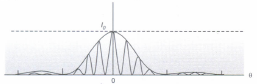
The diagram, given here, shows several fringes, due to double slit interference,' contained' in a broad diffraction peak. When the separation between the slits is large compared to their width, the diffraction pattern becomes very flat and we observe the two slit interference pattern.
[Note: The students may be awarded 1mark even if they just draw the diagram.] Two basic features:
(i) The interference pattern has a number of equally spaced bright and dark bands while diffraction pattern has a central bright maximum which is twice as wide as the other maxima.
(ii) Interference pattern is the superimposition of two waves slits originating from two narrow slits.The diffraction pattern is a superposition of a continuous family of waves originating from each point on a single slit.
(iii) For a single slit of width 'a' the first null of diffraction pattern occurs at an angle of \(\lambda\over a\). At the same angle of \(\lambda/a\), we get a maxima for two narrow slits separated by a distance
8.
The reflected, completely plane polarised light makes an angle of 90° with the direction of corresponding refracted light.
Brewster's law According to Brewster, the polarising angle ip, the reflected plane polarised light and refracted rays are perpendicular to each other, then
ip + r = 90°
where, r = angle of refraction
r = 90°- ip
\(\because\) Snell's law, \(\mu={{sin\ {i}_{p}}\over{sin\ r}}={{sin\ {i}_{p}}\over{sin(90°-{i}_{p})}}\)
\(\mu={{sin\ {i}_{p}}\over{cos \ {i}_{p}}}\Rightarrow\mu = tan\ {i}_{p}\)
This relation is known as Brewster's law.
9.
The required graph would have the form as shown in figure below:
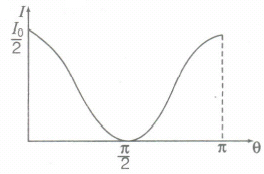
Using I2 = I1 cos2 \(\theta\)
Given
I1 = light transmitted by F1
I2 = light transmitted by P2
I3 = light transmitted by P3
According to Malus law
I3 = I1 cos2 \(\beta \) ...(i)
I2 = I3 cos2\((\theta-\beta)\) ...(ii)
According to question
I2=I3
Substituting the value of I2 and I3 from Eq. (i) and Eq. (ii), we get
I3cos2\((\theta-\beta)\) = I1cos2\(\beta\)
Substituting the value of I3 from Eq. (i),
I1cos2\(\beta\)cos2\((\theta-\beta)\) = I1 cos2 \(\beta\)
cos2\((\theta-\beta)\) = 1
\((\theta-\beta)\) = cos-1(1)
\((\theta-\beta)\) = 0
\(\theta=\beta\) ...(iii)
According to question I1 = 12
Substituting the value of I2 from Eq. (ii).
I1 = I3 cos2\((\theta-\beta)\)
Substituting the value of I3 from Eq. (i),
I1 = I1 cos213 cos2(\(\theta-\beta\))
or cos2\(\beta \) = 1 [From Eq. (iii), \(\theta=\beta\) ]
\(\beta=0°\) or \(\pi.\)
10.
When a ray after passing through a prism suffers minimum deviation, the ray will travel parallel to the base of the prism inside the prism.
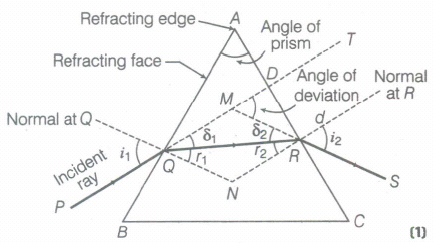
Let PQ and RS are incident and emergent rays. Let incident ray get deviated by \(\delta \) by prism
\(\angle TMS=\delta \)
Suppose \(\delta _{ 1 },\delta _{ 2 }\) are deviation produced at refractors taking place at AB and AC, respectively.
\(\therefore \delta =\delta _{ 1 }+\delta _{ 2 }\)
\(\delta =\left( i_{ 1 }-r_{ 1 } \right) +\left( i_{ 2 }-r_{ 2 } \right) \)
\(\delta =\left( i_{ 1 }+i_{ 2 } \right) -\left( r_{ 1 }+r_{ 2 } \right) \)
Also, in quadrilateral AQNR,
\(A+\angle QNR=180^{ 0 }\)
[.: QN and RN are normal on two surfaces]
Also in \(\triangle QNR\)
\(\angle QNR+r_{ 1 }+r_{ 2 }=180^{ 0 }\)
\(\Rightarrow A=r_{ 1 }+r_{ 2 }\)
From Eqs. (i) and (ii), we get
\(\delta =\left( i_{ 1 }+i_{ 2 } \right) -A\)
Angle of deviation produced by prism varies with angle of incidence. When prism is adjusted at angle of minimum deviation, then
\(i_{ 1 }=i_{ 2 }=i\)
\(\delta =\delta _{ m }\)
\(\Rightarrow r_{ 1 }=r_{ 2 }=r\)
From Eqs. (i) and (ii), we have
\(\delta _{ m }=2i-2r\quad 2r=A\)
\(\Rightarrow i=\frac { A+\delta _{ m } }{ 2 } \)
\(r=\frac { A }{ 2 } \)
Refractive index of material of prism is
\(\mu =\frac { sini }{ sinr } =\frac { sin\left( \frac { A+\delta _{ m } }{ 2 } \right) }{ sin\frac { A }{ 2 } } \)
This is the required expression.
11.
In Newton's corpuscular (Particle) picture of refraction, particles of light incident from a rarer to a denser medium experience a force of attraction normal to the surface. This results in an increase in the normal component of velocity but the component along the surface remains unchanged. This means
\(c\sin { i=\upsilon \sin { r } } \)
Where,
i = Angle of incidence
r = Angle of reflection
c = Velocity of light in air
v = Velocity of light in water
or \(\frac { \upsilon }{ c } =\frac { \sin { i } }{ \sin { r } } =\mu .\)
Since \(\mu >i,\therefore \mu >c.\)
Hence, it can be inferred from equation (ii) that v > c. This is not possible since this prediction is opposite to the experimental results of c > v.
The wave picture of light is consistent with the experimental results.
12.
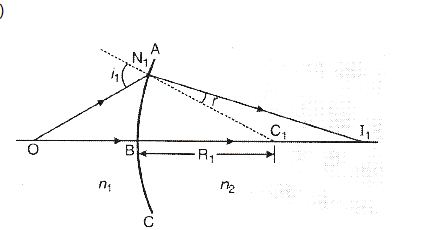
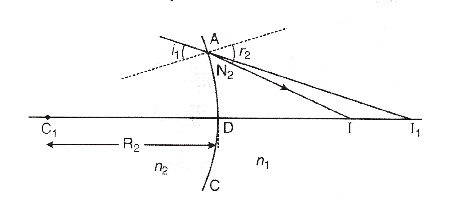
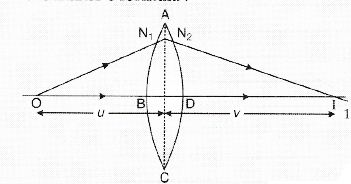
The first refracting ABC forms the image I1 of the object O. The image I1 acts as virtual object for the second refracting surface ADC, which forms the real image I as shown in the diagram
For refraction at ABC
\(\frac { { n }_{ 2 } }{ { v }_{ 1 } } -\frac { { n }_{ 1 } }{ u } =\frac { { n }_{ 2 }-{ n }_{ 1 } }{ { R }_{ 1 } } \)
For refraction at ADC
\(\frac { { n }_{ 1 } }{ v } -\frac { { n }_{ 2 } }{ { v }_{ 1 } } =\frac { { n }_{ 1 }-{ n }_{ 2 } }{ { R }_{ 2 } } \)
Adding equation (i) and equation (ii)
\(\frac { { n }_{ 1 } }{ v } -\frac { { n }_{ 2 } }{ u } =\left( { n }_{ 2 }-{ n }_{ 1 } \right) \left( \frac { 1 }{ { R }_{ 1 } } -\frac { 1 }{ { R }_{ 2 } } \right) \)
\(\frac { 1 }{ v } -\frac { 1 }{ u } =\left( \frac { { n }_{ 2 } }{ { n }_{ 1 } } -1 \right) \left( \frac { 1 }{ { R }_{ 1 } } -\frac { 1 }{ { R }_{ 2 } } \right) \)
We know, If \(u=\infty ,v=f\)
\(\frac { 1 }{ v } -\frac { 1 }{ u } =\frac { 1 }{ f } \)
\(\frac { 1 }{ f } =\left( \frac { { n }_{ 2 } }{ { n }_{ 1 } } -1 \right) \frac { 1 }{ { R }_{ 1 } } -\frac { 1 }{ { R }_{ 2 } } \)
\(\frac { 1 }{ f } =\left( { \mu }_{ 21 }-1 \right) \left( \frac { 1 }{ { R }_{ 1 } } -\frac { 1 }{ { R }_{ 2 } } \right) \)
\(\frac { 1 }{ f } =\left( { \mu }_{ 21 }-1 \right) \left( \frac { 1 }{ { R }_{ 1 } } -\frac { 1 }{ { R }_{ 2 } } \right) \)
\(\frac { 1 }{ f } =\left( 1.55-1 \right) \left( \frac { 1 }{ R } -\frac { 1 }{ -R } \right) \)
\(=0.55\times \frac { 2 }{ R } \)
\(R=0.55\times 2\times 20=22 \ cm\)

12th Standard CBSE Syllabus & Materials
12th Standard CBSE
CBSE 12th Computer Science Python Revision Tour I - New Previous year Question Papers Study Material - QB365 Set A
NEW12th Standard CBSE
CBSE 12th Business Studies Planning Important Questions And Answers Study Material - QB365 Set A
NEW12th Standard CBSE
CBSE 12th Business Studies Business Environment Important Questions And Answers Study Material - QB365 Set A
NEW12th Standard CBSE
CBSE 12th Business Studies Principles of Management Important Questions And Answers Study Material - QB365 Set A



CBSE 12th Standard CBSE Subjects
CBSE Standards










