
 100% FREE ACCESS
12th Standard CBSE Syllabus & Materials
12th Standard CBSE
CBSE 12th Economics Government Budget and the Economy Previous year Question Papers Study Material - QB365 Set A
NEW12th Standard CBSE
CBSE 12th Computer Science Interface Python with MySQL - New Previous year Question Papers Study Material - QB365 Set A
NEW12th Standard CBSE
CBSE 12th Computer Science Database Concept - New Previous year Question Papers Study Material - QB365 Set A
NEW12th Standard CBSE
CBSE 12th Computer Science Data Communication - New Previous year Question Papers Study Material - QB365 Set A
NEW12th Standard CBSE
CBSE 12th Computer Science Data Structures - New Previous year Question Papers Study Material - QB365 Set A
NEW12th Standard CBSE
CBSE 12th Computer Science Functions - New Previous year Question Papers Study Material - QB365 Set A

Published on: 03/03/2020
12th Standard Chemistry Board Exam Model Question 2019-2020
Download CBSE Class 12th Standard CBSE Chemistry question papers, sample papers, important questions, and previous year solved papers in PDF format. Get free study materials, NCERT solutions, and exam preparation resources for Class 12th Standard CBSE Chemistry
Questions + Answers key
Take MCQ Chemistry Test
1.
Following data are obtained for the reaction:
N2O5 ⟶ 2NO2+1/2O2
| t/s | 0 | 300 | 600 |
| [N2O5]/moL-1 | 1.6 x 10⁻² | 0.8 x 10⁻² | 0.4 x 10⁻² |
Show that it follows first order reaction.
(b) Calculate the half-life. (Given: log 2= 0.3010 ,log 4= 0.6021)
2.
Differentiate among a homogeneous solution, a suspension and a colloidal solution, give a suitable example of each.
3.
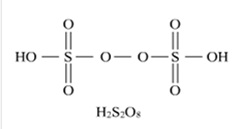
(a) Draw the structures of the following:
(i) XeF2 (ii) BrF3
(b) Write the structural difference between white phosphorus and red phosphorus.
4.
Calculate the molarity of pure water (density of water \(=1\quad g\quad mL^{ -1 }\)).
5.
If the molar conductivities at infinite dilution at infinite dilutiuon at 293 K for aqueous hydrocloric acid,sodium acetate and sodium chloride are 383.5, 78.4 and 102.0 S Cm2 respectively, calculate the molar mass conductivity of acetic acid at this temperature and dilution. If the molar conductivity of acetic acid at some other dilution is 100.0 S cm2 at 293 K, Calculate the degree of ionization of acetic acid at some otherdilution is 100.0 S cm2 at 293K, calculate the degree of ionization of acetic acid at this dilution.
6.
(i) Give the structures of different isomeric amines corresponding to the molecular formula, C4H11N.
(ii) Write the IUPAC names of all the isomers.
(iii) What type of isomerism is exhibited by different pairs of amines?
7.
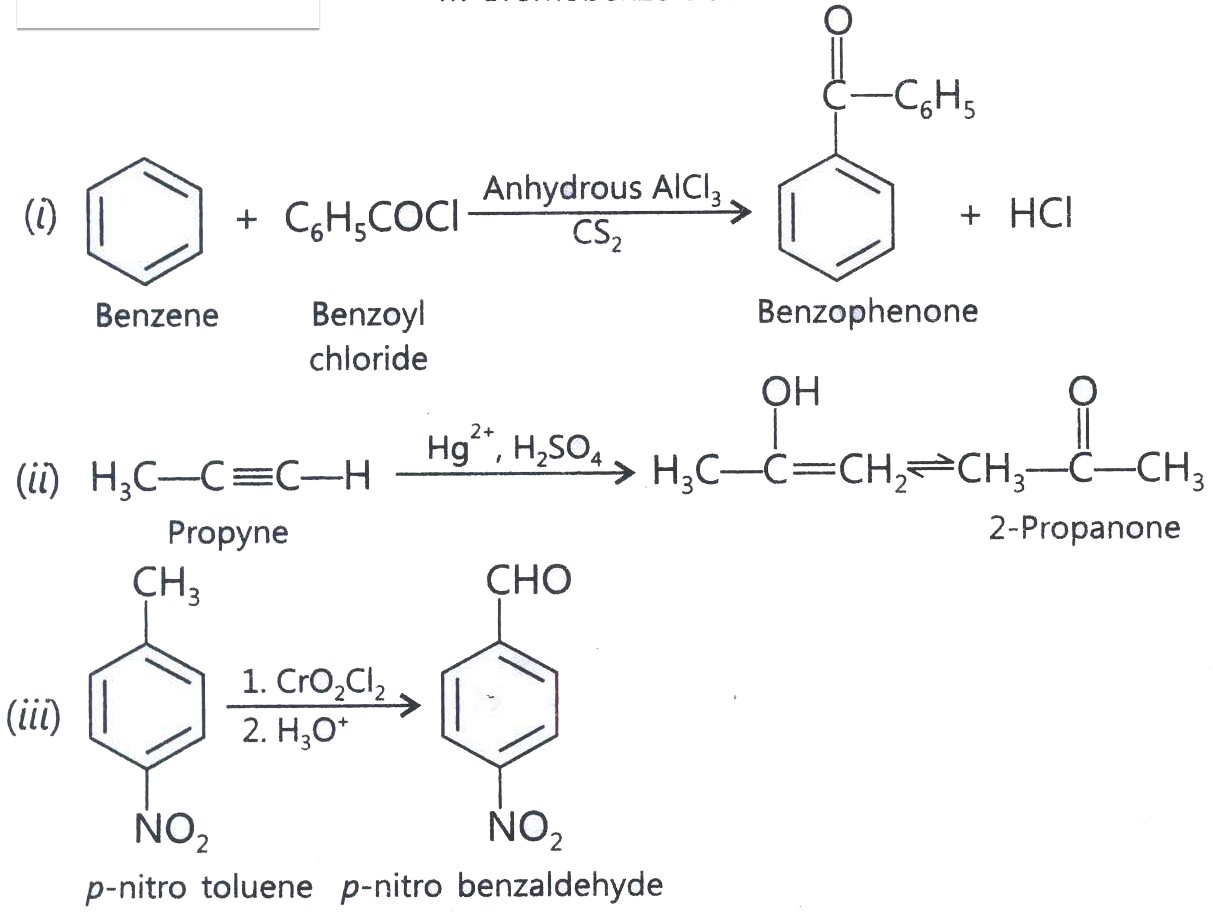
Write the structures of the main products of following reactions:
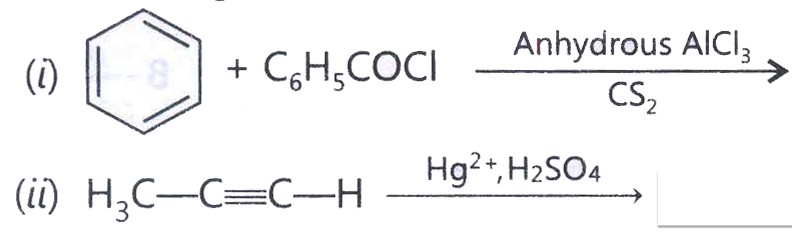
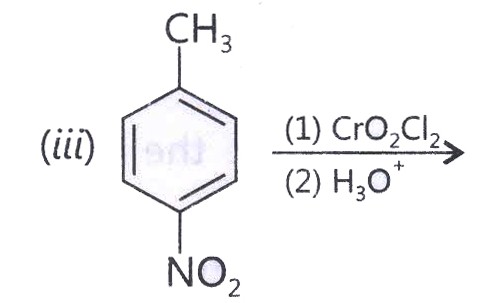
8.
Identify the first row transition metal ions which have outer electronic configurations of 3d4 and 3d6 and describe their oxidation states.
9.
State the role of
(i) depressant in froth floatation process.
(ii) silica in the metallurgy of copper.
(iii) graphite rod in the electrolytic reduction of alumina.
10.
Which out of \(Lu(OH_{ 3 })\) and \(La(OH)_{ 3 }\) is more basic and why?
11.
Amino acids can be classified as \(\alpha -, \beta -, \gamma-, \) \(\delta -\) and so on depending upon the relative position of amino group with respect to carboxyl group. Which type of amino acids form polypeptide chain in proteins ?
12.
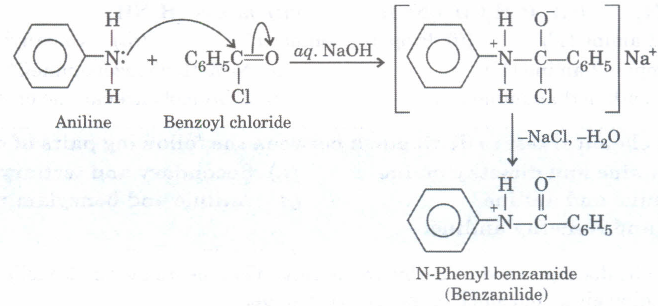
Write chemical reaction of aniline with benzoyl chloride and write the name of the product abtained.
13.
Write the name, state of hybridization, shape and magnetic behaviour of the following complexes :
[CoCl4]2-,[Ni(CN)4]2-,[Cr(H2O)2(C2O4)2]-
(At. nos. : Co = 27, Ni = 28, Cr = 24)
14.
Why is H2O a liquid and H2S a gas?
15.
Give four examples of heterogeneous catalysis.
16.
In each of the following pairs, which will allow greater conduction of electricity and why ?
(a) Silver wire at 20°C, Same silver wire at 50°C
(b) NaCl solution at 20°C, Same NaCl solution at 50°C
(c) NH4 OH solution at 20°C, Same NH4 OH solution at 50°C
(d) 0.1 M acetic acid solution, 1 M acetic acid solution.
17.
Glass is considered as a supercooled liquid. Give reason.
18.
Given below is the sketch of a plant carrying out a process.
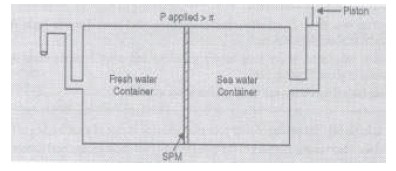
(i) Name the process occurring in the above plant.
(ii) To which container does the net flow of solvent take place ?
(iii) Name one SPM which can be used in this plant.
(iv) Give one practical use of the plant.
19.
Artificial sweetener which is stable under cold conditions only is
saccharine
sucrolose
aspartame
alitame
20.
What reagent is used in Hinsberge test of amines?
(CH3CO)2O and pyridine
C6H5SO2CI in aq.NaOH
NaNO2 in aq.H2SO4
CH3I (excess) followed by AgOH
21.
Which of the following statements is correct ?
All amino acids are optically active
All amino acids except glycine are optically active
All amino acids except glutamic acid are optically active
All amino acids except lysine are optically active
22.
The polymer used in the squeeze bottles is
polystyrene
teflon
polypropene
high density polythene
low density polythene
23.
Which element do you expect to have the smallest atomic radius ?
Sc
Zn
La
Hg
24.
The smallest ketone and its next homologue are reacted with NH2OH to form oxime
two different oximes are formed
three different oximes are formed
two oximes are optically active
all oximes are optically active
25.
The case of dehydrohalogenation of alkyl halides with alcholic KOH is
3o < 2o < 1o
3o > 2o > 1o
3o < 2o > 1o
3o > 2o < 1o
26.
Halogens combine with each other to form interhalogen compounds (XX', XX'3, XX'5 and XX'7). Halide ions often react with molecules of halogens or interhalogens to form polyhalide ions consisting either of the same halogen or of two or three different halogens. Besides these, a few other anions are known, which do not contain any of the halogen atoms but behave like halide ions. These anions are called pseudohalides and consist of two or more atoms of which one is always a nitrogen atom.
Which one of the following is not a pseudohalide?
CNO-
RCOO-
OCN-
NNN-
27.
Phenol reacts with bromine in CS2 to give
o-bromophenol
m-bromophenol
o-and p-bromophenol
2, 4, 6-tribromophenol
28.
Which one of the following ligand is caple of forming a low spin as well as a high spin complex?
CO
F-
NH3
CN-
29.
In the lead-acid battery during charging, the cathode reaction is
formation of PbO2
formation of PbSO4
reduction of Pb2+ to Pb
decomposition of Pb at the anode
30.
The function of potassium ethyl xanthate in froth floatation process is to make the ore
attracted towards water
water repellant
porous
heavier
31.
Which of the following result the chemist must have observed about his studies with KCI solution ?
Dilute KCI solution shows no adsorption whereas concentrated KCI shows adsorption
Concentrated KCI solution shows no adsortion wheares dilute KCI solution adsorption
Dilute KCI solution shows positive adsorption whereas concentrated KCI solution shows negative adsorption
Concentrated KCI solution shows positive adsorption whereas dilute KCI solution shows negative adsorption.
32.
According to Maxwell Boltzmann distribution of energy, ....... .
the fraction of molecules with most probable kinetic energy decreases at higher temperatures
the fraction of molecules with most probable kinetic energy increases at higher temperatures
most probable kinetic energyincreases at higher temperatures
most probable kinetic energy decreasesat higher temperatures.
33.
Solution A contains 7 g/L MgCI2 and solution B contains 7 g/L of NaCI. At room temperature, the osmotic pressure of
solution A is greater than B
both have same osmotic pressure
solutin B is greater than A
can't determine.
34.
Structure of a mixed oxide is cubic close-packed(c.c.p) The cubic unit cell of mixed oxide is composed of oxide ions.One fourth of the tetrahedral voids are occupied by divalent metal A and the octahedral voids are occupied by a monovalent metal B.The formula of the oxide is:
A2B3O4
AB2O2
ABO2
A2BO2
35.
Compounds having general molecular formula \(AFe_{ 2 }O_{ 4 }\) are called ferrites and posses spinel type structures. Some common examples are \(MgFe_{ 2 }O_{ 4 }\) and \(ZnFe_{ 2 }O_{ 4 }\) They may be thought of being formed by replacing \(Fe^{ 2+ }\) ions present in \(Fe_{ 3 }O_{ 4 }\) by bivalent cations such as \(Mg^{ 2+ },Zn^{ 2+ }\) ions etc. Now answer the following questions :
(i) What types of materials are ferrites?
(ii) What are the main uses of ferrites?
36.
(a) Write the structures of main products when products when benzene diazonium chloride reacts with the following reagents:
(i) H3PO2+H2O
(ii) CuCN/KCN
(iii) H2O
(b) Arrange the following in the increasing order of their basic character in an aqueous solution:
C2H5NH2 , (C2H5)2NH, (C2H5)3N
(c) Give a simple chemical test to distinguish between the following pair of compounds:
C6H5-NH2 and C6H5-NH-CH3
37.
(a) Write the structures of A and B in the following reactions:
(i) \({ CH }_{ 3 }COCI\overset { { H }_{ 2 },Pd-BaSO_{ 4 } }{ \longrightarrow } A\overset { { H }_{ 2 }N-OH }{ \longrightarrow } B\)
(ii) \({ CH }_{ 3 }MgBr\overset { 1.CO_{ 2 } }{ \underset { 2.H_{ 3 }O^{ + } }{ \longrightarrow } } A\overset { PCI_{ 5 } }{ \longrightarrow } B\)
(b) Distinguish between:
(i) C6H5- COCH3 and C6HS- CHO
(ii) CH3COOH and HCOOH.
(c) Arrange the following in the increasing order of their boiling points :
CH3CHO, CH3COOH, CH3CH2OH.
(OR)
(a) Write the chemical reaction involved in Wolff-Kiphner reduction
(b) Arrange the following in the increasing order of-their reactivity towards nucleophilic addition reaction
C6H5COCH3 , CH3 - CHO, CH3COCH3
(c) Why carboxylic acid does not give reactions of carbonyl group?
(d) Write the product in the following reaction
\({ CH }_{ 3 }{ CH }_{ 2 }CH=CH-{ CH }_{ 2 }CN\overset { 1.(i-Bu)_{ 2 }AIH }{ \underset { 2.H_{ 2 }O }{ \longrightarrow } } ?\)
(e) A and Bare two functional isomers of compound C3H60. On heating with NaOH and I2 isomer Bforms yellow precipitate of iodoform whereas isomer A does not form any precipitate. Write the formulae of A and B.
38.
Due to hectic and busy schedule, Mr. Singh started taking junk food in the lunch break and slowly became habitual of eating food irregularly to excel in his field. One day during meeting he felt severe chest pain and fell down. Mr. Khanna, a close friend of Mr. Singh took him to doctor immediately. The doctor diagnosed that Mr. Singh was suffering from acidity and prescribed some medicines. Mr. Khanna advised him to eat home made food and change his lifestyle by doing yoga, meditation and some physical exercise. Mr. Singh followed his friend's advice and after few days he started feeling bener.
After reading the above passage, answer the following:
(i) What are the values (at least two) displayed by Mr. Khanna?
(ii)What are antacids? Give one example.
(iiii)Would it be advisable to take antacids for a long period of time? Give reason
39.
(a) Draw the structure of:
(i) BrF3 (ii) XeOF4
(b) Explain giving reason in each case:
(i) Why H2Teis more acidic than H2 S?
(ii) Why are halogens strong oxidising agents?
(iii)Why does nitrogen show catenation tendency less than phosphorus?
40.
A house wife while working in the kitchen gots a cut on the finger. It started bleeding and become panicked. She immediately called her neighbour.She had kept ferric chloride in her house. She immediately applied it on the affected area and the bleeding stopped.
(i) What is the chemical formula of ferric chloride?
(ii) Why did bleeding stop on applying it on the affected finger?
(iii) What is the name of the phenomenon involved?
(iv) What do we learn from it? What is the value associated with this from the point of view of chemist?
41.
While washing a miner's overalls, a washerwoman noticed that sand and similar dirt fell to the bottom of the washtub. What was peculiar, the copper-bearing compounds that had come to the clothes from the mines were caught in the soaplids and so they came to the top. One of her clients was a chemist, Mrs. Malik. The washerwoman told her experience to Mrs. Malik. The latter thought that the idea could be used for separating copper compounds from rocky and earth materials on a large scale. After reading the above passage answer the following questions-
What type of ores are concentrated by this process?
42.
(i) With reference to structural variability and chemical reactivity, write the differences between lanthanoids and actinoids.
(ii) Name a member of the lanthanoid series which is well known to exhibit +4 oxidation state.
(iii) Complete the following equation:
\(MnO_{ 4 }^{ - }8H^{ + }5e^{ - }\longrightarrow \)
(iv) Out of \(Mn^{ 3+ }\) and \(Cr^{ 3+ }\) , which is more paramagnetic and why?
(Atomic nos.: Mn = 25, Cr = 24)
43.
Glucose and fructose give the same osazone ? Explain.
44.
What is the relationship between observed colour of the complex and the wavelength of light absorbed by the complex ?
45.
Wurtz reaction falils in case of tert-alkyl halides. Explain.
1.
When time and rate of a reaction is given then can use hit and trial method to find out the order; of reaction by substituting the values in different v integrated equation.
Using data, to find out the rate constant
| t/s | 0 | 300 | 600 |
| [N2O5]/moL-1 | 1.6 x 10⁻² | 0.8 x 10⁻² | 0.4 x 10⁻² |
Using hit and trial method,
For first order reaction, k=\(\frac { 2.303 }{ 300 } log\frac { (1.6\times { 10 }^{ -2 })molL^{ -1 } }{ (0.4\times { 10 }^{ 2 })molL^{ -1 } } \)
=\(\frac { 2.303 }{ 300 } log2=\frac { 2.303 }{ 300 } \times 0.3010\)
k = 2.31 x 10⁻³ s-1
similarly, k= \(\frac { 2.303 }{ 600 } log\frac { (1.6\times { 10 }^{ -2 })molL^{ -1 } }{ (0.4\times { 10 }^{ -2 })molL^{ -1 } } \)
k = 2.31 x 10⁻³s-1
Thus, it is proved that reaction proceed through first order kinetics as the rate constant remains same.
(b) Half-life (t1/2)=0.693/k
\({ t }_{ 1/2 }=\frac { 0.693 }{ 2.31\times { 10 }^{ -3 } } { s }^{ -1 }\)
t1/2=300s
2.
| Homogeneous solution | Colloidal solution | Suspension |
| Particle size < 1 nm |
Particle size between 1 to 1000 nm. |
Particle size > 1000nm. |
| Constituent particles are ions or small molecules. |
Constituent particles are single macromolecule or aggregates of many atoms, ions or molecules. |
Constituent particles are molecules |
| e.g. sugar solution | e.g. paints | e.g. sand solution |
3.
(a) (i)
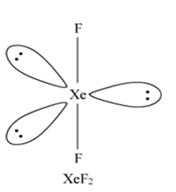
(ii)
4.
Density of water \(=1\ g\ mL^{ -1 }\)
Mass of 1000 mL of water = Volume\(\times \)Density
=1000\(\times \)1 = 1000 g
Moles of water \(\\ =\frac { 1000 }{ 18 } =55.5\)
\(\therefore \) 55.55 moles of \({ H }_{ 2 } O\) are present in 1000 mL or 1 L of water
Molarity = 55.55 M.
5.
\({ { \wedge } }^{ o }\)= 359.9 S cm2, \(\alpha\) = 0.278
6.
(i) and (ii)
Eight isomers of C4H11N are
(a) \(\stackrel{4}{\mathrm{C}} \mathrm{H}_3-\stackrel{3}{\mathrm{C}} \mathrm{H}_2-\stackrel{2}{\mathrm{C}} \mathrm{H}_2-\stackrel{1}{\mathrm{C}} \mathrm{H}_2-\mathrm{NH}_2\)
Butan -1 -amine
(Primary)
(b) CH3
|
\(\stackrel{3}{CH}_3-{ }^2 \mathrm{CH}-\stackrel{1}{C} \mathrm{H}_2-\mathrm{NH}_2\)
2-methyl propan -1-amine
(Primary)
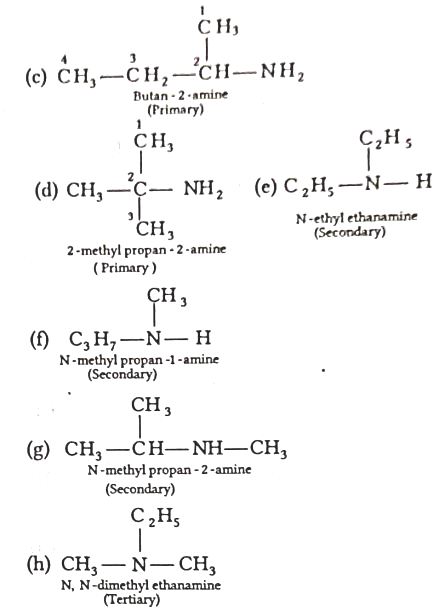
(iii) Isomerism exhibited by different amines are:
(a) Chain isomers, i.e. have different carbon chains, (a) and (b), (c) and (d) (as discussed in part (i) and (ii)]
(b) Position isomers, i.e. functional group occupy different positions, (a) and (c), (b) and (d).
(c) Metamers, i.e. different alkyl groups are attached to the same functional group, (e) and (f), (e) and (g).
(d) Functional isomers, i.e. they have different functional groups. All the three categories (1°, 2° and 3°) of amines are the functional isomers of each other.
7.
8.
Cr2+ has electronic configuration 3d4 Chromium also shows +3 and +6 oxidation states. Fe2+ has electronic configuration 3d6. Iron has oxidation states +2 and +3.
9.
(i) It prevents certain sulphides like ZnS to enter the froth in presence of PbS, therefore, helps in their separation. Sodium cyanide is used as depressant in the separation of ZnS from PbS.
(ii) It acts as flux.
(iii) Graphite rods act as anode in the extraction of aluminium.
10.
La(OH)3 is more basic than Lu(OH)3 As the size of the lanthanoid ions decreases from La3+ to Lu3+, the covalent character of the hydroxides increases (Fajan's rules). Hence, the basic strength decreases from La(OH)3 to Lu(OH)3.
11.
\(\alpha \)-Amino acids form polypeptide chains in proteins.Their general structure is
\(\underset { \alpha -Amino\quad acid }{ R-\overset { * }{ CH } -COOH\\ \quad \quad |\\ \quad \quad { NH }_{ 2 } } \)
12.
13.
(i) sp3 , tetrahedral, paramagnetic
(ii) dsp2, square planar, diamagnetic
(iii) d2sp3, octahedral, paramagnetic
14.

Due to greater electronegativity of O than S, H2O undergoes extensive intermolecular H-bonding. As a result, H2O exists an associated molecule in which each O is tetrahedrally surrounded by four water molecules. Quite a larger amount of energy is required to break these H-bonds. Therefore, H2O is a liquid at room temperature. In contrast, H2S does not undergo H-bonding. It exists as discrete molecules which are held together by weak vander Waals forces of attraction. To break these forces of attraction, only a small amount of energy is required. Therefore, H2S is a gas at room temperature.
15.
Examples of heterogeneous catalysis: (i) Manufacture of ammonia by Haber's process using an iron catalyst.
\({ 3H }_{ 2 }+{ N }_{ 2 }\xrightarrow [ ]{ Fe } 2{ NH }_{ 3 }\)
(ii) Manufacturer of SO3 from SO2 in the Contact process using V2 O5 as a catalyst.
\(2{ SO }_{ 2 }+{ O }_{ 2 }\xrightarrow [ ]{ { V }_{ 2 }{ O }_{ 5 } } 2{ SO }_{ 3 }\)
(iii) Dehydrogenation of ethanol by Ni catalyst
\({ CH }_{ 3 }{ CH }_{ 2 }OH\xrightarrow [ ]{ Ni } { C }_{ 6 }{ H }_{ 5 }{ NH }_{ 2 }+{ 2H }_{ 2 }O\)
(iv) Reduction of nitrobenzene in the presence of Ni as a catalyst.
\({ C }_{ 6 }{ H }_{ 5 }{ NO }_{ 2 }(l)\xrightarrow [ ]{ Ni } { C }_{ 6 }{ H }_{ 5 }{ NH }_{ 2 }+2{ H }_{ 2 }O\)
16.
(a) Sliver wire at 20°C because with increase in temperature, metallic conduction decreases due to vibration of kernals.
(b) NaCl solution at 50°C because in case of a strong electrolyte with increase in temperature, the ionic mobilities increase.
(c) NH4 OH at 50°C because in case of a weak electrolyte, dissociation increases with increase in temperature.
(d) 0.1 M acetic acid because with dilution, dissociation/ionisation increases.
17.
On being heated, glass has the property to flow like lliquids as shown by greater thickness of the window panses at the bottom. Hence, it is called supercooled liquid.
18.
(i) Desalination (i.e., removal of salts from sea water) by reverse osmosis.
(ii) From sea water container to fresh water container.
(iii) Cellulose acetate placed over a suitable suport.
(iv) To remove salts from sea water to obtain drinking water.
19.
(c)
aspartame
20.
(b)
C6H5SO2CI in aq.NaOH
21.
(b)
All amino acids except glycine are optically active
22.
(e)
low density polythene
23.
(b)
Zn
24.
(b)
three different oximes are formed
25.
(b)
3o > 2o > 1o
26.
(b)
RCOO-
27.
(c)
o-and p-bromophenol
28.
(c)
NH3
29.
(c)
reduction of Pb2+ to Pb
30.
(b)
water repellant
31.
(d)
Concentrated KCI solution shows positive adsorption whereas dilute KCI solution shows negative adsorption.
32.
(a)
the fraction of molecules with most probable kinetic energy decreases at higher temperatures
33.
(c)
solutin B is greater than A
34.
(b)
AB2O2
35.
(i) Ferrites are magnetic material.
(ii) They are used in telephones and memory loops in computers.
36.
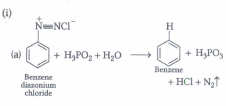
(b) C2H5NH2 < (C2H5)3N < (C2H5)2NH
(c) Add CHCl3 and alc. KOH, C6H5-NH2 gives foul smell of isocyanide whereas C6H5-NH-CH3 does not (or any other correct test).
37.
(i) \({ CH }_{ 3 }COCI\overset { { H }_{ 2 },Pd-BaSO_{ 4 } }{ \longrightarrow } { CH }_{ 3 }CHO+HCI+\overset { { H }_{ 2 }N-OH }{ \longrightarrow } { CH }_{ 3 }-CH=N-OH+{ H }_{ 2 }O\)
[A] [B]
Acetaldehyde Acetaldoxime
(ii) \({ CH }_{ 3 }MgBr\overset { 1.CO_{ 2 } }{ \underset { 2.H_{ 3 }O^{ + } }{ \longrightarrow } } { CH }_{ 3 }COOH\overset { PCI_{ 5 } }{ \longrightarrow } { CH }_{ 3 }COCI+HCI+POC{ I }_{ 3 }\)
[A] [B]
Acetic acid Acetyl chloride
(b) (i) C6H5being an aldehyde reduces Tollen's reagent to give shining silver mirror whereas C6H5COCH3 being a ketone does not.
(ii) HCOOH gives silver mirror test with Tollen's reagent whereas ethanoic acid does not.
\(HCOOH+2[Ag(NH_{ 3 })_{ 2 }]^{ + }+2O{ H }^{ - }\longrightarrow 2Ag\downarrow +2{ H }_{ 2 }O+{ CO }_{ 2 }+4{ NH }_{ 3 }\)
Silver mirror
\({ CH }_{ 3 }COOH\overset { Tollen's }{ \underset { reagent }{ \longrightarrow } } No\quad silver\quad mirror\)
(c) CH3CHO
(a)
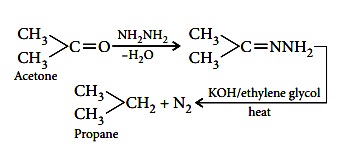
(b) C6H5COCH3
(c) Carboxylic acids do not give reactions of carbonyl groups as it enters into resonance with lone pair 0 of -COOH groups thereby making the carbon atoms less electrophilic.
(d) \({ CH }_{ 3 }{ CH }_{ 2 }CH=CH-{ CH }_{ 2 }CN\overset { 1.(i-Bu)_{ 2 }AIH }{ \underset { 2.{ H }_{ 2 }O }{ \longrightarrow } } { CH }_{ 3 }{ CH }_{ 2 }CH=CH-{ CH }_{ 2 }-\overset { \begin{matrix} O \\ \parallel \end{matrix} }{ C } -H\)
Hex-3-enenitrile Hex-3-enal
(e) \({ CH }_{ 3 }{ CH }_{ 2 }CHO+NaOH+{ I }_{ 2 }\longrightarrow No\quad Yellow\quad precipitate\)
Propanal
[A]
\({ CH }_{ 3 }-\overset { \begin{matrix} O \\ \parallel \end{matrix} }{ C } -{ CH }_{ 3 }+3NaOH+4{ I }_{ 2 }\overset { \triangle }{ \longrightarrow } { CHI }_{ 3 }+3NaI+{ CH }_{ 3 }COONa+3{ H }_{ 2 }O\)
Acetone Yellow
[B] precipitate
38.
(i) Friendly, caring nature, supportive and has good awareness towards health. (Any two)
(ii) Antacids are the chemical substances which neutralize excess acid in the gastric juices and give relief from acid indigestion, heart bums, acidity and gastric ulcers. e.g., Histamine, Ranitidine, Cimetidine.
(iii) It is not advisable to take antacids for a long time as they control only symptoms and not the cause. Therefore, the patients cannot be treated easily and completely through them. The production of more acid They may also lead to.
39.
(b) (i) Because of low bond dissociation enthalpy of H-Tebond.
(ii) Because of their strong electron affinity, they easily accept an electron to complete their octet.
(iii) Because N-N single bond is weaker than P-P single bond.
40.
(i) Chemical formula of ferric chloride is FeCI3.
(ii) Fe3+ ions of FeCl3 neutralize the charge on the colloidal particles of blood. This leads to coagulation of blood. Bleeding therefore, stopped.
(iii) This phenomenon is known as coagulation or flocculation.
(iv) All house wives must keep small bag or kit in their kitchen. It must have ferric chloride kept in small bottle or potash alum, burnol and bandages etc. Minor accidents are very common in kitchen. The kit can be very helpful to deal with emergency skill of applying knowledge, helping others, kindness, etc are the values associated with it.
41.
Only sulphide ores like ZnS, CuFeS2, etc. are concentrated by froth floatation process
42.
(i) Zinc (Z= 30, 1822822p6 3823p6 3d10 482)does not have partially filled d-subshell in its elementary state or in its commonly occurring oxidation state (Zn2+: 3dlO). Therefore, it is not regarded as a transition element.
(ii) Transition elements or the d-block elements from a large number of coordination complexes. The transition metal ions bind to a number of anions or neutral molecules in these complexes. The common examples are [Ni(NHJJ2+, [Co(NHJJ3-, [Fe(CN)J3+,
[Fe(CN)J4-, [Cu(NH3)4]2+e,etc. The high tendency of transition metal ions to form complexes is due to
(a) small size of the atoms and ions of transition metals
(b) high nuclear charge
(c) availability of vacant d-orbitals of suitable energy to accept lone pairs of electrons donated by other groups (called ligands).
(iii) Mn2+ has 3d5 electronic configuration. It is stable because of the half-filled configuration of d-subshell. Therefore, Mn has very high third ionization enthalpy for the change from d5 to d4 and it is responsible for much more positive Eovalue for Mn3+/Mn2+couple in comparison to Cr3+/Cr2+couple
43.
During osazone formation, the reaction occurs only at CI and C2 while rest of the molecule remains intact. Since glucose and fructose differ from each other only in the arrangement of atoms at CI and C2, therefore, they. give the same osazone.
44.
When white light falls on the complex, some part of it is absorbed. Greater the CFSE, greater is the energy absorbed or shorter is the wavelength absorbed \((E={hc\over\lambda })\). The observed colour is the complementary colour of the colour absorbed.
45.
tert-Alkyl halides prefer to undergo dehydrohalogenation in presence of a strong base such as Na metal instead of undergoing Wurtz reaction as explained below:
\(\underset{tert-Butyl\ bromide}{(CH_3)_3C-Br}+2Na\longrightarrow\underset{tert-Butylsodium}{(CH_3)_3Na^+}+Na^+Br^-\)
Thus, only rand 2° alkyl halides undergo Wurtz reaction while 3° alkyl halides prefer to undergo dehydrohalogenation to form alkenes.

12th Standard CBSE Syllabus & Materials
12th Standard CBSE
CBSE 12th Computer Science Python Revision Tour I - New Previous year Question Papers Study Material - QB365 Set A
NEW12th Standard CBSE
CBSE 12th Business Studies Planning Important Questions And Answers Study Material - QB365 Set A
NEW12th Standard CBSE
CBSE 12th Business Studies Business Environment Important Questions And Answers Study Material - QB365 Set A
NEW12th Standard CBSE
CBSE 12th Business Studies Principles of Management Important Questions And Answers Study Material - QB365 Set A



CBSE 12th Standard CBSE Subjects
CBSE Standards










