
 100% FREE ACCESS
12th Standard CBSE Syllabus & Materials
12th Standard CBSE
CBSE 12th Economics Government Budget and the Economy Previous year Question Papers Study Material - QB365 Set A
NEW12th Standard CBSE
CBSE 12th Computer Science Interface Python with MySQL - New Previous year Question Papers Study Material - QB365 Set A
NEW12th Standard CBSE
CBSE 12th Computer Science Database Concept - New Previous year Question Papers Study Material - QB365 Set A
NEW12th Standard CBSE
CBSE 12th Computer Science Data Communication - New Previous year Question Papers Study Material - QB365 Set A
NEW12th Standard CBSE
CBSE 12th Computer Science Data Structures - New Previous year Question Papers Study Material - QB365 Set A
NEW12th Standard CBSE
CBSE 12th Computer Science Functions - New Previous year Question Papers Study Material - QB365 Set A

Published on: 29/11/2018
The National Council of Education and Research Training (NCERT) sets the curriculum and exam standards for schools following the Central Board of Secondary Education (CBSE). NCERT solutions for Class 12 Chemistry have been solved by expert teachers. The Chemistry NCERT Solutions Class 12 provides step-by-step solutions to complex equations and tough questions which prepare students to crack the toughest papers without facing any difficulty. Students can avail the CBSE class 12 chemistry previous year question papers with solutions. The solutions to the questions are compiled by our experienced teachers keeping in mind, the NCERT suggested answers and exam guidelines. The format of the answers is such that it can be used as a reference by the students to base their own answers in order to score well in the exam. Students should make sure to practice the question papers in the exam-like situation, keeping a tab on the time and following the question paper instructions completely in order to understand the exam pressure and how to overcome it. Practicing exam papers will give you confidence and a head start to be better prepared for the board examinations. Practice will also allow you to devise a strategy, help you know your strengths and weaknesses and allow you to work on them beforehand.
CBSE Class 12 Chemistry always important to practice last year board exam question paper to practice for the upcoming board exams. Here the questions are covered from last 10 years which you should practice understanding the paper pattern and type of questions which have come in previous board exams for class 12. This will help you to get better marks in class 12 board exams. Practice getting better marks in board exams.
In this question paper, the questions are covered from the entire syllabus of 12th Chemistry. Questions are prepared as per NCERT guideline with the help of expert teachers.
Download CBSE Class 12th Standard CBSE Chemistry question papers, sample papers, important questions, and previous year solved papers in PDF format. Get free study materials, NCERT solutions, and exam preparation resources for Class 12th Standard CBSE Chemistry
Questions + Answers key
Take MCQ Chemistry Test
1.
What type of crystalline solid is graphite?
2.
Can nucleic acids, proteins and starch be considered as step growth polymers ?
3.
Conductivity of silicon increases on doping it with phosphorus. Why
4.
Write the name, state of hybridisation, shape and magnetic behaviour of the following complexes
{CoCl4]2-, [Ni(CN)4]2-, [Cr(H2O)2(C2O4)2]- (Atomic no of Co = 27, Ni = 28, Cr = 24)
5.
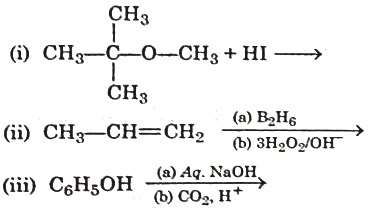
Write the main products(s) in each of the following reactions:
6.
(i) Deficiency of which vitamin causes scurvy?
(ii) What type of linkange is responsible for the formation of proteins ?
(iii) Write the product 'formed when glucose is treat with HI.
7.
At 10\(°\) C, the average osmotic pressure of blood is 8.8 atm. Find the total concentration of the various constituents in the blood. Assuming that the concentration is the same as the molarity, find the freezing point of the solution (Kf for water = 1.86 K kg mol-1)
8.
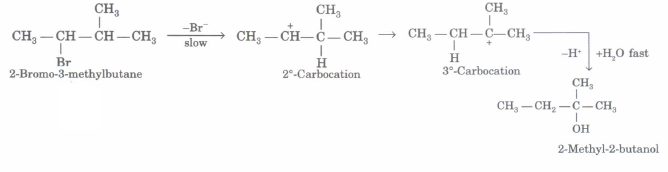
Hydrolysis of 2-bromo-3-methylbutane \(\left( 2° \right) \) gives only 2-methyl1-2-butanol \(\left( 3° \right) \).Explain.
9.
(a) Define the term 'Chemotherapy'.
(b) While antacids and antiallergic drugs interfere with the function of histamines, why do these not interfere with the function of each other?
10.
An aqueous solution of 3.12 g of BaCl2 in 250 g of water is found to boil at 100.0832oC. Calculate the degree of dissociation of BaCl2. [K b (H2O) = 0.52 K/m.]
11.
An element occurs in bcc structure. It has a cell edge length of 250 pm. Calculate the molar mass if its densuty is 8.0 g cm-3. Also calculate the radius of an atom of this element.
12.
'Stability of a crystal is reflected in the magnitude of its melting point Comment. Collect melting point of water, ethyl alcohol, diethyl ether, and methane from a data. What can you say about the intermolecular forces between these molecules?
13.
How will you convert bromobenzene to 1-phenylethanol?
14.
Arrange the following in increasing order of basic strength: Aniline, p-Nitroaniline and p-Toluidine
15.
Compound 'A' was prepared by oxidation 'B' with alkaline KMnO4. Compound 'A' on reduction with lithium aluminium hydride gets converted back to compound 'B'. When compound 'A' is heated with compound B in the presence of H 2SO4 it produces fruitly smell of compound C to which family the compounds 'A', 'B' and 'C' belong to?
16.
(a) The molecular masses of polymers are determined by osmotic pressure method and not by measuring other colligative properties. Give two reasons.
(b) At 300 K, 36 g of glucose, C6H12O6 present per litre in its solution has an osmotic pressure of 4.98 bar. If the osmotic pressure of another glucose solution is 1.52 bar at the same temperature, calculate the concentration of the other solution.
17.
Deficiency of ............. causes scurvy.
18.
Diphenylhydrazine and terfenadine are ________ drugs.
19.
The catalysts which increases the rate of reaction are called........................catalysts.
20.
In an electrochemical cell, the conventional current flows from -------- to ----------------
1.
()
Graphite is covalent crystalline solid.
2.
()
Yes, because these are condensation polymers involving loss of small molecules like H2O, NH3, etc., therefore, these are step growth polymers.
3.
()
It is because it forms n-type semiconductor in which electrons are free to move.
4.
(i) [CoCl4]2-
IUPAC name Tetrachloridocobalt (II) ion In [CoCl4]2-. Co is in +2 state and has an Outer Outer electronic configuration of 3d7 Cl- is a weak field ligand so pairing of electrons will not occur
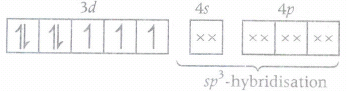
Four pairs of electrons one from each Cl- ion occupy the four Sp3 hybrid orbitals. Therefore. the complex has tetrahedral geometry and paramagnetic nature as it contains three unpaired electrons. Thus,
Hybridisation - Sp3
Shape - Tetrahedral
Magnetic nature - Paramagnetic
(ii) [Ni(CN)4]2-
IUPAC name Tetracyanonickelate (II) ion
Hybridisation - dsp2
Shape Square planar
Magnetic nature Diamagnetic [For detailed structure refer to solution 16 of Topic 2.]
(iii) [Cr(H2O)2(C2O4)2]-
IUPAC name
Diaquadioxalatochroma te (iii ) ion
Hybridisation - d2Sp3
Shape Octahedral
Magnetic behaviour Paramagnetic
[For detailed structure, refer to solution 18 (i) subpart of Topic 2 ]
5.
(i) \({ CH }_{ 3 }-\overset { \underset { | }{ { CH }_{ 3 } } }{ \underset { \overset { | }{ { CH }_{ 3 } } }{ C } } -O-{ CH }_{ 3 }+HI\longrightarrow { CH }_{ 3 }-\overset { \underset { | }{ { CH }_{ 3 } } }{ \underset { \overset { | }{ { CH }_{ 3 } } }{ C } } -I+\underset { Methanol }{ { CH }_{ 3 }OH } \)
(ii) \({ CH }_{ 3 }-CH={ CH }_{ 2 }\overset { (i){ B }_{ 2 }{ H }_{ 6 } }{ \underset { (ii)3{ H }_{ 2 }{ O }_{ 2 }/{ H }^{ - } }{ \longrightarrow } } { CH }_{ 3 }{ CH }_{ 2 }{ CH }_{ 2 }OH\)

6.
(i) Vitamin C.
(ii) Peplide linkange.
(iii) n-hexane or its structure.
7.
Step-I : Calculation for concentration of the solution.
According to Van't Hoff's equation
p = CRT or C = \(\frac { \pi }{ RT } \)
p = 8.8 atm, T = 40\(°\)C = 313 K
R = 0.0821 L atm K-1 mol-1
\(C=\frac { 8.8 }{ 0.0821\times 313 } \)=0.34 molL-1(M)
Step-II: Calculation of freezing point of the solution depression in freezing point of solution
\(\Delta\)Tf = Kf \(\times\) m
m = 0.34 mol kg-1
(same as molarity as given)
Kf = 1.86 K kg mol-1
\(\Delta\)Tf = 1.86 \(\times\) 0.84 (\(\because\) \(\Delta\) Tf = Kf m)
= 0.63 K = 0.63\(°\)C
Freezing point of the solution = 0 - 0.63 \(°\)C
= - 0.63\(°\) C
8.
During SNIreaction, the ionization gives 2° carbocation which rearranges by a hydride shift to a more stable 3"-carbocation to form 3°-alcohol as:
9.
(a) Chemotherapy: Chemotherapy is the science in which chemicals are used in treatment of diseases due to bacterial invasion. These chemicals destroy the microorganisms without affecting, to any material extent, the tissues (of the host).
(b) The antacids prevents the interaction of histamine with receptors present in stomach wall which results in lesser amount of acid. Antacids and antiallergic drugs have different receptors, therefore, they do not interfere with the function of each other.
10.
ΔTb = 100.0832 - 100.0 = 0.0832°C,
Kb = 0.52 K kg mol-1,
WA = 250 g, WB = 3.12 g,
MB = 137 + 71 = 208 9 mol-1
Now \(ΔT_b=iK_b\times{W_B\over M_B}\times{1000\over W_A}\)
⇒ \(0.0832 = i \times 0.52 \times{3.12\over4 6.489}\times{1000\over 250}\)
\(⇒ i={0.0832\times208\over 4\times3.12\times0.52}={17.30\over 6.489}=2.66\)
\(\alpha={i-1\over n-1}={2.66-1\over 3-1}={1.66\over 2}=0.83\)
Degree of dissociation (α) = 83%
11.
\(d=\frac { Z\times M }{ { a }^{ 3 }\times { N }_{ A } } \)
\(\\ M=\frac { d\times { a }^{ 3 }\times { N }_{ A } }{ Z }\)
\( Z=\frac { 8.0g{ cm }^{ -3 }\times { \left( 250 \right) }^{ 3 }\times { 10 }^{ -30 }{ cm }^{ 3 }\times 6.023\times { 10 }^{ 23 } }{ 2 }\)
\(Z=\frac { 8\times 15.625\times 6.023 }{ 20 } \)
\(=\frac { 752.875 }{ 20 } \)
\(\\ 37.64 \ g{ \ mol }^{ -1 }\)
\(For \ bcc, \ 4r=\sqrt { 3 } a\)
\(\ r=\frac { \sqrt { 3 } a }{ 4 } =\frac { 1.732\times 250 }{ 4 } =108.25 \ pm\)
12.
Higher the melting point more will be the stability of crystals. Methane has a lower melting point because it is non-polar and has least intermolecular forces of attraction. Diethyl ether is polar, therefore, its melting point is higher than that of methane due to greater intermolecular forces of attraction. Ethyl alcohol has higher melting point than CH4 as well as diethyl ether because molecules of ethyl alcohol are associated with intermolecular hydrogen bonding. Water has the highest melting point because water molecules are associated with' intermolecular hydrogen bonding more than ethyl alcohol.
13.

14.
p-Nitroaniline < Aniline < p- Toluidine
15.
'A' is carboxylic acid, 'B' is alcohol, 'C' is easter.
16.
\(\pi =CRT\)
\(\therefore\) In the first case, \(4.98=\frac { 36 }{ 180 } \times R\times 300=60R\)
In the second case,\(1.52=C\times R\times 300\)
Dividing (ii) by (i), we get C = 0.061 M.
17.
()
vitamin C
18.
()
antihistamine
19.
()
positive
20.
()
+ ve pole (cathode) to - ve pole (anode)

12th Standard CBSE Syllabus & Materials
12th Standard CBSE
CBSE 12th Computer Science Python Revision Tour I - New Previous year Question Papers Study Material - QB365 Set A
NEW12th Standard CBSE
CBSE 12th Business Studies Planning Important Questions And Answers Study Material - QB365 Set A
NEW12th Standard CBSE
CBSE 12th Business Studies Business Environment Important Questions And Answers Study Material - QB365 Set A
NEW12th Standard CBSE
CBSE 12th Business Studies Principles of Management Important Questions And Answers Study Material - QB365 Set A



CBSE 12th Standard CBSE Subjects
CBSE Standards










