
 100% FREE ACCESS
12th Standard CBSE Syllabus & Materials
12th Standard CBSE
CBSE 12th Economics Government Budget and the Economy Previous year Question Papers Study Material - QB365 Set A
NEW12th Standard CBSE
CBSE 12th Computer Science Interface Python with MySQL - New Previous year Question Papers Study Material - QB365 Set A
NEW12th Standard CBSE
CBSE 12th Computer Science Database Concept - New Previous year Question Papers Study Material - QB365 Set A
NEW12th Standard CBSE
CBSE 12th Computer Science Data Communication - New Previous year Question Papers Study Material - QB365 Set A
NEW12th Standard CBSE
CBSE 12th Computer Science Data Structures - New Previous year Question Papers Study Material - QB365 Set A
NEW12th Standard CBSE
CBSE 12th Computer Science Functions - New Previous year Question Papers Study Material - QB365 Set A

Published on: 03/03/2020
12th Standard Economics Board Exam Model Question 2019-2020
Download CBSE Class 12th Standard CBSE undefined question papers, sample papers, important questions, and previous year solved papers in PDF format. Get free study materials, NCERT solutions, and exam preparation resources for Class 12th Standard CBSE undefined
Questions + Answers key
Take MCQ Biology Test
1.
Which is not a part of income receipts and payments from/to abroad in BoP account?
Profits
Grants
Interest
Dividends
2.
In a two sector economy, AD is equal to
G + (X-M)
C + G
C + S
C + I
3.
India heavily depends on _______and ______ power plants.
solar, gobar gas
thermal, hydro
CNG,solar
None of the above
4.
Human Development Index measures__________ in an economy
quality of life
birth rate
death rate
quality of education
5.
Agricultural marketing is a process that involves functions of
storage
distribution
processing
All of these
6.
Hired worker can be categorised into two parts, they are
I. self worker
II.skilled worker
III.regular salaried worker
IV. unskilled worker
V. casual wage labour
Both I and III
Both II and IV
Both III and V
Both III and IV
7.
IRDP and allied programme and million wells scheme were integrated into one in 1999 and since then it is known as
Swarnajayanti Gram Swarozgar Yojana
Sampoorna Gram Swarozgar Yojana
National Foodfor Work Programme
None of the above
8.
In terms of generation of power_______energy's contribution is the maximum.
hydel
nuclear
thermal
solar
9.
How investment in education stimulate economic growth? Select from the following.
It helps to develop responsible citizens
It helps in development of science and technology
It helps in the optimum utilisation of natural, physical and financial resources
All of the above
10.
Predecessor of WTO is
General Agreement on Trade and Tariff
General Announcement on Trade and Tax
General Agreement on Taxes and Trials
None of the above
11.
Upto____Indian Government followed an inward looking trade strategy.
1990
1991
1992
1989
12.
Which industry of India suffered the most due to British rules?
Paper
Cement
Capital
Handicraft
13.
Total expenditure by Ashmin remains the same even after the price of apples fall. According to total expenditure approach, what could be the elasticity of demand?
Perfectly elastic
Perfectly inelastic
Unitary elastic
More than unitary elastic
14.
The non-tax revenue in the following is: (choose the correct alternative
Export duty
Import duty
Dividends
Excise
15.
Short - run supply curve of the firm is ................. .
rising portion of MC curve
rising portion of MC curve which lies above AVC curve
rising portion of MC curve which lies above AFC curve
entire MC curve
16.
As per the value added method of measuring National Income, identify which of the following item will be excluded.
Production for self-consumption
Imputed rent of owner occupied houses
Brokerage earned by selling second hand goods
Sale proceeds of second hand goods
17.
Central bank of a country does not deal with ..............
State government
General public
Central government
Commercial Banks
18.
Gross Investment= Net Investment + ............
Net Indirect Tax
Reserve
Depreciation
None of these
19.
Firm in a monopolistic market has - control over price.
no
full
partial
None of the above
20.
Central economic problems are the problems of a ......... .
market economy
socialist economy
mixed economy
All of these
21.
Explain the circular flow of income.
22.
You are residing in highly populated area of Mumbai. Due to over population your locality harms the environment, suggest any four measures to your neighbours to protect environment.
23.
Group the following features pertaining to the economies of India, China and Pakistan under three heads
(i) One-child norm
(ii) Lowfertility rate
(iii) High degree of urbanisation
(iv) Mixed economy
(v) Veryhigh fertility rate
(vi) Large population
(vii) High density of population
(viii) Growth due to manufacturing sector
(ix) Growth due to service sector
24.
Mention the salient features of the unemployment situation in India
25.
Explain the role of non-farm employment in promoting rural diversification.
26.
UNDP has identified two categories of poverty. Briefly explain those categories.
27.
What do you mean by transmission and distribution losses? How can they be reduced?
28.
Why and how do firms give on-the-job-training to their workers?
29.
Do you think outsourcing is good for India? Why are developed countries opposing it?
30.
Name our major trading partners at the time of Independence and at present.
31.
When was the Suez Canal opened? How did it affect the Indian economy?
32.
Out of the Bank rate policy and open market operations, which will you prefer in India?
33.
Giving reasons, explain the treatment assigned to the following which estimating national income.
(i) Family members working free on the farm owned by the family.
(ii) Payment of interest on borrowings by general government
34.
When exchange rate of foreign currency falls it's supply also falls. Explain how?
35.
Identify the following as revenue expenditure and capital expenditure. Give reason.
(i) grants given by central government to state government
(ii) 10% share purchase by the government in a private company.
(iii) Pension paid to retired government employees
36.
In which market situation, the influence of an individual seller is zero?
37.
If the Value of Average Propensity to Consume is 1.5, what will be the value of Average Propensity to Save?
38.
Calculate market demand from the following information:
| Price (Rs.) | Demand(dx) | Demand(dy ) | Market demand |
| 1 | 7 | 16 | ... |
| 2 | 6 | 14 | ... |
| 3 | 5 | 12 | ... |
| 4 | 4 | 8 | ... |
39.
Explain any two factors that cause a shift of supply curve.
40.
Water resources are limited in our country, how can we economise the water resources, so that it would not become a future problem for us? Give any two suggestions.
41.
Enlist some problems faced by farmers during the initial years of organic farming
42.
Explain the vicious circle of poverty
43.
Why do so many children drop out from different levels of education in India?
44.
What are the objectives of privatisation?
45.
'Economic growth' and 'Economic development' means one and the same'. Defend or refute the given statement. Do you think that India is economically developed? Why or why not?
46.
What do you understand by the drain of Indian wealth during the colonial period?
47.
Explain with the help of a diagram, how aggregate demand and aggregate supply determine the equilibrium level of income.
48.
Why exports are added and imports subtracted from domestic final expenditure in order to estimate GDPMP
49.
How does favourable change in the taste of commodity affect the demand of a commodity.Explain
50.
Explain the meaning of increase in supply and increase in quantity supplied with the help of a schedule.
51.
An economy produces two goods: T-shirts and Cell phones. The following table summarises its production possibilities. Calculate the marginal opportunity cost of T-shirts at various combinations
| T-shirts (in millions) | Cell phones (in thousands) |
| 0 | 90,000 |
| 1 | 80,000 |
| 2 | 68,000 |
| 3 | 52,000 |
| 4 | 34,000 |
| 5 | 10,000 |
52.
Explain 'Government's Bank' function of Central Bank.
53.
Can there be a fiscal deficit without a revenue deficit?
54.
Explain the concept of surplus in the Balance of payment account.
55.
Under perfect competition, firms can sell any quantity at the existing price, then why firms are reluctant to reduce the price in orde to capture the entire market?
56.
'All producers goods are not capital goods'. Do you agree?
57.
Explain the concept of inflationary gap. Also explain the role of legal reserves in reducing it
(or)
Define and represent inflationary gap on a diagram. Explain the role of the varying reserves requirement in removing the gap.
58.
Why does the demand for foreign currency fall and supply rises when its price rises? Explain.
59.
Explain how government budget can be used to influence distribution of income
60.
Keeping in view your locality, describe any four strategies of sustainable development
or
Four strategies of sustainable development opted in our locality are:
61.
Comment on the growth rate trends witnessed in China and India in the last two decades.
62.
Why is it being considered necessary to replace the private moneylenders by institutional sources of credit?
63.
Differentiate between conventional and nonconventional sources of energy.
64.
Illustrate the difference between rural and urban poverty. Is it correct to say that poverty has shifted from rural to urban areas? Use the trends in poverty ratio to support your answer.
65.
Why is it necessary to generate more employment in the formal sector?
Or
Is it necessary to generate employment in the formal sector rather than in the informal sector? Why?
66.
Discuss the following as a source of human capital formation
(i) Health infrastructure
(ii) Expenditure on migration.
67.
What are the major factors responsible for the high growth of the service sector?
68.
Give the achievements of Five Year Plans in India
69.
What was the condition of agricultural sector at the time of Independence?
70.
Explain the relation between:
(i) Marginal Revenue and Total Revenue
(ii) Marginal Revenue and Average Revenue
71.
A consumer consumes only two goods X and Y whose prices are Rs.5 and Rs.4 respectively. If the consumer chooses a combination of the two goods with marginal utility of X equal to 4 and that of Y equal to 5, is the consumer in equilibrium? Why or why not? What will a rational consumer do in this situation? Use utility analysis.
72.
How does an economic problem arise? Is it true to say if resources had not been limited, there would not have been any economic problem?
73.
What is meant by Repo Rate? How does the Central Bank use this measure to control inflationary conditions in an economy?
74.
How will you treat the following while the following estimating National Income? Give reasons for your answer.
(i) Capital gain on sale of a house.
(ii) Prize won in a lottery.
(iii) Interest on public debt.
1.
Grants are called unilateral transfers because residents of country receive it 'for free'. Nothing has to be paid in return (at present or future) for these receipts
2.
Aggregate Demand (AD) is the sum total of households consumption demand (C) and private investment demand (I) in a two sector economy, i.e. AD = C + I
3.
(b)
thermal, hydro
4.
5.
(d)
All of these
6.
(c)
Both III and V
7.
(a)
Swarnajayanti Gram Swarozgar Yojana
8.
(c)
thermal
9.
Investment in education makes the educated, responsible, skill and knowledgable people in the country and helps in development and optimum utilisation of natural, technical, financial and physical resources
10.
11.
(b)
1991
12.
Hint: Britishers followed the policy of systematic de-industrialisation to destroy Indian handicraft, which was popular all over the world. As a result India becomes importer of finished goods.
13.
(c)
Unitary elastic
14.
(c)
Dividends
15.
(b)
rising portion of MC curve which lies above AVC curve
16.
(d)
Sale proceeds of second hand goods
17.
(b)
General public
18.
Depreciation
19.
partial
20.
All of these
21.
Circular flow of income refers to the continuous circulation of production, income generation and expenditure involving different sectors of the economy.
Phases of Circular Flow of Income
There are three different phases (generation, distribution and disposition) in circular flow of income, as shown in the given diagram:
(i) Production phase In this phase, firms produce goods and services with the help of factor services.
(ii) Income phase This phase involves the flow of factor income (rent, wages, interest and profits) from firms to the households
(iii) Expenditure phase In this phase, the income received by factors of production, is spent on the goods and services produced by firms.
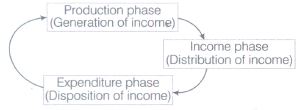
Income is first generated in production units, then distributed to households and finally spent on goods and services produced by these units to make the circular flow complete its course.
22.
I shall suggest following measures to protect environment:
(i) Avoid the use of plastic.
(ii) Promote the use of CNG as fuel.
(iii) Promote the use of solar energy.
(iv) Promote rain water harvesting.
23.
Features pertaining to economies of India, China and Pakistan are:
| India | China | Pakistan |
|---|---|---|
| Mixed economy | One-child norm | Mixed economy |
| High density of population | Low fertility rate | Very high-fertility rate |
| Growth due to service sector | High degree of urbanisation, Large population, Growth due to manufacturing sector |
24.
Following are some of the salient features of the unemployment situation in India:
(i) The incidence of unemployment is much higher in urban areas than in rural areas.
(ii) Unemployment rates for women are higher than those for men.
(iii) Under employment is higher in case of women.
(iv) Incidence of unemployment among the educated is much higher.
25.
Agricultural sector in India is already overcrowded and suffering from the problem of disguised unemployment. A major proportion of the increasing labour force needs to find alternate employment opportunities in other non-farm sectors.
Animal husbandry, fisheries, horticulture and information technology are the key areas of non -farm activities which have helped in promoting rural diversification. Rural workforce is actively engaged in various non-farm activities to augment their earnings.
26.
United Nations Development Programme (UNDP) has identified two categories of poverty which are explained below:
(i) Income poverty which arises due to lack of necessities of material well-being, and
(ii) Human poverty which is a denial of opportunity for living a tolerable life.
27.
Transmission and distribution losses refer to the losses that occur in transmission of electricity between the sources of supply and points of distribution. These losses occur due to the inherent resistance and transformation inefficiencies in the electrical conductors (conducting wires, etc) and distribution transformers respectively. In most of the states of our country, it is more than 20%. These losses can be reduced by using high quality wires of appropriate resistance and proper positioning of transformers.
28.
Firms give on-the-job-training to their workers to enhance their productive skills so as to enable them to absorb new technologies and modern ideas.
It can be given in two forms:
(i) Training given within the office premises.
(ii) Training given outside the office premises.
29.
Outsourcing is good for India since it has generated new employment opportunities in the Indian economy, contributed to GDP and has increased the foreign reserves of the country. The developed countries are opposing outsourcing services to India because it results in loss of employment opportunities in these countries.
30.
Major trading partners at the time of independence were United Kingdom, United State of America and Commonwealth countries.
Major trading partners at present are United Arab Emirates, China, Switzerland, Singapore, Australia, Iran, Hong Kong, Korea, Indonesia, United Kingdom, Japan and Belgium
31.
Suez Canal was opened in 1869. Suez Canal is an artificial waterway running from North to South across the Isthmus of Suez in North-Eastern Egypt. It
is one of the most important waterways in the world. Its opening reduced the cost of transportation and made access to the Indian market easier and
economical. A significant reduction in transport cost prompted monopoly control of India's foreign trade by the British Government.
32.
The bank rate policy should be preferred by the RBI because the policy of open market operations cannot be used effectively in our country.
33.
(i) Imputed salaries of these members will be included in national income.
(ii) It will not be included in national income because it is non-factor payment as general government borrows only for consumption purpose.
34.
When exchange rate falls, experts become less profitable hence supply of foreign currency through exports falls.
35.
(i) & (iii) Are revenue expenditure as it neither create assets nor reduce liability of the government.
(ii) Is capital expenditure as it increase assets of the government
36.
In the Perfectly Competitive market situation.
37.
Here, APC=1.5
Now, we know that, APS=1-APC
So, APS=1-1.5 =-0.5
38.
| Price (Rs.) | Demand(dx) | Demand(dy ) | Market demand(dx + dy) |
| 1 | 7 | 16 | 23 |
| 2 | 6 | 14 | 20 |
| 3 | 5 | 12 | 17 |
| 4 | 4 | 8 | 12 |
39.
Two factors that cause a shift of supply curve are:
(i)Change in technology Technological improvement tends to lower the marginal and average costs of production because better technology facilitates higher output with the same inputs.According, producers are willing to supply more at the existing price.This implies a rightward shift in supply curve and vica-versa.
(ii)Change in input price Input price may increase or decrease.In case of increase in input price, marginal and average cost tend to rise.Accordingly, producers will supply less of the commodity at its existing price.This implies a leftward shifts in supply curve and vice-versa.
40.
The two suggestion which can be used for economising the water resources are:
(i) Rainwater should be preserved for future usage.
(ii) Wastage of water should be avoided so that economical use of water can be made.
41.
The problem faced by farmers during the initial years of orgamc farming are:
(i) Organic farming requires inputs like organic manure, bio-fertilisers and organic pesticides. Though they are cheaper yet farmers find it difficult to get them
(ii) The yield from organic farming is much less than that of modem agricultural farming
(iii) The price of organic food is high, so it is difficult to sell them.
(iv) Organic products generally have more blemishes and shorter shelf life.
42.
Various circle of poverty implies that poverty is the cause of poverty There are many vicious circles of poverty. One of them is depicted below:
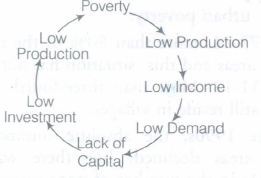
various Circle of Poverty
43.
The rate of drop outs from school is one of the major problems in achieving the objective of 100% literacy levels. The rate is higher at higher levels of education and among females. A large section of the population lives below poverty line and do not have the means to afford basic educational facilities. A substantial section cannot afford higher education.
The education at tertiary level is also not job-oriented and does not suit the needs of the poor who drop out from school in search of casual or low wage employment to earn a living
44.
The most common and important objectives of privatisation are:
(i) Improving the financial condition of the government.
(ii) Raising funds through disinvestment.
(iii) Reducing the workload of public sector.
(iv) Increasing the efficiency of the government undertakings.
(v) Providing better goods and services to consumers.
(vi) Bringing healthy competition within an economy.
(vii) Making way for Foreign Direct Investment (FDI).
45.
The given statement is refuted. Economic growth means that there is a continuous and sustained rise in the GDP of the country. Economic development means that in addition to a continuous and sustained rise in the GDp, there is equitable distribution of income and changes in sectoral composition in favour of secondary and tertiary sectors.
The above interpretation of the two terms leads us to the conclusion that these terms do not convey the same meaning. Economic development is a wide term which includes economic growth within its purview.
No, I don't think that India is economically developed because income inequalities are continuously rising in our country.
The rich are getting richer and the poor are getting poorer, thus defeating the value of social justice.
46.
The Britishers exploited India in every possible way. Raw material from India was exported and expensive finished goods were imported to India. Also, the heavy administrative costs related to running of the colonial rule in India, in the form of wages and salaries of the administrative staff, and the expenses borne by Britishers in fighting wars, were borne by revenues generated in India. All this led to drain of India's wealth.
47.
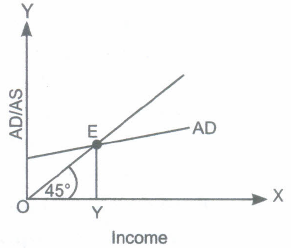
Equilibrium level of income is determined at that point when aggregate demand is equal to aggregate supply. Aggregate Demand represents the total expenditure on final goods and services in an economy. It consists of (a) Consumption expenditure (C) and (b) Investment expenditure (I). Thus, AD = C + I. Aggregate supply refers to the total production of final goods and services in an economy. In other words, it refers to the country's National Product or National Income. Thus, AS = Y. The equilibrium level of income is determined at a point where AD = AS. The given diagram illustrates the idea. In the diagram, AD and AS curves intersect each other at point E, which is the point of equilibrium. The equilibrium level of income is OY.
48.
(i) While estimating the components of final expenditure viz.Private final consumption expenditure, government consumption expenditure and capital formation the value of goods and services produced outside the domestic territory is also included as they are a part of final expenditure.However, their value should not be included in domestic product as these goods and services are not produced within the domestic territory of the country.
(ii) Similarly, the final expenditure does not include the goods and services produced within the domestic territory which are consumed outside the domestic territory through the process of exports.
49.
Favourable change in the taste of a commodity will increase the demand of a commodity.For example, favourable change in taste will lead to increase in the demand for that product. This will shift the demand curve to the right.
50.
| Basis | Increase in quantity supplied | Increase in supply | ||||||||||||||||||||||
| (a) Causes | increase In quantity supplied is caused by increase in price of the commodity alone, other things remaining the same. | Increase in supply is caused by change In factors other than price i.e., fall in price of inputs, technological advancement, fall in taxes, fall in price of related commodities etc | ||||||||||||||||||||||
| (b) Supply curve | ncrease in quantity supplied of a commodity is shown by an upward movement along a supply curve i.e., Expansion of supply | Increase in supply of a commodity is shown by a rightward shift in the supply curve. | ||||||||||||||||||||||
| (c) Schedule |
|
|
51.
| T-shirts (in millions) (X) |
Cell phones (in thousands) (Y) |
Marginal Opportunity cost of T-shirts (in cell phones) =\(\frac { \triangle \quad is\quad cell\quad phones }{ \triangle \quad is\quad cell\quad T-shirts } \) |
| 0 | 90,000 | ------- |
| 1 | 80,000 | 1X:10Y |
| 2 | 68,000 | 1X:12Y |
| 3 | 52,000 | 1X:16Y |
| 4 | 34,000 | 1X:18Y |
| 5 | 10,000 | 1X:24Y |
52.
The Central bank acts as a banker to the Government. In performing this role, it accepts receipts and makes payments on behalf of the government. It carries out exchange, remittance and other normal banking operations for the government. The Central bank manages the public debt and also lends to the government. The above-mentioned functions performed by the Central bank substaritiate its role as 'a banker to the government' or 'Government's Bank'.
53.
Yes,there can be a fiscal deficit without a case of revenue deficit.This situation can arise whwn the capital expenditure of the budget exceed the capital receipts other then borrowings.In other words,when capital budget deficit exceeds revenue budget surplus.
54.
BoP surplus It refers to a situation when payments of a country on account of autonomous items are less than the receipts of the country on account of these transactions.
55.
It is true that firms under perfect competition can sell any quantity at the existing market price of their commodity as it will lead to zero supply because each firm is selling homogeneous goods. On the other hand, firms are reluctant to reduce the price because of the following two reasons:
(i) They are earning only normal profits in the long-run.Selling before the prevailing price will result in abnormal losses.
(ii) There is no logic in lowering the price, as unlimited quantity can be sold at the prevailing price.
56.
Yes, I agree that all producer goods are not capital goods because producer goods includes:
(i) Goods which are used as raw material like wood used to make furniture.
(ii) Goods which are used as fixed assets like plant and machinery.
Capital goods include only fixed assets of the producers. These are durable goods. On the other hand, goods used as raw material are not capital goods.
57.
Inflationary gap occurs when AD>AS corresponding to full employment level. This inflationary gap, i.e. excess of Aggregate Demand causes inflation in the economy and price levels tend to rise.
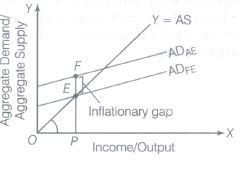
In this figure,
ADFE= AD at full employment level
ADAE= AD above full employment level
The point E is the equilibrium point where AD= AS. But there is excess demand (current) at ADAE'where Aggregate Demand FP is more than the Aggregate Supply in the economy. This difference of actual Aggregate Demand and Supply, i.e. EF is the inflationary gap.
Inflationary Gap = Excess Demand = ADAE- ADFE =EF
Role of Legal Reserves to Correct the Problem of Inflationary Gap Legal reserves like Cash Reserve Ratio and Statutory Liquidity Ratio are the tools to correct the problem of inflationary gap:
(i) Cash Reserve Ratio (CRR) Each and every commercial bank has to keep a certain proportion of its demand and time deposits in the form of cash and other liquid assets with the Central Bank. This ratio is termed as Cash Reserve Ratio. To correct the problem of inflationary gap, the Central Bank increases the CRR. It reduces the supply of money and credit creation capabilities of commercial banks. Due to lesser supply of money, the Aggregate Demand comes down and the economy attains equilibrium situation.
(ii) Statutory Liquidity Ratio (SLR) It refers to a fixed percentage of the total assets of a bank in the form of cash or other liquid assets that is required to be maintained by the bank. During the situation of inflationary gap, SLR is increased. This reduces the credit creation capacity of commercial banks and reduces the flow of money in the economy. As a result of that, the Aggregate Demand comes down and ultimately, the economy attains equilibrium.
58.
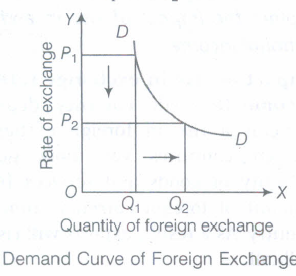
Foreign exchange rate shares an inverse relationship with the demand for the currency. With a fall in the price of foreign exchange, value of domestic currency increases (i.e. appreciation of domestic currency) and that means foreign goods become cheaper and their domestic demand (i.e. imports) increases.
The rising domestic demand for foreign goods implies higher demand for foreign exchanges which increases from OQj to OQ2 as shown in the figure.
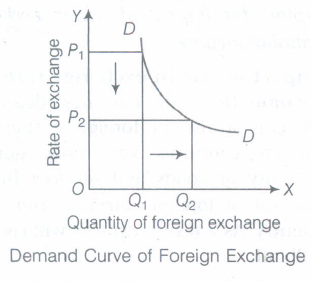
The supply of foreign currency is directly proportional to the price of foreign exchanges. When the price of a. foreign currency falls, it leads cheaper imports and exports because it leads to appreciation of domestic currency. The exporters are discouraged due to costlier exports. This results lesser inflow or supply of foreign currency in the economy. As a result supply of foreign exchange decreases from OQ2 to OQ1j as shown in the figure
59.
Government budget refers to the annual statement of government estimated revenue and estimated expenditure during a financial year (1 st April to 31st March). Reducing inequality is a major objective of government's budget especially in developing country like India, where inequality of income and wealth is very high.
Government uses its financial tools of taxation and subsidies to enhance equal distribution of income and wealth. Equitable distribution is a way to attain soc ial justice and in India. This is a principal objective of welfare, and it is the responsibility of the government to ensure a fair distribution of income. It is true that everyone's income cannot be equalized, however income should not also get concentrated in fewer hands. In order to ensure equity of income progressive tax structured is followed in India, which imposes higher burden of taxes on higher income group and lesser burden on lower income group. Also, those who earns below a substantial limit are also exempted from payment of taxes, and the additional income generated from higher income group is redistributed by the government in the form of subsidies to the poor sections of the society, to ensure the objective of welfare. LPG subsidy is a good example of such redistribution of income.
60.
(i) Use of eco-friendly fuel (CNG, LPG) The fuels such as petrol and diesel emit huge amount of carbon dioxide that add to the green house impact. In order to control pollution, the use of CNG and LPG should be promoted. These fuels are cleaner and eco-friendly. Also, pooling of vehicles in the locality should be promoted.
(ii) Use of renewable resources (Wind power) India being a tropical country is well endowed with sunlight, water and wind energy. These natural resources are renewable and pollution free. Thus, attempts should be made to harness solar and wind energy by employing different technologies and to go for rain water harvesting. It would help in sustainable economic development.
(iii) Recyclable products The household waste materials like newspapers, old bottles, used batteries, etc should be accumulated and should be distinguished as biodegradable and nonbiodegradable wastes. The biodegradable wastes are those wastes that can be decomposed and can be used as manure for organic farming. The non-biodegradable wastes like plastic, etc should be recycled and re-used. Use of polythene bags should be 'discouraged.
(iv) Judicious use of electricity Electricity is a resource which is used in all households in our locality. It is one such resource which is already in short supply and may not be available to future generations, if we do not start using it judiciously. Therefore, the easiest strategy for sustainable development is to use power in an efficient manner without wasting it. This can be done by using energy efficient equipments.
61.
China has the second largest GDP (PPP) of $ 15.6 trillion whereas India's GDP (PPP) is $ 6.6 trillion. When many developed countries were finding it difficult to maintain a growth rate of even 5%, China was able to maintain near double-digit growth for more than two decades. Its growth rate in 1980-90 was 10.3% and for 2005-2013, it was 10.2%. In the 1980-90, China was having double-digit growth and India was stuck at 5.7% decadal growth rate.
This rate showed improvement in 2005-2013 at 7.6%, but still it was fan behind China's growth rate. As far as sector-wise contribution to growth is concerned, in 2013, contribution of agriculture to GDP in China was 10% while in India it was 18%.On the other hand, manufacturing contributes the highest to GDP in China at 44%, whereas in India service sector contributes the highest at around 57%. In the last two decades, the growth of agriculture sector has declined in both the countries. In the industrial sector, China has maintained a double-digit growth rate, whereas for India industrial growth rate has declined. In the case of service sector, China has been able to raise its rate of growth in 2005-13, while service sector growth in India has stagnated. China's growth is mainly contributed by the manufacturing sector and India's growth by service sector.
62.
It has been considered necessary to replace the private moneylenders by institutional sources of credit because:
(i) The supply of credit was irregular and depended largely on personal relations between the borrower and the lender.
(ii) The moneylenders often took advantage of the ignorance and helplessness of the cultivator to exploit him.
(iii) Since the borrower was generally illiterate, the moneylender often resorted to downright cheating such as failure to record the repayments in full.
(iv) The landless tenants and farm workers, who had no land to offer as security, found it difficult to borrow. The loans were available on very difficult terms, and the borrowers were often burdened with permanent debt.
63.
Differences between conventional and nonconventional sources of energy
| Conventional Sources of Energy | Non-conventional Sources of Energy |
| These are the traditional sources of energy which are generally bought and sold in the market | These are modern sources of energy. |
| In India, conventional sources are being used in total disregard to the environment i.e., these sources create pollution | These are being developed as sources of commercial energy with a view to check environmental pollution |
| Consumers have to pay a price for energy generated through these sources | Consumers do not have to pay a price for energy generated through these sources. |
| These sources of energy are exhaustible | These sources of energy are renewable |
| These sources are used by business. | These sources are generally used by households |
| Coal, petroleum and electricity are examples of commercial sources of energy | Firewood and cow-dung are examples of non-commercial sources of energy. |
64.
Rural poor are the poor people residing in villages and small towns. The rural poor work mainly as landless agricultural labourers, cultivators with very small land holdings, landless labourers and tenant cultivators.
On the other hand, the urban poor are the poor people living in metros and big cities. Urban labourers do a variety of casual jobs, sell a variety of things on roadsides and are engaged in various other such activities. It can be seen from the given table that poverty ratio has shifted from rural to urban areas.
| Year-wise poverty Ratio | |||
| Years | Rural (in%) | Urban (in%) | India (in%) |
| 1973-74 | 56.4 | 49.0 | 54.9 |
| 2004-05 | 28.3 | 25.7 | 27.5 |
It is evident from the above table that rural poverty has declined significantly from 56.4% in 1973-74 to 28.3% in 2004-05 whereas, decline in urban poverty (from 49% to 25.7%) is not that significant.
Moreover, the gap between the rural and urban poverty ratios which 'was around 7% in 1973-74 fell to just around 2% in 2004-05 again signifying the shift in poverty from rural to urban areas.
65.
Yes, it is necessary to generate employment in the formal sector than in the informal sector because those who work in the informal sector do not get any regular income and do not get protection from the government. Workers are dismissed without any compensation. Technology used is outdated and they also do not maintain any accounts. Workers live in slums or badly built houses.
Those who work in the formal sector on the other hand earn more than those in the informal sector and also enjoy social benefits. It is thus, necessary to generate more employment in the formal sector.
66.
(i) Health infrastructure It means investment in health facilities to build a physically as well as mentally strong human capital. It is essential for increasing productivity. Preventive medicine (vaccination), curative medicine (medical intervention during illness), social medicine (spread of health literacy) and provision of clean drinking water and good sanitation are the various forms of expenditures done on health infrastructure.
These expenditures are considered as important factors for human capital formation as they increase the supply of healthy labour force. Therefore, health infrastructure is a source of human capital formation.
(ii) Expenditure on migration People migrate in search of jobs with higher salaries than what they may get in their native places. People from rural areas migrate to urban areas in search of employment. Technically qualified persons, like engineers and doctors, migrate to other countries because of higher earnings in such countries.
Migration in both these cases involves cost of transport, higher cost of living in the migrated places and psychological costs of adapting to a new socio-cultural setup. The increase in earnings in the new place outweighs these expenditures of migration. Hence, expenditure on migration is a source of human capital formation.
67.
The major contribution to GDP in India comes from the service sector which has grown impressively since liberalisation. The major factors responsible for the high growth of the service sector are as follows:
(i) High income elasticity of demand It has been noticed that income elasticity of demand for services is more than one. Hence, the demand for services increases at a faster rate than demand for commodities, with the increase in income.
(ii) Technical and structural changes The technical and structural changes in the economy, have made it an attractive destination for outsourcing, contributing towards the growth of service sector.
(iii) Information technology revolution With the advent of the information technology revolution, it has become possible to deliver services over long distance at a reasonable cost. Thus, trading in services has increased worldwide, also benefitting India.
(iv) Economic reforms in 1991 Economic reforms initiated in 1991, increased demand for manufacturing industry, thereby benefitting the service sector also. Liberalisation of financial sector boosted the growth of financial services. Reforms in certain segments of infrastructure also contributed to the growth of services.
68.
Some major achievements of the Five Year Plans are:
(i) Increase in national income Prior to planning, the National Income of India increased at the rate of 0.5% per annum. During the period of planning, the average annual growth rate in India had been around 5%.
(ii) Increase in per capita income During the planning period, Per Capita Income increased at the rate of 2.9% per annum.
(iii) Institutional and technical changes in agriculture Planning has contributed tremendously towards the development of agriculture in our country. During the period of planning, average growth rate of agricultural produce was 2.8% per annum.
(iv) Growth and diversification of industry During the period of planning, the growth rate of industrial production has been around 7% per annum. Basic and capital goods industries have shown tremendous growth. In consumer goods industries, the country has become self-sufficient. Industrial sector has been diversified and modernised.
(v) Economic and social infrastructure During the period of planning, economic infrastructure such as means of transport and communication, irrigation facilities and power, banking and insurance facilities have shown significant growth. Health and educational facilities have recorded a significant rise.
(vi) Employment Concentrated efforts have been made to increase employment opportunities during the plan peod. In the Eleventh Five Year Plan, the government fixed the target of creating 58 million jobs. The Twelfth Plan aims at creating 70 million jobs.
(vii) International trade India's international trade has also grown at a phenomenal rate. In 1948-49, the value of foreign trade was Rs.792 crore. In 2011-2012, it stood at Rs.38,11.422 crore.
So, we can say that our economy showed considerable progress during the plan period.
69.
The condition of agricultural sector at the time of Independence can be understood with the help of the following points;
(i) Low level of productivity The productivity levels were very low, at about 660 kg per hectare for wheat and 665 kg per hectare for rice.
(ii) High degree of vulnerability Agricultural was greatly affectes by erratic rainfall.
(iii) Rift and turmoil between owners and tillers The owners charged high rent from the tillers and demanded rent even when the crops failed. THis demotivated the tillers, and agricultural productivity was negatively affected.
(iv) uneconomic and fragmented landholdings The size of the landholdings was uneconomic and also the landholdings were scattered. This further affected the productivity of land adversely.
(v) Problem of unemployement and underemployement The agricultural sector was plagues with the problem of unemployement and underemployement.
(vi) Use of primitive techniques of production The farmers used age old primitive techniques of production, which was a cause of low productivity.
70.
(a) Relationship between TR and MR. MR represents addition to TR.
(i) When MR is positive, TR rises.
(ii) When MR = 0, TR is maximum.
(iii) When MR is negative, TR falls.
(iv) In case when MR becomes constant TR increases at a constant Rate
| Qty sold (Q) | Price (P) | TR | MR | ||
|
1 2 3 |
6 5 4 |
6 10 12 |
TR rises
|
6 4 2 |
MR > 0
|
| 4 | 3 | 12 | TR max | 0 | MR = 0 |
|
5 6 |
2 1 |
10 6 |
TR falls |
-2 -1 |
MR < 0 |
(b) Relationship between MR and AR
(i) When a firm is able to sell more quantity of output at the same price ti,e., under perfect competition) then AR and MR are equal and AR and MR curves take the shape of a straight line parallel to x-axis.
| Q | P | TR | MR | AR/P |
| 1 | 10 | 10 | 10 | 10 |
| 2 | 10 | 20 | 10 | 10 |
| 3 | 10 | 30 | 10 | 10 |
| 4 | 10 | 40 | 10 | 10 |

(ii) When a firm is able to sell more quantity of output only by lowering the price, then AR and MR both will be falling, i.e., sloping downward and MR will be less than AR. The rate of decline in MR is twice the rate of decline in AR.
| Q | P | TR | MR | AR/P |
| 1 | 4 | 4 | 4 | 4 |
| 2 | 3 | 6 | 2 | 3 |
| 3 | 2 | 6 | 0 | 2 |
| 4 | 1 | 4 | -2 | 1 |
.png)
71.
Px = Rs.5, Py = Rs.4, MUx = 4 utils, MUy = 5 utils
A consumer is in equilibrium in case of two commodities, if \({MU_X\over P_X}={MU_Y\over P_Y}\)
Here, \({MU_X\over P_X}={4\over 5}=0.8\) and \({MU_Y\over P_Y}={5\over4}=1.25\)
Clearly, \({MU_Y\over P_Y}>{MU_X\over P_X}\ or\ {MU_X\over P_X}<{MU_Y\over P_Y}\)
Since per rupee, MUx is lower in case of X, the consumer will transfer expenditure from X to Y by buying lessof X and more of Y. Buying less of X raises MUx while buying more of Y lower MUy
Thus, MUx rises and MUy falls till \({MU_X\over P_X}={MU_Y\over P_Y}\) once again
72.
An economic problem mainly arises on account of the scarcity of the resources available to satisfy the unlimited human wants. To a large extent, if the resources were not limited, the economic problem would not have arisen, because every want could be satisfied, i.e., everyone could have everything. But this indeed is not true as the reality is that relative scarcity will continue to prevail and the other related problem -of 'choice' would always exist. One is always confronted with the problem of what to choose and what to give up, i.e., sacrifice. Thus, scarcity, being a relative term, will always exist and so would an economic problem.
73.
Repo Rate refers to the rate of interest at which Central Bank (RBI) lends money to commercial banks for a short term. To control the inflationary condition in the economy, RBI raises the Repo Rate to make borrowings expensive.
74.
(i) Capital gain on sale of a house is not included in the National Income estimation because it does not add to the flow of goods and services in the economy.
(ii) Prize won in a lottery is not included in National Income estimation because it is a part of transfer payments.
(iii) Interest on public debt is deemed as transfer payment. Hence, not included in the estimation of National Income.

12th Standard CBSE Syllabus & Materials
12th Standard CBSE
CBSE 12th Computer Science Python Revision Tour I - New Previous year Question Papers Study Material - QB365 Set A
NEW12th Standard CBSE
CBSE 12th Business Studies Planning Important Questions And Answers Study Material - QB365 Set A
NEW12th Standard CBSE
CBSE 12th Business Studies Business Environment Important Questions And Answers Study Material - QB365 Set A
NEW12th Standard CBSE
CBSE 12th Business Studies Principles of Management Important Questions And Answers Study Material - QB365 Set A



CBSE 12th Standard CBSE Subjects
CBSE Standards











