
 100% FREE ACCESS
12th Standard CBSE Syllabus & Materials
12th Standard CBSE
CBSE 12th Economics Government Budget and the Economy Previous year Question Papers Study Material - QB365 Set A
NEW12th Standard CBSE
CBSE 12th Computer Science Interface Python with MySQL - New Previous year Question Papers Study Material - QB365 Set A
NEW12th Standard CBSE
CBSE 12th Computer Science Database Concept - New Previous year Question Papers Study Material - QB365 Set A
NEW12th Standard CBSE
CBSE 12th Computer Science Data Communication - New Previous year Question Papers Study Material - QB365 Set A
NEW12th Standard CBSE
CBSE 12th Computer Science Data Structures - New Previous year Question Papers Study Material - QB365 Set A
NEW12th Standard CBSE
CBSE 12th Computer Science Functions - New Previous year Question Papers Study Material - QB365 Set A

Published on: 29/11/2018
CBSE is the Central Board of State Education and the NCERT conducts examinations from the syllabus for the same. CBSE notes for class 12 are one of the most important pieces of study material that students can receive as it will aid them to study better and reduce any stress that they might face during the hectic year ahead. From this question paper, it provides chapter wise revision notes and short keynotes for the CBSE board exam in an easy-to-understand, free downloadable PDF format so students can use it for their studies and score better in their board exams. The CBSE class 12 revision notes are made for the main science subjects of Physics, Chemistry, Maths and Biology. These core subjects can be very tricky for students and the revision notes for each chapter will enable them to have an expert studying pattern with which they can perform so much better and also enjoy learning the subject.
The Central Board of Secondary Education conducts the Class 12 examinations in the months of March every year. Students must be prepared for these examinations and one way to do so is by solving question mock papers. The CBSE sample papers for class 12 help students identify frequently asked questions, topics that need to be focused on, types of trick questions, and much more. Anyone can download the CBSE sample papers for class 12 with free PDF solution to test their problem-solving ability. Students who have opted for the science stream require a lot of practice in the form of mock tests and sample papers. This will enable them to write the final board exam with confidence. By going through the CBSE solved sample papers for class 12, you can better understand mistakes and develop a deeper understanding of these subjects.
CBSE Class 12 Mathematics always important to practice last year board exam question paper to practice for the upcoming board exams. Here the questions are covered from last 10 years which you should practice understanding the paper pattern and type of questions which have come in previous board exams for class 12. This will help you to get better marks in class 12 board exams. Practice getting better marks in board exams.
In this question paper, the questions are covered from the entire syllabus of 12th Mathematics. Questions are prepared as per NCERT guideline with the help of expert teachers.
Download CBSE Class 12th Standard CBSE Maths question papers, sample papers, important questions, and previous year solved papers in PDF format. Get free study materials, NCERT solutions, and exam preparation resources for Class 12th Standard CBSE Maths
Questions + Answers key
Take MCQ Maths Test
1.
Find the particular solution of the differential equation
\(xcos\left( \frac { y }{ x } \right) \frac { dy }{ dx } =ycos\left( \frac { y }{ x } \right) +x\) given that when x = 1, y = \(\frac { \pi }{ 4 } \)
2.
Two schools A and B want to award their selected students on the values of Sincerity, Truthfulness and helpfulness. The school A wants to award Rs. x each, Rs. y each and Rs. z each for the three respective values to its 3, 2 and 1 students with a total award money of Rs. 1,600. School B wants to spend Rs. 2,300 to award its 4, 1 and 3 students on the respective values (by giving the same award money for the three values as before). If the total amount of awards for one prize on each value is Rs. 900. Using matrices, find the award money for each value. Apart from these three values, suggest one more value which should be considered for award.
3.
A company manufactures two types of sweaters, type A and B. It costs Rs. 360 to make one unit of type A and Rs. 120 to make a unit of type B. The company can make at most 300 sweaters and can spend Rs. 72,000 a day. The number of sweaters of type A cannot exceed the number of type B by more than 100. The company makes a profit of Rs 200 on each unit of type A. The company charging a nominal profit of Rs. 20 on a unit of type B. Using LPP, solve for max. profit.
4.
There are two types of fertilizers 'A' and 'B'. 'A' consists of 12% nitrogen and 5% Phosphoric acid. 'B' consists of 4% nitrogen and 5% Phosphoric acid. After testing the soil conditions, farmer finds that he needs at least 12 kg of nitrogen and 12 kg of Phosphoric acid for his crops. If 'A' costs Rs. 10 per kg and 'B' costs Rs. 8 per kg, then graphically determine how much of each type of fertilizer should be used so that nutrient requirements are met at a minimum cost.
5.
Five bad oranges are accidently mixed with 20 good ones. If four oranges are drawn one by one successively with replacement, then find the probability distribution of number of bad oranges drawn. Hence, find the mean and variance of the distribution.
6.
Find the shortest distance between the line x - y + 1 = 0 and the curve y2 = x.
7.
Show that of all the rectangles inscribed in a given fixed circle, the square has the maximum area.
8.
Find the vector and cartesian forms of the equation of the plane passing through the point (1, 2, - 4) and parallel to the lines \(\\ \vec { r } =\left( \hat { i } +2\hat { j } -4\hat { k } \right) +\lambda \left( 2\hat { i } +3\hat { j } +6\hat { k } \right) \)
and \(\vec { r } =\left( \hat { i } -3\hat { j } +5\hat { k } \right) +\mu \left( \hat { i } +\hat { j } -\hat { k } \right) \)
Also, find the distance of the point (9, -8, -10) from the plane thus obtained.
9.
Draw the graph of y = |x+1| and using integration find the area below y = |x+1| above x-axis and between x = -4 to x = 2.
10.
Show that the binary operation * on A = R-{-1} defined as a*b = a + b for all a, b, c A is commutative and associative on A. Also find the identity element of * in A and prove that every element of A is invertible
11.
Using integration, find the area of the region in the first quadrant enclosed by the x-axis, the line y = x and the circle x2+y2 = 18.
12.
Prove that : \(\left| \begin{matrix} { a }^{ 2 } & { a }^{ 2 }-{ (b-c) }^{ 2 } & bc \\ { b }^{ 2 } & { b }^{ 2 }-{ (c-a) }^{ 2 } & ca \\ { c }^{ 2 } & { c }^{ 2 }-{ (a-b) }^{ 2 } & ab \end{matrix} \right| =(b-c)(c-a)(a+b+c)({ a }^{ 2 }+{ b }^{ 2 }+{ c }^{ 2 })\)
13.
Let Z be the set of all integers and R be the relation on Z defined as R = {(a,b) : a,b \(\in\) Z, and (a-b) is divisible by 5}. Prove that R is an equivalence relation.
14.
\(y={ tan }^{ -1 }\frac { 5x }{ 1-6{ x }^{ 2 } } \),\(-\frac { 1 }{ \sqrt { 6 } }
15.
If x = \(\theta\)sin\(\theta\), y = \(\theta\)cos\(\theta\) find dy/dx at \(\theta\) = \(\pi/4\)
16.
If P(A)=\(\frac { 2 }{ 5 } ,P(B)=\frac { 1 }{ 3 } ,P(A\cap B)=\frac { 1 }{ 5 } ,\) then find \(P(\bar { A } /\bar { B } )\) .
17.
If \(\left|\overset\rightarrow a+\overset\rightarrow b \right| =60,\left|\overset\rightarrow a-\overset\rightarrow b \right|=40\)and \(\left| \overset\rightarrow a \right| =22,\) then find \(\left| \overset\rightarrow b \right| \).
18.
Find the sum of the order and degree of the following differential equations :
\(\frac { { d }^{ 2 }y }{ dx^{ 2 } } +\sqrt [ 3 ]{ \frac { dy }{ dx } } +\left( 1+x \right) =0\)
19.
Find: \(\int { \left( \frac { 1-x }{ 1+{ x }^{ 2 } } \right) ^{ 2 } } { e }^{ x }dx\)
20.
If \(\left[ \begin{matrix} cos\theta & -sin\theta \\ sin\theta & cos\theta \end{matrix} \right] \), find the value of \(\theta \) satisfying the equation A + AT = I2 , where \(0\le 0\le \frac { \pi }{ 2 } \) .
21.
Let f:\(X\rightarrow Y\) be a function Define a relation R on X given be R=[(a,b) ; (f(b)] Show that R is an equivalence relation ?
22.
\(\int {x^2-1\over x^2+1}dx.\)
23.
If \({ X }_{ m\times 3 }{ Y }_{ p\times 4 }={ Z }_{ 2\times b }\), for three matrices X, Y and Z, find the values of m, p and b.
24.
Let d1,d2,d3 be three mutually exclusive diseases. Let S = [S1, S2,...,S 6] be the set of observable symptoms of these diseases. For example, S1is the shortness of breath, S2 is the loss of weight, S3 3,500 with disease d2 and 3,300 with disease d2. Also, 3,100 patients with disease d1, 3,300 with disease d2 and 3,000 with disease d3 . Show the symptoms S. Knowing that the patient has symptoms S, the doctor wishes to determine the patient's illness. On the basis of this informations, what should the doctor conclude?
25.
Evaluate: \(\int { \frac { \sin ^{ 6 }{ x } +\cos ^{ 6 }{ x } }{ \sin ^{ 2 }{ x } \cos ^{ 2 }{ x } } } dx.\)
26.
(Manufacturing Problem) A manufacturing company makes two types of teaching aids A and B of Mathematics for class XII. Each type of A requires 9 labour hours of fabricating and 1 labour hour for finishing. Each type of B requires 12 labour hours for fabricating and 3 labour hours for finishing. For fabricating and finishing, the maximum labour hours available per week are 180 and 30 respectively. The company makes a profit of Rs. 80 on each piece of type A and Rs. 120 on each piece of type B. How many pieces of type A and B should be manufactured per week to get maximum profit? Make it as an LPP and solve graphically. What is the maximum profit per week?
27.
Determine the intervals in which the following function is strictly increasing or strictly increasing or strictly decreasing
\(f(x)=2x^{ 3 }-9x^{ 2 }+12x+15\)
28.
Solve \({ e }^{ x }\sqrt { 1-{ y }^{ 2 } } dx+\frac { y }{ x } =0,\) given that \(x=0\) when \(y=1\)
29.
If A is a square matrix such that \({ A }^{ 2 }=A\) , then write the value of \(7A-{ \left( I+A \right) }^{ 3 }\) , where I is an identity matrix.
30.
If f = {(5, 2), (6, 3)}, g = {(2, 5), (3, 6)}, write fog.
31.
Show that zero is the identity for addition on R and 1 is the identity for multiplication on R. But there is no identity elements for the operations.
\(-:R\times R\rightarrow R\) and \(\div :R\times R\rightarrow R\).
32.
Find values of x, if:
(i)\(\begin{vmatrix} 2 & 4 \\ 5 & 1 \end{vmatrix}=\begin{vmatrix} 2x & 4 \\ 6 & x \end{vmatrix}\)
(ii)\(\begin{vmatrix} 2 & 3 \\ 4 & 5 \end{vmatrix}=\begin{vmatrix} x & 3 \\2x & 5 \end{vmatrix}\)
1.
The given D.E. is:
\(xcos\left( \frac { y }{ x } \right) \frac { dy }{ dx } =ycos\left( \frac { y }{ x } \right) +x\) ..(i)
When, \(x=1, y=\frac { \pi }{ 4 } \)
\(cos\left( \frac { y }{ x } \right) \frac { dy }{ dx } =\frac { y }{ x } cos\left( \frac { y }{ x } \right) +1\)....(ii)
Put, y/x = v
\(\Rightarrow\) \(\frac { dy }{ dx } =v+x\frac { dv }{ dx } \)
From (ii), \(cosv\left( v+x\frac { dv }{ dx } \right) =v\quad cosv+1\)
\(\Rightarrow\) v cosv+x cosv dv/dx = v cos v + 1
\(\Rightarrow\) \(\\ xcos\frac { dv }{ dx } =1\)
\(\Rightarrow\) \(\int { cosv\quad dv=\int { \frac { dx }{ x } } } \)
Put \(y=\frac { \pi }{ 4 } \) , x = 1
\(\Rightarrow\) \(\frac { 1 }{ \sqrt { 2 } } =C\)
The particular solution is
\(sin\left( \frac { y }{ x } \right) =logx+\frac { 1 }{ \sqrt { 2 } } \)
2.
3x + 2y + z = 1,600
4x + Y + 3z = 2,300
x + y + z = 900
\(\therefore \left[ \begin{matrix} 3 & 2 & 1 \\ 4 & 1 & 3 \\ 1 & 1 & 1 \end{matrix} \right] \left[ \begin{matrix} x \\ y \\ z \end{matrix} \right] =\left[ \begin{matrix} 1,600 \\ 2,300 \\ 900 \end{matrix} \right] \ or\ AX=B\)
|A| = 3(-2)-2(1)+1(3)
= -5 \(\ne\)0
Cofactors are:
\({ A }_{ 11 }=-2, { A }_{ 12 }=-1, { A }_{ 13 }=3 \)
\({ A }_{ 21 }=-1, { A }_{ 22 }=2, { A }_{ 23 }=-1 \)
\({ A }_{ 31 }=5, { A }_{ 32 }=-5, { A }_{ 33 }=-5 \)
\(\left[ \begin{matrix} x \\ y \\ z \end{matrix} \right] =-\frac { 1 }{ 5 } \left[ \begin{matrix} -2 & -1 & 5 \\ -1 & 2 & -5 \\ 3 & -1 & -5 \end{matrix} \right] \left[ \begin{matrix} 1,600 \\ 2,300 \\ 900 \end{matrix} \right] \)
\(\left[ \begin{matrix} x \\ y \\ z \end{matrix} \right] =\left[ \begin{matrix} 200 \\ 300 \\ 400 \end{matrix} \right] \)
x = 200, y = 300 and z = 400
i.e., Rs. 200 for sincerity, Rs. 300 for truthfullness and Rs. 400 for helpfulness.
Value: One more value like honesty, kindness etc.
3.
Let the company manufactures sweaters of type A = x, type B = y, daily.
\(\therefore\) LPP is maximize. P = 200x + 20y s.t.
360x + 120y \(\le \) 72000
\(\Rightarrow\) 3x + y \(\le \) 300
x + y \(\le \) 300
x - y \(\le \) 100
\(3x+y=600,\begin{cases} x=0,y=600 \\ y=0,x=200 \end{cases}\)
\(x+y=300,\begin{cases} x=0,y=300 \\ y=0,x=300 \end{cases}\)
\(x-y=100,\begin{cases} x=100,\quad y=0 \\ y=100,\quad x=200 \end{cases}\)
\(\\ x\ge 0\)
\(y\ge 0\)
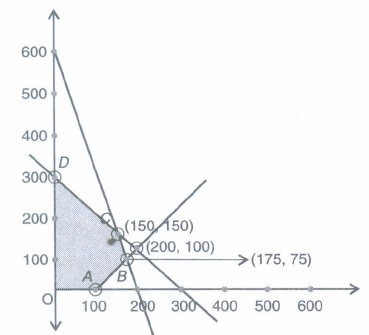
Getting vertices of feasible region as, O(0, 0), A(100, 0), B(175, 75), C(150, 150) and D(0, 300)
Maximum profit is P = 200(175) + 20(75)
= 35000 + 1500 = Rs. 36500
4.
Let x kg of fertilizer A and y kg of fertilizer B be used. As per the question:
| Fertilizer | Nitrogen | Phosphoric acid | Cost |
| A | 12% | 5% | Rs 10/kg |
| B | 4% | 5% | Rs 8/kg |
| Minimum requirement | 12 kg | 12 kg |
\(\therefore\) The LPP is given as
Min Z = 10x + 8y,
subject to the constants
\(\frac { 12x }{ 100 } +\frac { 4y }{ 100 } \ge 12\)
\(\Rightarrow 12x+4y\ge 1200\)
\(\Rightarrow 3x+y\ge 300\)
\(\frac { 5x }{ 100 } +\frac { 5y }{ 100 } \ge 12\)
\(\Rightarrow 5x+5y\ge 1200\)
\(\Rightarrow x+y\ge 240\)
\(x\ge 0,y\ge 0\)
L1: 3x + y = 300
| x | 0 | 100 | 50 |
| y | 300 | 0 | 150 |
L2: x + y = 240
| x | 0 | 2400 | 120 |
| y | 240 | 0 | 120 |
By Corner- point Method :
| Corner Points | Z = 10x+8y |
| (0, 300) | 2,400 |
| (240, 0) | 2,400 |
| (30, 210) | 1,980(Min) |
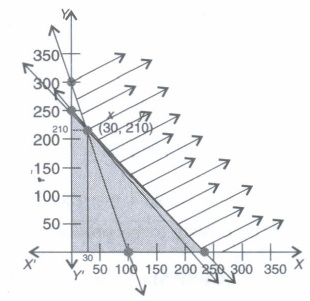
Here cost is minimum at (30, 210) and is Rs. 1,980/. Since the region is unbounded, we have to draw
10x + 8y < 2340
L : 10x + 8y = 2340
Clearly open half plane has no common point with the feasible region is minimum value of Rs. 1,980.
Farmer has to use 30 kg of fertilizer A and 210 kg of fertilizer B so that nutrient requirements are met at a minimum cost.
5.
Total number of oranges = 25
number of good oranges = 20
number of bad oranges = 5
Probability of getting a bad orange,
\(P(B)=\frac { 5 }{ 25 } =\frac { 1 }{ 5 } \)
Now \(p=\frac { 1 }{ 5 } \)
\(\\ q=1-p=\frac { 4 }{ 5 } \)
Let X be the random variable of "Number of bad oranges".
\(\Rightarrow X=0,1,2,3,4\)
\(P(X=0)={ n }_{ { C }_{ r } }{ \left( p \right) }^{ n-r }{ \left( q \right) }^{ r }\)
\(P(X=0)={ 4 }_{ { C }_{ 0 } }{ \left( \frac { 4 }{ 5 } \right) }^{ 4 }=\frac { 256 }{ 625 } \)
\(P(X=1)=4\times \frac { 64 }{ 125 } \times \frac { 1 }{ 5 } =\frac { 256 }{ 625 } \)
\(P(X=2)={ 4 }_{ { C }_{ 2 } }{ \left( \frac { 4 }{ 5 } \right) }^{ 2 }{ \left( \frac { 1 }{ 5 } \right) }^{ 2 }\)
\(=6\times \frac { 16 }{ 625 } =\frac { 96 }{ 625 } \)
\(P(X=3)={ 4 }_{ { C }_{ 3 } }\left( \frac { 4 }{ 5 } \right) { \left( \frac { 1 }{ 5 } \right) }^{ 3 }\)
\(=4\times \frac { 4 }{ 625 } =\frac { 16 }{ 625 } \)
\(P(X=4)={ 4 }_{ { C }_{ 4 } }{ \left( \frac { 4 }{ 5 } \right) }^{ 0 }{ \left( \frac { 1 }{ 5 } \right) }^{ 4 }\)
\(=\frac { 1 }{ 625 } \)
\(\therefore\) Probability distribution is
| X | P(X) | XP(X) | X2P(X) |
| 0 | 256/625 | 0 | 0 |
| 1 | 256/625 | 256/625 | 256/625 |
| 2 | 96/625 | 192/625 | 384/625 |
| 3 | 16/625 | 48/625 | 144/625 |
| 4 | 1/625 | 4/625 | 16/625 |
\(\therefore Mean=\sum { XP(X) } \)
\(=\frac { 500 }{ 625 } =\frac { 20 }{ 25 } =\frac { 4 }{ 5 } \)
\(Var.\quad (X)=E({ X }^{ 2 })-[E(X){ ] }^{ 2 }\)
\(=\frac { 800 }{ 625 } -\frac { 16 }{ 25 } \)
\(Var.(X)=\frac { 32 }{ 25 } -\frac { 16 }{ 25 } =\frac { 16 }{ 25 } \)
6.
Let \((t^{ 2 },t)\) be any point on the curve y2 = x. Its distance (S) from the
line x - y + 1 = 0 is given by
\(S=\left| \frac { t-t^{ 2 }-1 }{ \sqrt { 1+1 } } \right| \)
\(=\frac { t^{ 2 }-t+1 }{ \sqrt { 2 } } \)
\(\left\{ \because t^{ 2 }-t+1=\left( t-\frac { 1 }{ 2 } \right) ^{ 2 }+\frac { 3 }{ 4 } >0 \right\} 1\)
\(\Rightarrow \frac { ds }{ dt } =\frac { 1 }{ \sqrt { 2 } } (2t-1)\)
\(\frac { d^{ 2 }S }{ dt^{ 2 } } =\sqrt { 2 } >0\)
Now , \(\frac { ds }{ dt } =0\)
\(\Rightarrow \frac { 1 }{ \sqrt { 2 } } (2t-1)=0\)
\(t=\frac { 1 }{ 2 } \)
This S is minimum at \(t=\frac { 1 }{ 2 } \)
So the required shortest distance is
\(\frac { \left( \frac { 1 }{ 2 } \right) ^{ 2 }-\left( \frac { 1 }{ 2 } \right) +1 }{ \sqrt { 2 } } =\frac { 3 }{ 4\sqrt { 2 } } ,\frac { 3\sqrt { 2 } }{ 8 } \)
7.
Let ABCD be a rectangle inscribed in a given circle with centre at 0 and radius a.
Let AB = 2x and BC = 2y
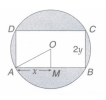
Then, OA2 = OM2 + AM2
\(\Rightarrow a^2=y^2+x^2\)
\(\Rightarrow y=\sqrt{a^2-x^2}\)
Let A be the area of the rectangle.
\(\therefore A=4xy=4x\sqrt{x^2-x^2}\)
\(\Rightarrow \ \ \frac{dA}{dx}=4\{\frac{a^2-2x^2}{\sqrt{a^2-x^2}}\}\)
For maximum or minimum value of A,
\(\frac{dA}{dx}=0\)
\(=4\{\frac{a^2-2x^2}{\sqrt{a^2-x^2}}\}=0\Rightarrow\ \ x=\frac{a}{\sqrt{2}}\)
Now, \(\frac{d^2A}{dx^2}=4\frac{d}{dx}\{(a^2-2x^2)(a^2-x^2)^{-1/2}\}\)
\(\Rightarrow \frac{d^2A}{dx^2}=4[-4x(a^2-x^2)^{-1/2}+(a^2-2x^2)\times(-1/2)(a^2-x^2)^(-3/2)(-2x)]\)
\(=[\frac{-4x}{\sqrt{a^2-x^2}}+\frac{x(a^2-2x^2)}{(a^2-x^2)^{3/2}}]\)
\(\therefore\ (\frac{d^2A}{dx^2})_{x=\frac{a}{\sqrt2}}=-16<0\)
Thus A is maximum when \(x=\frac{a}{\sqrt2}\)
putting \(x=\frac{a}{\sqrt2}\) in (i) \(y=\frac{a}{\sqrt2}\)
Therefore \(x=y=\frac{a}{\sqrt2}\)
Hence area is maximum when x = y ⇒ 2x = 2y
i.e., the rectangle is a square.
8.
Let equation of plane through (1, 2, -4) be a(x-1) + b(y-2) + c(z+4) = 0.
The plane is parallel to the given lines
\(\therefore\) 2a + 3b + 6c = 0; a + b - c = 0
Solving: \(\frac { a }{ -9 } =\frac { b }{ 8 } =\frac { c }{ -1 } =k\left( say \right) \)
\(\therefore\) a = -9k, b = 8k, c = -k
From (i), -9k(x-1) + 8k(y-2) - k(z+4) = 0
\(\therefore\) Equation of plane in cartesian form is 9x - 8y + z+11 = 0
Vector form of plane is: \(\Rightarrow \vec { r } .\left( 9\hat { i } -8\hat { j } +\hat { k } \right) =-11\)
Distance of (9, -8, -10) from the plane = \(\left| \frac { 9.9-8\left( -8 \right) +1\left( -10 \right) +11 }{ \sqrt { 81+64+1 } } \right| =\sqrt { 146 } \)
9.
y = |x+1|
| y | x |
| 1 | 0 |
| 0 | -1 |
| 2 | +1 |
| 3 | +2 |
| 1 | -2 |
| 2 | -3 |
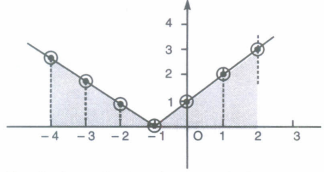
Required area is given by integral of curve:
\(A\left( x \right) =\int _{ -4 }^{ 2 }{ \left| x+1 \right| } dx\)
|x+1| = 0 at x = -1
At x > -1, |x+1| = x + 1
At x < -1, |x+1| = -(x+1)
So, \(A\left( x \right) =\int _{ -4 }^{ -1 }{ -\left( x+1 \right) dx+\int _{ -1 }^{ 2 }{ \left( x+1 \right) } dx } \)
\(=\left[ -\left( \frac { { x }^{ 2 } }{ 2 } +x \right) \right] _{ -4 }^{ -1 }+\left[ \left( \frac { { x }^{ 2 } }{ 2 } +x \right) \right] _{ -1 }^{ 2 }\)
\(=-\left[ \left( \frac { 1 }{ 2 } -1 \right) -\left( \frac { 16 }{ 2 } -4 \right) \right] +\left[ \left( \frac { 4 }{ 2 } +2 \right) -\left( \frac { 1 }{ 2 } -1 \right) \right] \)
\(=4\frac { 1 }{ 2 } +4\frac { 1 }{ 2 } =\ 9\ sq.units.\)
10.
Let a, b \(\in A\), a " b = a + b + ab
Commutatively : for all a, b \(\in A\)
.a * b = a + b + ab
= b + a + ba
= b * a
Associatively: Let a, b, c \(\in A\)
(a * b) " c = (a + b + ab) " c
= (a + b + ab) + c + (a + b + ab)c
(a * b) " c = a + b + c + ab + bc + ac + abc
a * (b * c) = a * (b + c + bc)
= a + b + c + ab + bc + ac + abc
Clearly
(a * b) * c = a * (b "c) \(\forall \) a, b, c \(\in A\)}
* is associative.
Identity: Let e \(\in A\)}such that
a * c = a
c + a + ea = a
c = 0
Identity element of A is e = O.
Inverse: Let b \(\in A\)such that
a*b = b*a = e
\(\Rightarrow \) a + b + ab = 0 and b + a + ba = 0
\(\Rightarrow \) a = -b-ab
\(\Rightarrow \) a = -b(l + a)
\(\Rightarrow \) b = \(\frac { -a }{ 1+a } \) \([\because \quad a\in A\therefore a\neq -1]\)
Invertible element of A is \(\frac { -a }{ 1+a } \) for all \(a\in A\)
11.
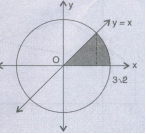
Point of intersection of Circle and line is (3, 3).
\(\therefore \ Area=\int _{ 0 }^{ 3 }{ x\quad dx } +\int _{ 3 }^{ 3\sqrt { 2 } }{ \sqrt { 18-{ x }^{ 2 } } } dx\)
\(=\left[ \frac { { x }^{ 2 } }{ 2 } \right] _{ 0 }^{ 3 }+\left[ \frac { x }{ 2 } \sqrt { 18-{ x }^{ 2 } } +9{ sin }^{ -1 }\frac { x }{ 3\sqrt { 2 } } \right] _{ 3 }^{ 3\sqrt { 2 } }\)
\(=\frac { 9 }{ 2 } +\frac { 9\pi }{ 2 } -\frac { 9 }{ 2 } -\frac { 9\pi }{ 4 } \)
\(=\frac { 9\pi }{ 4 } sq.units.\)
12.
\(\Delta=\left| \begin{matrix} { a }^{ 2 } &-{ (b-c) }^{ 2 } & bc \\ { b }^{ 2 } &-{ (c-a) }^{ 2 } & ca \\ { c }^{ 2 } &-{ (a-b) }^{ 2 } & ab \end{matrix} \right| \)
= \(-\left| \begin{matrix} { a }^{ 2 } &{ (b-c) }^{ 2 } & bc \\ { b }^{ 2 } &{ (c-a) }^{ 2 } & ca \\ { c }^{ 2 } &{ (a-b) }^{ 2 } & ab \end{matrix} \right| \)
= \(\begin{vmatrix} a^2&a^2+b^2+c^2&bc\\b^2&a^2+b^2+c^2&ca\\c^2&a^2+b^2+c^2&ab\end{vmatrix}\)
= \(-(a^2+b^2+c^2)\begin{vmatrix} a^2&1&bc\\b^2&1&ca\\c^2&1&ab\end{vmatrix}\)
= \(-(a^2+b^2+c^2)\begin{vmatrix}a^2-b^2&0&c(b-a)\\b^2-c^2&0&a(c-b)\\c^2&1&ab \end{vmatrix}\)
= \((a^2+b^2+c^2(a-b)(b-c)\begin{vmatrix}a+b&0&c\\b+c&0& -a\\c^2&1&ab \end{vmatrix}\)
\(=-(a^2+b^2+c^2)(a-b)(b-c)(-1)(a^2-ab+bc+c^2)\)
= \((a-b)(b-c)(a^2+b^2+c^2)(c-a)(c+a+b)\)
= \((b-c)(c-a)(a+b+c)({ a }^{ 2 }+{ b }^{ 2 }+{ c }^{ 2 })\)
13.
For \(a\in Z,a-a=0,\) which is divisible by 5.
\(\therefore \) \((a,a)\in R\forall a\in Z\).
Thus R is reflexive.
Now let \((a,b)\in R\) \(\Rightarrow \) a-b is divisible by 5
\(\Rightarrow \) b-a is divisible by 5 \(\Rightarrow \) \((b,a)\in R\).
Thus R is symmetric.
Again let \((a,b)\in R,\ (b,c)\in R\)
\(\Rightarrow \) a-b and b-c are divisible by 5
\(\Rightarrow \) (a-b) + (b-c) = a-c is divisible by 5
\(\Rightarrow \) \((a,c)\in R\).
Thus R is transitive.
Hence, R is an equivalence relation.
14.
\(y={ tan }^{ -1 }\frac { 3x+2x }{ 1-3x2x } \)
= \({ tan }^{ -1 }3x+{ tan }^{ -1 }2x\)
\(\Rightarrow \frac { dy }{ dx } =\frac { 3 }{ 1+9{ x }^{ 3 } } +\frac { 2 }{ 1+4{ x }^{ 2 } } \)
15.
\(\frac { dx }{ d\theta } =\theta cos\theta +sin\theta \)
\(\frac { dy }{ d\theta } =-\theta sin\theta +cos\theta \)
\(\frac { dy }{ dx } =\frac { cos\theta -\theta sin\theta }{ \theta cos\theta +sin\theta } \)
dy/dx at \(\theta\)= \(\pi/4\)
\(=\frac { cos\frac { \pi }{ 4 } -\frac { \pi }{ 4 } sin\frac { \pi }{ 4 } }{ \frac { \pi }{ 4 } cos\frac { \pi }{ 4 } +sin\frac { \pi }{ 4 } } \)
\(=\frac { \frac { 1 }{ \sqrt { 2 } } -\frac { \pi }{ 4 } \times \frac { 1 }{ \sqrt { 2 } } }{ \frac { \pi }{ 4 } \times \frac { 1 }{ \sqrt { 2 } } +\frac { 1 }{ \sqrt { 2 } } } \)
=\(\frac { 1-\frac { \pi }{ 4 } }{ \frac { \pi }{ 4 } +1 } \)
\(\Rightarrow\)\(\frac { dy }{ dx } =\frac { 4-\pi }{ 4+\pi } \)
16.
\(P(\bar { A } /\bar { B } )=\frac { P(\bar { A } \cap \bar { B } ) }{ P(\bar { B } ) } \)
\(=\frac { 1-P(A\cup B) }{ 1-P(B) } \)
\(=\frac { 1-[P(A)+P(B)-P(A\cap B)] }{ 1-P(B) } \)
\(=\frac { 7 }{ 10 } \)
17.
\(\left|\overset\rightarrow a+\overset\rightarrow b \right|^{ 2 } +\left|\overset\rightarrow a-\overset\rightarrow b \right|^{ 2 }=2{(\left| \overset\rightarrow a \right| ^{2 }+\left|\overset\rightarrow b \right| ^{ 2 })}\)
\(\Rightarrow\left| \overset\rightarrow b \right| ^{ 2 }=2,116\)
\(\Rightarrow\left| \overset\rightarrow b \right| =46\)
18.
Given, differential equation is
\(\frac{d^2 y}{d x^2}+\sqrt[3]{\frac{d y}{d x}}+(1+x)=0 \Rightarrow \frac{d^2 y}{d x^2}+(1+x)=-\sqrt[3]{\frac{d y}{d x}}\)
On cubing both sides, we get
\(\left\{\frac{d^2 y}{d x^2}+(1+x)\right\}^3=-\frac{d y}{d x}\)
Hence, the order is 2 and degree is 3. So, the sum is 5.
19.
Given integral \(=\int { \left( \frac { 1 }{ 1+{ x }^{ 2 } } -\frac { 2x }{ (1+{ x }^{ 2 })^{ 2 } } \right) } { e }^{ x }dx\)
\(=\frac { 1 }{ 1+{ x }^{ 2 } } { e }^{ x }+C \left[ as\frac { d }{ dx } \left( \frac { 1 }{ 1+{ x }^{ 2 } } \right) =\frac { -2x }{ (1+{ x }^{ 2 })^{ 2 } } \right] \)
20.
We have, \(A=\left[ \begin{matrix} cos\theta & -sin\theta \\ sin\theta & cos\theta \end{matrix} \right] \)
\({ A }^{ T }=\left[ \begin{matrix} cos\theta & sin\theta \\ -sin\theta & cos\theta \end{matrix} \right] \)
\(\Rightarrow A+{ A }^{ T }=\left[ \begin{matrix} 2cos\theta & 0 \\ 0 & cos\theta \end{matrix} \right] =\left[ \begin{matrix} 1 & 0 \\ 0 & 1 \end{matrix} \right] \)
\(\Rightarrow 2cos\theta =1\)
\(\Rightarrow cos\theta =\frac { 1 }{ 2 } \Rightarrow \theta =\cos ^{ -1 }{ \left( \frac { 1 }{ 2 } \right) } \)
\(\because \quad \theta =\frac { \pi }{ 3 } \)
21.
The given function is f: X → Y and relation on X is R={(a, b): f(a) = f (b)}
Reflexive Since, for every x ∈ X, we have
f'(x) = f(x)
⇒ (xx) ∈ R, ∀ ∈ X Therefore, R is reflexive.
Symmetric Let (x, y) ∈ R
Then, f(x)=f(y)
⇒ f(y)=f(x)
⇒ (y, x) ∈ R
Thus, (x, y) ∈ R ⇒ (y, x)∈ R, ∀x, y∈ X
Therefore, R is symmetric.
Transitive Let x, y, z∈ X such that
(x, y) ∈ R and (y, z) ∈ R
Given a relation 5 in \(N \times N\), defined as
(a, b) S(c, d), if a+d=b+c.
Reflexive Let (a, b) be any arbitrary element of \(N \times N\)
i.e. \((a, b) \in N \times N\), where \(a, b \in N\)
Now, as a+b=b+a
[∴ addition is commutative ]
Therefore \quad(a, b) S(a, b)
So, S is reflexive.
Symmetric \(\operatorname{Let}(a, b),(c, d) \in N \times N\), such that (a, b)
S(c, d). Then, a+d=b+c
\( \Rightarrow b+c=a+d \Rightarrow c+b=d+a \)
\(\Rightarrow (c, d) S(a, b)\)
So, S is symmetric.
Transitive Let \((a, b),(c, d),(e, f) \in N \times N\) such that (a, b) S(c, d) and (c, d) S(e, f).
Then, a+d=b+c and c+f=d+e
On adding the above equations, we get
a+d+c+f=b+c+d+e
\( \Rightarrow a+f=b+e \Rightarrow(a, b) S(e, f)\)
So, S is transitive.
Thus, S is reflexive, symmetric and transitive. Hence, S is an equivalence
22.
= x-2 tan-1x + c
23.
Given \({ X }_{ m\times 3 }{ Y }_{ p\times 4 }={ Z }_{ 2\times b }\)
If XY is defined,
then \(3=p\Rightarrow p=3\)and
\({ Z }_{ m\times 4 }={ Z }_{ 2\times b }\Rightarrow \) m = 2 and b = 4.
\(\therefore \ p=3,m=2\quad and\quad b=4.\)
24.
2Let D1 denote the event that the patient has disease d1. The events D2 and D3 are defined similarly.
Then, \(P({ D }_{ 1 })=\frac { 3,200 }{ 10,000 } =0.32\)
\(P({ D }_{ 2 })=\frac { 3,500 }{ 10,000 } =0.35\)
and \(P({ D }_{ 3 })=\frac { 3,300 }{ 10,000 } =0.33\)
Let S be the event that the patient shows the symptoms S,
Then, \(P(S/{ D }_{ 1 })=\frac { P(S\cap D)) }{ P({ D }_{ 1 }) } =\frac { 3,100 }{ 3,200 } \)
= 0.97 (approx.)
\(P(S/{ D }_{ 3 })=\frac { 3,000 }{ 3,500 } =0.94\quad (approx.)\quad \)
\(P(S/{ D }_{ 3 })=\frac { 3,000 }{ 3,300 } =0.91\quad (approx.)\)
Using Bayes' theorem, we get
P(D1/S) = The probability that the patient has disease d1 knowing that he/she has symtoms S1, S2 ,....,S6
P(D1/S)
\(=\frac { P({ D }_{ 1 })|P(S/{ D }_{ 1 }) }{ P({ D }_{ 1 })P(S/{ D }_{ 1 })+P({ D }_{ 2 })P(S/{ D }_{ 2 })+P({ D }_{ 3 })P(S/{ D }_{ 3 }) } \)
\(=\frac { 0.32\times 0.97 }{ 0.32\times 0.97+0.35\times 0.94+0.33\times 0.91 } \)
\(=\frac { 0.3104 }{ 0.3104+0.329+0.3003 } \)
\(=\frac { 0.3104 }{ 0.9397 } =0.33\quad approx\)
Similarly,
\(P({ D }_{ 2 }/S)=\frac { 0.329 }{ 0.9397 } =0.35\quad approx\)
and \(P({ D }_{ 3 }/S)=\frac { 0.3003 }{ 0.9397 } =0.32\quad approx\)
Thus, knowing that the patient has symtoms S1,S2, ..., S3, the probability that he has disease d1 is 0.33, the probability that he has disease d2 is 0.35, the probability that he has disease d3 is 0·32. Therefore, the doctor should conclude that the patient is most likely to have disease d2.
25.
\(\int { \frac { \sin ^{ 6 }{ x } +\cos ^{ 6 }{ x } }{ \sin ^{ 2 }{ x } \cos ^{ 2 }{ x } } } dx.\)
\(=\int { \frac { { (\sin ^{ 2 }{ x } +\cos ^{ 2 }{ x } ) }^{ 3 }-3\sin ^{ 2 }{ x } \cos ^{ 2 }{ x } (\sin ^{ 2 }{ x+ } \cos ^{ 2 }{ x } ) }{ \sin ^{ 2 }{ x } \cos ^{ 2 }{ x } } } \)
\([\because { a }^{ 3 }+{ b }^{ 3 }={ (a+b) }^{ 3 }-3ab(a+b)]\)
\(=\int { \frac { { (1) }^{ 3 }-3\sin ^{ 2 }{ x } \cos ^{ 2 }{ x } (1) }{ \sin ^{ 2 }{ x } \cos ^{ 2 }{ x } } } dx\)
\(=\int { \frac { 1-3\sin ^{ 2 }{ x } \cos ^{ 2 }{ x } }{ \sin ^{ 2 }{ x } \cos ^{ 2 }{ x } } } dx\)
\(=\int { \left( \frac { 1 }{ \sin ^{ 2 }{ x } \cos ^{ 2 }{ x } } -3 \right) } dx\)
\(=\int { \left( \frac { \sin ^{ 2 }{ x+ } \cos ^{ 2 }{ x } }{ \sin ^{ 2 }{ x } \cos ^{ 2 }{ x } } -3 \right) } dx\)
\(=\int { \left( \frac { 1 }{ \cos ^{ 2 }{ x } } +\frac { 1 }{ \sin ^{ 2 }{ x } } -3 \right) } dx\)
\(=\int { \sec ^{ 2 }{ x } } dx+\int { co\sec ^{ 2 }{ x } } dx-3\int { 1dx } \)
\(=\tan { x } -\cot { x } -3x+C.\)
26.
Let 'x' and 'y' be the number of pieces of type A and type B respectively.
Then the problem is:
Maximize Z - 80x + 120y subject to:
\(9x+12y\le 180,\quad x+3y\le 30,\quad x\ge 0,\ge 0.\)
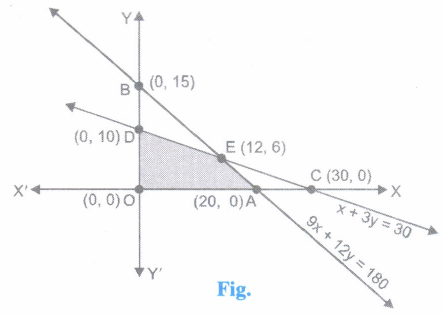
For solution set, we draw the lines:
x = 0, y = 0, 9x + 12y = 180 and x + 3y = 30.
The feasible region OAED is bounded whose vertices are:
O(0, 0), A(20, 0), D(0, 10) and E(12, 6)
[Solving 9x +12y = 180 and x + 3y = 30; x = 12, y = 6]
Applying Corner Point Method, we have:
| Corner Point | Z = 80x + 120y |
| O: (0, 0) | 0 |
| A : (20, 0) | 1600 |
| E : (12, 6) | 1680 (Maximum) |
| D : (0, 10) | 1200 |
Hence, the maximum profit is Rs. 1680 when 12 pieces of Type A and 6 pieces of Type B are manufactured per week.
27.
We have \(f(x)=2x^{ 3 }-9x^{ 2 }+12x+15\)
\(f'(x)=6x^{ 2 }-18x+12\)
\(=6(x^{ 2 }-3x+12)\)
\(=6(x-1)(x-2)\)
(I)For f(x) to be strictly increasing function of x,
\(f'(x)>0\)
i.e., (x-1)(x-2)>0
i.e., \(x\in (-\infty ,1)\cup (2,\infty )\)
Hence the function is strictly increasing in \((-\infty ,1)\cup (2,\infty )\)
(II)For f(x) to be strictly decreasing function of x,
\(f'(x)<0\)
i.e., 6(x-1)(x-2)<0
Hence the function is strictly decreasing in the interval (1,2)
28.
The given equation is \({ e }^{ x }\sqrt { 1-{ y }^{ 2 } } dx+\frac { y }{ x } =0,\)
\(\Rightarrow \) \(x{ e }^{ x }\quad dx+\frac { y }{ \sqrt { 1-{ y }^{ 2 } } } dy=0\)
|Variables Separable
Integrating, \(\int { x\quad { e }^{ x }\quad dx+ } \int { \frac { y }{ \sqrt { 1-{ y }^{ 2 } } } dy= } c\)
\(\Rightarrow \) \(x{ e }^{ x }-\int { \left( 1 \right) } { e }^{ x }\quad dx-\frac { 1 }{ 2 } \int { { \left( 1-{ y }^{ 2 } \right) }^{ -\frac { 1 }{ 2 } } } \left( -2\quad y \right) dy=c\)
\(\Rightarrow \) \(x{ e }^{ x }- { e }^{ x }-\frac { 1 }{ 2 } \frac { { \left( 1-{ y }^{ 2 } \right) }^{ -\frac { 1 }{ 2 } } }{ \frac { 1 }{ 2 } } =c\)
\(\Rightarrow \) \(\left( x-1 \right) { e }^{ x }-\sqrt { 1-{ y }^{ 2 } } =c\) ...(1)
When \(x=0,y=1\)
\(\therefore \) \(\left( -1 \right) \left( 1 \right) -0=c\Rightarrow c=-1\)
Putting in (1), \(\left( x-1 \right) { e }^{ x }-\sqrt { 1-{ y }^{ 2 } } =-1\)
\(\Rightarrow \) \(\sqrt { 1-{ y }^{ 2 } } =\left( x-1 \right) { e }^{ x }+1,\)
which is the required solution
29.
\({ \left( I+A \right) }^{ 2 }=(I+A)(I+A)\)
\(=II+IA+AI+AA\)
\(=I+A+A+{ A }^{ 2 }\)
\( =I+2A+A \quad \left[ \because \quad { A }^{ 2 }=A \right] \)
\(=I+3A ....(1)\)
\(\therefore \ { \left( I+A \right) }^{ 3 }={ (I+A) }^{ 2 }(I+A)\)
\(=(I+3A)(I+A)\ \left[ Using\quad (1) \right] \)
\( =II+IA+3AI+3AA\)
\(=I+A+3A+3{ A }^{ 2 }\)
\(=I+A+3A+3A\ \left[ \because \quad { A }^{ 2 }=A \right] \)
\(=I+7A...(2)\)
\(Hence,\ 7A-{ \left( I+A \right) }^{ 3 }=7A-(I=7A) = -I\) Using (2)
30.
In g : \(2\rightarrow 5\) and in f, \(5\rightarrow 2\); etc.
fog = {(2, 2), (3, 3)}.
31.
Since a + 0 = 0 + a = a and \(a\times 1=1\times a=a,\ \therefore \ 0\ and\ 1\) are the identity elements for operations '+' and '\(\times \)' respectively.
Further, there is no \(e\in R\) such that \(a-e=e-a=a\) and \(a\div e=e\div a=a\forall a\in R\).
Hence, '-' and '\(\div \)' do not have identity elements.
32.
(i)\(\begin{vmatrix} 2 & 4 \\ 5 & 1 \end{vmatrix}=\begin{vmatrix} 2x & 4 \\ 6 & x \end{vmatrix}\)
\(\Rightarrow 2 \times 1-5 \times 4=2 x \times x-6 \times 4 \)
\(\Rightarrow 2-20=2 x^{2}-24 \)
\(\Rightarrow 2 x^{2}=6 \)
\(\Rightarrow x^{2}=3 \)
\(\Rightarrow x=\pm \sqrt{3} \)
(ii)We have:
\(\begin{vmatrix} 2 & 3 \\ 4 & 5 \end{vmatrix}=\begin{vmatrix} x & 3 \\2x & 5 \end{vmatrix}\)
\(\Rightarrow 2 \times 5-3 \times 4=x \times 5-3 \times 2 x \)
\(\Rightarrow 10-12=5 x-6 x \)
\(\Rightarrow-2=-x \)
\(\Rightarrow x=2\)

12th Standard CBSE Syllabus & Materials
12th Standard CBSE
CBSE 12th Computer Science Python Revision Tour I - New Previous year Question Papers Study Material - QB365 Set A
NEW12th Standard CBSE
CBSE 12th Business Studies Planning Important Questions And Answers Study Material - QB365 Set A
NEW12th Standard CBSE
CBSE 12th Business Studies Business Environment Important Questions And Answers Study Material - QB365 Set A
NEW12th Standard CBSE
CBSE 12th Business Studies Principles of Management Important Questions And Answers Study Material - QB365 Set A



CBSE 12th Standard CBSE Subjects
CBSE Standards










