
 100% FREE ACCESS
12th Standard CBSE Syllabus & Materials
12th Standard CBSE
CBSE 12th Economics Government Budget and the Economy Previous year Question Papers Study Material - QB365 Set A
NEW12th Standard CBSE
CBSE 12th Computer Science Interface Python with MySQL - New Previous year Question Papers Study Material - QB365 Set A
NEW12th Standard CBSE
CBSE 12th Computer Science Database Concept - New Previous year Question Papers Study Material - QB365 Set A
NEW12th Standard CBSE
CBSE 12th Computer Science Data Communication - New Previous year Question Papers Study Material - QB365 Set A
NEW12th Standard CBSE
CBSE 12th Computer Science Data Structures - New Previous year Question Papers Study Material - QB365 Set A
NEW12th Standard CBSE
CBSE 12th Computer Science Functions - New Previous year Question Papers Study Material - QB365 Set A

Published on: 29/11/2018
The Central Board of Secondary Education conducts the Class 12 examinations in the months of March every year. Students must be prepared for these examinations and one way to do so is by solving question mock papers. The CBSE sample papers for class 12 help students identify frequently asked questions, topics that need to be focused on, types of trick questions, and much more. Anyone can download the CBSE sample papers for class 12 with free PDF solution to test their problem-solving ability. Students who have opted for the science stream require a lot of practice in the form of mock tests and sample papers. This will enable them to write the final board exam with confidence. By going through the CBSE solved sample papers for class 12, you can better understand mistakes and develop a deeper understanding of these subjects.
Getting a good score in class 12 requires dedicated, untiring focus towards studies on the part of the student. It is important to have a strategic approach towards your exams where extra effort is put in analyzing and understanding what topics are important from the exam point of view. Practice makes perfect, and there is no better way to practice than to attempt previous year question paper of CBSE class 12. A thorough study of past year question papers will help you to understand the pattern of how questions are being asked so that you are able to identify and focus on the important topics that are frequently asked.
CBSE Class 12 Physics always important to practice last year board exam question paper to practice for the upcoming board exams. Here the questions are covered from last 10 years which you should practice understanding the paper pattern and type of questions which have come in previous board exams for class 12. This will help you to get better marks in class 12 board exams. Practice getting better marks in board exams.
In this question paper, the questions are covered from the entire syllabus of 12th Physics. Questions are prepared as per NCERT guideline with the help of expert teachers.
Download CBSE Class 12th Standard CBSE Physics question papers, sample papers, important questions, and previous year solved papers in PDF format. Get free study materials, NCERT solutions, and exam preparation resources for Class 12th Standard CBSE Physics
Questions + Answers key
Take MCQ Physics Test
1.
The diagram given below represents the block diagram of a generalised communication system. Identify the elements labelled as X, Y, Z in this diagram. Explain the function of each of these elements.

2.
The carrier frequency of a station is 40 MHz. A resistor of 10 \(k\Omega \) and a capacity of 12 pF are available in the detector circuit. Is it good enough for detection? Explain.
3.
A 100 resistor is connected to a 220V, 50Hz ac supply.
(a) What is the rms value of current in the circuit?
(b) What is the net power consumed over a full cycle?
4.
What is the decimal number of binary number \((111001.01)_{ 2 }\)
5.
The work function of caesium is 2.14 eV. Find
(a) the threshold frequency for caesium and
(b) wavelength of the incident light if the photocurrent is brought to zero by a stopping potential of 0.60 V
6.
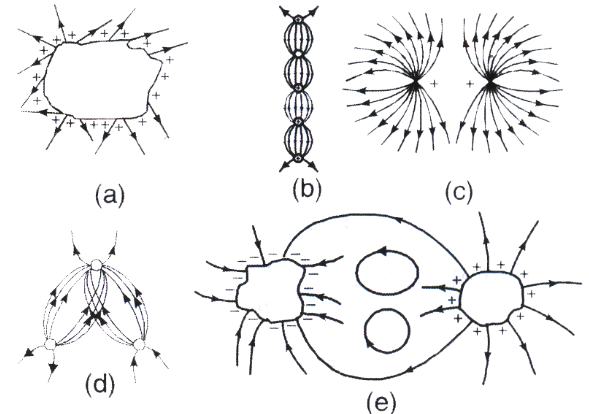
Which of the following figures cannot possibly represent electrostatic field lines?
7.
What is the force between two small charged spheres having charges of 2 \(\times\) 10-7C and 3 \(\times\) 10-7C placed 30 cm apart in air?
8.
Why is potentiometer preferred over a voltmeter for determining the emf of a cell?
9.
Two point charges q1 and q2 are located at r1 and r2 respectively in an external electric field E. Obtain the expression for the total work done in assembling this configuration.
10.
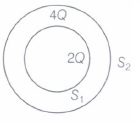
Consider two hollow concentric spheres, S1 and S2 enclosing charges 2Q and 4Q respectively as shown in the figure.
(i) Find out the ratio of the electric flux through them.
(ii) How will the electric flux through the sphere S1 change, if a medium of dielectric constant \({ \varepsilon }_{ r }\) is introduced in the space inside S1 in place of air? Deduce the necessary expression.
11.
Ordinary rubber is an insulator. But the special rubber tyres of aircraft's are made slightly conducting. Why is this necessary?
12.
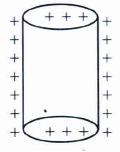
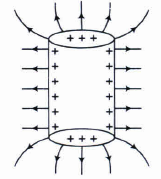
Sketch the electric field lines for a uniformly charged hollow cylinder as shown in the figure.
13.
In the northern hemisphere, do magnetic lines of force due to earth's field point towards or away from earth ?
14.
What is the cause of charging?
15.
In a parallel plate capacitor with air between the plates, each plate has an area of 6\(\times\)10-3m2 and the distance between the plates is 3 mm. Calculate the capacitance if this capacitor. If this capacitor is connected to a 100 V supply, what is the charge on each plate of the capacitor?
16.
(a) A point object is placed in front of a double convex lens (of refractive index n =n2/n1 with respect air) with its spherical faces of radii of curvature R1 and R2.. Show the path of rays due to surface to obtain the formation of the real image of the object.
Hence obtain the lens maker's formula for a thin lens.
(b) A double convex lens having both faces of the same radius of curvature has refractive index 1.55. Find out the radius of curvature of the lens required to get the focal length of 20 cm.
17.
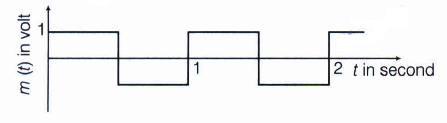
A modulating signal is a square wave as shown in the figure.
The carrier wave is given by c(T) = 2 sin (8\(\pi \) t) volt.
(i) Sketch the amplitude modulated waveform
(ii) What is the modulation index?
18.
The electric field at a point on the axial line at a distance of 10 cm from the center of an electric dipole is 3.75\(\times\) N/C. Calculate the length of an electric dipole.
19.
A rectangular coil of n turns each of area A, carrying current I, when suspended in a uniform magnetic field B, experiences a torque
\(\tau =nI \ BA \ sin\theta \)
Where is \(\theta \) the angle which a normal drawn on the plane of coil makes with the direction of magnetic field. This torque tends to rotate the coil and bring it in an equilibrium position. In the stable equilibrium state, the resultant force on the coil is zero. The torque on the coil is also zero and the coil has minimum potential energy.
Read the above passage and answer the following questions:
(i) In which position, a current carrying coil suspended in uniform magnetic field experiences
(a) minimum torque and
(b) maximum torque?
(ii) a circular coil of 200 turns, radius 5 cm carries a current of 2.0 A. It is suspended vertically in a uniform horizontal magnetic field of 0.20 T, with the plane of the coil making an angle with \(60°\) the field lines. Calculate the magnitude of the torque that must be applied on it to prevent it from turning.
(iii) what is the basic value displayed by the above study?
20.
An infinite number of charges each numerically equal to q and of the same sign are placed along the X-axis at x = 1, x = 2, x = 4, x = 8 and so on. Find electric potential at x = 0
21.
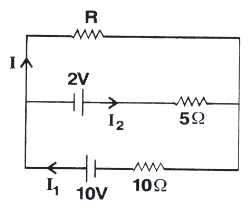
Two cells of voltages 10V and 2V and internal resistances \(10\Omega\ and\ 5\Omega \) respectively are connected in parallel with the positive end of 10V battery connected to negative pole of 2V battery. Find the effective voltage and effective resistance of the combination.
22.
The cause of charging is ......... of electrons from ..... to ............
23.
The cross product \(\overrightarrow { E } \times \overrightarrow { B } \) (where \(\overrightarrow { E } \) = electric field vector \(\overrightarrow { B } \) and is the magnetic field vector) always gives the ....... of electromagnetic wave.
1.
X: Message signal generator
Y: Modulator
Z: Power amplifier
Function of elements
X : It converts one form of message signal into electrical energy. The variation of current or voltage changes in accordance to variation in pressure, ete. also known as transducer.
Y : Used for superimposing the low frequency modulating signals over high frequency carrier wave.
Z : Power amplifier strengthens the modulated signals for transmission.
2.
Here, R = 10 \(k\Omega \) = 10 x 103 \(\Omega \); C = 12 pF = 12 x 10-12 F
vc = 40 MHz = 40 x 106 Hz = 4 x 10⁷ Hz
Time period of carrier frequency, \({ T }_{ c }=\frac { 1 }{ { v }_{ c } } =\frac { 1 }{ 4\times { 10 }^{ 7 } } =2.5\times { 10 }^{ -8 }s\)
Time constant of C-R circuit, \(\tau =RC=\left( 10\times { 10 }^{ 3 } \right) \times \left( 12\times { 10 }^{ -12 } \right) =12\times { 10 }^{ -8 }s\)
As \({ T }_{ c }<\tau ,\) therefore, circuit is good enough for detection.
3.
\(Here, \ R=100\Omega , \ { E }_{ v }=220V, \ v=50Hz\)
\((a) \ { I }_{ v }=?, \ { I }_{ v }=\frac { { E }_{ v } }{ R } =\frac { 220 }{ 100 } =2.2A\)
\((b) \ Net \ power \ consumed \ over \ a \ full \ cycle,\)
\(P={ E }_{ v }{ I }_{ v }=220\times 2.2=484W\)
4.
\((111001.01)_{ 2 }=(111001)_{ 2 }+(0.01)_{ 2 }\)
\( (111001)_{ 2 }=1\times2^{ 0 }+0\times2^{ 1 }+0\times2^{ 2 }+1\times2^{ 3 }+1\times2^{ 4 }+1\times2^{ 5 5 }\)
\( =1+0+0+8+16+32=(57)_{ 10 } \ (0.01)_{ 2 }=0\times2^{ -1 }+1\times2^{ -2 }=0+0.25=(0.25)_{ 10 }\)
\(\therefore \ (111001.01)_{ 2 }=(57)_{ 10 }+(0.25)_{ 10 }=(57.25)_{ 10 }\)
5.
(a) For the cut-off or threshold frequency, the energy h v0 of the incident radiation must be equal to work function Φ0, so that
\({ V }_{ 0 }=\frac { { \phi }_{ 0 } }{ h } =\frac { 2.14eV }{ 6.63\times { 10 }^{ -34 }Js }\)
\(=\frac { 2.14\times 1.6\times { 10 }^{ -19 }J }{ 6.63\times { 10 }^{ -34 }Js } =5.16\times { 10 }^{ 14 }Hz\)
Thus, for frequencies less than this threshold frequency, no photoelectrons are ejected.
(b) Photocurrent reduces to zero, when maximum kinetic energy of the emitted photoelectrons equals the potential energy eV0 by the retarding potential V0. Einstein’s Photoelectric equation is
\(e{ V }_{ 0 }=\frac { hc }{ \lambda } -{ \phi }_{ 0 }\)
\(or\ \lambda =\frac { hc }{ \left( e{ V }_{ 0 }+{ \phi }_{ 0 } \right) }\)
\(or \ \lambda =\frac { \left( 6.63\times { 10 }^{ -34 }Js \right) \times \left( 3\times { 10 }^{ 8 }m/s \right) }{ \left( e\times 0.6V+2.14eV \right) } \)
\(\lambda =\frac { 19.89\times { 10 }^{ -26 }Jm }{ 2.74\times 1.6\times { 10 }^{ -19 }J } =454nm\)
6.
Only (c) is right; the rest cannot represent electrostatic field lines.
(a) is wrong because field lines must be normal to a conductor.
(b) is wrong because lines of force cannot start from a negative charge.
(d) is wrong because lines of force cannot intersect each other.
(e) is wrong because electrostatic field lines cannot form closed loops.
7.
Given q1 = 2 \(\times\) 10-7 C, q2 = 3 \(\times\) 10-7 C r = 30 cm = 0.3 m
Therefore, Force of repulsion, F = 9 \(\times\) 109 \(\times\) \(\frac { { q }_{ 1 }{ q }_{ 2 } }{ { r }^{ 2 } } \)
= \(9\times { 10 }^{ 9 }\times \frac { 2\times { 1 }0^{ -7 }\times 3\times { 10 }^{ -7 } }{ { (0.3) }^{ 2 } } =\frac { 54\times { 10 }^{ -5 } }{ 9\times { 10 }^{ -2 } } \)
\(=\ 6\times { 10 }^{ -3 }N\)
8.
Potentiometer does not draw any (net) current front-the cell. Voltmeter draws some current from cell, when connected across at, hence measures terminal voltage.
9.
Work done in bringing the charge q1 from infinity to position r1
W1 = q1 V(r1)
Work done in bringing charge q2 to the position r2
W2 = q2 V(r2) + \(\frac{q_1q_2}{4\pi\epsilon_0r_{12}}\)
Hence, total work done in assembling the two charges
W = W1 +W2
= q1V(r1) + q2V(r2) + \(\frac{q_1q_2}{4\pi\epsilon_0r_{12}}\)
10.
(i) According to Gauss' theorem,
\(\phi=\frac { \Sigma q }{ { \varepsilon }_{ 0 }{ \varepsilon }_{ r } } \propto \Sigma q\)
\(\therefore\) \(\frac { { \phi }_{ { s }_{ 1 } } }{ { \phi }_{ { s }_{ 2 } } } =\frac { 2Q }{ 2Q+4Q } \)
\(=\frac { 2Q }{ 6Q } =\frac { 1 }{ 3 } \)
(ii) If a medium of dielectric constant \({ \varepsilon }_{ r }\) is introduced in the space inside S 1 in place of air, then
\({ \phi }_{ { s }_{ 1 } }=\frac { \Sigma q }{ { \varepsilon }_{ 0 }{ \varepsilon }_{ r } } =\frac { 2Q }{ { \varepsilon }_{ 0 }{ \varepsilon }_{ r } } \)
11.
During landing or take off, the tyres of aircraft's get charged due to the friction between tyres and ground. In case, the tyres are slightly conducting, the charge developed on the tyres will not stay on them and it finds its way to the earth.
12.
Here the hollow cylinder is positively charged. We know that the electric field lines appear to come out from the conductor. thus the field lines for a uniformely positive charged hollow cyclinder is shown in the figure.
13.
Towards the earth.
14.
The cause of charging is actual transfer of electrons from one body to the other.
15.
Given,
The area of plate of the capacitor, A = 6 x 10⁻³ m2
Distances between the plates, d = 3mm = 3 x 10⁻³ m
Voltage supplied, V = 100V
Capacitance of a parallel plate capacitor is given by, \(C=\frac{\epsilon \times A}{d}\)
Here,
ε = permittivity of free space = 8.854 x10⁻¹² N-1 m -2 C-2
\(C=\frac{8.854 \times 10^{-12} \times 6 \times 10^{-3}}{3 \times 10^{-3}}=17.81 \times 10^{-12} \mathrm{~F}=17.71 \mathrm{pF}\)
Therefore, each plate of the capacitor is having a charge of
q = VC = 100 x 17.81 x 10-12 C = 1.771 x 10⁻⁹ C
16.
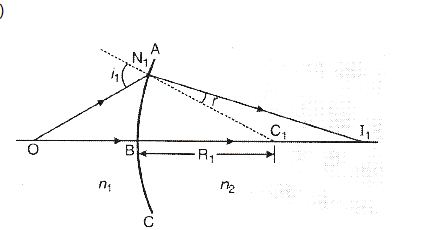
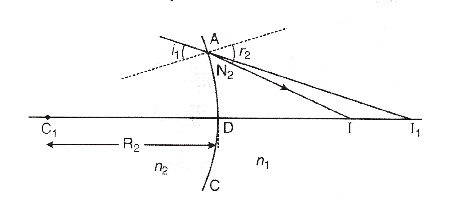
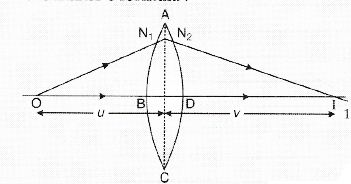
The first refracting ABC forms the image I1 of the object O. The image I1 acts as virtual object for the second refracting surface ADC, which forms the real image I as shown in the diagram
For refraction at ABC
\(\frac { { n }_{ 2 } }{ { v }_{ 1 } } -\frac { { n }_{ 1 } }{ u } =\frac { { n }_{ 2 }-{ n }_{ 1 } }{ { R }_{ 1 } } \)
For refraction at ADC
\(\frac { { n }_{ 1 } }{ v } -\frac { { n }_{ 2 } }{ { v }_{ 1 } } =\frac { { n }_{ 1 }-{ n }_{ 2 } }{ { R }_{ 2 } } \)
Adding equation (i) and equation (ii)
\(\frac { { n }_{ 1 } }{ v } -\frac { { n }_{ 2 } }{ u } =\left( { n }_{ 2 }-{ n }_{ 1 } \right) \left( \frac { 1 }{ { R }_{ 1 } } -\frac { 1 }{ { R }_{ 2 } } \right) \)
\(\frac { 1 }{ v } -\frac { 1 }{ u } =\left( \frac { { n }_{ 2 } }{ { n }_{ 1 } } -1 \right) \left( \frac { 1 }{ { R }_{ 1 } } -\frac { 1 }{ { R }_{ 2 } } \right) \)
We know, If \(u=\infty ,v=f\)
\(\frac { 1 }{ v } -\frac { 1 }{ u } =\frac { 1 }{ f } \)
\(\frac { 1 }{ f } =\left( \frac { { n }_{ 2 } }{ { n }_{ 1 } } -1 \right) \frac { 1 }{ { R }_{ 1 } } -\frac { 1 }{ { R }_{ 2 } } \)
\(\frac { 1 }{ f } =\left( { \mu }_{ 21 }-1 \right) \left( \frac { 1 }{ { R }_{ 1 } } -\frac { 1 }{ { R }_{ 2 } } \right) \)
\(\frac { 1 }{ f } =\left( { \mu }_{ 21 }-1 \right) \left( \frac { 1 }{ { R }_{ 1 } } -\frac { 1 }{ { R }_{ 2 } } \right) \)
\(\frac { 1 }{ f } =\left( 1.55-1 \right) \left( \frac { 1 }{ R } -\frac { 1 }{ -R } \right) \)
\(=0.55\times \frac { 2 }{ R } \)
\(R=0.55\times 2\times 20=22 \ cm\)
17.
Given, the equation of carrier wave,
c(t) = 1 sin (8\(\pi \) t) ..........(i)
(i) According to the figure,
Amplitude of modulating signal,
Am = 1 V
Amplitude of carrier wave,
AC =2
Tm = 1 s
From Eq.(i), we get
\({ \omega }_{ m }=\frac { 2\pi }{ { T }_{ m } } =\frac { 2\pi }{ 1 } =2\pi \ rad/s\) ....(ii)
c(t) = 2 sin (8 \(\pi \) t)
So, \({ \omega }_{ c }=4{ \omega }m_{ }\)
From Eq. (ii) , we get
So, \({ \omega }_{ c }=4{ \omega }_{ m }\)
Amplitude of modulated wave,
A = Am + Ac
= 1 + 2= 3 V
The sketch of the amplitude modulated waveform is shown below:
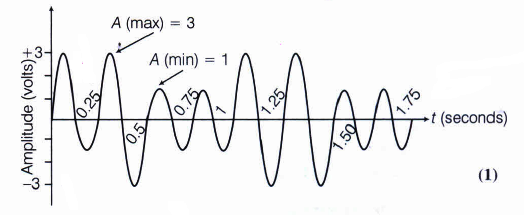
For carrier signal, \({ \omega }\) = 8 \(\pi \)
\(T=\frac { 2\pi }{ \omega } =\frac { 2\pi }{ 8\pi } =\frac { 1 }{ 4 } =0.25s\)
(ii) Modulation index, \(m=\frac{A_{m}}{A_{c}}=\frac{1}{2}=0.5\)
18.
\(We \ know \ that,{ E }_{ axial }=\frac { 1 }{ 4\pi { \varepsilon }_{ 0 } } .\frac { 2\rho r }{ { ({ r }^{ 2 }-{ r }^{ 2 }) }^{ 2 } } \)
\(CaseI,\)
\( When \ r=10cm=0.1m\)
\(\\ { E }_{ axial }=3.75\times { 10 }^{ 5 }N/C\)
\(\\ 3.75\times { 10 }^{ 5 }=9\times { 10 }^{ 5 }\times \frac { 2\rho \times 0.1 }{ { { [(0.1) }^{ 2 }-{ a }^{ 2 }] }^{ 2 } } \ .....(i)\)
\(Case \ II,\)
\( When \ r=20cm=0.2m\)
\(\\ { E }_{ axial }=3\times { 10 }^{ 4 }\times \frac { 2\rho \times 0.2 }{ { { [(0.2) }^{ 2 }-{ a }^{ 2 }] }^{ 2 } } \ .......(ii)\)
Solving the Eqs. (i) and (ii), we get
a = 0.05 m
Therefore, lemgth of the dipole is 2z.
So, 2a = 2 x 0.05
or 2a = 0.1 m
19.
As \(\tau =nIBA \ sin \ \theta ,\ therefore,\ (i) \ \tau =0, \ when \ sin\theta =0 \ or \ \theta =0°, \ i.e.\)when the plane of coil is perpendicular to the direction of magnetic field. (ii) \(\tau =\) maximum, when \(sin \ \theta \)=maximum=1 or \(\theta =90°\)
\({ \tau }_{ max }=nIBA\times 1=nIBA\)
It will be so when the plane of coil is parallel to the direction of magnetic field.
(ii) Here, n = 200; r = 0.05m; I = 2.0 A; B = 0.20 T; \(\theta =90°-60°\)=\(30°\)
\( \tau =nIBA \ sin \ \theta ,\ therefore,\ (i) \ \tau =0, \ when \ sin\theta =0 \ or \ \theta =30°-60°, \ i.e.,\)
\( \\ { \tau }_{ max }=nIBA\times 1=nIBA\)
\( \tau =nIBA \ sin \ \theta =nIB({ \pi r }^{ 2 })sin\theta =200\times 2.0\times 0.20\left[ (22/7)\times { \left( 0.05 \right) }^{ 2 } \right] \times sin30°\)
\(=0.314\quad N-m=0.31\ Nm\)
(iii) From the above study, we find that when potential energy of the coil is minimum, both force and torque acting on the coil are zero. The same is true in real life. a person who is humble and boasts of nothing, would be a happy person, with no pulls and pressure of life.
20.
Using superposition principle, we may write electric potential at the origin (x = 0) due to various charges as
\(V={1\over 4\pi\epsilon_o}[{q\over 1}+{q\over 2}+{q\over 4}+{q\over 8}_....]\)
\(V={q\over 4\pi\epsilon_o}[{1\over1}+{1\over2}+{1\over2^2}+{1\over2^3}+....]\)
As sum of infinite G.P. series, S = \({a\over 1-r}\)
Where a is first term and r is common ratio.
\(V={q\over 4\pi\epsilon_o}\){\(1\over (1-1/2)\)}=\(2q\over 4\pi\epsilon_o\)
21.
From Kirchhoff's junction rule, we have
\( { I }_{ 1 }={ I }+{ I }_{ 2 }\) ...........(i)
Applying Kirchhoff's loop rule to outer loop containing 10V cell, we get
\(10=IR+{ 10I }_{ 1 }\) ............(ii)
Applying Kirchhoff's loop rule to outer loop containing 2V cell, we get
\(2={ 5I }_{ 2 }-RI\)
\(2=5\left( { I }_{ 1 }-I \right) -RI\)
\(4={ 10I }_{ 1 }-10I-2RI\)
Subtracting eq (ii) from eq (i), we get
\(6=3RI+10I\)
\(2=I\left( R+\frac { 10 }{ 3 } \right) \)
From Ohm's law, we have
\(V=I\left( R+{ R }_{ off } \right) \)
Comparing eq (iii) and (iv), we get
\({ R }_{ ef }=\frac { 10 }{ 3 } \Omega \)
If \({ E }_{ eff }\) and \({ R }_{ eff }\) are the effective voltage and effective internal resistance of the combination, then the equivalent circuit is shown.
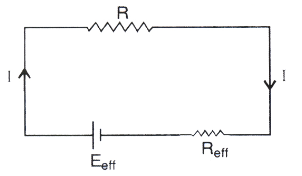
22.
()
actual transfer ; one material ; the other
23.
()
direction of propagation

12th Standard CBSE Syllabus & Materials
12th Standard CBSE
CBSE 12th Computer Science Python Revision Tour I - New Previous year Question Papers Study Material - QB365 Set A
NEW12th Standard CBSE
CBSE 12th Business Studies Planning Important Questions And Answers Study Material - QB365 Set A
NEW12th Standard CBSE
CBSE 12th Business Studies Business Environment Important Questions And Answers Study Material - QB365 Set A
NEW12th Standard CBSE
CBSE 12th Business Studies Principles of Management Important Questions And Answers Study Material - QB365 Set A



CBSE 12th Standard CBSE Subjects
CBSE Standards










