
 100% FREE ACCESS
12th Standard CBSE Syllabus & Materials
12th Standard CBSE
CBSE 12th Economics Government Budget and the Economy Previous year Question Papers Study Material - QB365 Set A
NEW12th Standard CBSE
CBSE 12th Computer Science Interface Python with MySQL - New Previous year Question Papers Study Material - QB365 Set A
NEW12th Standard CBSE
CBSE 12th Computer Science Database Concept - New Previous year Question Papers Study Material - QB365 Set A
NEW12th Standard CBSE
CBSE 12th Computer Science Data Communication - New Previous year Question Papers Study Material - QB365 Set A
NEW12th Standard CBSE
CBSE 12th Computer Science Data Structures - New Previous year Question Papers Study Material - QB365 Set A
NEW12th Standard CBSE
CBSE 12th Computer Science Functions - New Previous year Question Papers Study Material - QB365 Set A

Published on: 01/08/2018
The chapter Alcohols, Phenols and Ethers contains important questions in CBSE 12th Standard chemistry. It also covered with most important questions in Alcohols, Phenols and Ethers. Students, subscribe and get plenty of question paper with answer key. For subscription please click here.
Download CBSE Class 12th Standard CBSE Chemistry question papers, sample papers, important questions, and previous year solved papers in PDF format. Get free study materials, NCERT solutions, and exam preparation resources for Class 12th Standard CBSE Chemistry
Questions + Answers key
Take MCQ Chemistry Test
1.
How many sigma bonds present in 4-methyl phenol?
2.
Given reasons of the following:
(i) Phenol is more acidic than methanol.
(ii) The C-O-H bond angle in alcohols in slightly less than the tetrahedral angle(109 028 ' ).
3.
How would you obtain phenol from benzene?
4.
Explain why alcohols do not react with NaBr but H2SO4 is added they form alkyl bromides.
5.
Explain a process in which a biocatalyst is used in industrial preparation of compound known to you.
6.
Write the chemical equation for the preparation of phenol from benzene using oleum and sodium hydroxide.
7.
Dipole moment of diethyl ether is lower than that of
CH3OH
C6H5OH
CH3-I
CH3CHO
8.
Correct statement(s) in case of n-butanol and t-butanol is (are)
both are having equal solubility in water
t-butanol is more soluble in water than n-butanol
boiling point of t-butanol is lower than n-butanol
boiling point of n-butanol is lower than t-butanol
9.
Which of the following compounds is resistant to nucleophilic attack y hydroxyl ions?
Methyl acetate
Acetonitrile
Acetamide
Diethyl ether
10.
The major product obtained on interaction of phenol with sodium hydroxide and carbon dioxide is
salicylaldehyde
salicylic acid
phthalic acid
benzoic acid
11.
From amongst the following alcohols, the one that would react fastest with Conc.HCl and anhydrous ZnCl2, is
2-methylpropanol
1-butanol
2-butanol
2-methylpropan-2-ol
12.
Acid-catalysed hydration of alkenes except ethane leads to the formation of
primary alcohol
secondary or tertiary alcohol
mixture of primary and secondary alcohols
mixture of secondary and tertiary alcohols
13.
What is the correct order of reactivity of alcohols in the following reaction?
\(R-OH+HCI\overset { ZnCl_{ 2 } }{ \longrightarrow } R-Cl+{ H }_{ 2 }O\)
\({ 1 }^{ \circ }>{ 2 }^{ \circ }>{ 3 }^{ \circ }\)
\({ 1 }^{ \circ }<{ 2 }^{ \circ }{ >3 }^{ \circ }\)
\({ 3 }^{ \circ }>{ 2 }^{ \circ }>{ 1 }^{ \circ }\)
\({ 3 }^{ \circ }>{ 1 }^{ \circ }>{ 2 }^{ \circ }\)
14.
CH3OC2H5 and (CH3)3 COCH3 are treated with hydriodic acid. The fragments after reactions obtaind are:
CH3I+HOC2H5 ; (CH3)3C-I+HOCH3
CH3HO+C2H5I; (CH3)3C-I+HOCH3
CH3OH+C2H5I; (CH3)3C-OH+CH3I
CH3I+HOC2H5; CH3I+(CH3)3C-O H
15.
The relative ease of dehydration of alcohols follows the following order :
tertiary>secondary>primary
primary>secondary>tertiary
secondary>tertiary>primary
tertiary>primary>secondary
16.
Which of the following will produce only one product on reduction with LiAIH4?
CH3OCOCH2CH3
CH3CH2OCOCH2CH3
CH3CH2OCOCH3
CH3CH2OCOCH2CH2CH3
17.
An organic compound (A) with molecular formula C6H6O gives a characteristic colour with aqueous FeCl3 solution. When (A) is treated with CO2 and NaOH at 410K under pressure, it gives compound (B) which upon acidification gives compound (C). Compound (C) reacts with acetyl chloride to give (D) which is a popular pain killer, Deduce the structures of (A), (B), (C) and (D) and explain all the reactions involved.
1.
16 σ-bonds.
2.
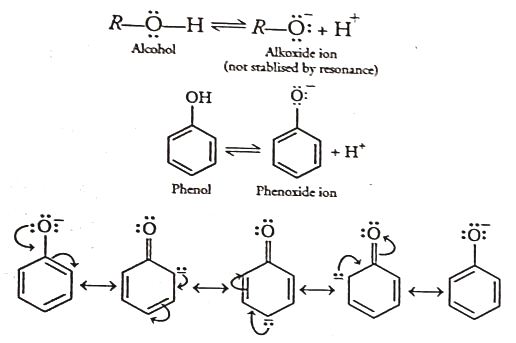
(i) The reaction of phenol with aqueous NaOH indicates that phenols are stronger acids than alcohols. It is because the phenoxide ion left after the release of a proton is stabilised by resonance but not the alkoxide ion.
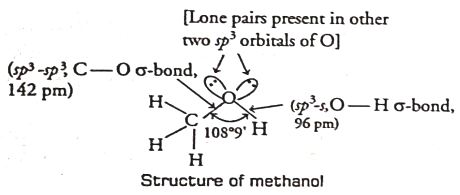
(ii) Inalcohols, the bond angle of  is 108°9'. Due to the repulsion between the unshared electron pairs of oxygen, the bond angle in alcohols is lesser than the tetrahedral angle (109°28').
3.
Benzene react with chlorine in the presenc of ferric chloride which form chlorobezene, which on further reaction with sodium hydroxide gives sodium phenoxide. Then sodium phenoxide acidified and form phenol.

4.
OH- being a strong base is a bad leaving group. When H2SO4 is added, protonation of alcohol occurs i.e -OH is converted into \(-\stackrel{+}{\mathrm{O}} \mathrm{H}_{2}\)
5.
Enzymes are biocatalyst. These biocatalysts (enzymes) are used in the industrial preparation of ethanol. Ethanol is prepared by the fermentation of molasses -a dark brown coloured syrup left after crystallisation of sugar which still contains about 40% of sugar. In winemaking, grapes are the source and yeast.
6.

7.
(a)
CH3OH
8.
(c)
boiling point of t-butanol is lower than n-butanol
9.
(d)
Diethyl ether
10.
(b)
salicylic acid
11.
(c)
2-butanol
12.
(b)
secondary or tertiary alcohol
13.
(c)
\({ 3 }^{ \circ }>{ 2 }^{ \circ }>{ 1 }^{ \circ }\)
14.
(a) CH3OC2H5 undergoes cleavage by SN2 mechanism to give CH3I and C2H5OH while (CH3)3COCH3 undergoes cleavage by SN1 mechanism to give (CH3)3CI and CH3OH.
15.
(a)
tertiary>secondary>primary
16.
(c), esters having the same number of carbon atoms in the alkyl and acyl group, i.e., CH3CH2 and COCH3 group in CH3CH2OCOCH3.
17.
(i) Since compound (A) with M.F. C6H6O gives characteristic colour with FeCI3, therefore, (A) must be phenol.
(ii) Since compound (A), i.e., phenol reacts with CO2 and NaOR under pressure (i.e., Kolbe's reaction) to give compound (B) which on acidification gives compound (C), therefore, (B) must be sodium salicylate and (C) must be salicylic acid.
(iii) Since (C) reacts with acetyl chloride to form a popular pain killer (D), therefore, (D) must be aspirin.

12th Standard CBSE Syllabus & Materials
12th Standard CBSE
CBSE 12th Computer Science Python Revision Tour I - New Previous year Question Papers Study Material - QB365 Set A
NEW12th Standard CBSE
CBSE 12th Business Studies Planning Important Questions And Answers Study Material - QB365 Set A
NEW12th Standard CBSE
CBSE 12th Business Studies Business Environment Important Questions And Answers Study Material - QB365 Set A
NEW12th Standard CBSE
CBSE 12th Business Studies Principles of Management Important Questions And Answers Study Material - QB365 Set A



CBSE 12th Standard CBSE Subjects
CBSE Standards










