
 100% FREE ACCESS
12th Standard CBSE Syllabus & Materials
12th Standard CBSE
CBSE 12th Economics Government Budget and the Economy Previous year Question Papers Study Material - QB365 Set A
NEW12th Standard CBSE
CBSE 12th Computer Science Interface Python with MySQL - New Previous year Question Papers Study Material - QB365 Set A
NEW12th Standard CBSE
CBSE 12th Computer Science Database Concept - New Previous year Question Papers Study Material - QB365 Set A
NEW12th Standard CBSE
CBSE 12th Computer Science Data Communication - New Previous year Question Papers Study Material - QB365 Set A
NEW12th Standard CBSE
CBSE 12th Computer Science Data Structures - New Previous year Question Papers Study Material - QB365 Set A
NEW12th Standard CBSE
CBSE 12th Computer Science Functions - New Previous year Question Papers Study Material - QB365 Set A

Published on: 27/05/2021
QB365 Provides the HOT Question Papers for Class 12 Physics, and also provide the detail solution for each and every HOT Questions. HOT Questions will help to get more idea about question pattern in every exams and also will help to get more marks in Exams
Download CBSE Class 12th Standard CBSE Physics question papers, sample papers, important questions, and previous year solved papers in PDF format. Get free study materials, NCERT solutions, and exam preparation resources for Class 12th Standard CBSE Physics
Questions + Answers key
Take MCQ Physics Test1.
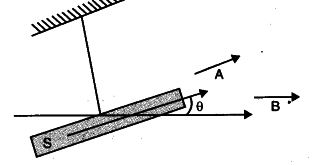
A magnetic dipole is placed in a uniform magnetic field with its axis tilted with respect to its position of stable equilibrium. Deduce an expression for the time period of (small amplitude) oscillation of this magnetic dipole about an axis, passing through its centre and perpendicular to its plane. If this bar magnet is replaced by a combination of two similar bar magnets, placed over each other, how will the time period vary?
2.
(i) In a double slit experiment using light of wavelength 600 nm, the angular width of the fringe formed on a distant screen is \(0.1^o\) . Find the spacing between the two slits.
(ii) Light of wavelength 5000\(\dot { A } \) propagating in air gets partly reflected from the surface of water. How will the wavelengths and frequencies of the reflected and refracted light be affected?
3.
A teacher has given three lenses of power 0.5D, 4D and 10D to a studet. He is not sure as to which lens should he use for constructing a good astronomical telescope. So, he consults his seniors and the teacher, and then constructs a telescope. Later, he shows this telescope to the junior classes and ex[plains about the choice of lenses.
Read the above passage and give the answer of the following questions:
(i) What values has he shown by doing these?
(ii) Which lenses are used as objective and which one as eyepiece?
4.
A group of students while coming from the school noticed a box marked "Danger HT 2200 V" at a substation in the main street. They did not understand the utility of a such high voltage, while they argued, the supply was only 220 V. They asked their teacher this question the next day. The teacher thought it to be an important question and therefore explained to the whole class.
Answer the following questions:
(i) What device is used to bring the high voltage down to low voltage of AC current and what is the principle of its working?
(ii) Is it possible to use this device for bringing down the high DC voltage to the low voltage? Explain.
(iii) Write the values displayed by the students and the teacher.
5.
Mandeep's mother had put lot of clothes for washing in the washing machine, but the machine did not start and an indicator was showing that the lid of the machine did not close. Mandeep seeing his mother disturbed thought that, he would close the lid by applying some force but would close the lid by applying some force but realised that the mechanism was different. It was a magnetic system. He went to the shop and got a small magnetic door closer and put it on the lid of the machine. The machine started working. His mother was happy that Mandeep helped her to save 500 rs also.
i) What were the values developed by Mandeep?
ii) What values did his mother impart to Mandeep?
iii) Every magnetic configuration has a North pole and a South pole, What about the field due to toroid?
6.
A resistor of \(400\Omega \) an inductor of \(\frac { 5 }{ \pi H } \)and a capacitor of \(\frac { 50 }{ \pi } \mu F\) are connected in series across a source of alternating voltage of 140 \(sin\ \pi t\ V\). Find the voltage (rms) across the resistor, the inductor and the capacitor. Is the algebraic sum of these voltage more than the source voltage? If yes, resolve the paradox.
7.
The critical angle between a given transparent medium and air is denoted by C. A ray of light in air enters this transparent medium at an angle of incidence equal to polarizing angle p. Deduce a relation for the angle of refraction in terms of C.
1.
\(sin\theta =\theta \)
\(\tau =mB\quad sin\theta =mB\theta \)
This torque is in the nature of a restoring torque.
Hence equation of motion, for the oscillatory motion, of the magnet is
\(I\frac { { d }^{ 2 }\theta }{ dt^{ 2 } } =-mB\theta \)
This is the equation of a S.H.M.
\(\frac { { d }^{ 2 }\theta }{ dt^{ 2 } } +\omega ^{ 2 }\theta =0\)
where \({ \omega }^{ 2 }=\frac { mB }{ I } \)
Hence the time period of oscillation of the magnet is given by
\(T=\frac { 2\pi }{ \omega } \)
\(=2\pi \sqrt { \frac { I }{ mB } } \)
mnet = 2m
Inet = 2I
\(\Rightarrow \) T will remain same.
2.
(i) Here,
\(\lambda =600 \ nm=600\times { 10 }^{ -9 }m=6\times { 10 }^{ -7 }m\)
\(\theta ={ 0.1 }^{ \circ }=\frac { 0.1\pi }{ 180 } rad,d=?\)
From angular width,\(\theta =\frac { \lambda }{ d } \)
\(\Rightarrow \ d=\frac { \lambda }{ \theta } =\frac { 6\times { 10 }^{ -7 } }{ \frac { \pi }{ 180 } \times 0.1 } =3.44\times { 10 }^{ -4 }m\)
(ii) The frequency and wavelength of reflected wave will not change. The refracted wave will have same frequency. The velocity of light in water is given by \(v=f\lambda \)
where, v = velocity of light
f = frequency of light
\( lambda =wavelength \ of \ light\)
If velocity will decrease, then wavelength (\(\lambda \)) will also decrease.
3.
(i) The values shown by him are as follows:
(a) Consulting others in case of need
(b) Curosity
(c) Sharing knowledge.
(ii) From these three lenses, he will use a lens of power 0.5D for objective and lens of power 10D for eyepiece.
4.
(i) The device that is used to bring high voltage down to low voltage of an AC current is a transformer. It works on the principle of mutual induction of two windings or circuits. When current in one circuit changes, emf is induced in the neighbouring circuit.
(ii) The transformer cannot convert DC voltages because it works on the principle of mutual induction. When the current linked with the primary coil changes, the magnetic flux linked with secondary coil also changes. This change in flux induces emf in the secondary coil. If we apply a direct current to the primary coil, then current will remain constant. Thus there is no mutual induction, and hence, no emf is induced.
(iii) The value of gaining knowledge and curiosity about learning new things is being displayed by the students. The value of providing good education and undertaking the doubts of students has been displayed by teacher.
5.
i) The values developed by Mndeep were sympathy, responsibility, helping nature and self-reliance.
ii) The vlue imparted by mother are appreciation and thankfulness.
iii) It is not necessary that every magnetic configuration has a North pole and a South pole.It is true only if the source of the field has a net non-zero magnetic moment.This is not possible for a toroid or even for a straight infinite conductor.
6.
Applied voltage, V = 140 \(sin\ 100\pi t\ V\)
\(C \ = \ \frac { 50 }{ \pi } \mu F=\frac { 50 }{ \pi } \times { 10 }^{ -6 }F.\\ L \ = \ \frac { 5 }{ \pi } H, \ R=400\Omega \)
Comparing with V = V0 \(sin\ \omega t,\) we get
V0 = 140 V and \(\omega =100\pi \)
Inducting reactance,
\({ X }_{ L }=\omega L=100\pi \times \frac { 5 }{ \pi } =500\Omega \)
Capacitive reactance,
\({ X }_{ C }=\frac { 1 }{ \omega C } =\frac { 1 }{ 100\pi \times \frac { 50 }{ \pi } \times { 10 }^{ -6 } } \)
\(=200\Omega \quad \)
Impedance of the circuit,
\(Z=\sqrt { { R }^{ 2 }+({ X }_{ L }-{ X }_{ C })^{ 2 } } \)
\(=\sqrt { ({ 400) }^{ 2 }+({ 500-200) }^{ 2 } } \)
\( =\sqrt { 1600+900 } \ = \ 500\Omega \)
Maximum current in the circuit,
\({ I }_{ 0 }=\frac { { V }_{ 0 } }{ Z } =\frac { 140 }{ 500 }\)
\( { I }_{ rms }=\frac { { I }_{ 0 } }{ \sqrt { 2 } } =\frac { 140 }{ 500\times \sqrt { 2 } } =0.2\quad A\)
\({ V }_{ rms }\) across resistor, VR = Irms R
\(=0.2\times 400\ =\ 80V\)
Vrms across capacitor, VC = Irms XL
\(=0.2\times 200\ =\ 40V\)
Now, \(V\neq { V }_{ R }+{ V }_{ L }+{ V }_{ C }\)
Because VC,VL and VR are not in same phase, instead
\(V=\sqrt { { V }_{ R }^{ 2 }+({ V }_{ L }-{ V }_{ C })^{ 2 } } \)
\(=\sqrt { { 80 }^{ 2 }+({ 100-40) }^{ 2 } } =100V\)
Which is same as that of applied rms voltage.
7.
According to Brewster's law,
\(\mu =tanp....(i)\)
\(Also \ \mu =\frac { 1 }{ sin\quad C } .....(ii)\)
\( From \ (i) \ and \ (ii), \ tanp=\frac { 1 }{ sin \ C } \)
\(If \ r \ is \ angle \ of \ refraction, \ then \ p=90°-r\)
\(or \ tan \ r=sin \ C \ r={ tan }^{ -1 }(sin \ C)\)

12th Standard CBSE Syllabus & Materials
12th Standard CBSE
CBSE 12th Computer Science Python Revision Tour I - New Previous year Question Papers Study Material - QB365 Set A
NEW12th Standard CBSE
CBSE 12th Business Studies Planning Important Questions And Answers Study Material - QB365 Set A
NEW12th Standard CBSE
CBSE 12th Business Studies Business Environment Important Questions And Answers Study Material - QB365 Set A
NEW12th Standard CBSE
CBSE 12th Business Studies Principles of Management Important Questions And Answers Study Material - QB365 Set A



NCERT Books

Syllabus

Exam Pattern

Sample Question Papers

Previous year Question Papers

Important Notes

MCQ Practice test

NCERT Exemplers

Case study Questions

Image Based Questions

Passage based Questions

HOT Questions

Value Based Questions

Model Questions Papers
NCERT ( Book Back ) Questions

Assertion and Reason
Important Questions And Answers

CBSE 12th Standard CBSE Subjects
CBSE Standards









