
 100% FREE ACCESS
12th Standard CBSE Syllabus & Materials
12th Standard CBSE
CBSE 12th Economics Government Budget and the Economy Previous year Question Papers Study Material - QB365 Set A
NEW12th Standard CBSE
CBSE 12th Computer Science Interface Python with MySQL - New Previous year Question Papers Study Material - QB365 Set A
NEW12th Standard CBSE
CBSE 12th Computer Science Database Concept - New Previous year Question Papers Study Material - QB365 Set A
NEW12th Standard CBSE
CBSE 12th Computer Science Data Communication - New Previous year Question Papers Study Material - QB365 Set A
NEW12th Standard CBSE
CBSE 12th Computer Science Data Structures - New Previous year Question Papers Study Material - QB365 Set A
NEW12th Standard CBSE
CBSE 12th Computer Science Functions - New Previous year Question Papers Study Material - QB365 Set A

Published on: 02/11/2025
Download CBSE Class 12th Standard CBSE Biology question papers, sample papers, important questions, and previous year solved papers in PDF format. Get free study materials, NCERT solutions, and exam preparation resources for Class 12th Standard CBSE Biology
Questions + Answers key
Take MCQ Biology Test
1.
Why are green plants not found beyond certain depth in the ocean?
2.
State the effect of UV-B on human eyes.
3.
Name the interspecific interaction in which one is detrimental while the other is neutral.
4.
How do snails escape from the stressful time in summer?
5.
Suggest any two techniques which can help in early detection of bacterial/viral inflection much before the symptoms appear in the body.
6.
Biodiversity must be conserved as it plays an important role in many ecosystem services that nature provides. Explain any two services of the ecosystem.
7.
What is genetic diversity? Explain.
8.
How is transgenic tobacco plant protected against Meloidogyne incognita? Explain the process.
9.
How does global warming pose a threat to the coastal areas of the earth?
10.
Explain the defence mechanisms evolved in preys to avoid overpopulation of their predators.
11.
How do desert lizards cope with temperature variations in their environment? Explain.
12.
How is recombinant DNA technology helping in detecting the presence of mutant genes in cancer patients?
13.
Give an account of energy flow in an ecosystem.
14.
What is ADA deficiency? Describe three methods to cure it.
15.
Why should biodiversity be conserved? Explain giving three reasons.
16.
"Man can be primary as well as secondary consumer". Justify this statement.
17.
Explain co-evolution with reference to parasites and their hosts. Mention any four special adaptive features evolved in parasites for their parasitic mode of life.
18.
Why is thermal pollution harmful to aquatic animals?
19.
What are genetically modified organisms?
20.
Why does the ozone hole form over Antarctica? How will enhanced ultraviolet radiation affect us?
21.
Explain biomagnification. How does the biomagnification of DDT affect the population of fish-eating birds?
22.
Why should the spraying DDT as an insecticide on vegitable crops be banned?Explain
23.
How do organisms like fungi, zooplanktons and bears overcome the temporary, short-lived climatic stressful conditions? Explain.
24.
(a) List any three ways of measuring population density of a habitat.
(b) Mention the essential information that can be obtained by studying the population density of an organism.
25.
Construct a pyramid of biomass starting with phytoplanktons.Label three trophic level.Is the pyramid upright or inverted?Why?
1.
()
The sunlight cannot penetrate beyond certain line.
2.
()
1. High dose of UV-B causes inflamation of cornea, called snow-blindness and also cataract.
2. It may permanently damage the cornea.
3.
()
Amensalism.
4.
()
Snails go into aestivation in summers.
5.
()
(i) Enzyme-linked immunosorbent assay (ELISA) test.
(ii) Polymerase chain Reaction (PCR)
6.
Biodiversity plays major role in many ecosystem services that nature provides:
1. Amazon forests produce 20 percent of total oxygen of earth's atmosphere through photosynthesis.
2. Ecosystems provide pollinator layers, bees, birds, and bats.
7.
Genetic Diversity.
(i) Greater the genetic diversity among organisms of a species, more sustenance it has against environmental perturbations, The genetically uniform populations are highly prone to diseases and harsh environment.
(ii) The genetic variation shown by Rauwolfia can be in terms of the conservation and potency of the chemical reserpine.
There are more than 50,000 genetically different strains of rich and 1000 varieties of mango in India.
8.
Nematode-resistant tobacco plants are produced through RNA interference. The process RNA interference (RNAi) involves silencing of a specific mRNA.
A complementary double-stranded RNA binds to the mRNA and prevents its translation.
The complementary! RNA for making the double stranded RNA comes either from an infection by RNA viruses or mobile genetic elements, called transposons, which replicate through an RNA-intermediate.
The nematode-specific genes were introduced into the host plant by the use. of Agrobacterium vectors.
The introduction of DNA is such that it produced both sense and anti-sense RNA in the host cells.
These two RNAs are complementary to each other and hence form a double-stranded RNA, which initiates the RNA interference and silencing of mRNA.
The parasite could not live in such a transgenic host that expresses the specific interfering double-strandedRNA; so, the transgenic plant is protected from the nematode.
9.
1. It is believed that the rise in temperature is leading to deleterious changes in the environment and resulting in odd climatic changes (like EI Nino-effect) leading to increased melting of polar ice caps and snow caps in other places like Himalayas.
2. Over many years, this will result in a rise in sea level that can submerge many coastal areas.
10.
(i) Certain insect species and frogs have camouflage (cryptic colouration) to avoid detection by their predators.
(ii) Some animals are highly distasteful to their predators, e.g. monarch butterfly accumulates a chemical by feeding on a poisonous weed during its caterpillar stage.
(iii) Some prey are poisonous and hence are avoided by predators.
(iv) Plants have developed thorns and spines as defence mechanism against browsing animals.
(v) Some plants produce certain chemicals which affect the metabolism of the herbivores.
11.
Desert lizards cope with the temperature variations in their habitat by behaviour means.
They bask in the sun and absorb heat when their body temperature drops below the comfort zone.
They move into the shade when the temperature starts increasing.
12.
A single-stranded DNA or RNA is tagged with a radioactive molecule and used as a probe.
It is allowed to hybridise with its complementary DNA in a clone of cells, followed by detection using autoradiography.
The clone having the mutant gene will not appear on the photographic film, because the probe will not be complementary with the mutated gene.
13.
1. Sun is the ultimate source of energy for all ecosystems on the earth.
2. Only about 50% of the incident solar radiation is photosynthetically active radiation (PAR).
3. Plants capture only 2-10% of the PAR and all organisms are dependent for their food on producers, either directly or indirectly.
4. The flow of energy from the sun to producers and then to consumers is unidirectional and is keeping with the first law of thermodynamics.
5. Ecosystems need a continuous supply of energy for the synthesis of molecules needed and to counteract the tendency towards increasing disorderliness, i.e. energy flow follows the second law of thermodynamics too.
14.
Deletion of the gene for ADA causes ADAdeficiency, i.e. deficiency of adenosine deaminase, the enzyme which is crucial for the normal functioning of our immune system.
ADA deficiency can be cured by:
(i) Bone marrow transplantation.
(ii) Enzyme replacement therapy in which functional ADA is given by injection.
(iii) Gene therapy, in which functional ADA cDNA is introduced into lymphocytes or into cells at early embryonic stage.
15.
Narrowly utilitarian: Humans derive direct economic benefits from nature (or explained with example). Broadly utilitarian: Provides many ecosystem services such as provide oxygen (through photosynthesis) prevents pollution, provides aesthetic pleasure.
Ehical: We share this planet with millions of other organisms and every species has intrinsic value and it is our moral duty to conserve them and pass on the legacy to future generation.
16.
Man can be a primary as well as secondary consumer because man eats plants as well as meat of other animals. So, man is herbivores as well as carnivores.
17.
Co-evolution is a phenomenon where many parasites have evolved to be host-specific in such a way that both the host and parasite tend to co-evolve, i.e.if the host develops/evolves special mechanism for rejecting or resisting the parasite the latter has to evolve mechanism to counteract and neutralise them to succeed with the same host species, e.g. malarial parasite.
Parasites have special adaptations according to their lifestyles such as; loss of unnecessary sense organs, presence of adhesive organs or suckers, loss of digestive system and high reproductive system
18.
Warm water can hold much less dissolved oxygen than cold water. Also, rise in temperature speeds up animal metabolism increasing O2 requirement thus further aggravating O2 problem for aquatic animals.
19.
Genetically modified organisms are the living organisms (plants, animals, or bacteria) which have been genetically 'engineered' by the insertion of a foreign gene (a transgene).
20.
1. In Antarctica, winter (June to August) months receive no sunlight and the temperature is about - 85 °C that facilitates the formation of ice clouds.
2. The Antarctica air is completely isolated from the rest of the world by a natural circulation of wind, called polar vortex.
3. The ice clouds provide a catalytic surface on which the chlorine atoms react with ozone and degrade it; since light is necessary,it happens with the return of sun in spring .(September and October).
Effects:
The UV-B radiation reaches the earth and causes the following :
(i) It damages the DNA and mutations arise.
(ii) It causes ageing of skin, damage to skin cells and ultimately causes skin cancer.
(iii) It causes inflammation of cornea (called snow-blindness) and cataract.
(iv) It is lethal to microbes.
21.
1. It refers to the increase in concentration of the harmful/toxic substances at successive trophic levels.
2. It happens because such harmful/toxic substances can neither be metabolised nor excreted, but are passed onto the next (higher) trophic level.
3. In fish-eating birds, the high concentrations of DDT disturb the calcium metabolism.
4. It causes thinning of eggshell and the premature breaking of such eggs leads to a decline in bird populations of fish-eating birds.
22.
1. When DDT is: sprayed on the crop plants, it remains in the soil as it is non-biodegradable and enters the plant.
2. As it travels through food chain, it undergoes biomagnification, i.e. increase in concentration at successive higher trophic levels, as it can neither be metabolised nor excreted; this causes disorders in those organisms.
3. In birds, a high concentration of DDT interferes with calcium metabolism and causes thinning of egg shells leading to their premature breaking; consequently there is a decline in bird population.
23.
Fungi produce various kinds of thick-walled spores to survive under unfavorable conditions; they germinate when conditions become favorable.
Zooplanktons enter diapause, a stage of suspended development, under unfavourable conditions.
Bears go into hibernation during winter to escape in time of unfavourable conditions.
24.
(a) (i) Per cent cover.
(ii) Number caught per trap for fishes.
(iii) Pug marks or faecal pellets for tiger census.
(b) The population density tells us about the status of a species, i.e. the outcome of competition, impact of predation, or effect of pesticides, etc.
25.
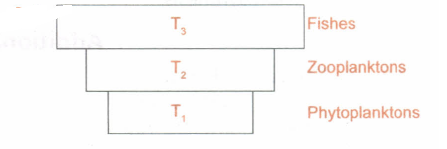
1. The pyramid is inverted.
2. Since the biomass of fishes far exceeds that of the phytoplanktons, the pyramid is inverted.

12th Standard CBSE Syllabus & Materials
12th Standard CBSE
CBSE 12th Computer Science Python Revision Tour I - New Previous year Question Papers Study Material - QB365 Set A
NEW12th Standard CBSE
CBSE 12th Business Studies Planning Important Questions And Answers Study Material - QB365 Set A
NEW12th Standard CBSE
CBSE 12th Business Studies Business Environment Important Questions And Answers Study Material - QB365 Set A
NEW12th Standard CBSE
CBSE 12th Business Studies Principles of Management Important Questions And Answers Study Material - QB365 Set A



NCERT Books

Syllabus

Exam Pattern

Sample Question Papers

Previous year Question Papers

Important Notes

MCQ Practice test

NCERT Exemplers

Case study Questions

Image Based Questions

Passage based Questions

HOT Questions

Value Based Questions

Model Questions Papers
NCERT ( Book Back ) Questions

Assertion and Reason
Important Questions And Answers

CBSE 12th Standard CBSE Subjects
CBSE Standards








