
 100% FREE ACCESS
12th Standard CBSE Syllabus & Materials
12th Standard CBSE
CBSE 12th Economics Government Budget and the Economy Previous year Question Papers Study Material - QB365 Set A
NEW12th Standard CBSE
CBSE 12th Computer Science Interface Python with MySQL - New Previous year Question Papers Study Material - QB365 Set A
NEW12th Standard CBSE
CBSE 12th Computer Science Database Concept - New Previous year Question Papers Study Material - QB365 Set A
NEW12th Standard CBSE
CBSE 12th Computer Science Data Communication - New Previous year Question Papers Study Material - QB365 Set A
NEW12th Standard CBSE
CBSE 12th Computer Science Data Structures - New Previous year Question Papers Study Material - QB365 Set A
NEW12th Standard CBSE
CBSE 12th Computer Science Functions - New Previous year Question Papers Study Material - QB365 Set A

Published on: 28/11/2025
Download CBSE Class 12th Standard CBSE Biology question papers, sample papers, important questions, and previous year solved papers in PDF format. Get free study materials, NCERT solutions, and exam preparation resources for Class 12th Standard CBSE Biology
Questions + Answers key
Take MCQ Biology Test
1.
Explain GIFT and ICSI
2.
How many eggs are present in an embryo sac?
3.
Which type of cell division forms spermatids from the secondary spermatocytes?
4.
Name the respective asexual reproductive structure of Yeast and Sponge.
5.
Answer the following questions related to Down's syndrome.
(i) When was Down's syndrome first described?
(ii) What is its frequency in human and does it also occur in other animals?
(iii) How does Down's syndrome arise?
(iv) Related it with chromosome dysfunctions.
6.
(a) Why should we conserve biodiversity? How can we do it?
(b) Explain the importance of biodiversity hot spots and sacred groves.
7.
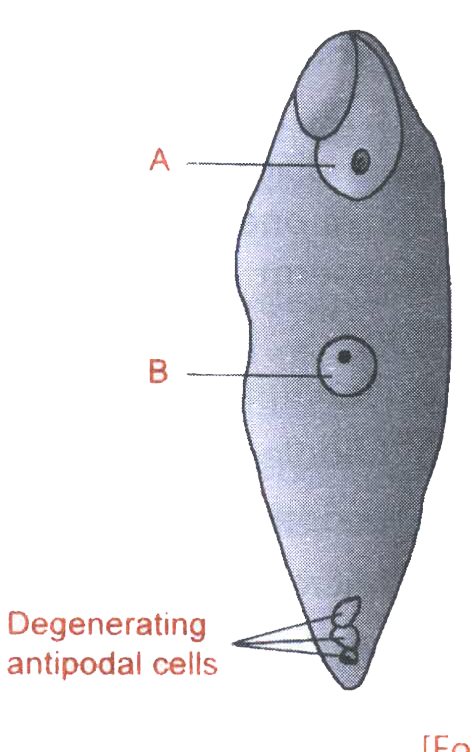
(a) Name the structures which the parts 'A' and 'B' shown in the diagram below respectively develop into.
(b) Explain the process of development which 'B' undergoes in albuminous and exalbuminous seeds. Give one
example of each of these seeds.
8.
(a) Name the primates that lived about 15 million years ago. List their characteristic features.
(b) (i) Where was the first man-like animal found?
(ii) Write the order in which Neanderthals, Homo habilis and Homo erectus appeared on the earth. State the brain capacity of each one of them.
(iii) When did modern Homo sapiens appear on this planet?
9.
Explain the steps involved in the production of genetically engineered insulin why is the insulin thus produced preferred to the one produced from non- human sources?
10.
A farmer cultivates sugar cane and rose by usin stem cuttings. He found that some of the cuttings did not continue to grow into new plants. As a student of Agriculture; Shanu gives some points to be followed.
(a) Can you suggest a reason for this?
(b) Enlist the aspects that Shanu must have given for consideration, while preparing stem cuttings for propagation.
(c) Name two other plants which are also propagated by stem cuttings.
(d) What value (s) is/are shown by Shanu?
11.
What is transcription unit?
12.
What is sex linkage?
13.
What is puberty and when does it occur in a human male and human female?
14.
Define ornithophily, chiropterophily and malacophily.
15.
How can the DNA segments separated by gel electrophoresis be visualised and isolated?
16.
Who had proposed the chromosomal theory of the inheritance?
17.
Three food chains are shown below:
1. Grass\(\rightarrow\)Deer \(\rightarrow\) Tiger
2. Tree \(\rightarrow\) Beetle \(\rightarrow\) Bacteria
3. Flowering plant \(\rightarrow\) Butterfly \(\rightarrow\) Bird
They can be represented by the three pyramids of numbers P, Q and R below:

Write the correct combination that correctly matches food chains and pyramids.
18.
How did the process of RNA interference help to control the nematode from infecting the roots of tobacco plants?
19.
At what stages does Plasmodium gain entry in to human body? Write the different stages of its life cycle in the human body.
20.
What is the function of hairy coat in most mammals, blubber in whales and seals, and feathers in birds?How do these animals regulate their body temperature?
21.
Identify the phenomenon in the following example-
"Sickle cell anaemia is an autosomal recessive trait.It is caused by the substitution of anino acid glutamic acid by valine at the sixth position of the beta globin chain of haemoglobin.This substitution of amino acid occurs due to phenomenon in which the sixth codon of beta globin gene is transformed from GAG to GUG".
22.
Name the blank spaces a,b,c and d from the table given below:
| Bacterium | a | lactic acid |
| Fungus | b | Cyclosporin A |
| c | monascus purpureus | statins |
| fungus | penicillium notatum | d |
23.
Write critical notes on eutrophication.
24.
Describe the process of gene amplification for rDNA technology experiments.
25.
Convergent evolution and divergent evolution are the two concepts explaining organic evolution. Explain each one with the help of an example.
26.
Explain what is meant by biofortification.
27.
Study the given figure
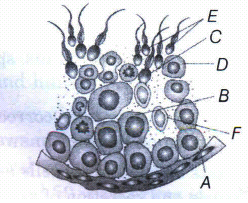
(i) Pick out and name the cells that undergo spermiogenesis.
(ii) Name 'A' and 'B' cells. What is the difference between them with reference to the number of chromosome?
(iii) Pick out and name the motile cells.
(v) What is 'F' cell? Mention its function?
(iv) Name the structure of which the given diagram is a part?
1.
()
GIFT-Gamete Intra Fallopian Transfer
ICSI-Intra-Cytoplasmic Sperm Injection
2.
()
One
3.
()
Meiosis II (similar to mitosis).
4.
()
Yeast- Buds
Sponge - Gemmules
5.
(i) It was first described in 1866 by J Langdon Down, so it is called Down's syndrome.
(ii) About 1 in every 750 children exhibits Down's syndrome throughout the world. It is also seen in chimpanzees and other related primates.
(iii) In humans, it comes as a result of non-disjunction of chromosome 21 during egg formation. The cause of this primary non-disjunction is not known.
(iii) The defect is associated with a particular small portion of chromosome 21. When this particular chromosome segment is present due to translation in three copies, instead of two, Down's syndrome occur.
6.
(a) Why should we Conserve biodiversity :
1. Narrow utilitarian arguments Human being draw.direct economic benefits from nature like food,firewood, fibre, construction materials, industrial products, medicines etc.
2. Broadly utilitarian arguments.
Biodiversity plays major role in maintaining and sustaining supplyofgoodsand services(i) Amazonforests provide 20% of oxygen present in atmosphere. (ii) Ecosystemprovidepollinatores.
3.Ethical reasons. Every organism have intrinsic value even if there is no economicvalue. Conservation of biodiversity.
(b) Importance of biodiversity hot-spots and sacred groves They provide protection of species richness and high degree of endemism in natural Habitat. Hot Spots are regions of igh level of species in their natural habitat. Sacret groves are forest tracts set aside and all trees and wildlife within area are giventotal protection.
7.
(a) A develops into the embryo.
B develops into the endosperm.
(b) 1. The endosperm development starts from the primary endosperm cell containing the primary endosperm nucleus.
2. In the most common type of endosperm development, the primary endosperm nucleus undergoes successive free nuclear divisions to give rise to a number of free nuclei; at this stage, it is called free nuclear endosperm.
3. Subsequently wall formation takes place from the periphery and proceeds towards the centre and the endosperm becomes cellular.
4. This type of endosperm development is seen in coconut; the water of the tender coconut represents the free nuclear endosperm with thousands of nuclei in it and the white kernel around it represents the cellular endosperm.
5. In albuminous seeds, some amount of endosperm persists in the mature seed, as the developing' embryo does not consume it fully, e.g. wheat/maize.
6. In exalbuminous seeds, the endosperm is completely consumed by the developing embryo before seed maturation, e.g. groundnut and pea.
8.
(a) Dryopithecus and Ramapithecus:
Characteristics:
(i) They were hairy.
(ii) They walked like gorillas and chimpanzees.
(iii) Ramapithecus was more man-like while Dryopithecus was more ape-like.
(b) (i) East African grasslands.
(ii) Homo habilis, Homo erectus and Neanderthals had brain capacities of 650-800 cc, 900 cc and 1400 cc, respectively.
(iii) During the ice age between 75,000-10,000 years ago.
9.
The mature/functional insulin consists of two polypeptide chains, coded by two genes.
The American Company, Eli Lilly, prepared the two genes or DNA sequences coding for the two polypeptide chains.
The genes were introduced into the plasmid of bacterium E.coli.
The bacterium produces the polypeptides which are secreted in the medium.
They are isolated from the medium and combined by creating disulphide bonds into functional insulin.
Since, genetically engineered insulin does not induce any immunological response, unlike insulin from other non-human sources, it is preferred.
10.
(a) (i) The polarity of the cutting would not have been correct.
(ii) It can be due to absence of buds.
(iii) The cutting may have been selected from a very old branch.
(b) (i) The cutting must be selected from a branch that is neither very old nor very young.
(ii) There should be enough number of buds.
(iii) The polarity of the cutting should be considered.
(iv) The season of growing must be properly selected.
(c) Bougainvillea, china rose, cotton, etc.(any two)
(d) Shanu's concern for fellow citizen and use of his knowledge for the benefit of the society
11.
The bases of DNA sense strands from the promoter to the terminator sites from transcription unit
12.
Sex-Linkage Or Sex-Linked Inheritance is the transmission of characters and their determining genes which are borne on the sex chromosomes and therefore are inherited together from one generation to the next.
Y-chromosome of male does not carry any gene other than TDF (testis determining factor).
It is estimated that in Drosophila melanogaster the X-chromosome (called X-linked genes bears) 150 genes while in human being it is 102.Two important sex-linked human diseases are hemophilia and colour blindness.The genes present on Y-chromosomes are called holandric genes.
Sex-linked inheritance was discovered by Thomas H.Morgan and named it as Sex-Linkage.
13.
Puberty. The period at which the generative organs become capable of exercising the function of reproduction is called puberty.It extends from 12 to 17 years of age in human beings.
14.
Ornithophily. Pollination carried out by small birds is called ornithophily. e.g. Australian plants.
Chiropterophily. It is pollination by bats. e.g. Sausage tree.
Marcophily. Snails also bring pollination, it is termed malacophily.
15.
The separated DNA fragments are stained with ethidium bromide.
Then by exposure to UV-radiation, the separated DNAs become visible as orange-coloured bands.
The separated bands of DNA are cut out from the agarose gel and DNA is extracted from these gel pieces by the process known as elution
16.
Sutton and Boveri.
17.
p \(\rightarrow\) 3, Q\(\rightarrow\)1, R\(\rightarrow\)2
18.
RNA interference is a gene-silencing process that blocks the expression of genes in the parasite when it enters the host's body.
19.
The part of life cycle of Plasmodium spent in human body includes following stages:
(i) Sporozoites enter the human body through the bite of infected female Anopheles mosquito (vector)
(ii) From the blood, they enter liver cells and multiply within the liver cells.
(iii) Infected liver cells burst and release the parasites again in the blood.
(iv) They attack RBCs repeatedly, multiply and cause their rupture.
(v) Ruptured RBCs release a toxin called haemozoin which is responsible for high recurring fever and resultant chill/shivering.
(vi) When a female Anopheles mosquito bites an infected person, these parasites enter the mosquito body and undergo further development
20.
These animals have insulating coat of hair or blubber or feathers to check loss of body heat.These animals regulate their body temperature by physiological means and maintain more or less constant internal temperature.They are, thus, termed endotherms.
21.
The phenomenon is point mutation that involves substitution of a single nitrogenous base in DNA.
22.
(a) Lactobacillus
(b) Trichoderma polysporum
(c) Yeast
(d) Penecillin
23.
Eutrophication
Eutrophication is defined as the process of nutrient enrichment of water and consequent loss of species diversity in water bodies.
1. Increased nutrient content of the water body causes algal bloom, i.e. excess growth of algae, especially cyanobacteria.
2. It covers the water surface, secretes toxins and reduces the dissolved oxygen content of water.
3. These toxins inhibit the growth of other algae and plants and cause death of aquatic animals.
4. Oxygen deficiency may be a cause for death of animals.
24.
Polymerase Chain Reaction:
Multiple copies of the desired gene or segment of DNA, can be synthesised in vitro using two sets of primers, the oligonucleotides that are complementary to the regions of DNA of the two strands and the enzyme DNA polymerase.
This enzyme extends the primers using the nucleotides provided in the reaction and the genomic DNA as the template.
For repeated amplification to be achieved, a thermostable DNA polymerase (Taq polymerase), extracted from the bacterium, Thermus aquaticus is employed; it remains active during the high temperature treatment used for denaturation and separation of the two strands.
25.
Convergent evolution:
It is the evolutionary process in which anatomically different organs in different groups of organisms, evolve towards the same function.
Analogous organs are the result of convergent evolution, e.g. Sweet potato (root modification) and potato (stem modification) are analogous, as they both are tuberous with stored food materials.
Divergent evolution:
It is the evolutionary process in which the same structure develops in different directions in different groups of organisms as adaptations to different needs.
Homologous organs are the result of divergent evolution, e.g. human hands are homologous to the wings of a bird, as their basic structure (number and types of bones) is similar.
26.
Biotortification refers to breeding of crops to produce varieties with higher levels of nutrients like vitamins, minerals,proteins or healthier fats.
The objective is to improve:
(i) Protein content and quality
(ii) Oil content and quality
(iii) Vitamin content and
(iv) Micronutrient and mineral content.
Many nutrient-enriched varieties have been produced as given below.
27.
(i) A-Spermatids, undergo spermiogenesis
(ii) A-Spermatids, B-Spermatogonium.
Spermatogonium (B) are diploid and have 46 chromosomes in humans, while spermatids (A) are haploid and have 23 chromosomes in case of human male.
(iii) E-spermatozoa, are motile cells
(iv) F-Sertoli cell, it provides nutrition to the germ cells
(v) Seminiferous tubule.

12th Standard CBSE Syllabus & Materials
12th Standard CBSE
CBSE 12th Computer Science Python Revision Tour I - New Previous year Question Papers Study Material - QB365 Set A
NEW12th Standard CBSE
CBSE 12th Business Studies Planning Important Questions And Answers Study Material - QB365 Set A
NEW12th Standard CBSE
CBSE 12th Business Studies Business Environment Important Questions And Answers Study Material - QB365 Set A
NEW12th Standard CBSE
CBSE 12th Business Studies Principles of Management Important Questions And Answers Study Material - QB365 Set A



NCERT Books

Syllabus

Exam Pattern

Sample Question Papers

Previous year Question Papers

Important Notes

MCQ Practice test

NCERT Exemplers

Case study Questions

Image Based Questions

Passage based Questions

HOT Questions

Value Based Questions

Model Questions Papers
NCERT ( Book Back ) Questions

Assertion and Reason
Important Questions And Answers

CBSE 12th Standard CBSE Subjects
CBSE Standards








