
 100% FREE ACCESS
12th Standard CBSE Syllabus & Materials
12th Standard CBSE
CBSE 12th Economics Government Budget and the Economy Previous year Question Papers Study Material - QB365 Set A
NEW12th Standard CBSE
CBSE 12th Computer Science Interface Python with MySQL - New Previous year Question Papers Study Material - QB365 Set A
NEW12th Standard CBSE
CBSE 12th Computer Science Database Concept - New Previous year Question Papers Study Material - QB365 Set A
NEW12th Standard CBSE
CBSE 12th Computer Science Data Communication - New Previous year Question Papers Study Material - QB365 Set A
NEW12th Standard CBSE
CBSE 12th Computer Science Data Structures - New Previous year Question Papers Study Material - QB365 Set A
NEW12th Standard CBSE
CBSE 12th Computer Science Functions - New Previous year Question Papers Study Material - QB365 Set A

Published on: 28/11/2025
Download CBSE Class 12th Standard CBSE Biology question papers, sample papers, important questions, and previous year solved papers in PDF format. Get free study materials, NCERT solutions, and exam preparation resources for Class 12th Standard CBSE Biology
Questions + Answers key
Take MCQ Biology Test
1.
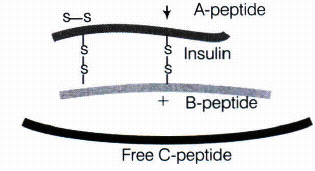
Refer to the diagram given below and answer the questions that follow.
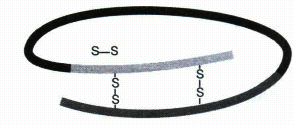
(i) The diagram shown above is insulin or proinsulin, Justify.
(ii) How is mature insulin syntheised?
2.
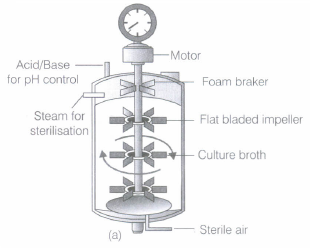
Give the name of the type of bioreactor shown. Write the purpose for which it is used.
3.
What are crepusucular animals?cite an example.
4.
Why is earth considered as closed system so far as materials are concerned?
5.
Name different transfection methods.
6.
(a) Why are transgenic animals so called?
(b) Explain the role of transgenic animals in (i) vaccine safety (ii) biological products with the help of example each.
7.
What are recombinant proteins? How do bioreactors help in their production?
8.
(a)A recombinant vector with a gene of interest inserted within the gene of \(\alpha\) -galactosidase enzyme is introduced into a bacterium. Explain the method that would help in selection of recombinant colonies from non-recombinant ones.
(b)Why is this method of selection referred to as 'insertional inactivation'?
9.
It is often said that the pyramid of energy is always upright. On the other hand, the pyramid of biomass can be both upright and inverted. 'Explain with the help of examples and sketches.
10.
A group of scientists are working on creating transgenic cows to produce milk with medicinal properties.
But there are adverse side effects seen on the cows due to this procedure. Their life span shortened; they became prone to diseases and died very early.
(i) What do you mean by transgenic animals?
(ii) Should the scientists continue with the production of transgenic cows? Give reason.
(iii) Is there any law to regulate such acts?
(iv) What values did scientists lack?
11.
Does light factor affect the distribution of organisms? Write a brief note giving suitable examples of either plants or animals.
12.
What is genetic engineering? List the steps involved in rDNA technology.
13.
Suresh thought of straight export of orchids as these flowers fetch high price in international market due to their beauty and longer vase life. He consulted his Botanist uncle who suggested him a fast method of propagation of orchids to earn good profits.
Read the above passage and answer the following questions:
(i) What is plant tissue culture ?
(ii) What is micropropagation ?
(iii) What value is displayed by Suresh's uncle ?
14.
(a)Why are engineered vectors preferred by biotechnologists for transferring the desired genes into another organism?
(b)Explain how 'ori', 'selectable markers' and 'cloning sites' facilitate cloning into a vector.
15.
In Lake Tanganyika in Africa, there are six species of fish of the genus Tropheus and a much larger number of distinctly coloured subspecies of each of the six species. Tropheus species are small fishes that are confined to isolated rocky habitats around the shores of Lake Tanganyika.

Recent research has compared DNA sequence data from these various species and subspecies and linked this with geological data on the lake. This suggests that some 1.25 million years ago, when the lake first filled, the six species evolved during the primary radiation phase. They arose from river dwelling ancestors and then filled all available niches. Secondary radiations into the many subspecies occurred during the last 2,00,000 years.
Sometime during this period, the water level in the lake fell, resulting in the formation of three separate lake basins. These basins persisted for level rose again.
Figure shown above is an outline map of the lake and the location of the three temporary basins caused by lowering of lake levels.
(i) Define the terms
(a) species
(b) niche
(ii) Explain how natural selection could have caused the evolution of the six closely related species in the primary radiation.
16.
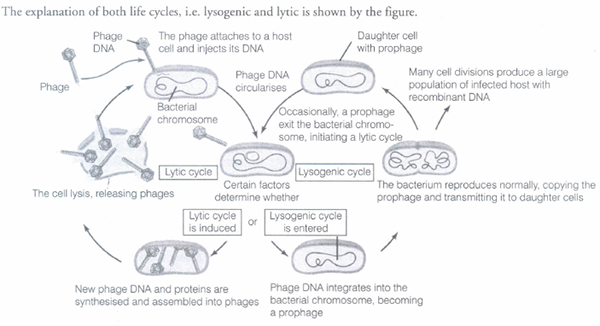
Bacteriophages are virus infecting bacteria, that are used as vectors because of their high copy number.
Lambda phage is a non-contractile bacteriophage used as vector that follows two life cycle, lysogenic and lytic. Explain, both the life cycles with the help of a diagram
17.
List three molecular diagnostic techniques that help detect pathogens from suspected patients.
Mention the advantage of these techniques over conventional methods.
18.
Distinguish between following:
(a) Grazing food chain and detritus food chain
(b) Production and decomposition
(c) Upright and inverted pyramids
(d) Food chain and food web.
(e) Litter and detritus
(f) Primary and secondary productivity
19.
Described any three potential applications of geneticlly modified plants.
20.
A schematic representation of Polymerase Chain Reaction (PCR) up to the extension stage is given below. Give answers of the following questions.
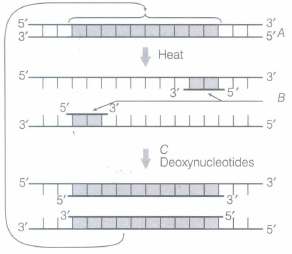
(i) Name the process A.
(ii) Identify B
(iii) Identify C and mention its importance in PCR.
21.
Explain how transgenic animals serve as model for human diseases?
22.
Few gaps have been left in the following table. Fill up the gaps.
| Restriction Enzyme | Source | Recognition sequence and site of cleavage |
| Bam HI | Bacillus amyloliquiefaciens H | a |
| Eco RI | b | \(\downarrow \) 5'-G-A-A-T-T-C-3' 3'-C-T-T-A-A-G-5' \(\uparrow \) |
| c | Haemophillus influenzae Rd | \(\downarrow \) 5'-G-T-C-G-A-C-3' 3'-C-A-G-C-T-G-5' \(\uparrow \) |
23.
Study the three different age pyramids for human population given below and answer questions that follows:
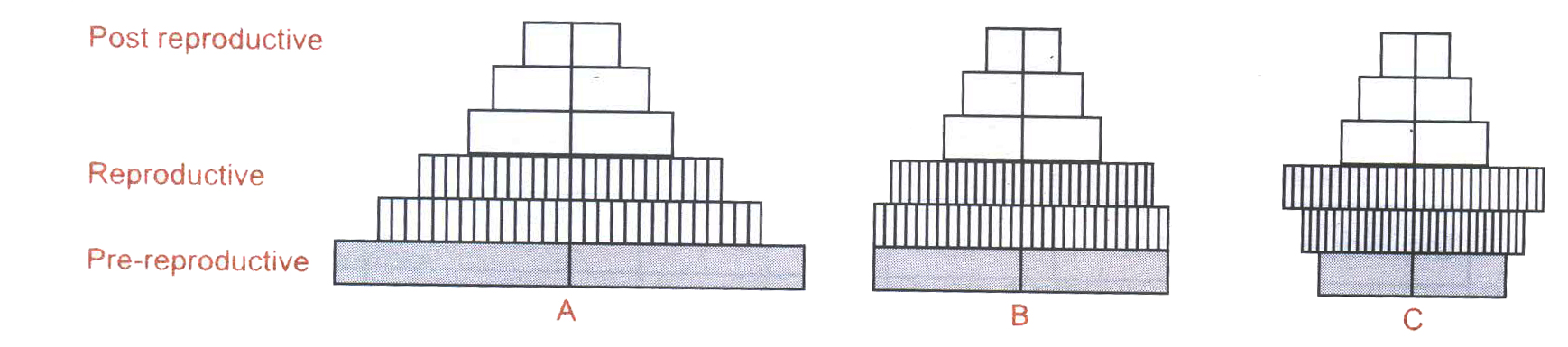
(a) Write the names given to each of these age pyramids.
(b) Mention the one which is ideal for human population and why?
(c) What would be the growth rate pattern when the resources are limited?
1.
(i) The diagram is proinsulin as it contains C-peptide.
(ii) Mature insulin is synthesised by removal of extra stretch called C-peptide.
2.
The given bioreactor shown in the figure is the simple stirred-tank type bioreactor.
Its purpose is large scale production of recombinant protein or enzymes, using microbial plants, animals and human cells.
3.
Which are active at dusk and dawn (rabbit).
4.
The earth is considered as a closed system so far as materials are considered because there is cycling of materials from non-living to living, which are essential for life such as oxygen, carbon, nitrogen, water and minerals is finite.
5.
Calcium phosphate precipitation, direct microinjection, Retrovirus infection, lipofection, particle gun delivery and electroporation
6.
(a) Animals that have had their DNA manipulated to possess and express (foreign) gene are called transgenic animals.
Example: Transgenic mice, transgenic rabbits.
(b) (i) Role of transgenic animals in vaccine safety,Transgenic mice are being developed for use in testing the safety of vaccine before they are used on humans. Transgenic mice are being used to test the safety of polio vaccine.
(ii) Role of transgenic animals in biological products
In 1997, the first transgenic cow, Rosie, produced human protein enriched milk 2.4 gm per litre. The milk contained the human alpha-lactalbumin and was more balanced product for human babies.
7.
The proteins produced by the expression of recombinant DNA in the transgenic organism are called recombinant proteins. Bioreactors help in the production of recombinant proteins as
(i) Large volumes of culture can be processed in them to produce appreciable quantities of the product.
(ii) They provide optimum conditions of temperature, pH, oxygen, salts, substrate, etc., to achieve the desired product.
8.
(a)The recombinants can be differentiated from the non-recombinants by their inability to produce colour in the presence of a chromogenic substrate.
The recombinants do not produce any colour, while the non-recombinants produce a blue colour with the chromogenic substrate in the medium.
(b) Since, the insert inactivates the enzyme, a-galactosidase, this method is called insertional inactivation.
9.
Ecological pyramids are diagrammatic illustrations of connection between different trophic levels in terms of energy, biomass and number of organisms.
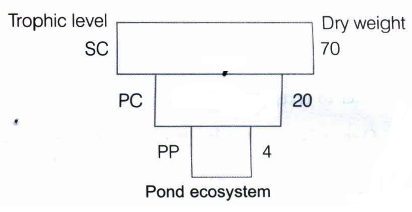
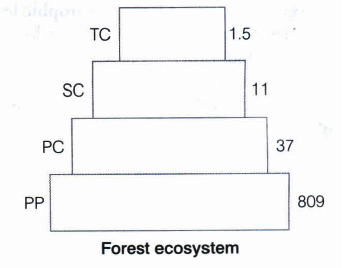
Pyramids of biomass can be both upright and inverted. This can be understood from the examples given below:
(i) The pyramid of biomass in a pond ecosystem is inverted. Because, the sum total of the weight of phytoplankton (produce) is far less than a few fishes feeding on them, at higher tropic levels.
(ii) Pyramid of biomass in a forest ecosystem is upright because producers are more in biomass than primary consumers.Primary consumers are more than secondary consumers and secondary consumers are more than tertiary consumers (top). Pyramid of energy is never inverted, (i.e. it is always upright).Because, when energy flows from a particular trophic level to the next trophic level, some energy is always lost as heat at each step. Each bar in the energy pyramid indicates the amount of energy present at each trophic level in a given time.
10.
(i) Animals that have had their DNA manipulated to possess and express an extra foreign gene are known as transgenic animals.
(ii) No, each cow would produce only a limited amount of medicinal milk before it dies. This means lives of many cows would be compromised for the production of substantial amount of medicinal milk, for the advantage of humans.
(iii) Some laws have been passed by the Government and agencies monitoring the genetic engineering researches to maintain ethics of life, and to regulate such acts.
(iv) Sympathy towards animals, ethics, respect for living organisms.
11.
Plants require sunlight for photosynthesis. Therefore, light is an important factor that affects the distribution of plants, e.g.,
(i) Many species of small plants (herbs and shrubs) growing in forests are adapted to photosynthesis optimally under very low light conditions so they are seen distributed in shady areas under tall, canopied trees.
(ii) Many plants in the shade will grow vertically to gain access to light. These plants will appear to have maller4 leafs than others of the same species of the same age found in conditions with better sunlight.
(iii) Large sized trees will be present in areas that get abundant sunlight.
(iv) Plants dependent on sunlight to meet their photoperiodic requirements of flowering, will try to be distributed in area where this requirement is being met for their reproductive success.
12.
Genetic engineering is a manipulation of genetic material in vitro. It involves the techniques to alter the chemistry of genetic material (DNA and RNA), to introduce the host organisms and thereby change the phenotype of the host organism.
Steps of rDNA technology are:
(i) Isolation of DNA.
(ii) Fragmentation of DNA by restriction endonucleases.
(iii) Isolation of the desired DNA fragments.
(iv) Amplification of the gene of interest.
(v) Ligation of the DNA fragment into the victor using DNA ligase.
(vi) Transfer of the recombinant DNA into the host.
(vii) Culturing the host cell on a suitable medium on a large scale.
(viii) Extraction of the desired product.
(ix) Downstream processing of the products as finished products.
13.
(i) It is the technique of growing cell, tissue, organ or whole plant under controlled conditions.
(ii) Micropropagation is the technique of producing a large number of identical plants from small explant within a short period using tissue culture technique.
(iii) His uncle, being a Botanist, guided his nephew to adopt modern biotechnology techniques so that he could earn handsome profits.
14.
(a) Engineered vectors are preferred because they help easy linking of foreign DNA and selection of recombinants from non-recombinants.
(b) Ori
It is a sequence of bases on DNA from where replication starts; any piece of DNA when linked to this sequence can be made to replicate within the host cells. This sequence also controls the copy number of linked DNA.
Selectable marker
The selectable marker helps in identifying and eliminating non-transformants or non-recombinants and permits selectively the growth of only recombinants.
Cloning sites
Cloning sites are necessary to link the alien DNA. Single recognition sites are commonly preferred.
When an alien DNA is introduced into the coding sequence of an enzyme or an antibiotic resistance, there is insertional inactivation; the enzyme is inactivated or the antibiotic resistance is lost and hence, recombinants can be selected from the non-recombinants.
15.
(i) (a) Species A group of specific organisms with similar characteristics which are capable of compatible interbreeding to produce fertile offsprings
(b) Niche The way in which an organism functions in relation to the biotic and abiotic factors within its habitat that serves a purpose in its environment.
(ii) Increased selection pressure due to climatic or habitat change cause organisms to become specialised and have the optimum phenotype that is suited to the prevailing environment condition.
In the primary radiation, the six closely related species evolved as a result of the increasing water levels when the lake first filled. This change in the environment exerted a selection pressure on their river dwelling ancestors to adapt by developing different characteristics for survival, thus giving rise to the six species that could occupy more niches.
16.
17.
(i) Recombinant DNA Technology (RDT)
(ii) Polymerase Chain Reaction (PCR)
(iii) Enzyme Linked Immunosorbent Assay (ELISA)
18.
(a)
| Grazing Food Chain | Detritus Food Chain |
|---|---|
|
1. It is the food chain where transfer of energy starts from the producers. |
1. It is the food chain where transfer of energy starts from detritus/decaying organic matter. |
(b)
| Production | Decomposition |
| It is the process of formation of organic matter | It is the process of breaking down of complex organic matter into simpler inorganic compounds like water, carbon dioxide, other nutrients, etc. |
| It is dependent on photosynthesis done by producers. | It is dependent on the decomposers. |
| For primary productivity, sunlight is required. | For decomposition, sunlight is not required. |
(c)
| Litter | Detritus |
| Litter is all types of above ground waste that has been disposed improperly | Detritus constitutes the remains of dead plants and animals. |
| It contains biodegradable and non-biodegradable material | It contains only biodegradable material |
(d)
| Upright pyramid | Inverted pyramid |
| In this type of pyramid the number and biomass of organisms at producer level is high, which keeps on decreasing at each trophic level | In this type of pyramid the number and biomass of organisms at each trophic level. |
| The base bar companies of producers in large number | The base bar companies of producers in small number |
| Energy pyramid is always upright | Pyramid of number and pyramid of biomass can be inverted. |
(e)
| Food chain | Food web |
| It is a linear sequence of organisms | It is an interconnection of many food chains |
| Members present at higher trophic level feeds on single type of organisms | One organisms has alternate food sources |
| The energy flow can be easily calculated | Energy flow is difficult to calcute |
| Competition is limited only to the members of same trophic level | Competition is amongst members of same and different trophic levels |
(f)
| Primary productivity | Secondary productivity |
| It is the amount of organic matter produced by producers per unit area over a period of time | It is defined as the rate of production of organic matter by consumers over a period of time |
19.
Potential applications of genetically modified plants are:
(i) nutritional enhancement, e.g vitamin-A enriched rice.
(ii) Stress tolerance crops are more toleeant to abiotic stresses such as cold, drought, etc.
(iii) Creation of tailor made plants by using GM plants to supply alternative resources to industries in the form of starches, biofuels, etc.
20.
(i) A - Denaturation process
(ii) B - Primers
(iii) C - Taq DNA polymerase. Taq polymerase is a thermostable enzyme, which remains active during the high temperature and incduces denaturation of DNA
21.
Transgenic animals contain functional foreign genes introduced into their genome from another species by the technique of genetic engineering. Many of such transgenics are designed to increase understanding and study of how genes contribute to the development of disease. These laboratory exercises are specially made to serve as models for human diseases so that preventive measures and treatments for such diseases are made possible.
22.
a = 5'- G-G-A-T-C-C-3',
b = Escherichia coli RY 13,
c = Hin d II
3'-C-C-T-A-G-G-5'
23.
(a) A - Expanding, B - Stable, C- Declining.
(b) Stable population is preferred. It is helpful for planning any welfare activity.
(c) Logistic growth curve.

12th Standard CBSE Syllabus & Materials
12th Standard CBSE
CBSE 12th Computer Science Python Revision Tour I - New Previous year Question Papers Study Material - QB365 Set A
NEW12th Standard CBSE
CBSE 12th Business Studies Planning Important Questions And Answers Study Material - QB365 Set A
NEW12th Standard CBSE
CBSE 12th Business Studies Business Environment Important Questions And Answers Study Material - QB365 Set A
NEW12th Standard CBSE
CBSE 12th Business Studies Principles of Management Important Questions And Answers Study Material - QB365 Set A



NCERT Books

Syllabus

Exam Pattern

Sample Question Papers

Previous year Question Papers

Important Notes

MCQ Practice test

NCERT Exemplers

Case study Questions

Image Based Questions

Passage based Questions

HOT Questions

Value Based Questions

Model Questions Papers
NCERT ( Book Back ) Questions

Assertion and Reason
Important Questions And Answers

CBSE 12th Standard CBSE Subjects
CBSE Standards








