
 100% FREE ACCESS
12th Standard CBSE Syllabus & Materials
12th Standard CBSE
CBSE 12th Economics Government Budget and the Economy Previous year Question Papers Study Material - QB365 Set A
NEW12th Standard CBSE
CBSE 12th Computer Science Interface Python with MySQL - New Previous year Question Papers Study Material - QB365 Set A
NEW12th Standard CBSE
CBSE 12th Computer Science Database Concept - New Previous year Question Papers Study Material - QB365 Set A
NEW12th Standard CBSE
CBSE 12th Computer Science Data Communication - New Previous year Question Papers Study Material - QB365 Set A
NEW12th Standard CBSE
CBSE 12th Computer Science Data Structures - New Previous year Question Papers Study Material - QB365 Set A
NEW12th Standard CBSE
CBSE 12th Computer Science Functions - New Previous year Question Papers Study Material - QB365 Set A

Published on: 02/11/2025
Download CBSE Class 12th Standard CBSE Biology question papers, sample papers, important questions, and previous year solved papers in PDF format. Get free study materials, NCERT solutions, and exam preparation resources for Class 12th Standard CBSE Biology
Questions + Answers key
Take MCQ Biology Test
1.
What are secondary sexual characters?
2.
How can bacterial DNA be released from the bacterial cell for biotechnology experiments?
3.
What is mons pubis?
4.
How do the pollen grains of Vallisneria protect themselves?
5.
Gynoecium of a flower may be apocarpous or syncarpous. Explain with the help of an example each.
6.
Why has the Indian Parliament cleared the second amendment of the country's patents bill?
7.
How does restriction endonuclease function?
8.
List the features of sexual reproduction.
9.
List the key tools used in recombinant DNA technology.
10.
What could be the reason for the fast rate of decomposition in the tropics?
11.
If the chromosome number of a plant species is 16, what would be the chromosome number and the ploidy level of the (i) microspore mother cell and (ii) the endosperm cells?
12.
Define ovulation.When does it occur?
13.
Name the muscular and glandular layers of human uterus.Which one of these layers undergoes cyclic changes during menstrual cycle?Name the hormone essential for the maintenance of this layer.
14.
Why are some seeds of Citrus referred to as polyembryonic? How are they formed?
15.
Women experience two major events in their lifetime one at menarche and the second at menopause, mention the characteristics of both the events.
16.
Explain the role of tapetum in the pollen grain wall formation.
17.
Describe the naming of the restriction enzymes with an example.
18.
Explain the basis on which the gel electrophoresis technique works. Write and two ways the products obtained through this technique can be utilised.
19.
What is humus?Mention its properties.
20.
Plasmid is a boon to biotechnology. Justify this statement quoting the production of human insulin as example
21.
Write the mode of pollination in Vallisneria and water lily. explain the mechanism of pollination in Vallisneria.
22.
How does yeast reproduce asexually? Show it diagrammatically.
23.
Monu's uncle is a diabetes patient and id dependent on insulin for diabetes treatment.Monu went to enquire about his health.His uncle told him that diabetes has become a very common problem due to change in life style and a lot of people need insulin for its treatment.Earlier, it was obtained from animals and was short in supply and costly but biotechnology has helped in making it cheaper and easily available.
Read the above passage and answer the following questions:
(i) What precautions will you take to avoid chances of diabetes?
(ii) What is the role of insulin?
(iii) How biotechnology is helpful in increased insulin production to benefit needy people?
24.
Last year, Dadaji was going to meet his old friend in a village near Lucknow. Dadaji's friend was earnings a lot by exporting mangoes. Anil also accompanied Dadaji as he also very found of mangoes. Dadaji's friend invited him to visit the orchard. Anil knew that there are many varieties of mangoes with different shapes, color of skin and tastes. On visiting the orchard, Anil was surprised to see that more than one type of mangoes were growing on the same tree.
(i) Is it possible for Anil to grow for commercial purpose any variety of mango on the tree of mango growing in his garden?
(ii) What type of reproduction is involved in this process?
(iii) Name any other species which can be propagated by this technique for commercial purpose.
(iv) How could Dadaji's friend improve the varieties of mangoes in his garden?
25.
What will happen to an ecosystem if
(a) All producers are removed.
(b) All organisms of herbivore level are eliminated and
(c) All top carnivore population is removed.
26.
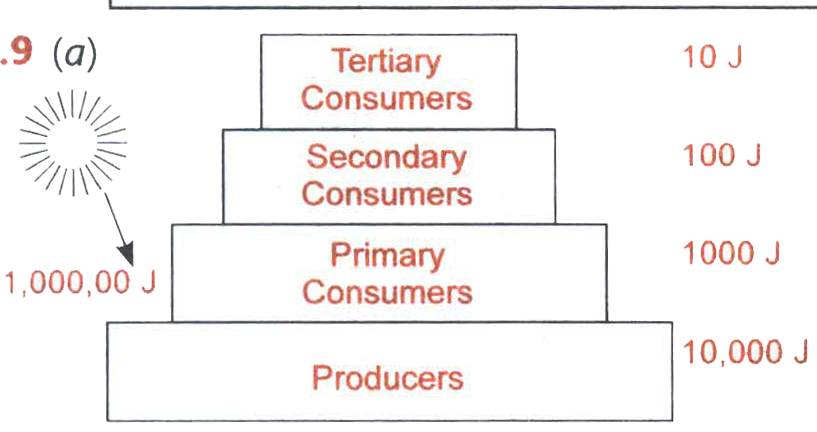
(a) Draw an ideal pyramid of energy upto four trophic levels, where 10,00,000 J are available from sunlight to the primary producer. Indicate the amount of energy available at each trophic level.
(b) Why is pyramid of energy always upright? Explain.
(c) Mention the limitations of an ecological pyramid.
27.
Draw the diagram of a microsporangium and label its wall layers. Write briefly about the wall layers.
28.
What is gene therapy? Illustrate using the example of adenosine deaminase (ADA?) deficiency.
1.
()
Secondary sexual characters are external and internal changes in organism which develop at the onset of reproductive phase
2.
()
The bacterial cell has to be treated with lysozyme to digest the cell wall to release DNA.
3.
()
Mons pubis is a cushion of fatty tissue covered by skin and pubic hair in human females.
4.
()
Pollen grains of Vallisneria are protected from wetting by the mucilaginous covering.
5.
Gynoecium of a flower is called apocarpous when the carpels are free, e.g. in Ranunculus
Whereas it is called syncarpous when the carpels are fused, e.g. in Petunia.
6.
Amendments to the patent bill has empowered India to prevent unauthorised exploitation of our bio-resources and traditional knowledge by other countries This bill also considers patent terms and mitiates research development in this field.
7.
Restriction endonuclease enzymes are called molecular scissors which can cut double stranded DNA at specific sites.
Role of restriction endonuclease.
1. Restriction endonuclease inspects the length of DNA sequence.
2. It find specific recognition sequence i.e. Palindromic nucleotide sequence in DNA.
3. These enzymes cut the strand of DNA a little away from centre of palindromic sites.
4. Thus restriction endonucleases leave overhanging stretches called sticky ends on each strand.
8.
Basic features of sexual reproduction
(1) Development of male and female organs.
(2) Meiosis occurs in the life cycle.
(3) production of large number of male and female gametes.
(4) Mobility of male gametes.
(5) The two types of gametes fuse together to produce a diploid structure called zygote.
(6) Zygote produces embryo by different changes.
(7) Only the mature individuals can produce the gametes.
9.
The key tools include restriction enzymes, polymerases, ligases, cloning vectors and competent host organism.
10.
1. The rate of decomposition is regulated by temperature and soil moisture, as they influence the activities of decomposers.
2. The trophic have a warm/hot and humid condition; such a condition is favourable for the decomposers and hence they speed up the process of decomposition.
11.
(i) Microspore mother cell - diploid , 2n=16
(ii) Endsperm cells - triploid, 3n=24.
12.
Ovulation is the process of rupture of a mature Graafian follicle and the subsequent release of ovum from it.
It occurs around the 14th day/middle of the menatrual cycle.
13.
1. Myometrium is the muscular layer and endometrium is the glandular layer.
2. Endometium undergoes cyclic changes during menstrual cycle.
3. Progesterone is the hormone.
14.
1. It is a case of polyembryony, the phenomenon of occurrence of more than one embryo in a seed.
2. It is possible in the following ways:
(i) Some of the nucellar cells surrounding the embryo sac start dividing, protrude into the embryos.
(ii) Synergids of the embryo sac divide and form embryos.
15.
Menarche represents the beginning of menstrual cycle which is an indication of attainment of sexual maturity.It usually occurs at the age of 12-15 years.Menopause, on the other hand, refers to the cessation of menstruation, which in turn means stoppage of gamete production i.e., it marks the end of reproductive fertile life of the female.It occurs between 45 to 55 years.Menopause, on the other hand, refers to the cessation of menstruation, which in turn means stoppage of gamete production i.e., it marks the end of reproductive fertile life of the female.It occurs between 45 to 55 years of age.
16.
Role of tapetum in the pollen grain wall formation
During microsporogenesis, the cells of tapetum provide various enzymes, hormones, amino acids and other nutritive materials to the dividing microsporocytes. The main functions of tapetum are:
1. Transportation of nutrients into anther locule at the time of meiosis in spore mother cells.
2. Secretion of enzymes and hormones.
3. Production of Ubisch bodies which are coated with sporopollenin to cause thickening of exine.
4. Secretion of any oily material (pollen kit) over outerside of mature pollen.
5. Secretion of special proteins for pollen to recognise compatibility.
17.
The first letter of the name comes from the genus of the bacterium.
The second and third letters come from the name of the species of the prokaryote cell from where it is isolated.
The next letter comes from the strain of the prokaryote.
The Roman Numbers following these four letters indicate the order in which the enzymes were isolated from that strain of the bacterium, e.g. EcoRI is isolated from E. coli, R Y 13.
18.
(i) The DNA fragments may be used to construct recombinant DNA by joining them with cloning vectors .
(ii) The desired DNA fragments may be amplified, i.e. making multiple copies, by polymerase chain reaction (PCR).
19.
Humus is a dark-coloured, amorphous substance accumulated by the process of humification during decomposition of detritus.
Properties:
(i) It is highly resistant to microbial action and undergoes decomposition at an extremely slow rate.
(ii) Being colloidal in nature ,it serves as a reservoir of nutrient.
(iii) It improves the water-holding capacity of soil.
20.
Plasmid is an autonomously replicating extra-chromosomal circular DNA found in bacterial cells.
Since it can replicate within a bacterial cell, it is used as a vector in rDNA technology. Production of Insulin:
Eli Lilly, the American company produced two DNA sequences in vitro coding for the polypeptides A and B of insulin.
These DNA sequences were introduced into the plasmid of Escherichia coli.
The E. coli cells produced the two polypeptides, which were isolated and combined by disulphide bridges to form human insulin.
21.
Vallisneria is pollinated by water.
Water lily is pollinated by insects.
In Vallisneria, the male flowers (later pollen grains) are released on the surface of water and keep floating.
The female flowers reach the surface of water by uncoiling of the long stalk
When the passively carried male flowers/pollen grains meet the female flowers, pollination is effected.
The stalk of the female flower coils and the flower is drawn inside the water column.
22.
Yeast reproduces asexually by budding under favourable conditions.
23.
(i) A balanced diet and regular exercise.
(ii) It regulates sugar level in the blood.
(iii) Biotechnology is helpful by producing genetically engineered bacteria which are capable of producing insulin in culture.It will cater to the demand of needy people.
24.
(i) Yes, by using grafting technique he can grow any variety of mango on the already existing trees.
(ii) Artificial method can also be used for commerecial production of roses.
(iii) This technique can also be used for commercial production of roses.
(iv) Dadaji's friend improved the varieties of mangoes by using grafting techniques .
25.
(a) Removal of all producer reduce primary production in the ecosystem. Hence, no biomass will be available to the successive/higher trophic level or heterotrophic organisms.
(b) Elimination of all organisms of herbivore level results into an increase in primary productivity and biomass of producer and the carnivorous animal will not survive due to inavailability of food due to the elimination of herbivores.
(c) Removal of top carnivores also disturbs the ecosystem as it will result in huge increase in a number of herbivores which will finish plants creating desertification.
26.
(a)
27.
A typical microsporangium is surrounded by four wall layers, i.e. the epidermis, endothecium, middle layers and the tapetum. The outer three wall layers are protective in function and help in dehiscence of anther to release pollen grains.
The innermost layer (tapetum) nourishes the developing microspores or pollen grains. The cells of tapetum possess dense cytoplasm and generally have more than one nucleus.
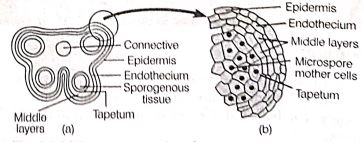
When the anther is young, a group of compactly arranged homogenous cells called the sporogenous tissue occupies the centre of each microsporangium.
28.
Gene therapy is a collection of methods, that allows correction or replacement of a defective gene.
Correction of a genetic defect involves delivery of a normal gene into the individual's embryo to take over the function of the non-functional gene.
ADA (Adenosine deaminase) deficiency was treated in a 4 year old girl.
This disorder is caused by the deletion of the gene for the enzyme.
The lymphocytes from the blood of the patient are grown in a culture in vitro.
A functional ADA cDNA (using retroviral vector) is introduced into lymphocytes; such lymphocytes are introduced back into the blood of the patient.
But the patient requires periodic infusion of such genetically-engineered lymphocytes.
If the gene isolated from marrow cells is introduced in cells in the early stage, it could be a permanent cure.

12th Standard CBSE Syllabus & Materials
12th Standard CBSE
CBSE 12th Computer Science Python Revision Tour I - New Previous year Question Papers Study Material - QB365 Set A
NEW12th Standard CBSE
CBSE 12th Business Studies Planning Important Questions And Answers Study Material - QB365 Set A
NEW12th Standard CBSE
CBSE 12th Business Studies Business Environment Important Questions And Answers Study Material - QB365 Set A
NEW12th Standard CBSE
CBSE 12th Business Studies Principles of Management Important Questions And Answers Study Material - QB365 Set A



NCERT Books

Syllabus

Exam Pattern

Sample Question Papers

Previous year Question Papers

Important Notes

MCQ Practice test

NCERT Exemplers

Case study Questions

Image Based Questions

Passage based Questions

HOT Questions

Value Based Questions

Model Questions Papers
NCERT ( Book Back ) Questions

Assertion and Reason
Important Questions And Answers

CBSE 12th Standard CBSE Subjects
CBSE Standards








