
 100% FREE ACCESS
12th Standard CBSE Syllabus & Materials
12th Standard CBSE
CBSE 12th Economics Government Budget and the Economy Previous year Question Papers Study Material - QB365 Set A
NEW12th Standard CBSE
CBSE 12th Computer Science Interface Python with MySQL - New Previous year Question Papers Study Material - QB365 Set A
NEW12th Standard CBSE
CBSE 12th Computer Science Database Concept - New Previous year Question Papers Study Material - QB365 Set A
NEW12th Standard CBSE
CBSE 12th Computer Science Data Communication - New Previous year Question Papers Study Material - QB365 Set A
NEW12th Standard CBSE
CBSE 12th Computer Science Data Structures - New Previous year Question Papers Study Material - QB365 Set A
NEW12th Standard CBSE
CBSE 12th Computer Science Functions - New Previous year Question Papers Study Material - QB365 Set A

Published on: 28/11/2025
Download CBSE Class 12th Standard CBSE Biology question papers, sample papers, important questions, and previous year solved papers in PDF format. Get free study materials, NCERT solutions, and exam preparation resources for Class 12th Standard CBSE Biology
Questions + Answers key
Take MCQ Biology Test
1.
Write the significance of adding proteases at the time of isolation of genetic materials.
2.
Expand the terms rDNA and cDNA
3.
What is the role of CaCl2 in the preparation of competent cells?
4.
Why is 'plasmid' an important tool in biotechnology experiments?
5.
Describe the role of CaCl2 in the preparation of competent cells.
6.
How does a restriction nuclease function? Explain.
7.
Explain the action of the restriction endonuclease EcoRI.
8.
Write any four ways used to introduce a desired DNA segment into a bacterial cell i recombinant DNA technology experiments.
9.
(a) Mention the diference in the mode of action of exonuclease and endonuclease.
(b) How does restriction endonuclease function?
10.
The fungus Penicillium chrysogenum is grown in fermentors on an industrial scale to produce penicillin, using a batch culture system.
Explain why, batch culture rather than continuous culture is used for production of penicillin.
11.
Draw a labelled sketch of sparged-stirred tank bioreactor. Write its application.
12.
Do you see the prospects of viroids being used as plant vectors in near future?
13.
Explain in sequence the process of amplification of a gene of interest using polymerase chain reaction.
14.
How do bioreactors help in production of recombinant proteins?
15.
What are bioreactors? Sketch the two types of bioreactors. What is the utility? Which is the common type of bioreactors?
16.
The restriction enzyme(s) used in recombinant DNA technology that make staggered cuts in DNA leaving sticky ends is/are
Eco R I
Hind III
Bam H I
all of these
17.
Biolistics (gene-gun) is suitable for
disarming pathogen vectors
transformations of plant cells
constructing recombinant DNA by joining with vectors
DNA fingerprinting
18.
A single strand of nucleic acid tagged with a radioactive molecule is called:
Vector
Selectable marker
Plasmid
Probe
19.
Agarose extracted from sea weeds is used in
spectrophotometry
tissue culture
PCR
gel electrophoresis
20.
Which one of the following pallindromic base sequences in DNA can be easily cut at about the middle by some particular restriction enzyme.
5' CACGTA 3' ; 3' CTCAGT 5'
5' CGTTCG 3' ; 3' ATGGTA 5'
5' GATATC 3' ; 3' CTACTA 5'
5' GAATTC 3' ; 3' CTTAAG 5'
21.
The role of DNA ligase in the construction of a recombinant DNS molecule is:
Formation of phosphodiester bond between two DNA fragments
Formation of hydrogen bonds between sticky ends of DNA fragments
Ligation of all purine and pyrimidine bases
None of the above
22.
In plant biotechnology, root tumours are induced in plant using the bacterium
Agrobacterium rhizogenes
Agrobacterium basilis
Rhizobium
None of these
23.
Restriction endonuclease
Synthesizes DNA
Cuts the DNA molecule randomly
Cuts the DNA molecule at specific sites
Restricts the synthesis of DNA inside the nucleus
24.
Human genome project was discovered by
Francis Collins and Roderick
Watson and Crick
Beadle and Tatum
Paul Berg and Wollman
1.
()
Protease is added because it helps in digesting proteins and helps in the breakdown of cell wall by dissolving it.
2.
()
rDNA- Recombinant DNA.
cDNA- Complementary DNA.
3.
()
CaCl2 increases the efficiency of the competent cells to pick up DNA through the pores in its cell wall
4.
()
Since plasmids can replicate within the bacterial cell independently of the genomic DNA, any alien DNA ligated to it will also multiply i.e, it is used as a vector as well as in gene cloning.
5.
CaCl2 is known to increase the efficiency of DNA uptake to produce transformed bacterial cells. The divalent Ca2+ ions create transient pores on the bacterial cell wall by which the entry of foreign DNA is facilitated into the bacterial cells.
6.
Restriction nuclease also called restriction enzymes (molecular scissors) are used for cutting of DNA at a specific location. These are the basic tool of biotechnology
7.
Restriction endonuclease, EcoRI cuts the DNA strands a little away from the centre of the palindromic, sequence, but between the same two bases on the two strands.
\({ 5 }^{ ' }-\begin{matrix} { G }^{ \downarrow } & A \end{matrix}\begin{matrix} A & T \end{matrix}\begin{matrix} T & C \end{matrix}-{ 3 }^{ ' }\)
\({ 3 }^{ ' }-\begin{matrix} { C } & T \end{matrix}\begin{matrix} T & A \end{matrix}\begin{matrix} { A }_{ \uparrow } & G \end{matrix}-{ 5 }^{ ' }\)
This leaves single-stranded portions, called sticky ends, overhanging at the end of each strand.
Since, the stickiness facilitates the action of DNA ligase, they easily form hydrogen bonds with their complementary counterparts.
8.
(i) Microinjection
(ii) Biolistics/ gene gun
(iii) Heat-Shock method
(iv) Using disarmed pathogen vectors.
9.
(i) Exonucleases cleave base pairs of DNA at their terminal ends (either 5' or 3') while, the endonucleases cleave DNA at any point within the DNA segment at specific position except terminal ends.
(ii) Restriction endonuclease EcoRI cuts the DNA strands a little away from the palindromic sequences, but between the same two bases on the two strands
5' - G - A - A - T - T - C - 3'
3' - C - T - T - A - A - G - 5'
10.
Penicillin is a secondary metabolite and secondary metabolites are produced only when the organism is under stress, i.e, due to shortage of nutrients or environmental stress, etc. In continuous culture, the nutrients are added at continuous intervals and it remains in exponential phase, therefore less penicillin is produced (organism is never under stress). This is why batch culture (nutrients are added once) rather than continous culture is used for production of penicillin.
11.
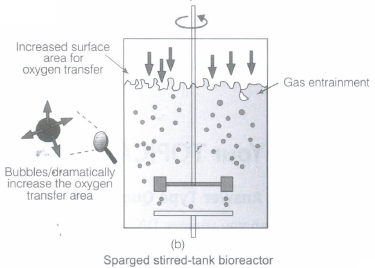
Application These bioreactors are used to produce large quantities of products enzymes, etc., using microbial, plant, animal of human cells.
12.
Viroids are smallest and simplest pathogenic agents comprising of 300-4000 bases long, circular, single standed, naked RNA. They are mechanically transferable and infect other parts of the plants. They have capability of being used as plant vectors
13.
Polymerase Chain Reaction
Multiple copies of the desired gene or segment of DNA, can be synthesised in vitro using two sets of primers, the oligonucleotides that are complementary to the regions of DNA of the two strands and the enzyme DNA polymerase.
This enzyme extends the primers using the nucleotides provided in the reaction and the genomic DNA as the template.
For repeated amplification to be achieved, a thermostable DNA polymerase (Taq polymerase), extracted from the bacterium, Thermus aquaticus is employed; it remains active during the high temperature treatment used for denaturation and separation of the two strands.
14.
Small volume cultures cannot yield appreciable quantities of products. To produce these products in large quantities the development of 'bioreactors' was required where large volumes (100-1000 litres) of culture can be processed. Thus bioreactors can be thought of as vessels in which raw materials are biologically converted into specific products, using microbial, plant, animal or human cells or individual enzymes.
Role. A bioreactor provides the optimal conditions for achieving the desired product by providing optimum growth conditions (temperature, pH, substrate, salts, vitamins, oxygen). One of the most commonly used bioreactor is of stirring type. A stirred tank reactor is usually cylindrical or with a curved base to facilitate the mixing of the reactor contents. The stirrer facilitates even mixing and oxygen availability throughout the bioreactor. Alternatively air can be bubbled 1lhroughthe reactor. If you look at the figure closely you will see that the bioreactor has an agitator system; an oxygen delivery system, a foam control system, a temperature control system, pH control system, sampling ports so that small volumes of the culture can be withdrawn periodically.
15.
Small volume cultures cannot yield appreciable quantities of products. To produce these products in large quantities the development of 'bioreactors' was required where large volumes (100-1000 litres) of culture can be processed. Thus bioreactors can be thought of as vessels in which raw materials are biologically converted into specific products, using microbial, plant, animal or human cells or individual enzymes.
Role. A bioreactor provides the optimal conditions for achieving the desired product by providing optimum growth conditions (temperature, pH, substrate, salts, vitamins, oxygen). One of the most commonly used bioreactor is of stirring type. A stirred tank reactor is usually cylindrical or with a curved base to facilitate the mixing of the reactor contents. The stirrer facilitates even mixing and oxygen availability throughout the bioreactor. Alternatively air can be bubbled 1lhroughthe reactor. If you look at the figure closely you will see that the bioreactor has an agitator system; an oxygen delivery system, a foam control system, a temperature control system, pH control system, sampling ports so that small volumes of the culture can be withdrawn periodically.
16.
(d)
all of these
17.
(b)
transformations of plant cells
18.
(d)
Probe
19.
(d)
gel electrophoresis
20.
(d)
5' GAATTC 3' ; 3' CTTAAG 5'
21.
(a)
Formation of phosphodiester bond between two DNA fragments
22.
(a)
Agrobacterium rhizogenes
23.
(c)
Cuts the DNA molecule at specific sites
24.
(a)
Francis Collins and Roderick

12th Standard CBSE Syllabus & Materials
12th Standard CBSE
CBSE 12th Computer Science Python Revision Tour I - New Previous year Question Papers Study Material - QB365 Set A
NEW12th Standard CBSE
CBSE 12th Business Studies Planning Important Questions And Answers Study Material - QB365 Set A
NEW12th Standard CBSE
CBSE 12th Business Studies Business Environment Important Questions And Answers Study Material - QB365 Set A
NEW12th Standard CBSE
CBSE 12th Business Studies Principles of Management Important Questions And Answers Study Material - QB365 Set A



NCERT Books

Syllabus

Exam Pattern

Sample Question Papers

Previous year Question Papers

Important Notes

MCQ Practice test

NCERT Exemplers

Case study Questions

Image Based Questions

Passage based Questions

HOT Questions

Value Based Questions

Model Questions Papers
NCERT ( Book Back ) Questions

Assertion and Reason
Important Questions And Answers

CBSE 12th Standard CBSE Subjects
CBSE Standards








