
 100% FREE ACCESS
12th Standard CBSE Syllabus & Materials
12th Standard CBSE
CBSE 12th Economics Government Budget and the Economy Previous year Question Papers Study Material - QB365 Set A
NEW12th Standard CBSE
CBSE 12th Computer Science Interface Python with MySQL - New Previous year Question Papers Study Material - QB365 Set A
NEW12th Standard CBSE
CBSE 12th Computer Science Database Concept - New Previous year Question Papers Study Material - QB365 Set A
NEW12th Standard CBSE
CBSE 12th Computer Science Data Communication - New Previous year Question Papers Study Material - QB365 Set A
NEW12th Standard CBSE
CBSE 12th Computer Science Data Structures - New Previous year Question Papers Study Material - QB365 Set A
NEW12th Standard CBSE
CBSE 12th Computer Science Functions - New Previous year Question Papers Study Material - QB365 Set A

Published on: 28/11/2025
Download CBSE Class 12th Standard CBSE Biology question papers, sample papers, important questions, and previous year solved papers in PDF format. Get free study materials, NCERT solutions, and exam preparation resources for Class 12th Standard CBSE Biology
Questions + Answers key
Take MCQ Biology Test
1.
In a pyramid of biomass, if the total dry weight (kg/m2) of primary producers is about 809 it will decrease at tertiary consumer level upto
37 kg/m2
11 kg/m2
5 kg/m2
1.5 kg/m2
2.
About 70% of total global carbon is found in
oceans
forests
grasslands
agroecosystems
3.
Which one of the following is not used for construction of ecological pyramids?
fresh weight
dry weight
number of individuals
rate of energy flow
4.
Which one of the following has the largest population in a food chain?
Producers
Primary consumers
Secondary consumers
Decomposers
5.
The major reservoir of carbon on earth is
6.
Phosphorus cycle has no atmosphere phase. Is it true?
7.
What are the main sources of carbon?
8.
What is a Savannah?
9.
What category of organisms from the starting point of a food chain?
10.
What are various climatic factors important for survival and continuation of an ecosystem?
11.
Name the two basic categories of ecosystems.
12.
The diagram shows the flow of energy through an ecosystem

Which arrows represent the smallest amount of energy transferred between organisms and the largest amount of energy lost to the ecosystem?
13.
The second trophic level in a lake is
(i) phytoplankton
(ii) zooplankton
(iii) benthos
(iv) fishes
14.
Sometimes due to biotic/abiotic factor the climax remain in a particular seral stage (pre climax) without reaching climax. Do you agree with this statement? If yes give a suitable example.
15.
Differentiate between primary and secondary succession.
16.
What is stratification in an ecosystem?Explain with an example.
17.
Autotrophs convert inorganic materials into organic material with the help of solar energy.
(i) Name the process depicted by the given statement.
(ii) Name the pigment which traps solar energy and convert light energy to chemical energy.
(iii) What do you understand by a photosynthetic unit?
18.
Pitcher plant is justified as a producer as well as a consumer (it consumes insect for nitrogen requirement)
(i) Which part of the plant is modified to form a pitcher?
(ii) Name other modifications of the part with examples.
19.
Construct a pryamid of biomass starting with phytoplankton. Label trophic levels. Is the pyramid upright or inverted? Why?
20.
Describe the different classes of consumers.
21.
Construct a pyramid of biomass starting with phytoplanktons.Label three trophic level.Is the pyramid upright or inverted?Why?
22.
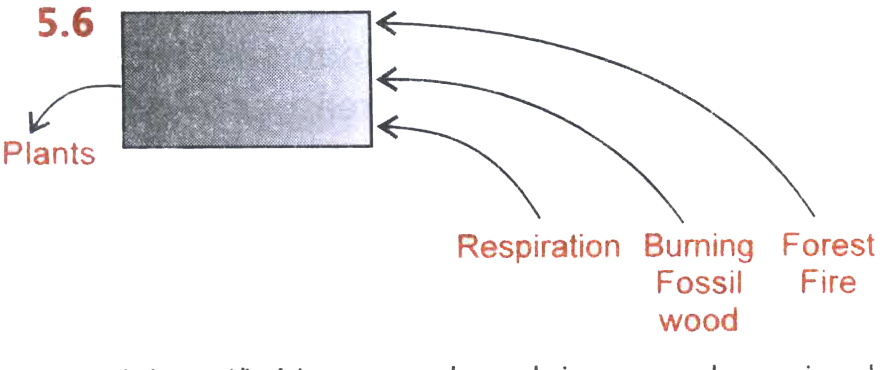
(a) (i) Name the biogeochemical (nutrient) cycle shown above.
(ii) Name an activity of the living organisms not depicted in the cycle by which this nutrient is returned to the atmosphere.
(b) How would the flow of the nutrient in the cycle be affected due to large scale deforestation? Explain giving reasons.
(c) Describe the effect of an increased level of this nutrient in the atmosphere on our environment.
1.
(d)
1.5 kg/m2
2.
(a)
oceans
3.
(a)
fresh weight
4.
(a)
Producers
5.
()
Ocean
6.
()
Yes
7.
()
Air, water, fossil fuel and rocks.
8.
()
A treeless, meadow-like plain biome.
9.
()
Producers form the starting point of a food chain.
10.
()
1. Solar radiation
2. Temperature
3. Light
4. Rainfall
11.
()
The two basic categories of ecosystem are:
(i) Terrestrial ecosystem, and
(ii) Aquatic ecosystem.
12.
The smallest amount of energy transferred is represented by arrow 2 and largest energy loss by arrow 3.
13.
Zooplankton: They are primary consumers in an aquatic food chain who feeds upon phytoplanktons.
14.
Sometimes climax remains in a particular seral stage without reaching the climax because during ecological succession any change in the abiotic and biotic component may affect the particular seral stage, leading to the preclimax stage before the climax is achieved.
This type of condition occurs presence of seeds and other propagules. This secondarily based area may be invaded by moss or exotic weeds thus exhibiting succession seriously and the climax community is never regenerated. In the case of natural calamities like fire lanslide, floods, change in soil texture.
15.
| Primary Succession | Secondary Succession |
|
(i) The ecological succession that takes place, where no life existed before, is called primary succession. |
(i) The ecological succession that takes place in a region where life existed in the past but got wiped out completely is called secondary succession. |
16.
Stratification refers to the vertical distribution of different species occupying different levels in the ecosystem.
Trees occupy the topmost vertical layer of a forest, shrubs occupy the second layer and herbs and grasses occupy the bottom layers.
17.
(i) The process by which autotrophs convert inorganic materials into organic material with the help of solar energy is called photosynthesis.
\({ { 6CO }_{ 2 } }+12{ { H }_{ 2 }O }\quad \underrightarrow { Light } \quad C{ _{ 6 } }{ { H }_{ 12 } }{ O_{ 6 }+6{ { H }_{ 2 } } }O+6{ { { O } }_{ 2 } }\)
(ii) The green pigment which traps solar energy and converts light energy into chemical energy is chlorophyll.
(iii) The three pigments, i.e. chlorophyll, carotenoids and xenthophylls together form a complex of pigments in the thylakoid membrane. These complexes work for the absorption of light and its transfer to a reaction centre.These complexes are called photosynthetic unit of photosystem or pigment system.
18.
(i) In a pitcher plant the leaves (lamina) are modified to form the pitcher to trap insects.
(ii) Other leaf modifications are:
(a) Tendrils
Whole leaf,e.g.Lathyrus aphaca
Leaflet,e.g. Pisum sativum
(b) Leaf hooks, e.g.Begonia
(c) Scally leaf, e.g. Ruscus
(d) Leaf blade, e.g. Utricularia
(e) Phyllode, e.g.Acacia
19.
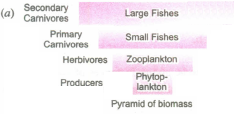
(b) Pyramid is inverted. It is because in pond ecosystem, producers are the smallest organisms while herbivores and carnivores are largest in size. Consequently, there is a gradual increase in biomass of organisms at successive trophic levels.
20.
All organisms/animals which depend directly or indirectly on plants for their food are called consumers.
Consumers are of the following types:
(i) Primary consumers
They are the organisms/animals which depend directly on producers for their food;they are also called as herbivores,e.g. deer, rabbit, zooplanktons.
(ii)Secondary consumers
Secondary consumers are those animals which depend on the primary consumers for their food; they are primary carnivores, e.g frogs,hyena.
(iii)Tertiary consumers
Tertiary consumers are those animals which depend on the secondary consumers for their food;they are the secondary carnivores, e.g. lion, eagle, kite, etc.
21.
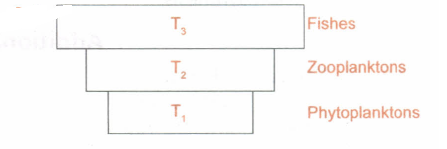
1. The pyramid is inverted.
2. Since the biomass of fishes far exceeds that of the phytoplanktons, the pyramid is inverted.
22.
a) (i) Carbon cycle.
(ii) Decomposition of organic wastes by microbes.
(b) Due to deforestation, the amount of carbon dioxide in the atmosphere increases because carbon dioxide is not used up for photosynthesis in the absence of plants.
(c) Carbon dioxide is the major greenhouse gas in the atmosphere; an increase in the amount of CO2 increases the temperature of the atmosphere by its greenhouse effect, i.e. by absorbing the infrared radiation reflected by the earth's surface.
1. The temperature of the earth has increased by /0.6 °C during the past century,atmostly during the last three decades.
2. This rise in temperature can lead to odd climatic changes, called EI Nino effect and produce deleterious changes in the environment.

12th Standard CBSE Syllabus & Materials
12th Standard CBSE
CBSE 12th Computer Science Python Revision Tour I - New Previous year Question Papers Study Material - QB365 Set A
NEW12th Standard CBSE
CBSE 12th Business Studies Planning Important Questions And Answers Study Material - QB365 Set A
NEW12th Standard CBSE
CBSE 12th Business Studies Business Environment Important Questions And Answers Study Material - QB365 Set A
NEW12th Standard CBSE
CBSE 12th Business Studies Principles of Management Important Questions And Answers Study Material - QB365 Set A



NCERT Books

Syllabus

Exam Pattern

Sample Question Papers

Previous year Question Papers

Important Notes

MCQ Practice test

NCERT Exemplers

Case study Questions

Image Based Questions

Passage based Questions

HOT Questions

Value Based Questions

Model Questions Papers
NCERT ( Book Back ) Questions

Assertion and Reason
Important Questions And Answers

CBSE 12th Standard CBSE Subjects
CBSE Standards








