
 100% FREE ACCESS
12th Standard CBSE Syllabus & Materials
12th Standard CBSE
CBSE 12th Economics Government Budget and the Economy Previous year Question Papers Study Material - QB365 Set A
NEW12th Standard CBSE
CBSE 12th Computer Science Interface Python with MySQL - New Previous year Question Papers Study Material - QB365 Set A
NEW12th Standard CBSE
CBSE 12th Computer Science Database Concept - New Previous year Question Papers Study Material - QB365 Set A
NEW12th Standard CBSE
CBSE 12th Computer Science Data Communication - New Previous year Question Papers Study Material - QB365 Set A
NEW12th Standard CBSE
CBSE 12th Computer Science Data Structures - New Previous year Question Papers Study Material - QB365 Set A
NEW12th Standard CBSE
CBSE 12th Computer Science Functions - New Previous year Question Papers Study Material - QB365 Set A

Published on: 28/11/2025
Download CBSE Class 12th Standard CBSE Biology question papers, sample papers, important questions, and previous year solved papers in PDF format. Get free study materials, NCERT solutions, and exam preparation resources for Class 12th Standard CBSE Biology
Questions + Answers key
Take MCQ Biology Test
1.
Which of the following is an ecosystem service provided by a natural ecosystem?
Cycling of nutrients
prevention of soil erosion
pollutant absorption and reduction of the threat of global warming
All of the above
2.
Identify the likely organisms (1), (2), (3) and (4) in the food web shown below:
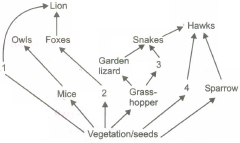
| (1) | (2) | (3) | (4) |
| deer | rabbit | frog | rat |
| (1) | (2) | (3) | (4) |
| dog | squirrel | bat | deer |
| (1) | (2) | (3) | (4) |
| rat | dog | tortoise | crow |
| (1) | (2) | (3) | (4) |
| squirrel | cat | rat | pigeon |
3.
Which one of the following is not a functional unit of an ecosystem
energy flow
Decomposition
Productivity
Stratification
4.
Which one of the following types of organisms occupy more than one trophic level in a pond ecosystem?
Frog
Phytoplankton
Fish
Zooplankton
5.
Which of the following is a free-living nitrogen fixing bacterium present in the soil?
Nitrosomonas
Rhizobium
Azotobacter
Pseudomonas
6.
About 70% of total global carbon is found in
oceans
forests
grasslands
agroecosystems
7.
Lichen is the pioneer vegetation in which type of succession?
hydrosere
lithosere
psammosere
xerosere
8.
Which one of the following is not used for construction of ecological pyramids?
fresh weight
dry weight
number of individuals
rate of energy flow
9.
These belong to the category of primary consumers
Insects and cattle
Eagle and snakes
Water insects
Snakes and frogs
10.
The second trophic level in a lake is
Phytoplankton
Zooplankton
Benthos
Fishes
11.
When did oxygen started collecting in the atmosphere? What is its percentage in the air at present?
12.
Define denitrification.
13.
Give the 3 types of pyramids of numbers.
14.
What are auroral and vesperal animals?
15.
Explain the terms standing crop, biomass and standing state.
16.
Flow of energy through various trophic levels in an ecosystem is unidirectional and non-cyclic. Explain.
17.
Who attempted to put a price tag on ecosystem services?What is the estimated value?
18.
Differentiate between primary and secondary succession.
19.
In terrestrial ecosystem DFC and GFC are interconnected at certain levels.Justify the statement.
20.
How are herbivores different from carnivores?
21.
Autotrophs convert inorganic materials into organic material with the help of solar energy.
(i) Name the process depicted by the given statement.
(ii) Name the pigment which traps solar energy and convert light energy to chemical energy.
(iii) What do you understand by a photosynthetic unit?
22.
Nutrients are essential for growth of producers, i.e. for the primary productivity of the ecosystem. The inorganic elements required by the plants present in the soil in the form of minerals are called mineral elements or mineral nutrients. Some of these mineral elements are nitrogen, sulphur, calcium, iron and manganese.State the deficiency symptoms of all elements mentioned above
23.
Distinguish between following:
(a) Grazing food chain and detritus food chain
(b) Production and decomposition
(c) Upright and inverted pyramids
(d) Food chain and food web.
(e) Litter and detritus
(f) Primary and secondary productivity
24.
Why are reducers or decomposers considered crucial and essential components of an ecosystem? Explain.
25.
When is the structure and composition of a community expected to remain unchanged?
26.
Construct a pryamid of biomass starting with phytoplankton. Label trophic levels. Is the pyramid upright or inverted? Why?
27.
What is biosphere? What are the main subdivisions of the biosphere?
28.
Describe the different classes of consumers.
29.
Give two examples of each of:
(i) Terrestrial ecosystem
(ii) Aquatic ecosystem
(iii) Man-made ecosystem
30.
What is primary productivity? Give a brief description of factors that affect primary productivity.
31.
Describe a pond as an ecosystem.
32.
Define decomposition and describe the processes and products of decomposition.
33.
Describe the components of an ecosystem.
1.
(d)
All of the above
2.
(a)
| (1) | (2) | (3) | (4) |
| deer | rabbit | frog | rat |
3.
(d)
Stratification
4.
(c)
Fish
5.
(c)
Azotobacter
6.
(a)
oceans
7.
(b)
lithosere
8.
(a)
fresh weight
9.
(a)
Insects and cattle
10.
(b)
Zooplankton
11.
With the evolution of oxygen releasing photoautotrophic organisms, 20.95%.
12.
Change of ammonium compounds, nitrites and nitrates into molecular nitrogen by certain bacteria and fugin is termed denitrification.
13.
Upright, inverted and spindle-like pyramids.
14.
Auroral animals are active at dawn, vesperal animals are active in the evening.
15.
Each trophic level has a certain mass of living material at a particular time called as standing crop.
Biomass: The standing crop is measured as mass of living organisms or the number in a unit area. The biomass of a species is expressed in terms of fresh or dry weight. Measurement of biomass in terms of dry weight is more accurate as the moisture content of biomass fluctuates greatly.
Standing state: Organisms need a constant supply of nutrients to grow, reproduce and regulate various body functions. The amount of nutrients, such as carbon, nitrogen, phosphorus, calcium, etc. present in the soil at any given time, is referred to as the standing state.
16.
Primary source of energy is sun.This solar energy is first trapped by the green plants, called producers, and is used to assimilate organic food by the process of photosynthesis. This food energy of the producers is transferred to the herbivores (primary consumers) and then to different types of carnivores because all the consumers are heterotrophs. The energy can not be transferred from consumers to producers and from the producers to sun. So there is producers and from the producers and from the producers and from the producers to sun. So there is always unidirectional flow of energy which is accompanied with decrease in usable energy.
17.
Robert Constanza et al tried to put a price tag ecosystem services.
It is about 33 billion US dollars/years.
18.
| Primary Succession | Secondary Succession |
|
(i) The ecological succession that takes place, where no life existed before, is called primary succession. |
(i) The ecological succession that takes place in a region where life existed in the past but got wiped out completely is called secondary succession. |
19.
1. Detritus food chain on terrestrial ecosystem becomes connected with the grazing food chain because some of the organisms of DFC are prey to the animals of GFC.
2. IN nature, some animals that are omnivores occupy a trophic level in both DFC and GFC and form a food web.
20.
| Herbivores | Carnivores |
|
1. These are the animals depend on plants for their food. |
1. These are the animals which feed on other animals. |
21.
(i) The process by which autotrophs convert inorganic materials into organic material with the help of solar energy is called photosynthesis.
\({ { 6CO }_{ 2 } }+12{ { H }_{ 2 }O }\quad \underrightarrow { Light } \quad C{ _{ 6 } }{ { H }_{ 12 } }{ O_{ 6 }+6{ { H }_{ 2 } } }O+6{ { { O } }_{ 2 } }\)
(ii) The green pigment which traps solar energy and converts light energy into chemical energy is chlorophyll.
(iii) The three pigments, i.e. chlorophyll, carotenoids and xenthophylls together form a complex of pigments in the thylakoid membrane. These complexes work for the absorption of light and its transfer to a reaction centre.These complexes are called photosynthetic unit of photosystem or pigment system.
22.
| Mineral element | Deficiency symptom |
| Nitrogen | Chlorosis(appears first in older leaves), dormancy of lateral buds and delay in flowering. |
| Sulphur | Chlorosis in young leaves, extensive root growth, formation of hard woody stem, reduced growth and reduction in juice content (citrus fruits). |
| Calcium | Death of roots and tips, chlorosis along the margin of young leaves and premature falling of flowers. |
| Iron | Interveinal chlorosis first in young leaves, inhibition of chloroplast formation and weaker stems. |
| Manganese | Chlorotic and necrotic spots on young leaves. |
23.
(a)
| Grazing Food Chain | Detritus Food Chain |
|---|---|
|
1. It is the food chain where transfer of energy starts from the producers. |
1. It is the food chain where transfer of energy starts from detritus/decaying organic matter. |
(b)
| Production | Decomposition |
| It is the process of formation of organic matter | It is the process of breaking down of complex organic matter into simpler inorganic compounds like water, carbon dioxide, other nutrients, etc. |
| It is dependent on photosynthesis done by producers. | It is dependent on the decomposers. |
| For primary productivity, sunlight is required. | For decomposition, sunlight is not required. |
(c)
| Litter | Detritus |
| Litter is all types of above ground waste that has been disposed improperly | Detritus constitutes the remains of dead plants and animals. |
| It contains biodegradable and non-biodegradable material | It contains only biodegradable material |
(d)
| Upright pyramid | Inverted pyramid |
| In this type of pyramid the number and biomass of organisms at producer level is high, which keeps on decreasing at each trophic level | In this type of pyramid the number and biomass of organisms at each trophic level. |
| The base bar companies of producers in large number | The base bar companies of producers in small number |
| Energy pyramid is always upright | Pyramid of number and pyramid of biomass can be inverted. |
(e)
| Food chain | Food web |
| It is a linear sequence of organisms | It is an interconnection of many food chains |
| Members present at higher trophic level feeds on single type of organisms | One organisms has alternate food sources |
| The energy flow can be easily calculated | Energy flow is difficult to calcute |
| Competition is limited only to the members of same trophic level | Competition is amongst members of same and different trophic levels |
(f)
| Primary productivity | Secondary productivity |
| It is the amount of organic matter produced by producers per unit area over a period of time | It is defined as the rate of production of organic matter by consumers over a period of time |
24.
Sun is the endless source of energy, but the chemical materials of the environment are exhaustible.The producers fix solar energy into the chemical energy of organic compounds by utilizing inorganic substance (i.e., CO2 and water). This stored energy is passed to consumers by repeated eating and being eaten.Decomposers act on dead decaying organic matter and return the locked inorganic substance back to the environment for their reuse by producers.Without this, all life will ultimately cease to exist and earth will be full of dead organisms and waste organic substances.
25.
In ecological succession, the climax community remains stable as long as the environment remains unchanged.
26.
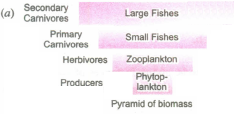
(b) Pyramid is inverted. It is because in pond ecosystem, producers are the smallest organisms while herbivores and carnivores are largest in size. Consequently, there is a gradual increase in biomass of organisms at successive trophic levels.
27.
All the regions of the world (atmosphere, lithosphere ad hydrosphere) where living organisms occur together with their abiotic environments from a biosphere. Main subdivisions of biosphere are atmosphere, lithosphere and hydrosphere.
28.
All organisms/animals which depend directly or indirectly on plants for their food are called consumers.
Consumers are of the following types:
(i) Primary consumers
They are the organisms/animals which depend directly on producers for their food;they are also called as herbivores,e.g. deer, rabbit, zooplanktons.
(ii)Secondary consumers
Secondary consumers are those animals which depend on the primary consumers for their food; they are primary carnivores, e.g frogs,hyena.
(iii)Tertiary consumers
Tertiary consumers are those animals which depend on the secondary consumers for their food;they are the secondary carnivores, e.g. lion, eagle, kite, etc.
29.
(i) Grasslands,Forests.
(ii) Oceans, Ponds, Lakes.
(iii) Agricultural fields, Aquariums.
30.
Primary productivity is defined as the amount of biomass or organic matter produced per unit area over a time period by the plants during photosynthesis.
It is also defined as the amount of biomass or organic matter produced per unit area over a time period by the plants during photosynthesis.
Primary productivity depends on:
(i)The plant species inhabiting a particular area.
(ii)The environmental factors.
(iii) Available of nutrient.
(iv) Photosynthetic capacity of plants.
31.
Pond - an Ecosystem
1. Pond is a fairly self-sustainable unit that shows even complex interactions of an aquatic ecosystem.
2. It is a shallow water body in which all the major/basic components of an ecosystem are well exhibited.
3. The abiotic components ar:
(i) Water with all the dissolved inorganic substance.
(ii) The rich soil deposit at the bottom.
(iii) The solar input.
(iv) The cycle of temperature.
(v) day length.
(vi) Climatic factor.
1. The producers or autotrophic components include phytoplanktons, some algae, floating and submerged and marginal plants.
2. The consumers are represented by
(i) zooplanktons,
(ii) f ree-swimming animals,
(iii) bottom dwelling animals.
1. The decomposers are the bacteria and fungi that are found at the bottom.
2. This system performs all the function of an ecosystem.
(i) Conversion of inorganic materials into organic compounds with the help of radiant energy of sun.
(ii) Consumption of autotrophs by heterotrophs, (food chain/food web), decomposition and mineralisation (nutrient cycling), etc.
32.
Process of decomposition
(i) Fragmentation:
It is the process of breaking of the detritus into smaller particles by detritivores like earthworm.
(ii) Leaching: It is the process in which watersoluble inorganic substances run down into soil horizon and get precipitated as unavailable salts.
(iii) Catabolism:
1. The enzymatic conversion of the detritus into simple organic compounds and then into inorganic compounds is called catabolism.
2. The enzymes are secreted by the decomposers like bacteria and fungi
(iv) Humification:
Humification during decomposition leads to the accumulation of a dark coloured, amorphous substance, called humus.
(v) Mineralisation:
It is the process in which the humus is degraded by certain microbes and the inorganic nutrients are released.
33.
Components of an Ecosystem:
The components are broadly classified into two categories:
(i) Biotic components
(ii) Abiotic components
Biotic components include the following:
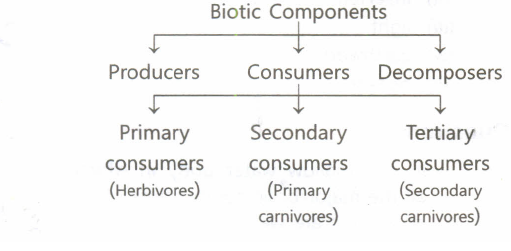
Producers:
These are the green plants or other autotrophs, which prepare their own organic food and feed energy into the ecosystem.
Decomposers:
Decomposers are the organisms which degrade the dead and decaying organic matter and satisfy their energy requirement, e.g. bacteria and fungi.
Abiotic Components:
They include the factors like:
(i) Air
(ii) Water
(iii) Solar radiation
(iv) Temperature
(v) Soil with organic and inorganic compounds as nutrients to plants.

12th Standard CBSE Syllabus & Materials
12th Standard CBSE
CBSE 12th Computer Science Python Revision Tour I - New Previous year Question Papers Study Material - QB365 Set A
NEW12th Standard CBSE
CBSE 12th Business Studies Planning Important Questions And Answers Study Material - QB365 Set A
NEW12th Standard CBSE
CBSE 12th Business Studies Business Environment Important Questions And Answers Study Material - QB365 Set A
NEW12th Standard CBSE
CBSE 12th Business Studies Principles of Management Important Questions And Answers Study Material - QB365 Set A



NCERT Books

Syllabus

Exam Pattern

Sample Question Papers

Previous year Question Papers

Important Notes

MCQ Practice test

NCERT Exemplers

Case study Questions

Image Based Questions

Passage based Questions

HOT Questions

Value Based Questions

Model Questions Papers
NCERT ( Book Back ) Questions

Assertion and Reason
Important Questions And Answers

CBSE 12th Standard CBSE Subjects
CBSE Standards








