
 100% FREE ACCESS
12th Standard CBSE Syllabus & Materials
12th Standard CBSE
CBSE 12th Economics Government Budget and the Economy Previous year Question Papers Study Material - QB365 Set A
NEW12th Standard CBSE
CBSE 12th Computer Science Interface Python with MySQL - New Previous year Question Papers Study Material - QB365 Set A
NEW12th Standard CBSE
CBSE 12th Computer Science Database Concept - New Previous year Question Papers Study Material - QB365 Set A
NEW12th Standard CBSE
CBSE 12th Computer Science Data Communication - New Previous year Question Papers Study Material - QB365 Set A
NEW12th Standard CBSE
CBSE 12th Computer Science Data Structures - New Previous year Question Papers Study Material - QB365 Set A
NEW12th Standard CBSE
CBSE 12th Computer Science Functions - New Previous year Question Papers Study Material - QB365 Set A

Published on: 02/11/2025
Download CBSE Class 12th Standard CBSE Biology question papers, sample papers, important questions, and previous year solved papers in PDF format. Get free study materials, NCERT solutions, and exam preparation resources for Class 12th Standard CBSE Biology
Questions + Answers key
Take MCQ Biology Test
1.
By what Latin name, is the first human-like being, the hominid known?
2.
Why are lichens regarded as pollution indicators?
3.
State the significance of Coelacanth in evolution.
4.
Mention two functions of the codon,AUG.
5.
Which of the two subunits of ribosome encounters an mRNA?
6.
Name two constrasting pod-related traits studied by mental in pea plant experiments
7.
In a test cross progeny of pea plats, all were bearing violet flowers. Give the genotypes of the parent pea plants.
8.
Differentiate between a cistron and an exon.
9.
Explain the role of enzyme nucleases and ligases
10.
What are plasmids?
11.
How is genetic drift different from gene migration? Explain.
12.
What is divergent evolution? Explain taking an example of plants.
13.
Explain the laws that Mendel derived from his monohybrid crosses
14.
Explain artificial selection in terms of evolution.
15.
What is palaeontology?
16.
Explain the sex determination mechanism in humans.How is it different from birds?
17.
State and explain any three factors affecting allele frequency in populations.
18.
How did Darwin's theory of natural selection explain the appearance of new forms of life on earth?
19.
What are satellite DNA in a genome?
Explain their role in DNA fingerprinting.
20.
Explain the role of regulatory gene in lac operon.Why is the regulation of the operon called negative regulation?
21.
Explain the role of RNA polymerase in transcription in bacteria
22.
What is biogeography? How Darwin succeeded to use the evidence from biogeography in favour of evolution?
23.
What is semiconservative replication of DNA? Explain how it was experimentally proved.
24.
(a) Write the blood group of people with genotype IA IB. Give reasons in support of your answer.
(b) In one family of four children, each has a different blood group. Their mother has blood group A and their father has blood group B. Work out a cross to explain how it is possible.
1.
()
Homo habilis is the first hominid.
2.
()
Since, lichens do not grow in polluted areas, they are regarded as pollution indicators.
3.
()
Their discovery was significant as they proved thatamphibians have evolved from fish-like organisms. Lobefins are the ancestors of modern day frogs and
salamanders.
4.
()
(i) AUG codes for amino acid methionine
(ii) It is the initiation codon i.e initiates translation
5.
()
Small subunit
6.
()
greenpods and yellow pods.Inflated pods and constricted pods
7.
()
VV and vv
8.
Difference between cistron and an exon:
1. Cistron : A segment of DNA coding for a polypeptide ,chain; the structural gene in a transcription unit could be said as monocistronic (mostly in eukaryotes) or polycistronic (mostly in bacteria or prokaryotes).
2. Exon : The coding sequences or expressed sequences are defined as exons. Exons are said to be those sequences that appear in mature or processed mRNA.
9.
Nucleases remove unwanted nucleotides while ligases rejoin useful of nucleic acid (RNA)
10.
Plasmids. They are circular double stranded DNA of bacteria carry genes for sexuality and resistance factors.Plasmids are used in genetic engineering.
11.
| Genetic drift | Gene flow |
|---|---|
| Random changes in the allele frequencies of a population, occurring only by chance, constitute genetic drift. | It refers to the change in allelic frequencies of a given population, when individuals migrate into the population (immigration) or from the population (emigration). |
12.
1. Divergent evolution is the evolutionary process, where the same structure develops along different directions in different groups of organisms adaptions to different needs.
2. All the different structures evolved are homologous structures, as they all have a similar anatomical structure, though they perform different functions, e.g. the thorn of Bougainvillea and tendril of Cucurbita are homologous organs, as both of them are modified stems, which perform different functions.
13.
Mendel derived law of dominance and law of segregation from his monohybrid crosses.
14.
Artificial selection refers to the selection of superior traits of plants and animals by man which it wants to perpetuate.It involves selective breeding of organism shotter span of time.The different plant and animals breeding programs are best known examples.
15.
Palaeontology is the study of past life based on the fossil record.
16.
In birds, female has dissimilar chromosomes(ZW) and males have two similar(ZZ) chromosomes.But in humans,female has a homogametic(XX) and male has hetrogametic (XY) sex chromosome.In human sperm is responsible for sex of offspring.In birds egg is responsible for the sex of the offsprings.
17.
Factors affecting allele frequency in populations are described below:
(i) Mutations: These are sudden heritable changes which are supposed to be the primary source of genetic variation. They are of following two types.
(a) Chromosomal Mutations: They arise due to changes in chromosome number and changes in structure.
(b) Gene Mutations: These are changes in gene structure and expression due to addition, deletion, substitution or inversion of nucleotides.
(ii) Non-random Mating: Repeated mating between individuals of certain selected traits changes the gene frequency, e.g., selection of more brightly coloured male bird by a female bird may increase the gene frequency of bright colour in the next generation.
(iii) Gene Flow (Gene Migration): It is the movement of alleles into and out of a gene pool. Breeding of immigrants with the host population adds new alleles to the gene pool of the host population.
18.
Darwin's theory of Natural Selection:
Any population has built in variation for every character.
Individuals with those characters which enable them to survive better would outbreed the others, who are less adapted.
Fitness, according to Darwin, is reproductive fitness, i.e. individuals who are better fit in an environment leave more progeny than others.
These progenies survive better and more fit individuals are added to the population, i.e. Natural Selection.
The population now comes to possess more fit individuals, i.e. nature selects the better fit individuals and over a long period of time, through a number of generations, the population slowly becomes modified into a different form, or a species, which is called evolution.
19.
1. Satellite DNA refers to the bulk of the genomic DNA, whose sequences do not code for proteins, but form major peaks during density gradient centrifugation.
2. The sequences of satellite DNA show high degree of polymorphism.
3. Since DNA from every tissue of an individual shows the same degree of polymorphism, it forms the basis of DNA fingerprinting.
4. Since the polymorphism is also inherited by children from the parents, it helps in paternity testing in case of disputes.
20.
(i) The regulatory gene in lac operon (also called i gene or inhibitor gene) codes for a protein, called repressor; the repressor is synthesised all the time constitutively.
(ii) The repressor has high affinity to the operator; it binds to the operator region and prevents the RNA polymerase from transcribing the structural genes of the operon.
21.
1. A single DNA dependent RNA polymerase catalyses the formation of mRNA, tRNA and rRNA in bacteria.
2. The enzyme is capable of catalysinq only the elongation step of transcription.
3. It combines transiently to the initiation or sigma factor and binds to the promoter and initiates transcription.
4. It somehow facilitates the opening of the DNA helix and catalyses the polymerisation of ribonucleoside triphosphates in a template-depended fashion, i.e. elongation.
5. When it reaches the terminator sequence, the enzyme associates transiently with the termination or rho(p) factor and terminates transcription, the RNA and the enzyme fall off the template.
22.
Biogeography means the study of geographical distribution of species. Darwin joined as an unpaid naturalist on a five-year navigational mapping of British Admiralty abrod the ship H.M.S. Beagle.
During his voyage Darwin observed and studied a wide variety of plants and animals on continents and in distant seas. Darwin studied on different continents different species. He found different species. He found different species in mainland and islands and showed evolutionary relation of species with biogeography.
Darwin studied birds called 'finches' which resemble with original birds of main land from Galapago islands separated. He also noticed giant tortoise, metre long marine and land iguanas, many unusual, plants, insects, sea shell. All these varieties of organisms influenced Darwin to think about evolutionary changes.
23.
1. It was to show that DNA replication is semi conservative.
2. After completion of replication, each new/daughter molecule of DNA has one parental strand and one newly synthesised strand; this is called semiconservative replication of DNA.
3. Experiment
Mathew Meselson and Franklin Stahl performed the experiment.
4. They grew E.coli. in a medium containing \(^{ 15 }{ { NH }_{ 4 } }Cl,\) until \(^{ 15 }N\) was incorporated in the two strands of newly formed E.coli cells; this 'heavy' DNA can be separated from the normal \(^{ 14 }N-DNA\) by centrifugation in cesium chloride (CsCI) density gradient.
5. Then they transferred the cells into a medium with normal \(^{ 14 }{ { NH }_{ 4 } }Cl\) and took out samples at various time intervals.
6. They extracted the DNA and centrifuged it to measure the densities.
7. The DNA extracted from cells after one generation after transfer from the \(^{ 15 }{ { N } }\) medium to \(^{ 14 }{ { N } }\) medium (i.e. after about 20 minutes), had an intermediate/hybrid density.
8. The DNA extracted after two generations (i.e. after 40 minutes) consisted of equal amounts of 'light' DNA and 'hybrid' DNA.
This proves that after replication, each DNA molecule has one parental strand and one newly synthesised strand, i.e. replication is semiconservative.
24.
(a) The person will be of blood group AB; since the alleles IA and IB are codominant, both express themselves in the presence of the other, i.e. both glycoprotein A and B are produced and hence the person is of blood group AB.
(b) Since all the blood groups (including the recessive 0 group) have appeared in the progeny, father must be heterozygous for B group and mother must also be hetrozygous for A group.
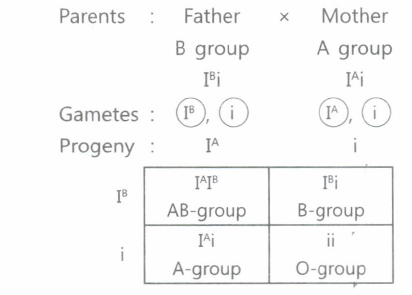
ABO blood group is under the control of a single gene, which exists in three allelic forms \(I^{ \wedge }I^{ B }\) and i, i.e. it shows multiple allelism.
\(I^{ \wedge }\)and \(I^{ B }\) IBare equally dominant and exhibit codominance and produce blood group AB.
Six genotypes are possible with the three alleles and they produce four phenotypes, i.e. blood groups A, B, AB and O.

12th Standard CBSE Syllabus & Materials
12th Standard CBSE
CBSE 12th Computer Science Python Revision Tour I - New Previous year Question Papers Study Material - QB365 Set A
NEW12th Standard CBSE
CBSE 12th Business Studies Planning Important Questions And Answers Study Material - QB365 Set A
NEW12th Standard CBSE
CBSE 12th Business Studies Business Environment Important Questions And Answers Study Material - QB365 Set A
NEW12th Standard CBSE
CBSE 12th Business Studies Principles of Management Important Questions And Answers Study Material - QB365 Set A



NCERT Books

Syllabus

Exam Pattern

Sample Question Papers

Previous year Question Papers

Important Notes

MCQ Practice test

NCERT Exemplers

Case study Questions

Image Based Questions

Passage based Questions

HOT Questions

Value Based Questions

Model Questions Papers
NCERT ( Book Back ) Questions

Assertion and Reason
Important Questions And Answers

CBSE 12th Standard CBSE Subjects
CBSE Standards








