
 100% FREE ACCESS
12th Standard CBSE Syllabus & Materials
12th Standard CBSE
CBSE 12th Economics Government Budget and the Economy Previous year Question Papers Study Material - QB365 Set A
NEW12th Standard CBSE
CBSE 12th Computer Science Interface Python with MySQL - New Previous year Question Papers Study Material - QB365 Set A
NEW12th Standard CBSE
CBSE 12th Computer Science Database Concept - New Previous year Question Papers Study Material - QB365 Set A
NEW12th Standard CBSE
CBSE 12th Computer Science Data Communication - New Previous year Question Papers Study Material - QB365 Set A
NEW12th Standard CBSE
CBSE 12th Computer Science Data Structures - New Previous year Question Papers Study Material - QB365 Set A
NEW12th Standard CBSE
CBSE 12th Computer Science Functions - New Previous year Question Papers Study Material - QB365 Set A

Published on: 02/11/2025
Download CBSE Class 12th Standard CBSE Biology question papers, sample papers, important questions, and previous year solved papers in PDF format. Get free study materials, NCERT solutions, and exam preparation resources for Class 12th Standard CBSE Biology
Questions + Answers key
Take MCQ Biology Test
1.
Give one example of each of indigenous and exotic milch breeds of cow.
2.
Why does 'Swiss Cheese' have big holes?
3.
Why is sewage water treated until the BOD is reduced ? Give a reason.
4.
Why are proteins synthesised from spirulina called single cell proteins?
5.
List the events that reduce the Biological Oxygen Demand (BOD) of a primary effluent during sewage treatment.
6.
Find out the name of microbes from which Cyclosporin-A (an immunosuppressive drug) and statins (blood cholesterol lowering agents) are obtained.
7.
Mention the advantages of artificial insemination.
8.
What is meant by germplasm collection? What are its benefits?
9.
Name the different types of cells providing cellular barrier responsible for innate immunity in humans.
10.
List any four objectives that you would recommend for biofortification.
11.
Name the plant source of the drug popularly called 'smack'.How does it affect the body of the abuser?
12.
What is Ganga action plan? What it tends to achieve?
13.
What is artificial insemination? Mention two way in which it is useful in breeding of dairy animals.
14.
What are methanogens? How do they help to generate biogas?
15.
Some Industrial products are derived from fungi. Name the fungi.
| Industrial product | Fungi from which derived |
|---|---|
| oxalic acid | A |
| Lactic acid | B |
| Citric acid | C |
| Gluconic acid | D |
16.
What is importance of biofortication?
17.
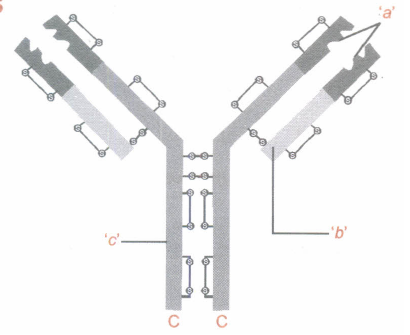
Identify a, b and c in the schematic diagram of an antibody given and answer the questions.
(i) Write the chemical nature of an antibody.
(ii) Name the cells that produce antibodies in humans.
(iii) Mention the type of immune response provided by an antibody.
18.
Describe how biogas is generated from activated sludge. List the components of biogas.
19.
Explain the role of the following in providing defence against infection in human body:
(i) Histamine
(ii) Interferons
(iii) B-cells
20.
Trace the life cycle of malarial parasite in the human body,when bitten by an infected female Anopheles.
21.
MOET is good technogy to the herd size of high - yielding cattle. How is it done? Explain the procedure.
22.
Differentiate between inbreeding and out breeding in cattle. State on eadvantage and on edisadvantage for each one of them.
23.
Discuss role of microbes in preparation of many household products.
24.
List the harmful effects caused by the alcohol/drug abuse.
25.
(a) What is plant breeding? List the two steps the classical plant breeding involves.
(b) how has the bmutation breeding helped in improving crop varieties?Give one example where this technique has helped.
(c) How has the breeding programme helped in improving the public nutritional health? State two examples in support of your answer.
1.
()
Indigenous breed: Sahiwal; Exotic breed: Brown swiss.
2.
()
Due to production of large amount of \({ Co }_{ 2 }\) by the bacterium Propionibacterium sharmanii involved in its processing.
3.
()
Sewage water is treated to reduce the BOD, because higher the BOD of the water, grater is its polluting potential
4.
()
The protein produced by microbes, is called single cell protein.
5.
Effluent from the primary settling tank passed into aeration tank, agitated mechanically and air is pumped into it, vigorous growth of aerobic microbes into flocs, microbes consume major part of the organic matter in effluent.
6.
(i) Cyclosporin-A is obtained from the fungus Trichoderma polysporum
(ii) Statins are obtained from yeast, Monascus purpureus.
7.
(i) Several cows (upto 3000) can be inseminated by the semen of a single good male.
(ii) Ensures progeny of good quality.
(iii) Avoids the transportation of animals.
(iv) Sperms can be stored for long period at freezing temperature.
8.
The collection of all the diverse alleles of all the genes of a crop plant is called germplasm collection. It is of great benefit in plant breeding programmes as it offers the breeders the entire genes and alleles and the characteristics which they express. The breeder selects the most favourable characters of a particular gene and manipulates its transfer to a desirable parent.
9.
The cellular barrier includes:
(i) Polymorpho nuclear leukocytes (PMNL).
(ii) Monocytes.
(iii) Natural killer type of lymphocytes.
(iv) Macrophages.
10.
The objectives of biofortification are to improve/increase:
(i) protein content and quality
(ii) oil content and quality
(iii) vitamin content
(iv)micronutrient and mineral content.
11.
Smack is obtained from Papaver somniferum. It affects the Central Nervous System (CNS) and gastrointestinal system. It slows down the body functions. It acts as a depressant.
12.
1. Ganga action plan was initiated by the ministry of environment and forest in order to save the holy river Ganga from pollution. Under this plan it has been proposed to build a large of sewage treatment plant so that only the treated sewage is discharged
into the river.
2. Industries may release their effluents and waste only after their proper treatment.
13.
Artificial insemination is a method of improvement in animals by using controlled breeding methods. During this process, the semen collected from the selected superior quality male parent is injected into the reproductive tract of selected female parent by the breeder.
Breeding of dairy animals by the artificial insemination methods is useful in following two ways:
(i) The bull of superior quality can be made to inseminate with many cows so, as to produce a large number of offsprings with desired traits.
(ii) The offspring produced by artificial insemination have higher yield as compared to the normal offspring.
14.
1. Certain bacteria which grow anaerobically on cellulosic material, produce large amounts of methane along with CO2 and H2. These bacteria are called methanogens (one of the common bacterium is Methanobacterium).
2. Methanogens are commonly found in the anaerobic sludge during sewage treatment and are also present in the rumen (a part of stomach) of cattle.
3. In rumen, methanogens help in the breakdown of cellulose and their excreta called gobar, is rich in these bacteria. Therefore, dung can be used to produce biogas commonly called as gobar gas.
15.
A. Aspergillus niger
B. Rhizopus oryzae
C. Aspergillus niger, Citromyces pfefferiaur
D. Penicillium prupurogenum.
16.
The method of breeding crops with higher levels of vitamins and minerals or higher protein and healthier fats is called biofortification. It is one the most important method for improving public health. During recent past, many varieties of crop plants such as rice, carrots, spinach, pumpkin, bathua have been developed which possess several times more nutritive value and vitamins as compared to existing varieties.
17.
a - Antigen binding site
b - Light chain
c - Heavy chain
(i) They are chemically proteins
(ii) B-Iymphocytes
(iii) Humoral immune response
18.
Biogas is a mixture of gases (methane 60%, CO2 40%, traces of hydrogen and several other gases) produced by the microbial activity and may be used as fuel.
19.
(i) Histamines cause reactions of the immune system against allergens.
(ii) Interferons protect the non-infected cells of our body from viral infections.
(iii) B-cells produce antibodies against antigens/pathogens.
20.
1. Life cycle of Plasmodium in human body.
2. When an infected female Anopheles mosquito bites a person,the sporozoites are injected into the body.
3. They reach the liver cells through blood.
4. The parasite reproduces asexually in the liver cells and by the bursting of liver cells,new cells are released into the blood.
5. They enter the red blood cells (RBCs) and reproduce asexually;by bursting the red blood cells,the cells of the parasite release haemozoin,which causes the cycles of fever,chill and shivering.
6. The released parasite cells infect new red blood cells;some continue the asexual reproduction and cause the cycles of fever.
7. Others enter the sexual stage and form gametocytes in the RBCs,which are picked by the Anopheles mosquito, along with the blood meal.
21.
(a) Multiple ovulation Embryo Transfer , (MOET) technology
(b) Steps in MOET technology:
1. A cow is administered hormones with FSH-like activity to induce follicular maturation and superovulation, i.e. instead of one egg, 6-8 eggs are produced per cycle.
2. The animal is either mated with an elite bull or artificially inseminated.
3. The fertilised eggs are recovered at the 8-32 celled stages, nonsurgically.
4. They are then transferred to surrogate mothers.
5. The genetic mother is available for and her round of superovulation.
22.
| Inbreeding | Outbreeding |
|---|---|
| Inbreeding refers to the mating of more closely related individuals within the same breed for 4-6 generations. | Outbreeding refers to the breeding of unrelated animals of the same breed with no common ancestors, or between two different breeds or different species |
Advantages:
Inbreeding: It is used to evolve purelines in animals.
Outbreeding: These methods are used for improving the yield of animals and also to produce new breeds.
Disadvantages:
Inbreeding: Continuous inbreeding leads to inbreeding depression and reduction in productivity.
Outbreeding: The success rate may below and the desired combinations of characters may appear in low frequency.
23.
Curd is produced by Lactobacillus and other lactic acid bacteria(LAB), which grow in milk and convert it into curd.
(i) LAB produce acids that coagulate and partially digest the milk and protein.
(ii) LAB also increase the nutritional quality of curd by increasing the content of vitamin B12.
2. The dough used for making Idli and dosa, is fermented by bacteria. The puffed up appearence is due to the CO2 produced during fermentation.
3. The dough used for making bread is fermented by saccharomyces cerevisiae, commonly called bakers yeast.
4. Toddy is produced by fermenting coconut water.
5. Microbes are used to ferment fish, bamboo shoots and soyabean to produce food items.
6. Cheese differs in texture, flavor and taste, depending on microbe used for fermentation and ripening.
24.
1. The immediate effects of drug/alcohol abuse are manifested as reckless behavior, vandalism, and violence.
2. Other symptoms include loss of weight, sterility, and loss of interest in work.
3. Secondary infections like AIDS, hepatitis and STDs are possible through use of contaminated needles/syringes to inject drugs.
4. Alcohol affects the liver.
5. Central nervous system is affected by alcohol as well as drugs.
25.
(a) Plant breeding is the purposeful manipulation of plant species in order to create desired plant types that are suited for cultivation, give better yield and are disease-resistant.
The two steps in classical plant breeding are:
(i) Crossing or hybridisation of purelines.
(ii) Artificial selection of plants with desirable traits.
(b) Mutation breeding involves inducing mutations artificially and selecting and using the plants that have the' desirable characters for further breeding.
e.g. Resistance to yellow mosaic in mung bean.
Resistance to powdery mildew in mung bean. (anyone)
(c) Through biofortification, some common food plants have been enriched with those micronutrients, which used to be deficient in them.

12th Standard CBSE Syllabus & Materials
12th Standard CBSE
CBSE 12th Computer Science Python Revision Tour I - New Previous year Question Papers Study Material - QB365 Set A
NEW12th Standard CBSE
CBSE 12th Business Studies Planning Important Questions And Answers Study Material - QB365 Set A
NEW12th Standard CBSE
CBSE 12th Business Studies Business Environment Important Questions And Answers Study Material - QB365 Set A
NEW12th Standard CBSE
CBSE 12th Business Studies Principles of Management Important Questions And Answers Study Material - QB365 Set A



NCERT Books

Syllabus

Exam Pattern

Sample Question Papers

Previous year Question Papers

Important Notes

MCQ Practice test

NCERT Exemplers

Case study Questions

Image Based Questions

Passage based Questions

HOT Questions

Value Based Questions

Model Questions Papers
NCERT ( Book Back ) Questions

Assertion and Reason
Important Questions And Answers

CBSE 12th Standard CBSE Subjects
CBSE Standards








