
 100% FREE ACCESS
12th Standard CBSE Syllabus & Materials
12th Standard CBSE
CBSE 12th Economics Government Budget and the Economy Previous year Question Papers Study Material - QB365 Set A
NEW12th Standard CBSE
CBSE 12th Computer Science Interface Python with MySQL - New Previous year Question Papers Study Material - QB365 Set A
NEW12th Standard CBSE
CBSE 12th Computer Science Database Concept - New Previous year Question Papers Study Material - QB365 Set A
NEW12th Standard CBSE
CBSE 12th Computer Science Data Communication - New Previous year Question Papers Study Material - QB365 Set A
NEW12th Standard CBSE
CBSE 12th Computer Science Data Structures - New Previous year Question Papers Study Material - QB365 Set A
NEW12th Standard CBSE
CBSE 12th Computer Science Functions - New Previous year Question Papers Study Material - QB365 Set A

Published on: 02/11/2025
Download CBSE Class 12th Standard CBSE Biology question papers, sample papers, important questions, and previous year solved papers in PDF format. Get free study materials, NCERT solutions, and exam preparation resources for Class 12th Standard CBSE Biology
Questions + Answers key
Take MCQ Biology Test
1.
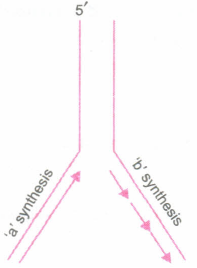
Name the types of synthesis 'a' and 'b' occurring in the replication fork of DNA as shown below:
2.
Mention the role of cyanobacteria as a biofertiliser.
3.
What type of virus causes AIDS? Name its genetic material.
4.
Why is the south indian sugar cane prederred by agriculturists?
5.
When do the human beings elicit an anamnestic response?
6.
Write the similarity between the wing of a butterfly and the wing of a bat. What do you infer the above with reference to evolution?
7.
Name the enzyme involved in the continuous replication of DNA strand Mention the polarity of the template strand.
8.
Name two constrasting pod-related traits studied by mental in pea plant experiments
9.
Name the event during cell division cycle that results in the gain or loss of chromosome
10.
Study the flow chart given below
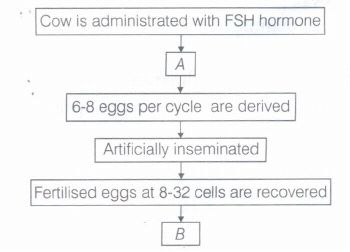
(i) Identify the events that take place at stage A and B, respectively.
(ii) State the importance of the technology explained above.
11.
What is individual's role in the evolutionary process?
12.
Explain the two factors responsible for conferring stability to double helix structure of DNA
13.
Write a note on Typhoid.
14.
Why is a little curd added to milk to set it into curd? Explain
15.
Explain in brief the role of animal husbandry in human welfare.
16.
How do Darwin's finches illustrate adaptive radiation?
17.
Why does a doctor administer tetanus antitoxoid and not a tetanus vaccine to a child injured in a roadside accident with a bleeding wound?Explain.
18.
What is the cause of discontinuous synthesis of DNA on one of the parental strands of DNA?What happens to these short stretches of the DNA synthesised?
19.
If the distance between the genes a, b, and c on a chromosome is as follows, prepare a genetic map assigning the correct order of genes. Which of the gene pairs will show maximum frequency of crossing over?
a - b = 5 cm, b - c = 3 cm and a - c = 2 cm.
20.
If a father and son are both defective in red-green colour vision, is it likely that the son inherited the trait from his father? Comment.
21.
How did Darwin explain the existence of different varieties of finches on Glapagos Islands?
22.
How many galaxies are present in the universe? Do all the stars that we can see with naked eye belong to our galaxy? Does earth is a part of solar system?
23.
How do you express the meaning of worlds like race, breed cultivars or variety?
24.
Trace the events that occur in human body to cause immunodeficiency,when HIV gains entry into the body.
25.
(a)List the structural genes involved in the digestion o lactose in E.Coli. Highlight the function of any one
(b)What triggers the transcription of these genes?
26.
What is 'Blue revolution'? Name two fresh water and two marine edible fish.
27.
Describe the technology that sucessfully increased the herd size of cattle in a short time to meet demands of growing human
population.
28.
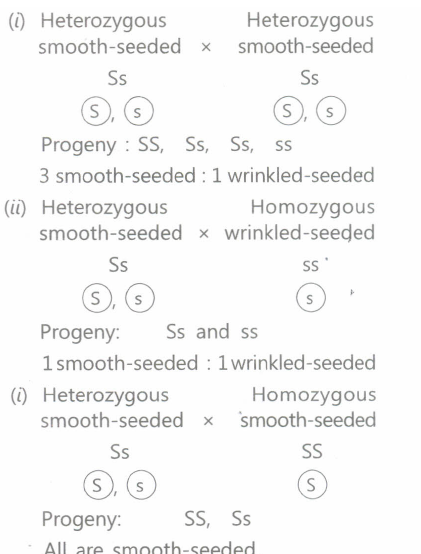
In garden pea, smooth seed coat is dominant over wrinkled seed coat. What will be the expected ratio of phenotypes of the offspring in a cross between:
(i) Heterozygous smooth \(\times\) Heterozygous smooth
(ii) Heterozygous smooth \(\times\) Homozygous wrinkled
(iii) Heterozygous smooth \(\times\) Homozygous smooth.
29.
(a) Sickle-cell anaemia in humans is a result of point mutation. Explain.
(b) Write the genotypes of both the parents who have produced a sickle-celled anaemic offspring.
30.
Doctor are worried about antibiotics resistance in disease causing bacteria such as Mycobacterium and are using DNA fingerprinting technique for screening of resistance bacteria.
Read the above passage and answer the following questions:
(i) What is antibiotics?
(ii) What are the possible reasons for development of resistance in bacteria to antibiotics?
(iii) How can DNA fingerprinting be helpful in controlling growth of such bacteria?
31.
After consuming sugarcane juice from a roadside vendor, Monu suffered from cough. His mother advised him to cover his nose while coughting and sneezing.
Read the above passage and answer the following questions:
(i) Why did Monu fall ill?
(ii) Why did his mother advise him to cover his nose while coughting and snazing?
32.
Give an account of following diseases
(i) Ascariasis
(ii) Filariasis
(iii) Ringworms
33.
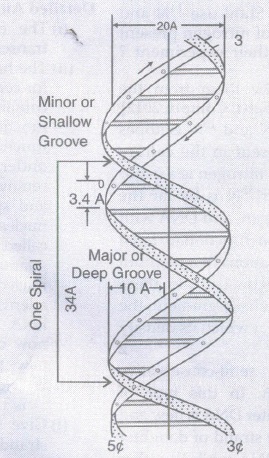
Enlist the salient features o the double helix strucutre of DNA.
34.
What is the inheritance pattern observed in the size of starch grains and seed shape of pisum sativum? Work out the monohybrid cross showing the above traits. How does this pattern of inheritance deviate from that of Mendelian law of dominance.
1.
Synthesis 'a' is continuous(3'--->5') and synthesis 'b' is discontinuous(5'--->3')
2.
()
(i) Cyanobacteria can fix atmospheric nitrogen.
(ii) They also add organic matter to the soil to increase soil fertility.
3.
()
Retrovirus causes AIDS.
RNA is its genetic material.
4.
()
The south indian sugarcane has thick stems with high sugar content
5.
()
When a human body encounters a pathogen for the second time,it elicits an anamnestic response.
6.
()
(i) They are analogous organs, which perform similar functions.
(ii) Analogous organs are the result of convergent evolution.
7.
Enzyme involved in continuous replication of DNA strand is DNA-dependent DNA polymerase. Template strand has 3'⟶ 5' polarity.
8.
()
greenpods and yellow pods.Inflated pods and constricted pods
9.
()
Failure of segergation of members of homologous pairs of chromosomes (non-disjunction) during anaphase 1 of meiosis
10.
(i) A- The home induces follicular maturation and superovulation, i.e. production of 6-8 eggs.
B- They are transferred to surrogate mother.
(ii) The technology is called MOET. It is used to increase the herd size by breeding high milk yielding breeds of females with high quality meat yielding bulls.
11.
To pass on its genetic variation to its offspring and thereby to contribute its specific genes to the gene pool of the population.
12.
The factors responsible for conferring stability of double helix structure of DNA are as follows
(i) Stacking of one base pair over other.
(ii) H-bond between nitrogenous bases.
13.
Typhoid.
1.it is an infectious disease caused by bacteria,Salmonella typhi.
2.The infection is by contaminated food and water.
3.The pathogen enters the small intestine and then the other parts through body fluids.
4.Its symptoms include:(a) sustained high fever (\({ 103 }^{ 0 }-{ 104 }^{ 0 }\) F),(b)stomach pain,(c)loss of appetite, (d) constipation and (e)headache.
5.Intestinal perforation leading to death in severe cases.
6.Typhoid can be confirmed by Widal test.
14.
1. The small amout of curd added to the milk contains millions of lactic acid bacteria they start multiplying at the suitable temperatures.
2. LAB produce acides that coagulate and partially digest the milk proteins; thus, milk is coverted into curd.
3. Vitamin B12 content is increased.
15.
Animal husbandry:
(i) The ever increasing demand for food from animals and animal products, both in terms of quality and quantity has been met by animal husbandry practies.
(ii) There has been a remarkable growth in the practicle of bee-keeping and production of honey
(iii) Demand for aquatic foods, espectively fish and fish products has also been met by animal husbendry practices.
16.
Adaptive radiation is the process of evolution of different species in a given geographical area starting from a point and literally radiating to other geographical areas (habitats).
Darwin's finches were the small black birds, which Darwin observed in Galapagos islands.
There were many varieties of these birds in the same island.
Darwin reasoned that after originated from a common ancestral seed-eating stock, the finches must have radiated to different geographical areas and undergone adaptive changes especially in their beaks, enabling some of them to become insectivorous.
Living in isolation for long, new kinds of finches must have evolved, which could survive in the new habitats.
17.
1. Tetanus antitoxin,i.e. preformed antibodies for tetanus are injected,as the child infected with deadly microbe (tetanus bacteria) to which quick immunisation response is required.
2. If tetanus vaccine is injected,it will take some time for the body to develop antibodies and this can lead to a fatal end.
18.
1. DNA polymerase can polymerise the nucleotides only in 5' -> 3' direction.
2. Hence on the template strand of DNA with 5' -> 3' polarity there is discountinuous synthesis.
3. These short stretches of DNA are joined together by DNA-ligase into a new strand of DNA.
19.
Maximum frequency of recombination will occur between b and a, as they are far apart.
20.
- No, the son never inherits colour blindness from his father.
- The gene for colour-blindness is present on the x-chromosome, but a son receives Y-chromosome from his father.
- Since a male receives the X-chromosome from his mother, he ihherits the disease from his mother only.
21.
Darwin explained it as the process of evolution of different species in given geographical area starting from a point and literally radiating to other areas of geography called adaptive radiation.
By the process of evolution many other forms with altered beaks arose from the original seed-eating features, enabling them to become insectivorous and vegetatian finches.
22.
There are approximately 100,000 million galaxies in the universe.
Yes, all the stars that we can see with the naked eye belong to our galaxy.
Earth is a part of solar system.
23.
The meaning of the given words are as given below
Race. It is a classification system used to categorise humans into large and distinct populations or groups
by anatomical, cultural, linguistic, geographical, historical and for religious relationship.
Breed. It is a specificgroup ofdomestic animals or plants having homogenous appearance and behaviour
and other characteristics that distinguish it from other animals or plants of the same species. They were formed through selective breeding.
Cultivar. It is a plant or grouping of plants selected for desirable characteristics that can be maintained by propagation. 'Cultivar' stands for 'cultivated variety'.
Variety. A variety arises naturally in the plant kingdom and plant grown from its seeds will typically come true to type.
24.
1. After entering the body of a person,the virus enters the macrophages.
2. The viral genome (RNA) undergoes replication and reverse transcription to become viral DNA with the help of reverse transcriptase.
3. The viral DNA gets incorporated into the DNA of the cells and directs these cells to produce virus particles.
4. The macrophages function as HIV factory and produce a number of HIV particles.
5. These HIV particles move out of macrophages and infect the helper T-lymphocytes and replicant to produce progeny viruses.
6. The progeny viruses released in the blood attack new helper T- cells.
7. This process is repeated and there is a progressive decrease in the number of helper T-cells.
25.
(a) Structural genes of lac operon
There are three structural genes, z, y and a in lac operon.
Gene z codes for \(\beta \) -galactosidase (\(\beta \) gal), that hydrolyses lactose into glucose and galactose.
Gene y codes for permease that helps lactose to enter the cell.
Gene a codes for transacetylase that makes lactose into its active form.
(b) Lactose acts as inducer.
(i) It binds to the repressor coded by the regulatory (i) gene and prevents it from binding to the operator. So,the RNA polymerase gains access to promoter and transcription of the structural genes is triggered .
(ii) Since, the repressor inhibits the transcription, the regulation of lac operon by repressor is called negative regulation.
26.
Blue revolution is a movement lanched to increase the production of fish.Freshwater fish: catla and Rohu. Marine water fish: Helsa and sardines.
27.
(a) Multiple ovulation Embryo Transfer , (MOET) technology
(b) Steps in MOET technology:
1. A cow is administered hormones with FSH-like activity to induce follicular maturation and superovulation, i.e. instead of one egg, 6-8 eggs are produced per cycle.
2. The animal is either mated with an elite bull or artificially inseminated.
3. The fertilised eggs are recovered at the 8-32 celled stages, nonsurgically.
4. They are then transferred to surrogate mothers.
5. The genetic mother is available for and her round of superovulation.
28.
29.
(a) Mutation arising due to a change in a single base pair of DNA, is called point mutation.
The defect is caused by the single base substitution at the sixth codon of the beta chain of haemoglobin from GAG to GUG; this leads to substitution of glutamic acid by valine.
The mutant or defective hemoglobin molecule undergoes polymerization under low oxygen tension causing sickle-shaped RBCs.
(b) The parents must be \(Hb^{ \wedge }\) \(Hb^{ s }\)
30.
(i) Antibiotics are the chemicals produced by bacteria which hinder growth of other microbes.
(ii) Indiscriminate and overuse of antibiotics are possible reasons for development of resistance in bacteria to antibiotics.
(iii) DNA fingerprinting is used to identify the antibiotic for which bacterium is resistant. This technique helps in selection of the right antibiotic for treatment.
31.
(i) He consumed uncovered food products and drinks which got contaminated by pathogenic microbes.
(ii) This practice helps in preventing spread of infectious diseases.
32.
(i) Ascariasis
Cause. It is caused by Ascaris lumbricoides.(round worm).
Symptoms.Its symptoms include:
(a) Blockage of intestinal passage,
(b)Anaemia,
(c)Abdominal/muscular pain,
(d)Internal bleeding,
(e)Nausea and headache.
Modes of transmission. Infection is through contaminated vegetables, fruits and water as eggs of parasite excreted by the infected persons contaminate soil, plants and water
(ii) Filariasis/Elephantiasis
Cause. It is caused by wuchereria bancrofti and wuchereria malayi(filarial worms)
They normally cause inflammation of the organs in which they live for many years.
They normally affect the lymph vessels of the lower limbs (causing them to swell like that of an elephant, hence called elephantiasis).
Genital organs may also be affected leading to gross deformation.
Modes of transmission. The female culex mosquito is the vector.
(iii)Ringworms
Cause. These are caused by fungi like microsporum, Epidermophyton and Trichophyton
Symptoms. The symptoms include
(i) dry scaly lesions on skins, nails and scalp.
(ii)lesions are accompanied by itching.
Modes of transmission. Ringworms are generally acquired from soil or by direct contact with the contaminated articles used by the infected persons.
33.
(i) In translation, a particular amino acid becomes activated and attached to the 3' end of a specific tRNA molecule.
(ii) The reaction is catalysed by the enzyme amino-acyl-tRNA synthetase.
\(Amino\quad acid\left( AA \right) +ATP\xrightarrow { Enzyme } AA-AMP-Enz+{ PP }_{ i }\\ AA-AMP-Enz+tRNA\longrightarrow AA-tRNA+AMP+{ PP }_{ i }\)
(iii) Initiation of protein synthesis
(iv) The ribosome, in its inactive state exits as two subunits - a large subunit and a small subunit.
(v) When the small subunit encounters the mRNA, translation begins.
(vi) The mRNA binds to the small subunit of ribosome, following base pair rule, between the bases of mRNA and those on rRNA; it is catalysed by certain 'initiation factors'.
(vii) There are two sites on the larger subunit, the P-site and the A-site.
(viii) The small subunit (with the tRNA) attaches to the large subunit in such. a way that the initiation codon (AUG) comes on the P-site.
The initiator tRNA (methionyl tRNA) binds to the P-site.
(ix) Elongation of polypeptide chain
(x) A second tRNA charged with an appropriate amino acid binds to the A-site of the ribosome.
(xi) A peptide bond is formed between the carboxyl group of methionine and the amino group of the second amino acid; this reaction is catalysed by the enzyme peptidyl transferase.
(xii) The ribosome moves from one codon to the next along the mRNA in the \({ 5 }^{ ' }\longrightarrow { 3 }^{ ' }\) direction.
(xiii) Amino acids are added 'one by one in the sequence of the codons and become joined together.
Termination of polypeptide synthesis
(i) When one of the termination codons (UAA, UAG, UGA) comes at the A-site, it does not code for any amino acid and there is no tRNA molecule for it.
(ii) As a result, the polypeptide synthesis (or elongation of polypeptide) stops.
The polypeptide synthesised is released from the ribosome, catalysed by a 'release factor'.
34.
(i) Seed shape shows complete dominance. Heterozygotes produce the round seeds.
(ii) Size of starch grains shows incomplete dominance. Heterozygotesproduce intermediate sized starch grains in seeds.
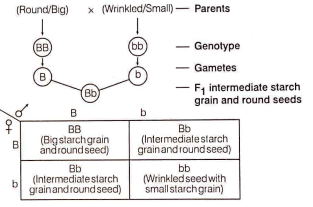
Size of starch grain is an example of incomplete dominance, whereas in Mendelian inheritance, seed shape shows complete dominance.

12th Standard CBSE Syllabus & Materials
12th Standard CBSE
CBSE 12th Computer Science Python Revision Tour I - New Previous year Question Papers Study Material - QB365 Set A
NEW12th Standard CBSE
CBSE 12th Business Studies Planning Important Questions And Answers Study Material - QB365 Set A
NEW12th Standard CBSE
CBSE 12th Business Studies Business Environment Important Questions And Answers Study Material - QB365 Set A
NEW12th Standard CBSE
CBSE 12th Business Studies Principles of Management Important Questions And Answers Study Material - QB365 Set A



NCERT Books

Syllabus

Exam Pattern

Sample Question Papers

Previous year Question Papers

Important Notes

MCQ Practice test

NCERT Exemplers

Case study Questions

Image Based Questions

Passage based Questions

HOT Questions

Value Based Questions

Model Questions Papers
NCERT ( Book Back ) Questions

Assertion and Reason
Important Questions And Answers

CBSE 12th Standard CBSE Subjects
CBSE Standards








