
 100% FREE ACCESS
12th Standard CBSE Syllabus & Materials
12th Standard CBSE
CBSE 12th Economics Government Budget and the Economy Previous year Question Papers Study Material - QB365 Set A
NEW12th Standard CBSE
CBSE 12th Computer Science Interface Python with MySQL - New Previous year Question Papers Study Material - QB365 Set A
NEW12th Standard CBSE
CBSE 12th Computer Science Database Concept - New Previous year Question Papers Study Material - QB365 Set A
NEW12th Standard CBSE
CBSE 12th Computer Science Data Communication - New Previous year Question Papers Study Material - QB365 Set A
NEW12th Standard CBSE
CBSE 12th Computer Science Data Structures - New Previous year Question Papers Study Material - QB365 Set A
NEW12th Standard CBSE
CBSE 12th Computer Science Functions - New Previous year Question Papers Study Material - QB365 Set A

Published on: 02/11/2025
Download CBSE Class 12th Standard CBSE Biology question papers, sample papers, important questions, and previous year solved papers in PDF format. Get free study materials, NCERT solutions, and exam preparation resources for Class 12th Standard CBSE Biology
Questions + Answers key
Take MCQ Biology Test
1.
Strict conditions are to be followed in Medical Termination of Pregnancy (MTP) procedures.mention two reasons.
2.
In the whiptail lizards, only females are born generation after generation. There are no males. How is this possible?
3.
Mention two inhercent characteristics of Amoeba and yeast that enable them to reproduce asexually.
4.
Which type of cell division forms spermatids from the secondary spermatocytes?
5.
Name the part of the flower that contributes to fruit formation in strawberry and guava respectively.
6.
Why doctors recommend breastfeeding during initial period of infant growth?
7.
How do surgical procedures prevent conception in humans?Mention the way it is achieved in human males.
8.
Give reasons as to why cell division cannot be a type of reproduction in multicellular organisms.
9.
Name the cell from which the endosperm of coconut develops. Give the characteristic features of endosperm of coconut.
10.
Why is it difficuit to get rid of 'water hyacinth' from a water body? Name one abiotic component and one biotic component of the ecosystem that gets affected by its spread in the water body.
11.
Write the importance of bagging of unisexual flowers in a crop improvement programme.
12.
Explain giving reasons why pollen grains can be best preserved as fossils
13.
Draw a sectional view of human ovary showing the different stages of developing follicles, corpus luteum and ovulation.
14.
(a) List any four characteristics of an ideal contraceptive.
(b) Name two intra uterine contraceptive devices that affect the motility of sperms.
15.
Describe any three steps taken up by our government to check population growth rate.
16.
Differentiate between vasa efferentia and vasa deferentia.
17.
What do the following parts form in a fruit? Ovary wall, outer integument, inner integument, zygote, primary endosperm nucleus, ovule.
18.
Draw a labelled diagram of a section through ovary.
19.
Mention the target cells of lutenising hormone in human males and females.Explain the effect and the changes which the hormone induces in each case.
20.
Explain the characteristic features of flowers that facilitate wind pollination.
21.
Explain the events taking place at the time of fertilisation of an ovum in human female.
22.
(a) Describe in sequence the process of megasporogenesis in angiosperms.
(b) Draw the seven-celled structure formed and label all the different cells.
1.
()
1. MTP is generally advised during first trimester of pregnancy as it becomes more and riskier as after this period fetus becomes more intimately associated with the uterine wall tissue.
2. Various methods of MTP require the help of qualified doctors.
3. To prevent illegal female foeticide.
2.
()
The whiptail lizard/turkey shows parthe-nogenesis, the phenomenon which the female gamete undergoes development without fertilisation into adult.
3.
()
(i) Amoeba and yeast are single-called organisms.
(ii) They have a relatively simple organ-isation of cells.
4.
()
Meiosis II (similar to mitosis).
5.
()
Strawberry-thalamus; Guava-ovary
6.
Because
(i) Mothers milk is a perfect diet for neonates and young infants.
(ii) Mother milk has antibodies(lgA,lgG) and several biochemicals for providing resistance against several pathogens.
(iii) Mother provides phagocytes to the baby for killing germs.
(iv) Breastfeeding is a natural method for preventing another pregnancy soon after.
7.
1. Surgical procedures block gamete transport and thereby prevent conception.
2. Sterilisation procedure in human males is called vasectomy; in this method a small part of the vas deferens is removed or tied up through a small incision on the scrotum.
8.
(i) In mullticellular organisms, cells/ tissues are specialised for various functions; the function of reproduction is performed by one group of speciallised cells.
(ii) Not all cells of a multicellular organism retains the power of division at maturity; the cells which retain the power of division are localised and they alone can help in reproduction.
9.
Primary endosperm cell forms the kernel of coconut.
Difference
The kernel of coconut is the cellular endosperm, while the coconut water is the free-nuclear endosperm.
10.
1. It is difficult to get rid of them because they propagate vegetatively at a rate faster than we could remove them.
2. It drains oxygen from the water.
3. It leads to fish mortality, i.e. death of fishes.
11.
1. In crop breeding programmes, pollen grains from the selected male parent only are used.
2. So, to prevent contamination of the stigma of the unisexual/female flower, they are bagged.
12.
Pollen grains are best preserved as fossils because of the following reasons:
(i) The sporopollenin of exine is highly resistant to the action of strong acids and alkali and can withstand a high temperature.
(ii) It is not easily degraded by any of the enzyme known so far.
13.
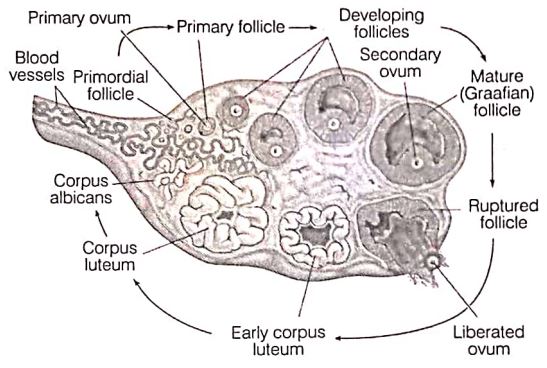
14.
(a) User friendly, no side effect, reversible, effective, should not interfere with sexual drive desire of the user, easily available.
(b) Copper T/ Multiload 375
15.
(a) Motivate smaller families.
(b) Use media/poster showing a happy couple with two children with slogan 'hum do hamare do'.
(c) Statutory raising of marriageable age of the female to 18 years and male to 21 years.
16.
Difference between vasa efferentia and vasa deferentia are as follows
| Vasa Efferentia | Vasa Deferentia |
| They arises from the rete testes. | They arises from the epididymis. |
| Fine and convoluted ductules. Vary from 15-20 in number. | Thick and coiled ductules, only 2 in number. |
| Carry spermatozoa from rete testes to epididymis. | Carry spermatozoa from epididymis to ejaculatory ducts |
17.
Formation of the parts in a fruit areas follows:-
| Ovary Wall | Pericarp or fruit wall Outer integument | Testa of seed |
| Inner integument | Tegmen of seed Zygote | Embryo |
| Primary endosperm nucleus | Endosperm Ovule | Seed |
18.
T.S.of Ovary
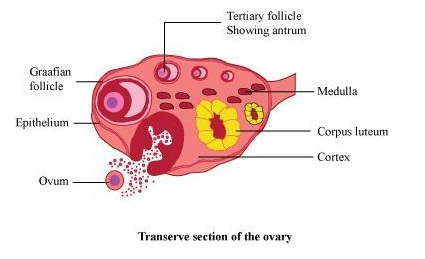
19.
The target cells for luteinising hormone in males are the Leydig cells and in females are the mature follicles.
LH in males stimulates the Leydig cells of testes to secrete androgens (testosterone) which controls spermatogenesis.
LH in females stimulates ovulation formation of corpus luteumfrom the reptured follicle and secretion of progesterone by corpus luteum.
20.
In wind pollinated flowers,
(i) The stamens are well-exposed, so that pollen grains are easily dispersed in wind currents.
(ii) The stigma is large and often feathery, to easily trap the air-borne pollen grains.
(iii) The pollen grains are light and non-sticky, to be transported in wind currents.
(iv) Pollen grains are produced in enormous quantity.
(v) Numerous small flowers are packed into an inflorescence.
(vi) There is a single ovule in the ovary of these flowers.
21.
Fertilisation is the fusion of two gametic nuclei to form a diploid zygote.It involves a series of chemical and physical steps as follows:
The cortical cytoplasm of ovum shows the physicochemical reactions called the cortical reactions.
1.Sperm lysins dissolve the membranes around egg.centriole physically passes into ovum.
3.Normally these reactions result in the formation of fertilisation membrane outside the egg plasma membrane.
4.In man, cortical granules burst and release their contents between egg plasma membrane and zona pellucida i.e. perivitelline space (No fertilisation membrane formation).The plasma membrane shows increased permeability for water, phosphate and potassium.
5.Electrical potentiality of plasma membrane changes from positive to negative, NAD kinase enzyme becomes activated after fertilisation for the oxidation and reduction reaction of the cell.
6.Rate of DNA synthesis increases with great pace after fertilisation.Hence the ovum is now ready for mitosis(cleavage).
7.Cleavage results in multicellular in dividual.
22.
Development of Female Gametophyte:
- The megaspore mother cell undergoes meiosis to form four megaspores.
- Three of them degenerate and the functional megaspore enlarges to form the embryo sac.
- Its haploid nucleus undergoes a mitotic division and the two daughter nuclei move towards the poles.
- Each of them undergoes two successive mitotic divisions.
- Cell wall formation starts in the 8-nucleate stage.
- Three of them at the micropylar end form the egg apparatus, consisting of a female gamete and two synergids.
- Three of them at the chalazal end form the antipodal cells.
- One nucleus from each of the poles moves to the centre; they are called polar nuclei.
- The two polar nuclei fuse in the centre (now the central cell) to form a diploid secondary nucleus.
- Thus, the mature embryo sac is 7-celled and 8-nucleate.

12th Standard CBSE Syllabus & Materials
12th Standard CBSE
CBSE 12th Computer Science Python Revision Tour I - New Previous year Question Papers Study Material - QB365 Set A
NEW12th Standard CBSE
CBSE 12th Business Studies Planning Important Questions And Answers Study Material - QB365 Set A
NEW12th Standard CBSE
CBSE 12th Business Studies Business Environment Important Questions And Answers Study Material - QB365 Set A
NEW12th Standard CBSE
CBSE 12th Business Studies Principles of Management Important Questions And Answers Study Material - QB365 Set A



NCERT Books

Syllabus

Exam Pattern

Sample Question Papers

Previous year Question Papers

Important Notes

MCQ Practice test

NCERT Exemplers

Case study Questions

Image Based Questions

Passage based Questions

HOT Questions

Value Based Questions

Model Questions Papers
NCERT ( Book Back ) Questions

Assertion and Reason
Important Questions And Answers

CBSE 12th Standard CBSE Subjects
CBSE Standards








