
 100% FREE ACCESS
12th Standard CBSE Syllabus & Materials
12th Standard CBSE
CBSE 12th Economics Government Budget and the Economy Previous year Question Papers Study Material - QB365 Set A
NEW12th Standard CBSE
CBSE 12th Computer Science Interface Python with MySQL - New Previous year Question Papers Study Material - QB365 Set A
NEW12th Standard CBSE
CBSE 12th Computer Science Database Concept - New Previous year Question Papers Study Material - QB365 Set A
NEW12th Standard CBSE
CBSE 12th Computer Science Data Communication - New Previous year Question Papers Study Material - QB365 Set A
NEW12th Standard CBSE
CBSE 12th Computer Science Data Structures - New Previous year Question Papers Study Material - QB365 Set A
NEW12th Standard CBSE
CBSE 12th Computer Science Functions - New Previous year Question Papers Study Material - QB365 Set A

Published on: 28/11/2025
Download CBSE Class 12th Standard CBSE Biology question papers, sample papers, important questions, and previous year solved papers in PDF format. Get free study materials, NCERT solutions, and exam preparation resources for Class 12th Standard CBSE Biology
Questions + Answers key
Take MCQ Biology Test
1.
Complete the table given below with respect to secretion of two hormones during pregnancy in a woman.
| Secretion site | Target site | Action | |
| (i) Progesterone | |||
| (ii) Oxytocin |
2.
The secondary oocyte retains bulk of the nutrientrich cytoplasm ofthe primary oocyte. Can you think
or any advantage for this?
3.
Mark the odd one in each series.
(i) Scrotum, rete testis, Fallopian tube, vas deferens
(ii) Ovary,uterus, vagina, ejaculatory duct
(ill) Prostate, testis, seminal vesicles,Cowper'sgland
(iv) Fallopian tubes, vagina, uterus, ovaries.
4.
Why not all copulations lead to fertilisation and pregnancy?
5.
Write the location and functions of Myometrium and endomatrium.
6.
Placenta acts as an endocrine gland. Explain.
7.
Match the items given in column I with appropriate items (one or more) of column II.
| Column I | Column II |
| (i) Hyaluronidase | (a) Nervous system |
| (ii) Fertilizin | (b) Sperm |
| (iii) Antifertilizin | (c) Acrosome |
| (iv) Ectoderm | (d) Ovum |
| (v) Mesoderm | (e) Dermis |
| (f) Most muscles | |
| (g) Epidermal derivatives |
8.
Cleavage has an additional role besides producing numerous blastomeres. Give this role.
9.
What is the role of oxytocin in copulation?
10.
What structure forms the 'corpus luteum' and at what stage? Name two hormones secreted by it.
11.
What is cumulus oophorus?
12.
What is colostrum? How is milk production hormonally regulated?
13.
(a) What is the function of tail of sperm?
(b) What is the role of cervix of the human female system in reproduction?
14.
What is the function of acrosome and head?
15.
Name the four major parts of a sperm.
16.
Explain the following terms (a) primary sex organs (b) secondary sex organs (c) accessory or external sex characters.
17.
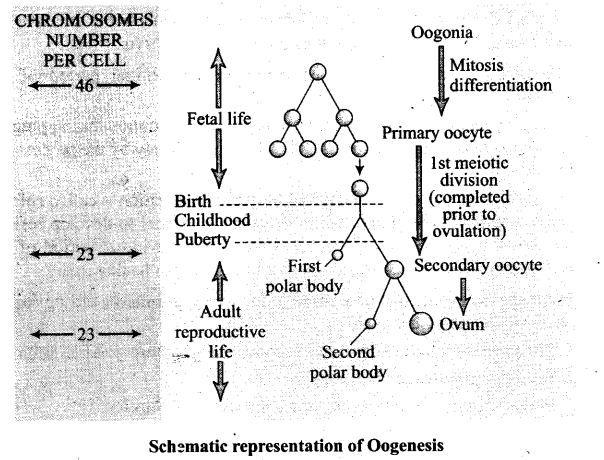
Give a schematic labelled diagram to represent oogenesis(without description)
18.
Why doctors recommend breastfeeding during initial period of infant growth?
19.
Why is it considered that the presence or absence of hymen is not an indication of virginity?
20.
Name the muscular and glandular layers of human uterus.Which one of these layers undergoes cyclic changes during menstrual cycle?Name the hormone essential for the maintenance of this layer.
21.
Describe the functions of the following
i) Epididymis
(ii) Vas deferens
(iii) Seminiferous tubules
(iv) Vagina
(v) Uterus
22.
Except its endocrine activity, what other functions are carried out by the vascular structure X fomed by the association of both the maternal and foetal tissues?
23.
Spermatogenesis in human males is a hormone regulated process. Justify.
24.
Write two major functions each of testes and ovaries.
25.
Read the following statements carefully and suggest a suitable word.
(i) Small sacs that form a part of male reproductive system and store spermatozoa.
(ii) Small tubes lying on either sides of uterus near the kidney and carry the egg from the ovary to the uterus.
(iii) The small erectile organ in females, which lies above the urethral opening and is homologous of glans penis of males.
26.
Why is breast-feeding recommended during the initial period of an infant's growth ? Give reasons.
27.
(i) How many primary follicles are left in each ovary in a human female at puberty?
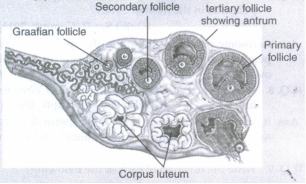
(ii) Draw a sectional view of the ovary showing the different follicular stages of a human female in her preovulatory phase of menstrual cycle.
28.
The middle piece of a mature sperm is characterised by the presence of mitochondria arranged in a spiral.These help in the movement of sperm tail.
With reference to the statement given above,answer the questions that follow.
(i)What do you understand by the term chondriosome?
(ii)State the major function of mitochondria
(iii)'Mitochondria is a site of presence of the major enzymes of cell.'Comment on the statement.
29.
The primary spermatocytes(diploid)undergo meiosis-I to produce secondary spermatocytes further undertake meiosis-II and produce spermatids.With reference to same,draw a diagram depictiong various stages of meiosis I and II which explain spermatogenesis.
30.
(a) Mention the event of meiosis that occurs in the tertiary follicle in a human ovary.
(b) Name the phase of menstrual cycle,when a Graafian follicle transforms into an endocrine structure.Write its action thereafter.
1.
| Secretion sites | Target sites | Actions | |
| (i) Progesterone | Corpus luteum | (i) Endometrial wall of uterus (ii) Pituitary gland |
(i) Regrowth of endometrium (ii) Maintenance of pregnancy |
| (ii) Oxytocin | Pituitary | Uterine muscles | Inhalation of uterine contractions to induce parturition. |
2.
1.lt helps it to survive and undergo meiosis II.
2.lt also helps in the nutrition of the zygote/embryo up to implantation.
3.
(i) Fallopian tube
(ii) Ejeculatory duct
(iii) Testis
(iv) Ovaries
4.
Reason: fertilisation can only occur if the ovum and sperms are carried simultaneously.
5.
Myometrium: Middle layer of uterus, contractions of the uterus during delivery/child birth/parturition.
Endometrium: Inner layer of uterus, cyclic changes during menstruation/implantation of embryo.
6.
The placenta secretes hormones like human gonadotropins, human placental lactogen, oestrogen and progesterone that are necessary to maintain pregnancy. Due to the secretion of these hormones, it is called an endocrine gland.
7.
(i) c
(ii) d
(iii) b
(iv) a, g
(v) e, f
8.
cleavage restores the size and nuclear/cytoplasmic ratio of the ordinary cells of the adult.
9.
Oxytocin cause contractions of uterus and fallopian tubes to propel the sperms upward.
10.
On 15th day of menstrual cycle, the peak of luteinising hormone (LH) together with prolactin hormone, stimulate the follicular cells of the empty Graafian follicle to form a yellow body called corpus luteum. It secretes progesterone and a smaller amount of estradiol.
11.
It is the pedicel - like structure formed by granulosa cells through which the maturing oocyte adheres to the wall of the follicle.
12.
Colostrum: The first milk which comes out from mother's mammary glands just after childbirth is known as colostrum.
Role of hormones in regulation of milk: Breasts secret.It is stimulated by prolactin hormone. Its release is stimulated by oxytocin.
13.
Tail of sperm is formed of an axial filament derived from distal centriole surrounded by cytoplasm and cell membrane as sheath.The undulating movements of tail provide the motility to sperm.The sperm swims in a liquid medium through female ducts and canals to reach the ovum for fertilisation.
(b) Cervix helps in regulating the passage of sperms into the uterus and forms the birth canal to facilitate parturition.
14.
Functions of Acrosome: It secretes sperm lysins which dissolve the membrane around egg and thus facilitate the penetration of sperm into ovum.
Functions of Head: Head contains nucleus which contains hereditary information. Fusion of nuclei is involved during fertilisation.
15.
Parts of a sperm.
1.Head
2.Neck
3.Middle piece
4.tail
16.
(a) Primary sex organs. The organs which produce gametes are called primary sex organs.Testes in male and ovaries in case of female are primary sex organs as they produce sperms (male gametes) and ova (female gametes) respectively.
(b) Secondary sex organs. Organs which perform important functions in reproduction but neither produce gametes nor secrete sex hormones are called secondary sex organs.e,g. Prostate, seminal vesicles, vas deferens and penis in male and the fallopian tube, uterus, vagina, and mammary glands in female.
(c) Accessory or external sex characters. These are the distinct structures or characters which distinguish sexes of a species in appearance but do not directly play any role in reproduction. Low pitch and high pitch of man and woman and pattern of facial hair distribution are the examples of accessory or external sex characters.
17.
18.
Because
(i) Mothers milk is a perfect diet for neonates and young infants.
(ii) Mother milk has antibodies(lgA,lgG) and several biochemicals for providing resistance against several pathogens.
(iii) Mother provides phagocytes to the baby for killing germs.
(iv) Breastfeeding is a natural method for preventing another pregnancy soon after.
19.
1.Hymen is the membrane that partially covers the vaginal opening.
2.The hymen gets torn during the first coitus.
3. But it can also be torn by active participation in sports like horse-riding,cycling,or by a sudden fall or jolt and insertion of vaginal tampon;so its presence or absence cannot indicate virginity.
20.
1. Myometrium is the muscular layer and endometrium is the glandular layer.
2. Endometium undergoes cyclic changes during menstrual cycle.
3. Progesterone is the hormone.
21.
(i) Epididymis: Maturation of spermatids to functional spermatozoa takes place here and the sperms are stored temporarily till ejaculation.
(ii) Vas deferens: It stores and transports the sperms from the testes to the outside through urethra.
(iii) Seminiferous tubules: Sperms are produced here by the process of spermatogenesis.
(iv) Vagina: It receives the semen from the male during coitus. It serves as the birth canal during parturition.
(v) Uterus: The uterus is a hollow muscular organ located in the pelvis region in human females. The uterus is also called the womb, and it serves as the site of the implantation of the developing embryo. The function of the uterus is to house the baby and provide nourishment to it for about nine months.
22.
Functions of placenta :
(i) It facilitates the supply of oxygen and nutrients to the embryo.
(ii) It aids in the removal of carbon dioxide and waste materials produced by the foetus.
(ii) The placenta is connected to the embryo through the umbilical cord, which helps in the transport of substances to and from the embryo
(iv) Placenta also acts as an endocrine tissue and produces several hormones like human Chorionic Gonadotropin (hCG), human Placental Lactogen (hPL), oestrogen, progestogens, etc.
23.
The spermatogenesis is a hormone mediated process the pituitary gland releases the follicle stimulating hormone. The FSH and testosterone are the hormones that enter into the testies where they stimulate the Sertoli cells. The sertoli cells are responsible for providing the nourishment to the sperm cells that are produced by the testes.
24.
Testes and ovaries are the primary sex organs in the males and females, respectively. Each testis bears large number of seminiferous tubules, which are the spermatogenic tissue of the testis. Similarly, ovaries bear the Graafian follicle or the ovarian follicles, which ultimately give rise to ovum. The testes secrete testosterone and the ovaries secrete oestrogen and progesterone
25.
(i) Testis
(ii) Oviducts
(iii) Clitoris
26.
Colostrum, rich in nutrients, rich in antibodies/ rich in IgA/provide passive immunity/provides immunity to new born/helps to develop resistance in new born/readily available for new born/ hygenic/develops a bond between mother and child.
27.
(i) 60000-80000 primary follicles
(ii)
28.
(i)The mitochondrion present in a cell are collectively referred to as chondriosome
(ii)Mitochondria are associated with cellular respiration (ie.oxidation of cellular nutrients) and energey generation of cell.Thus,it is also referred to as power house the cell.
(iii)Out of the total enzyme present in a cell,mitochondria alone contribute to 70%.The enzymes of Krebs, cycle are present in matrix of mitochondrial membrance) while that of Electron Transport System(ETS) and oxidative phosphorylation are situate in cristae
29.
A diagrammatic representation of meiosis-I and meiosis-II (stage(a-e) represent prophase-I)is given below

30.
(a) The primary oocyte grows in size and completes meosis I,forming a larger haploid cell,the secondary oocyte and a smaller cell,the first polar body.
(b) In the luteal phase,the ruptured graafian follicle transforms into corpus luteum.
Corpus luteum secretes large quantity of progesterone to maintain the endometrium.

12th Standard CBSE Syllabus & Materials
12th Standard CBSE
CBSE 12th Computer Science Python Revision Tour I - New Previous year Question Papers Study Material - QB365 Set A
NEW12th Standard CBSE
CBSE 12th Business Studies Planning Important Questions And Answers Study Material - QB365 Set A
NEW12th Standard CBSE
CBSE 12th Business Studies Business Environment Important Questions And Answers Study Material - QB365 Set A
NEW12th Standard CBSE
CBSE 12th Business Studies Principles of Management Important Questions And Answers Study Material - QB365 Set A



NCERT Books

Syllabus

Exam Pattern

Sample Question Papers

Previous year Question Papers

Important Notes

MCQ Practice test

NCERT Exemplers

Case study Questions

Image Based Questions

Passage based Questions

HOT Questions

Value Based Questions

Model Questions Papers
NCERT ( Book Back ) Questions

Assertion and Reason
Important Questions And Answers

CBSE 12th Standard CBSE Subjects
CBSE Standards








