
 100% FREE ACCESS
12th Standard CBSE Syllabus & Materials
12th Standard CBSE
CBSE 12th Economics Government Budget and the Economy Previous year Question Papers Study Material - QB365 Set A
NEW12th Standard CBSE
CBSE 12th Computer Science Interface Python with MySQL - New Previous year Question Papers Study Material - QB365 Set A
NEW12th Standard CBSE
CBSE 12th Computer Science Database Concept - New Previous year Question Papers Study Material - QB365 Set A
NEW12th Standard CBSE
CBSE 12th Computer Science Data Communication - New Previous year Question Papers Study Material - QB365 Set A
NEW12th Standard CBSE
CBSE 12th Computer Science Data Structures - New Previous year Question Papers Study Material - QB365 Set A
NEW12th Standard CBSE
CBSE 12th Computer Science Functions - New Previous year Question Papers Study Material - QB365 Set A

Published on: 28/11/2025
Download CBSE Class 12th Standard CBSE Biology question papers, sample papers, important questions, and previous year solved papers in PDF format. Get free study materials, NCERT solutions, and exam preparation resources for Class 12th Standard CBSE Biology
Questions + Answers key
Take MCQ Biology Test
1.
Study the figure given below and answer the question that follow:
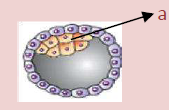
a) Identify 'a' in the figure and mention its function.
b) Mention the stage of human embryo it follows.
c) Where are the stem cells located in this embryo?
d) Which part of this stage of human embryo gets attached to endometrium to establish pregnancy?
2.
Differentiate between proliferative and secretory phases.
3.
Explain any two methods of Assisted Reproductive Technology (ART) that have helped childless couples to bear children.
4.
Give reasons for the following statements:
(a) Safe period or periodic abstinence method is not 100% safe method of birth control.
(b) Condoms are commonly termed as barriers.
(c) Oral contraceptive pills are termed physiological birth control devices.
5.
(a) Draw a diagram of the structure of a human ovum surrounded by corona radiata.Label the following parts:
(i) Ovum
(ii) Plasma membrane
(iii) Zona pellucida.
(b) State the function of Zona pellucida .
6.
Study the graph given below and answer the questions that follow.
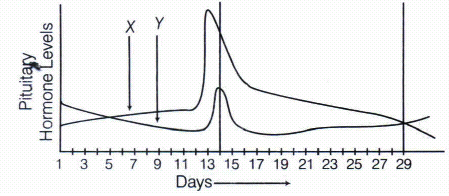
(i) Name the hormones 'X' and 'Y'.
(ii) Identify the ovarian phases during menstrual cycle.
(a) 5th-12th day of the cycle.
(b) 14th day of the cycle.
(c) 16th-25th day of the cycle.
(iii) Explain the ovarian events (a), (b) and (c) under the influence of hormones 'X' and 'Y'
7.
(a) Give a schematic representation of spermatogenesis in humans.
(b) At which stage of life does gametogenesis begin in human male and female respectively?
(c) Name the organs where gametogenesis gets completed in human male and female respectively?
8.
Given is a diagrammatic sketch of a portion of human male reproductive system.Select the correct set of names of the parts labelled A, B, C. D:
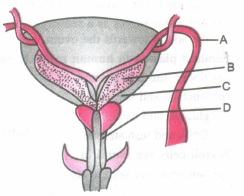
| A | B | C | D |
| ureter | seminal vesicle | prostate | bulbourethral gland |
| A | B | C | D |
| ureter | prostate | seminal vesicle | bulbourethral gland |
| A | B | C | D |
| vas deferens | seminal vesicle | prostate | bulbo urethral gland |
| A | B | C | D |
| vas deferens | seminal vesicle | bulbourethral gland | prostate |
9.
The correct sequence of spermatogenic stages leading to the formation of sperms in a mature human testis is
spermatogonia-spermatid-spermatocyte-sperms
spermatocyte-spermatogonia-spermatid-sperms
spermatogonia-spermatocyte-spermatid-sperms
spermatid-spermatocyte-spermatogonia-sperms
10.
Medical Termination of Pregnancy (MTP) is considered safe up to how many weeks of pregnancy?
8 weeks
12 weeks
18 weeks
6 weeks
11.
The correct surgical procedure as a contraceptive method is:
Ovariectomy
Hysterectomy
Vasectomy
Castration
12.
Choose the correct answer regarding the ZIFT procedure?
Ova collected from a female donor are transferred to the fallopian tube to facilitate zygote formation.
Zygote is collected from a female donor and transferred to the fallopian tube.
Zygote is collected from a female donor and transferred to the uterus
Ova collected from a female donor and transferred to the uterus
1.
a) Inner cell mass. It forms the tissues of future embryo
b) Morula
c) In the inner cell mass.
d) The pole of the blastocyst that contains the inner cell mass
2.
Differentiate between proliferative and secretory phases
| Proliferative phase | Secretory phase |
| 1.Growth of Graafian follicle and maturation and release of ovum occurs. | 1.Prepares the uterus for receiving the fertilised ovum and in case there is no fertilisation endometrium breaks resulting in bleeding. |
| 2.It is the first phase that follows menstruation. | 2.It is the second phase that follows after release of ovum. |
| 3.It starts on 5th day of menstrual cycle and lasts up to 14 day. | 3.It starts after 14th day when corpus luteum is formed. |
| 4.It is caused by estrogen and controlled by FSH. | 4.Corpus luteum is formed under the impact of LH. |
| 5.Contraction of uterine muscles increases. | 5.Contraction of uterine muscles decreases. |
3.
(i)Test-tube baby program
In this method ova from the wife or a donor female and the sperms from the husband or a donor male are allowed to fuse under simulated conditions in the laboratory.
The zygote or early embryo is implanted into the fallopian tube or uterus for further development.
(ii)Intracytoplasmic sperm injection(ICSI)
In this method the sperm is directly injected into the ovum to form the zygote and then embryo transfer is cerried out.
4.
(a) This method requires from sexual intercourse when conception is mostly likely, i.e., a few days before or a few days after ovulation. This method is not 100% safe because timing of ovulation may vary in women because of physiological complexities. Hence, ovulation may occur earlier or it may be delayed for many days
(b) Condoms are mechanical barriers which provent spermatozoa to come to ovum so that fertilization dest not occur.
(c) Birth control pills (oral contraceptives) check ovulation by inhibiting the secretion of gonadotropic hormones (FSH and LH) that are necessary for ovulation. Therefore, these are called physiological devices.
5.
a) Structure of ovum. Most animal eggs are spherical or oval, non-motile but on close examination. it is noted that one pole is different from the other. The pole from which polar bodies are given off is called animal pole while the opposite is termed as vegetal pole. Thus it is said to have polarity. Thus various cytoplasmic substances are distributed along the axis in unequal manner. The nucleus also called (germinal vesicle) having chromatin network is surrounded by nuclear membrane. It also contains prominent nucleolus. All animal eggs contain some reserve material to provide food called yolk. The cytoplasm of ovum is called ooplasm. It lacks centrosome but contains cortical granules derived from Golgi bodies in its outer region termed cortex.
(b) Function of Zona pellucida. During fertilisation as a result of cortical reaction, zona pellucida hardens and prevents the entry of additional sperms (polyspermy).
6.
(i) Horne 'X' is Luteinising Hormone (LH) and 'Y' is Follicle Stimulating Hormone (FSH).
(ii) (a) Follicular phase (proliferative phase).
(b) Ovulatory phase (release of ovum) followed by luteal phase.
(c) Luteal phase.
(iii) (a) FSH is secreted by the anterior pituitary, which stimulates the ovarian follicle to secrete oestrogen, which in turn stimulates the proliferation of the endometrium of the uterine wall.
(b) Both LH and FSH attain a peak level in the middle of cycle (about 14th day). Rapid secretion of LH leading to its maximum level during the mid-cycle is called LH surge. It induces rupture of Graafian follicle and thereby the release of ovum (ovulation). Due to these events, this phase is termed as evulatory phase of menstruate cycle.
(c) The remaining cells of ovarian follicles are stimulated by the LH to develop corpos luteum. The corpus luteum secretes large amount of progesterone, which is essential for the maintenance of endometrium. This is known as luteral phase.
7.
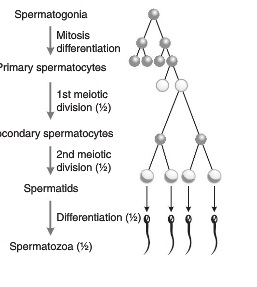
(b) Spermatogenesis starts at the age of puberty due to significant increase in the secretion of gonadotrophins releasing hormone. It acts on pituitary gland to bring release of gonadotrophin. Oogenesis is initiated during embryonic development stages.
(c) Spermatogenesis is completed in tests. Oogenesis is completed in the fallopian tube at the time of fertilization.
8.
(c)
| A | B | C | D |
| vas deferens | seminal vesicle | prostate | bulbo urethral gland |
9.
(c)
spermatogonia-spermatocyte-spermatid-sperms
10.
(b)
12 weeks
11.
(c)
Vasectomy
12.
(b)
Zygote is collected from a female donor and transferred to the fallopian tube.

12th Standard CBSE Syllabus & Materials
12th Standard CBSE
CBSE 12th Computer Science Python Revision Tour I - New Previous year Question Papers Study Material - QB365 Set A
NEW12th Standard CBSE
CBSE 12th Business Studies Planning Important Questions And Answers Study Material - QB365 Set A
NEW12th Standard CBSE
CBSE 12th Business Studies Business Environment Important Questions And Answers Study Material - QB365 Set A
NEW12th Standard CBSE
CBSE 12th Business Studies Principles of Management Important Questions And Answers Study Material - QB365 Set A



NCERT Books

Syllabus

Exam Pattern

Sample Question Papers

Previous year Question Papers

Important Notes

MCQ Practice test

NCERT Exemplers

Case study Questions

Image Based Questions

Passage based Questions

HOT Questions

Value Based Questions

Model Questions Papers
NCERT ( Book Back ) Questions

Assertion and Reason
Important Questions And Answers

CBSE 12th Standard CBSE Subjects
CBSE Standards








