
 100% FREE ACCESS
12th Standard CBSE Syllabus & Materials
12th Standard CBSE
CBSE 12th Economics Government Budget and the Economy Previous year Question Papers Study Material - QB365 Set A
NEW12th Standard CBSE
CBSE 12th Computer Science Interface Python with MySQL - New Previous year Question Papers Study Material - QB365 Set A
NEW12th Standard CBSE
CBSE 12th Computer Science Database Concept - New Previous year Question Papers Study Material - QB365 Set A
NEW12th Standard CBSE
CBSE 12th Computer Science Data Communication - New Previous year Question Papers Study Material - QB365 Set A
NEW12th Standard CBSE
CBSE 12th Computer Science Data Structures - New Previous year Question Papers Study Material - QB365 Set A
NEW12th Standard CBSE
CBSE 12th Computer Science Functions - New Previous year Question Papers Study Material - QB365 Set A

Published on: 28/11/2025
Download CBSE Class 12th Standard CBSE Biology question papers, sample papers, important questions, and previous year solved papers in PDF format. Get free study materials, NCERT solutions, and exam preparation resources for Class 12th Standard CBSE Biology
Questions + Answers key
Take MCQ Biology Test
1.
Explain the ovarian and uterine events that occur during a menstrual cycle in a human female, under the influence of pituitary and ovarian hormones respectively
2.
What is placenta? Writes its function?
3.
Give the structure of simple type placenta.
4.
Describe the structure of an ovum.
5.
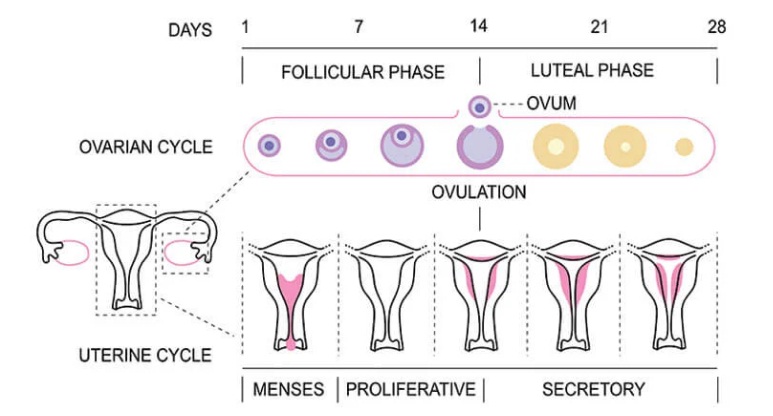
Show with graphic sketch the hormonal control over the menstrual cycle.
6.
Describe the Similarities between Spermatogenesis and Oogenesis.
7.
What roles does pituitary gonadotrophins play during follicular and ovulatory phases of menstrual cycle? Explain the shifts in steroidal secretions.
8.
Write two differences between spermatogenesis and oogenesis.
9.
Study the given figure
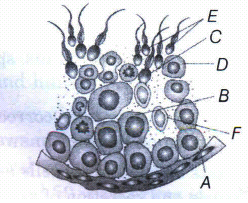
(i) Pick out and name the cells that undergo spermiogenesis.
(ii) Name 'A' and 'B' cells. What is the difference between them with reference to the number of chromosome?
(iii) Pick out and name the motile cells.
(v) What is 'F' cell? Mention its function?
(iv) Name the structure of which the given diagram is a part?
1.
Menstrual cycle is the reproductive cycle in all primates and begins at puberty (menarche). In human females, menstruation occurs once in 28 to 29 days. The cycle of events starting from one menstruation till the next one is called the menstrual cycle. During the middle of the menstrual cycle, one ovum is released (ovulation). The cycle starts with the menstrual flow (3 to 5 days), caused due to the breakdown of the endometrium of the uterus. Blood vessels in liquid state are discharged, but this occurs only when the ovum is not fertilised. It is followed by the follicular phase where the primary follicles mature into Graafian follicles. This causes the regeneration of the endometrium. These changes are brought about by ovarian and pituitary hormones. In this phase, the release of gonadotropins (LH and FSH) increases. This causes follicular growth and the growing follicles produce oestrogen. The LH and FSH are at their peak in the middle of the cycle (14th day) and cause the rupture of the Graafian follicles to release ovum. This phase is called the ovulatory phase. The remains of the Graafian follicles get converted into the corpus luteum, which secretes progesterone for the maintenance of the endometrium. In the absence of fertilisation, the corpus luteum degenerates, thereby causing the disintegration of the endometrium and the start of a new cycle.
2.
Placenta. It is temporary structure formed by the union of the foetal and uterine tissue for purpose of nutrition, respiration and excretion of the embryo .Although the blood vessels of the embryo and the mother come close but are kept separated by some barriers between them.The useful substances pass from maternal blood to foetal blood while the wastes(excretory products and \({ CO }_{ 2 }\)) are passed from the foetal blood to maternal blood.
Functions of placenta. The placenta serves primarily as an organ that permits the interchange of meterials carried in the blood of mother and foetus.The main functions are:
1.Nutrition. Supply of nutrient materials to foetus.
2.Respiration. Supply of \({ O }_{ 2 }\) to foetus and receives \({ CO }_{ 2 }\) back from it.
3.Excretion.Fluid nitrogenous waste products excape through the placenta.
4.Barrier. The placenta is a barrier-like semipermeable membrane.
5.Storage. The placenta stores fat, glycogen and iron for the embryo before the formation ofliver.
6.Hormonal function. The placenta secretes extra ovarian hormones-estrogen and progestrone in female during pregnancy that serves to maintain foetus.
3.
Structure of Epithelio-chorial placenta. Epithelio-chorial placenta is the simple and basic type of placenta as formed in cow, goat etc. In this case some of the components are derived from the uterine wall of mother while the other parts are derived from the foetus itself.
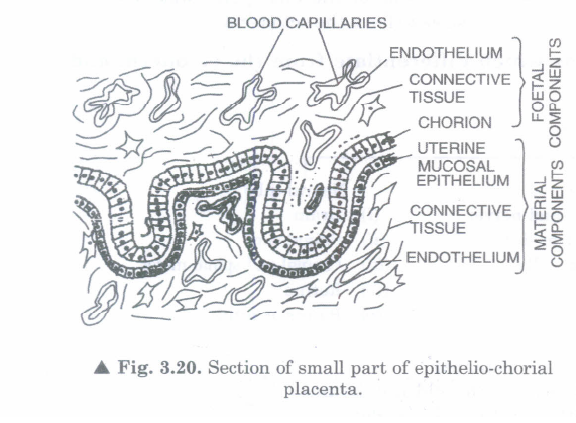
The maternal components of placenta are:
1. Mucous membrane of the uterine wall.
2. Uterine connective tissue.
3. Maternal endothelium (wall of maternal blood capillaries).
Foetal components of placenta are:
1.Wall of foetal blood capillaries.
2. Foetal connective tissue.
3. Foetal chorionic epithelium
4.
a) Structure of ovum. Most animal eggs are spherical or oval, non-motile but on close examination
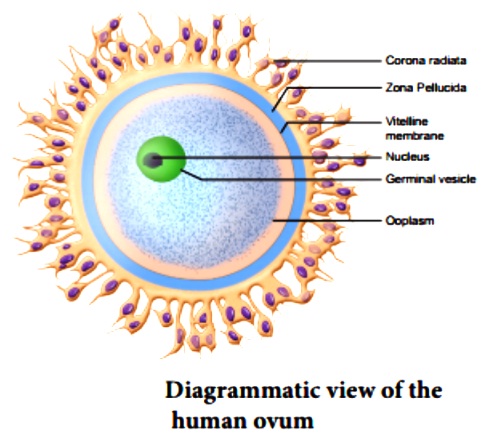
it is noted that one pole is different from the other. The pole from which polar bodies are given off is called animal pole while the opposite is termed as vegetal pole. Thus it is said to have polarity. Thus various
cytoplasmic substances are distributed along the axis in unequal manner. The nucleus also called (germinal vesicle) having chromatin network is surrounded by nuclear membrane. It also contains prominent nucleolus. All animal eggs contain some reserve material to provide food called yolk. The cytoplasm of ovum is called ooplasm. It lacks centrosome but contains cortical granules derived from Golgi bodies in its outer region termed cortex.
(b) Function of Zona pellucida. During fertilisation as a result of cortical reaction, zona pellucida hardens and prevents the entry of additional sperms (polyspermy).
5.
6.
Similarities between Spermatogenesis and Oogenesis.
1. Both the process starts with primordial germ cells derived from inside the gonads.
2. They occur inside the gonads.
3. Both the processes are completed in three phases i.e. multiplication, growth and maturation.
4.Both the processes show meiosis in the maturation phase.
5.Both the processes produce haploid gametes.
7.
Hormonal Control of Menstrual Cycle.
Gonadotropin-releasing hormone (GnRH) also called Gonadotropin-releasing Factor (GnRF), is secreted by the hypothalamus of the brain, which stimulates the release of follicle-stimulating hormone (FSH) and luteinizing hormone (LH).FSH stimulates the ovarian follicles to produce oestrogens during proliferative phase.LH stimulates the corpus luteum of the ovary to secrete progesterone.
1.Menstrual phase is caused by the reduction of progesterone and oestrogens.
2.Proliferative phase is caused by the increased production of oestrogens.
3.LH causes ovulation.
LH also causes transformation of empty Graafian follicle into corpus luteum by luteinisation inside the ovary. LH also stimulates corpus luteum to secrete progesterone hormone to help in implantation, placentation and maintenance of pregnancy.
4.Secretary phase is caused by increased production of progesterone.
8.
|
Spermatogenesis |
Oogenesis |
|---|---|
|
The process of formation of sperms in males starts from puberty. |
The process of formation of ova in females,starts from embryonic developmental stages. |
|
It is not a cyclic process;it occurd continuously. |
It is a cyclical process,completed every 28/29 days. |
|
One primary spermatocyte forms four functional sperms. |
One primary oocyte forms only one functional ovum. |
9.
(i) A-Spermatids, undergo spermiogenesis
(ii) A-Spermatids, B-Spermatogonium.
Spermatogonium (B) are diploid and have 46 chromosomes in humans, while spermatids (A) are haploid and have 23 chromosomes in case of human male.
(iii) E-spermatozoa, are motile cells
(iv) F-Sertoli cell, it provides nutrition to the germ cells
(v) Seminiferous tubule.

12th Standard CBSE Syllabus & Materials
12th Standard CBSE
CBSE 12th Computer Science Python Revision Tour I - New Previous year Question Papers Study Material - QB365 Set A
NEW12th Standard CBSE
CBSE 12th Business Studies Planning Important Questions And Answers Study Material - QB365 Set A
NEW12th Standard CBSE
CBSE 12th Business Studies Business Environment Important Questions And Answers Study Material - QB365 Set A
NEW12th Standard CBSE
CBSE 12th Business Studies Principles of Management Important Questions And Answers Study Material - QB365 Set A



NCERT Books

Syllabus

Exam Pattern

Sample Question Papers

Previous year Question Papers

Important Notes

MCQ Practice test

NCERT Exemplers

Case study Questions

Image Based Questions

Passage based Questions

HOT Questions

Value Based Questions

Model Questions Papers
NCERT ( Book Back ) Questions

Assertion and Reason
Important Questions And Answers

CBSE 12th Standard CBSE Subjects
CBSE Standards








